Table of Contents (click to expand)
Loktak Lake in Manipur, northeast India, is called the floating lake because it is covered with phumdis: floating mats of vegetation, soil, and decaying matter solid enough to walk on. The largest phumdi carries Keibul Lamjao, the world's only floating national park, the last refuge of the endangered sangai deer.
Manipur, a state in the northeast of India, is home to several endemic plants, animals, and peculiar landscape features. The state sits at an average altitude of around 790 meters (2,600 feet) above mean sea level.
In this land rich with history and culture lies a lake that, in a sense, floats. The Loktak Lake is India’s celebrated “floating lake”, and the largest of the drifting islands on its surface carries the world’s only floating national park, Keibul Lamjao National Park, which covers roughly 40 km2 (15 sq mi) in the southern zone.
This ancient lake plays a vital role in the economy of Manipur. Because of its importance in their socioeconomic and cultural life, it is considered the lifeline for Manipuris.
Now, what does it mean for a lake to float?
Floating Lake At The End Of The Stream
The name Loktak originated from the two words “Lok”, meaning “Stream”, and “Tak”, meaning “The End”. The lake works as the endpoint for several streams and rivers in the region. Its direct catchment area is about 980 km2 (380 sq mi). Run-off from this catchment drains into the lake mainly through seven streams that originate primarily on the northern and western flanks of the lake.
Hydrologically, Loktak Lake is dependent on nine major rivers, namely the Khuga, Thongjaorok, Awang Khujairok, Nambol, Nambul, Imphal, Kongba, Iril, and Thoubal. There were previously more tributary rivers, but the Heirok and Sekmai Rivers no longer contribute due to the diversion scheme.
On this lake are floating landmasses called Phumdis.
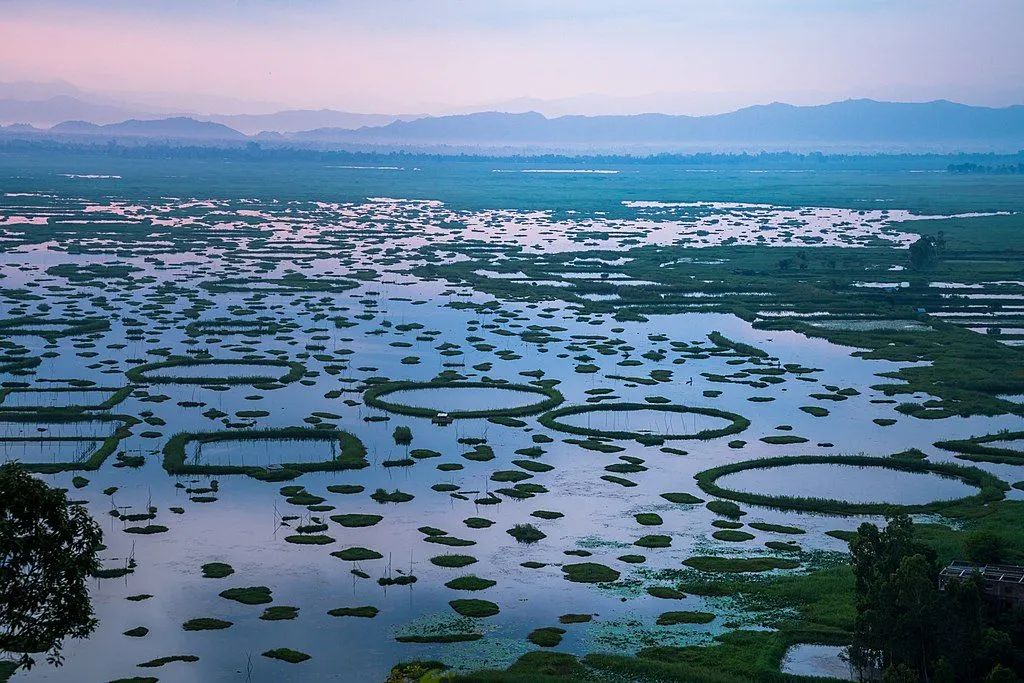
The phumdis form when floating fragments of foliage in the lake water knit together into large masses of vegetation over many years. Only around 20% of a phumdi generally sits above the water, while the remaining 80% stays submerged, much like an iceberg of roots and decaying plant matter. During the monsoon season, when water levels are high, the phumdis lift clear of the bottom and drift freely; in the drier summer months, when the water level drops, they settle onto the lakebed and draw nutrients from the substrate. It is these drifting masses of vegetation, rather than the water itself, that give the lake its “floating” reputation.
Located near the center of the state in the Moirang area, Loktak is the largest natural freshwater lake in Northeast India, with a recorded area of about 247 km2 (95 sq mi), though its open water expands and shrinks with the seasons. It is situated in the Indo-Burma Biodiversity Hotspot. Loktak Lake is characterized by the presence of Phumdis, defined as a “heterogeneous mass of vegetation, soil and organic matter at various stages of decomposition floating over it.”
Besides influencing the state’s climate, the lake also serves as a water source for hydropower generation, irrigation and drinking water supply. The lake is also a source of livelihood for rural fishermen living in the surrounding areas and on phumdis. By building khangpok (huts), the traditional fishermen are able to stay on these Phumdis. These huts are called “phumshongs”. The locals observe Loktak Day on October 15th every year.
Ecology And Conservation
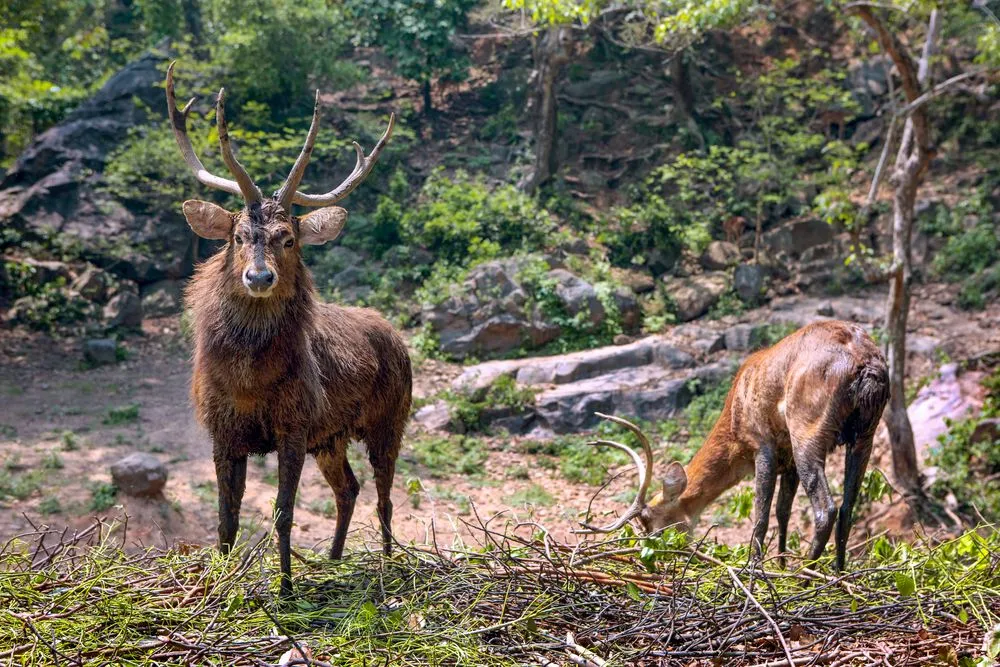
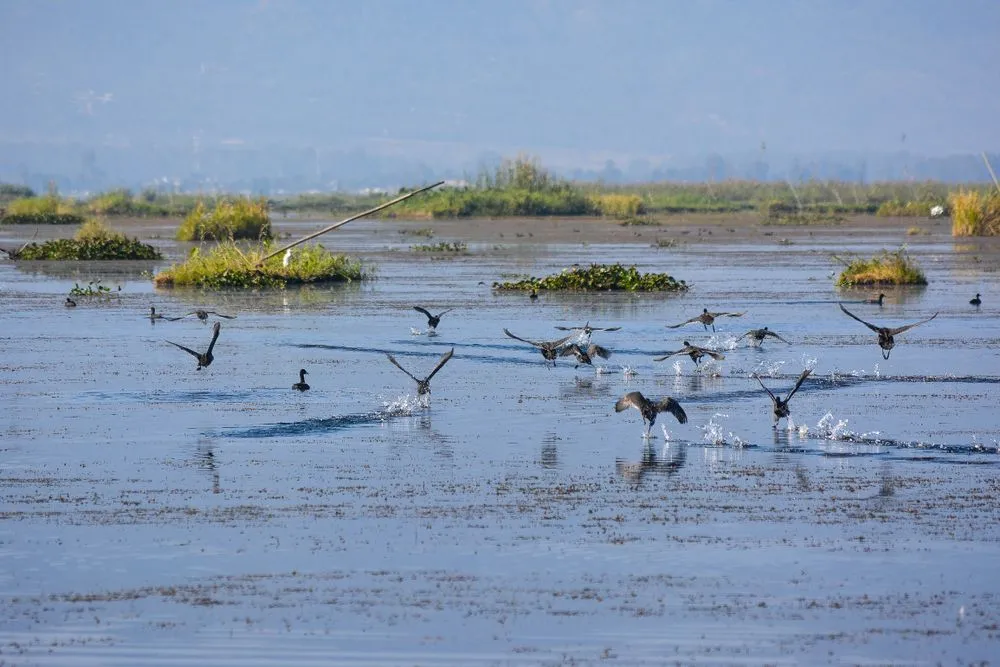
Loktak has a rich diversity of natural flora and fauna. The lake boasts 425 species of animals, including 249 vertebrates and 176 invertebrates. The vertebrate diversity includes six amphibian species, 106 species of birds and 32 species of mammals. Osteobrama belangeri, the prized carp locally known as pengba, once formed one of Loktak’s biggest fisheries, but it has since been wiped out in the wild here; today it survives in the wild only across the border in Myanmar and is kept going elsewhere through aquaculture, which is why the IUCN now lists it as Near Threatened rather than gone. The lake is also an important breeding site for waterfowl and migratory birds. The Keibul Lamjao National Park represents the world’s last refuge for the endangered Manipur brow-antlered deer (also known as the Sangai or Dancing deer, Rucervus eldii eldii).
Floating Lake In The Age Of Humans
However, this wonder of nature has been unable to escape the wrath of humanity’s developmental aspirations. The Ithai barrage, completed in 1983, was erected in the Loktak ecosystem to generate hydropower for the region. However, the construction of the barrage has resulted in a drastic reduction of seasonal water level fluctuations, which has changed the dynamics of the lake. By holding the water artificially high all year, the barrage has stopped the phumdis from settling onto the lakebed each dry season to take up nutrients; starved this way, many are slowly thinning and breaking apart. Even so, the surface level still drops enough that vast areas of shore are exposed during the dry season.
Before the barrage construction, Loktak was a cluster of water bodies, all of which used to become connected to form a larger body during monsoons. After the barrage construction, the water level increased, so the Loktak wetlands have now become a part of Loktak Lake.
There are negligible seasonal water fluctuations, as the water level now depends on the opening of the barrage. The barrage also affected the flushing of wetlands. Water stagnation, changes in circulation and mixing have directly impacted water quality and sediment deposition. Together, these factors have negatively affected the lake’s ecology.
Doomed Past And Bleak Future?
Loktak Lake is one of India’s natural wonders. Considering its ecological status and biodiversity values, the lake was initially designated as a wetland of international importance under the Ramsar Convention on March 23, 1990. It was also listed under the Montreux Record, “a record of Ramsar sites where changes in ecological character have occurred, are occurring or are likely to occur”, on June 16, 1993. However, Loktak has not yet turned out to be the safe haven for nature that its status promises. Several issues still demand our attention. Only by addressing them can this remarkable floating landscape, and the world’s only floating national park it carries, be kept in its perpetual beauty.
References (click to expand)
- Kangabam, R. D., Boominathan, S. D., & Govindaraju, M. G. (2015). An international journal of environment and biodiversity. NeBIO I An International Journal of Environment and Biodiversity, 6(2).
- Laishram, J., & Dey, M. (2014). Water Quality Status of Loktak Lake, Manipur, Northeast India and Need for Conservation Measures: A Study on Five Selected Villages. International Journal of Scientific and Research Publications, 4(6).
- Devi, K.N. (2017). A Wetland and a Lifeline: the Importance of Loktak Lake for Manipur, India. Journal of Innovation for Inclusive Development, 2(1), 30-35.
- Degradation And Conservation Of Indian Ramsar Wetlands.
- Loktak Lake. Ramsar Sites Information Service (RSIS).
- The Floating Islands of India. NASA Earth Observatory.