No, a straight line isn’t always the shortest distance between two points. The shortest distance between two points depends on the geometry of the object/surface in question. For flat surfaces, a line is indeed the shortest distance, but for spherical surfaces, like Earth, great-circle distances actually represent the true shortest distance.
All of us were taught at an early age that ‘a line is the shortest distance between two points’. However, what if someone told you this time-honored adage wasn’t exactly true—would your reality be able to handle it?
As it turns out, the statement is only partly true. The shortest distance between two points actually depends on the geometry of the object in question.
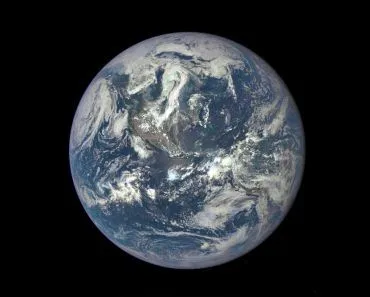
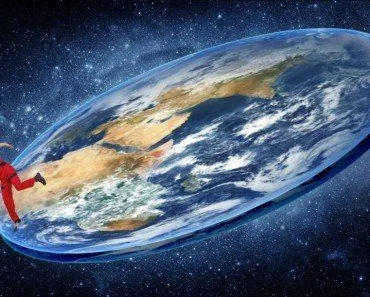
If we were living on a flat earth (which we don’t) then yes, a straight line would be the shortest distance between points A and B. However, the Earth is an approximate sphere, and the shortest distance between two points on the surface of a sphere is an arc known as ‘the great circle distance’.
Great Circle Distance
Great circle distance isn’t a new concept; in fact, many of you have already seen it in action.
People who have traveled by air or solely checked flight routes have probably noticed that flights don’t follow a direct path, but instead take a curved route to their destination. The curved routes aren’t employed to dig a deeper hole in the passenger’s pockets, but are used because they’re actually the shortest distance between any two given locations on our planet.
These curved routes are often confusing, as the routes are outlined on a flat 2-dimensional map, where a straight line might seem like the shortest distance. However, no 2-dimensional map of the Earth is accurate. Not even the one we grew up learning, which is the same as you would find in Google maps.
To give you the gist, our beloved Earth is a 3-dimensional space and is best represented using a model globe. However, when one tries to flatten the sphere into a rectangular shape, as most maps do, the age-old dilemma of distortion comes into the spotlight. Most rectangular maps trade country shapes, sizes, intermediate distance, and even legitimate information for ease of understanding. For more details on this matter, read What’s wrong with all our maps?

Imagine that you want to fly from the rat-infested depths of New York City to the City of Love, Paris. On a globe, the shortest distance between the two cities would be an arc of roughly 3,630 miles, but the same arc, when projected on a 2D map, transforms into a straight line measuring approximately 3,750 miles.
To confirm this for yourself, open Google Maps in an adjacent tab and search for New York. Once found, right-click on the name tag and select “measure distance”. Next, zoom out or scroll a bit to the right to find Paris and click on it. The following distance will be a curve, representing the shortest distance between the two cities. Click anywhere on this curve to make a keyframe and drag it a little towards the south to convert the curve into a straight line. You can make use of multiple keyframes to compose a straight line of some sort between the two locations. Upon completion, compare the dimensions of the curve and the straight line (and prepare for your reality to be shattered!).
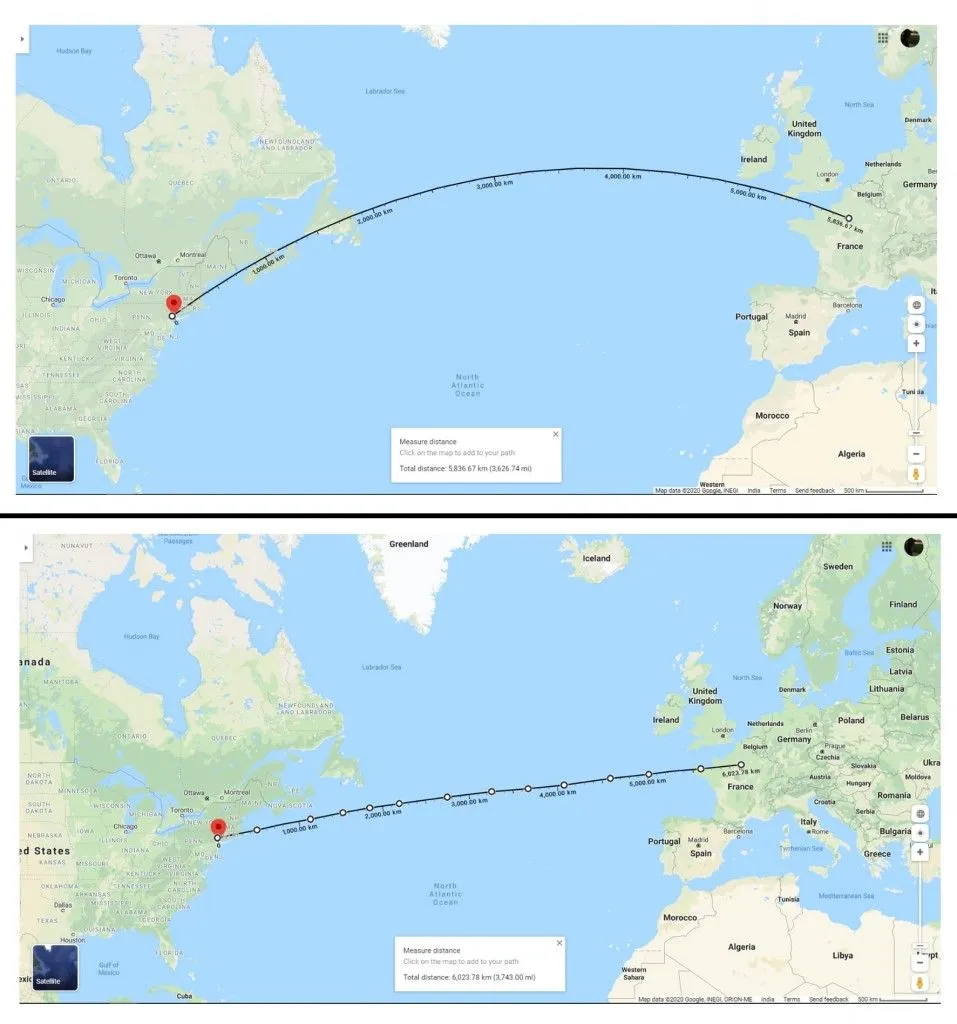
The difference between the two numbers (3,750 – 3,630 = 120 miles) may not seem like a big deal, but considering the fact that a Boeing 747 consumes an average of 5 gallons of fuel per mile of flight (Source), the plane would require an additional (5 gallons/mile × 120 miles =) 600 gallons (2250 liters) to traverse the extra distance, which is a big deal and would add to the cost of plane tickets.
Great Circle Distance In Mathematical Terms
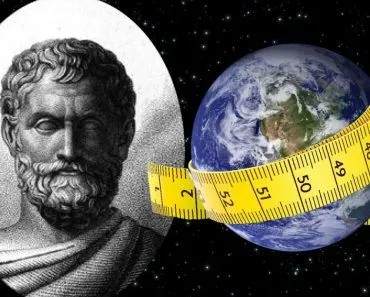
Speaking in purely mathematical terms, a great circle (also known as geodesics of spheres) is any circle drawn on a sphere whose center coincides with the center of the sphere, and thus divides the sphere into two equal halves. In simpler terms, a great circle is the largest circle that can be carved out of a sphere. A small circle, on the other hand, is when the center of the circle and the sphere do not coincide.
Imagine (or just check the below image) cutting the Earth along the equator or the poles. The resulting hemispheres in both cases would be equal, and the faces of these hemispheres would have the same diameter and center as the sphere (Earth) itself.
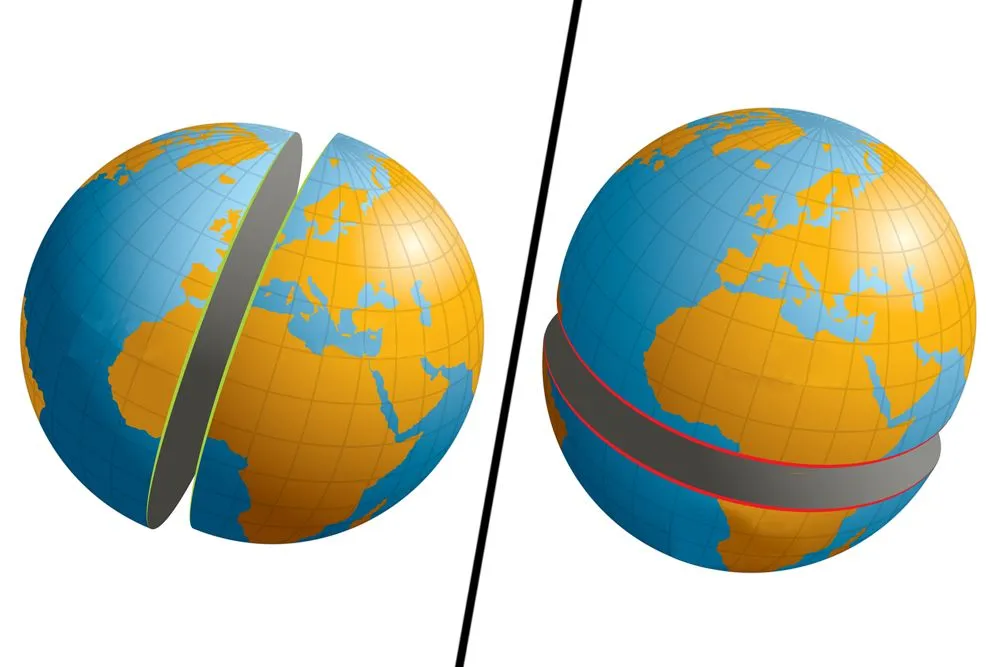
For any two non-diametrical points (locations) on a sphere (Earth), there exists only one unique great circle, whereas for diametrical points on a sphere, an infinite number of great circles can be drawn. These points divide the circle into two arcs; the smaller arc represents the true shortest distance between the two points and is called the great-circle distance.
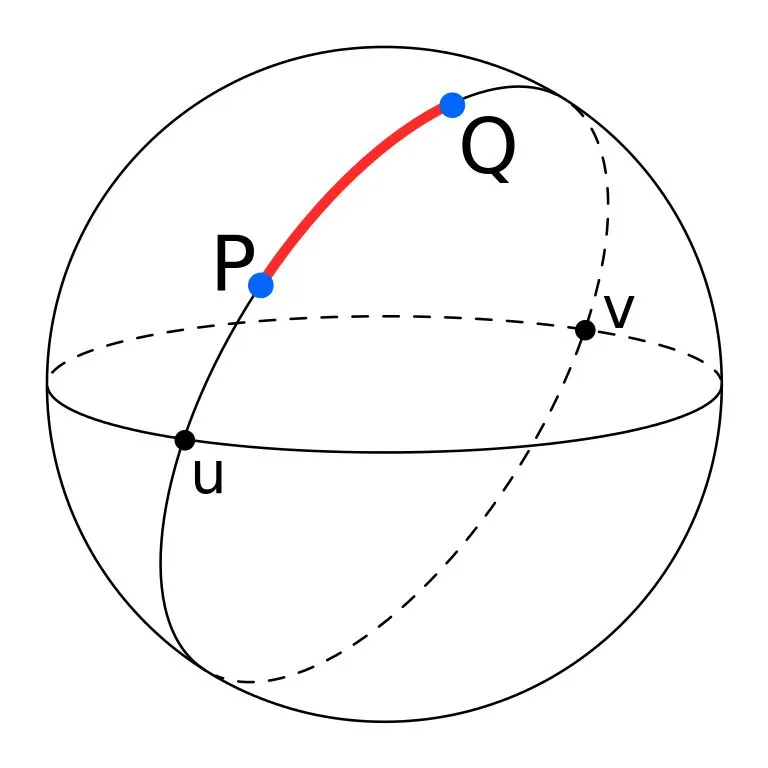
In the below image, the points P and Q are two non-diametrical points and the arc PQ represents the shortest distance between the two (great circle distance). The points u and v, on the other hand, are known as antipodal or diametrically opposite points, and divide the great circle into two identical arcs.
Calculating great circle distance between any two points on the surface of a sphere requires the use of spherical trigonometry, and while we might not have been familiar with the existence of great circle distances back in our school days, everyone’s hatred for sines and cosines is a well-known fact.

Here, d is the great circle distance, r is the radius of the sphere (Earth) and the term cos-1(cos σ1 .cos σ2 .cos (λ1 – λ2) + sin σ1 .sin σ2) is the central angle subtended by the two points having coordinates σ1, λ1 and σ2, λ2 respectively.
What Is The Shortest Distance Between Two Points Called?
If this exact question has ever ambushed you on a worksheet or a quiz, the honest answer is that it depends on who’s asking. The shortest distance goes by a different name in different corners of science.
In ordinary plane geometry, it’s simply a straight line (or, to be precise, the line segment joining the two points). This is the version we all memorized in school, and on a flat sheet of paper it’s perfectly correct.
In physics, that same straight-line gap between where you started and where you ended up has a special name: displacement. Displacement is a vector, carrying both a size and a direction, which is exactly what sets it apart from distance traveled, the total length of the meandering path you actually walked. Stroll 5 meters east and then 5 meters back west, and your distance traveled is 10 meters, yet your displacement is zero, because you’ve ended up precisely where you began.
And when the surface itself is curved, like the skin of our planet, the shortest route earns yet another title: a geodesic. A geodesic is the locally shortest path between two points on a given surface, and on a sphere that geodesic is precisely the great-circle arc we met earlier. So ‘straight line’, ‘displacement’ and ‘geodesic’ are really three answers to the very same question, each one correct in its own setting.
What Happens When Space Itself Is Curved?
So far, we’ve been bending our route around a curved surface, the outside of the Earth. Here’s where it gets genuinely strange: physicists have found that space itself can be curved, and when it is, the meaning of a ‘straight line’ has to be rewritten all over again.
The deeper rule is the one we just met. The shortest path between two points is always a geodesic, the straightest line a given geometry will allow. On a flat tabletop, that geodesic looks like the ruler-straight line you’d expect. On a globe, it becomes a great-circle arc. And in the four-dimensional fabric that Einstein called spacetime, geodesics can bend in ways no classroom ruler would recognize.
According to Einstein’s general theory of relativity, mass and energy warp the spacetime around them, a little like a bowling ball sagging a stretched trampoline. Anything passing through that region, light included, simply follows the local geodesic. Because the geodesic itself is now curved, the light appears to travel along a curve. It hasn’t slowed down or taken a detour; it’s still taking the shortest route available. The route itself is bent, because space is.
This isn’t just a chalkboard fantasy. During the total solar eclipse of 1919, the British astronomer Arthur Eddington measured the apparent positions of stars whose light skimmed the edge of the Sun, and found them shifted, deflected by roughly twice the amount that Newton’s ‘flat space’ gravity could account for. That starlight had followed a curved geodesic through the Sun’s warped spacetime, and the result turned Einstein into a household name almost overnight.
The most spectacular version of the effect is gravitational lensing. When the light from a distant galaxy streams past a massive foreground galaxy or cluster, the warped space can smear that background galaxy into a glowing loop known as an Einstein ring, like the one captured by the Hubble Space Telescope below. Every photon tracing that ring took the shortest path available to it, and not one of them traveled in anything we’d call a straight line.

So the schoolyard adage survives, but only with an asterisk. The shortest distance between two points is always the straightest path the geometry permits. It just happens that in our lumpy, mass-filled universe, ‘straight’ almost never means what your ruler thinks it does.
Final Words
As stated earlier, great circles find their main application in long-distance travel, particularly air and marine navigation. Following a true great-circle path requires continuously changing heading, because the compass bearing along the route is constantly shifting. To make navigation practical, the great-circle path is approximated by a sequence of ‘rhumb lines’ (also called loxodromes), short segments of constant compass bearing that together trace the curve.
Having said all that, even great-circle distances aren’t the absolute shortest distance between two locations. They’re calculated by treating Earth as a perfect sphere, but the planet is actually an oblate spheroid—slightly squashed at the poles and bulging at the equator (the equatorial radius is about 21 km greater than the polar radius). Modern navigation therefore uses the WGS84 ellipsoid model and algorithms like Vincenty’s or Karney’s formulae for true geodesic distances. In practice, however, the difference between a spherical great-circle calculation and the WGS84 ellipsoidal geodesic is at most about 0.5%, which is why the simpler great-circle formula remains good enough for most uses.
Nevertheless, great circle distances have played a huge role in long-distance travel over the past several years and will continue to do so, saving airlines fuel and saving travelers money!
References (click to expand)
- Map projection - Wikipedia
- Shortest flight paths - Dynamics. The University of Illinois Urbana-Champaign
- 9. Showing the Shortest Routes - Great Circles. The Pennsylvania State University
- Relative Motion, Distance, and Displacement - Physics. OpenStax
- Geodesic line - Encyclopedia of Mathematics
- Sun's Gravity Bends Starlight - NASA Goddard Space Flight Center
- Shining a Light on Dark Matter - NASA