Some believe that mathematics was “out there”, simply waiting to be discovered, while others believe it is instead a creation of our mind. Even today, the question doesn’t have an exact answer.
At times, we’ve all found it difficult to solve math problems and remember the long list of formulae we learned in school. But have you ever wondered if the subject itself existed in the universe, just waiting to be discovered? Or did someone deliberately invent it to punish children? Well, the answer to that is as complicated as calculus sums.
Believe it or not, mathematics is the center of our modern world. It’s also the reason behind the working of our smartphones, cars, buildings and even weather. Despite having existed for a very long time, there is still some debate between philosophers of mathematics, with the big question being: Was mathematics invented or discovered?
Some believe that mathematics exists within us, and that the objects of mathematics were therefore our creation. Other philosophers thought that mathematics exist independent of our thoughts, outside of us. However, does the truth lie somewhere between the stark choice of being invented or discovered? To better understand the truth, let’s try to understand exactly how old math really is.
How Old Is Mathematics?
The tale of mathematics is as old as humanity. It has evolved from simple math, like counting cattle, to an intricate study of an object through abstract concepts that we know today. It was not until 600 BC, when civilizations settled and various occupations began, that mathematics began to develop further. It was used to measure plots, calculate the taxation of individuals, etc. Later, in 500 BC, we saw the development of Roman numerals, which are still used to represent numbers.
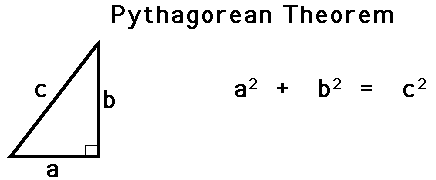
Scientists believe that thousands of years ago, basic mathematical functions like addition and subtraction might have appeared at the same time, but in different places, like India, Egypt and Mesopotamia. Advanced math dates back to Greece over 2500 years ago, when mathematician Pythagoras formalized his famous theorem about the sides of a right-angle triangle, which we now study as the Pythagorean theorem. Interestingly, the Babylonians and Indians had known of this relationship centuries before Pythagoras, but he is credited with producing the first widely known proof.
Since then, more mathematicians started working on expanding their understanding of mathematics. Yet, no one could find the one true answer to the big question.
Who Invented Mathematics?
Search for "who invented math" and you will quickly notice that there is no single name to point to. Unlike the light bulb or the telephone, mathematics had no lone inventor. It grew up slowly, in many places at once, as different peoples found they needed to count their goods, measure their land and keep records.
The oldest written mathematics we have does not come from Greece, but from the ancient civilizations of Mesopotamia and Egypt. The Babylonians were doing serious math around 2000 BC, using a base-60 (sexagesimal) number system. That ancient choice is the reason we still split an hour into 60 minutes, a minute into 60 seconds and a circle into 360 degrees. A famous Babylonian clay tablet known as Plimpton 322, dated to roughly 1800 BC, lists sets of numbers that behave like Pythagorean triples, which means its scribes grasped that relationship around a thousand years before Pythagoras was even born. In Egypt, documents such as the Rhind Mathematical Papyrus (copied around 1650 BC from an older text) show scribes already handling fractions, areas and practical geometry.

So who deserves to be called the "father of mathematics"? The title is genuinely disputed. The ancient Greek Archimedes is often given the honor for his work on geometry, areas and early ideas that resemble calculus, while Pythagoras, Thales and Euclid all have their champions too. The honest answer is that mathematics is a shared human inheritance, built piece by piece by the Babylonians, Egyptians, Greeks, Indians, Chinese and later Islamic scholars. Each culture added new tools, from practical geometry to the study of prime numbers. No single person invented mathematics, and that is itself a small clue in the bigger debate: a body of knowledge that so many separate cultures stumbled into may well have been waiting to be found.
Did Mathematics Already Exist In The Universe?
There were moments in the past when people discovered something that already existed when doing mathematics, and other times when people thought they invented equations and methods to write something that was simply going in their minds.
Some people argue that, unlike the light bulb, mathematics wasn’t an invention, but a discovery. The idea behind it is that mathematics exists in the mind of God or the Platonic world of ideas, and all we do is discover it, a position known as Platonism. It gets its name from the ancient Greek philosopher Plato. He believed that mathematical entities are abstract and exist independently in their own realm, outside of space and time.
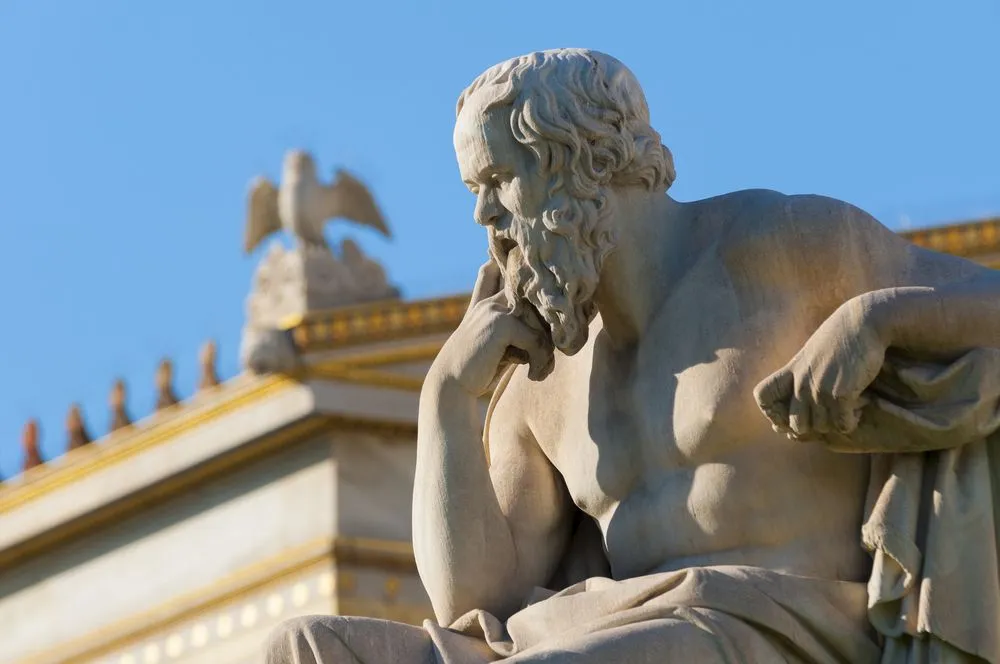
Some mathematical ideas are so fundamental that even if you didn’t discover them, someone else would have. Mathematics is the language of science and its structures are innate to nature. Even if the universe were to disappear tomorrow, the eternal mathematical truths would still exist. It is upon us to discover it, understand its functioning and build on our knowledge to find solutions to the physical event we seek to control.
Many mathematicians support this view. They have discovered many eternal truths, independent of the mind that found them. For example, there is no highest prime number, and the number pi when expressed in decimals can go on forever.
Math manifests itself in nature and holds answers to many universal questions. One such example where math can be found in nature is The Golden Ratio.
Golden Ratio And Fibonacci Sequence
The golden ratio describes some of the most recognizable patterns in nature. It appears in phenomena ranging from the spiral of a hurricane and the proportions of the human face and body to the structure of spiral galaxies. The golden ratio is when the ratio of parts (a) and (b) is equal to (a +b) divided by the larger part (a). It has a value of about 1.618 and is depicted by the greek alphabet phi, Φ. It is also known as the divine proportion.
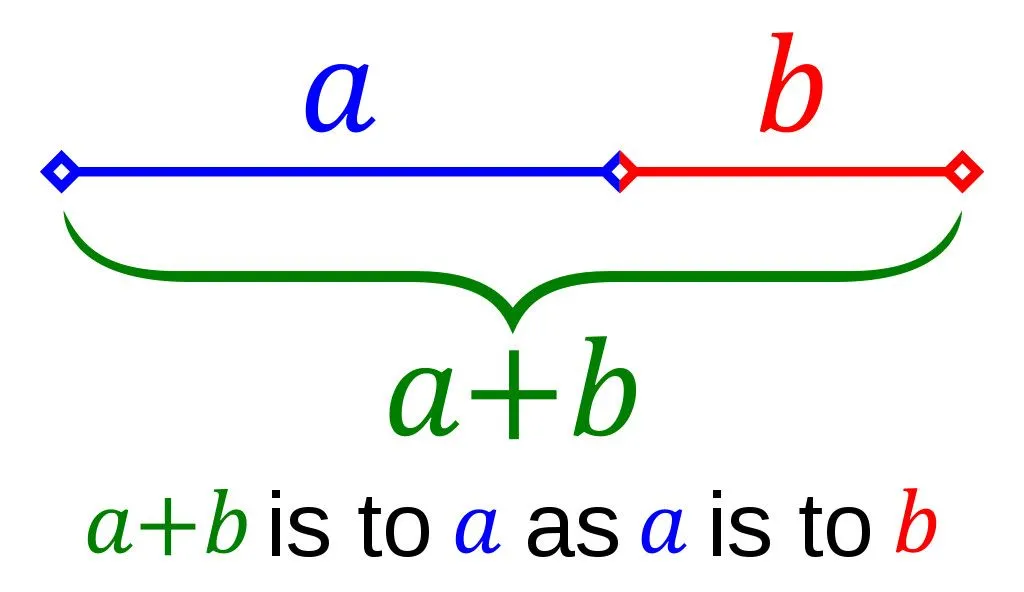
The golden ratio is closely related to the Fibonacci sequence, named after the Italian mathematician Leonardo Fibonacci. The ratio of consecutive Fibonacci numbers converges to the golden ratio as the numbers grow larger. For hundreds of years, the Fibonacci sequence has fascinated many mathematicians, scientists and artists. Each number in the sequence is the sum of the two numbers that precede it. So, the sequence will be: 0,1,1,2,3,5,8,13,21,34,55,….. and so on.
The Fibonacci sequence can be seen in various items around us, including seashells, animals, pyramids and other unexpected places.
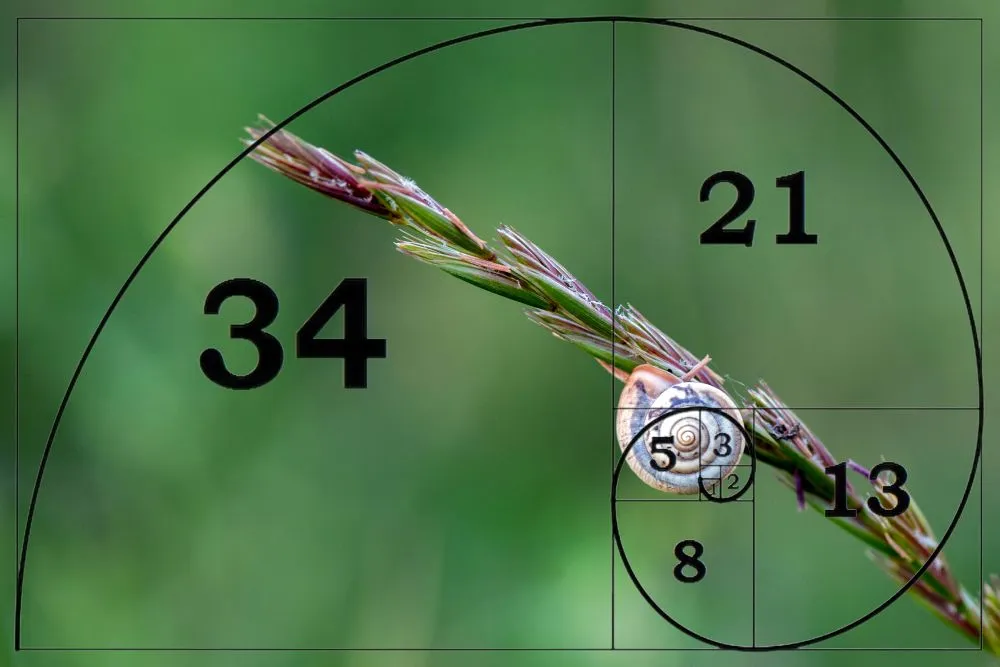
Flower petals also follow the Fibonacci sequence. If you observe, the number of petals in a flower will be either one of the following: 3, 5, 8, 13, 21, 34 or 55. For example, a lily has 3 petals, cosmos has 8 petals, corn marigold has 13 petals, chicory and daisy have 21 petals and Michaelmas daisies have 55 petals. This supports the argument that mathematical functions existed in nature, and all we did was discover them!

Check out our video about the golden ratio and Fibonacci sequence to understand this fascinating concept better.
Was Mathematics A Creation Of Our Making?
Some people oppose the idea that math was discovered. They belong to the anti-Platonist school of thought, broadly called formalism, which holds that mathematics was invented. Formalists consider math to be a human invention -- a set of rules and symbols designed in a way that suitably describes the physical world. To suit our needs, the human mind continually makes up new mathematical concepts.
If the universe were to disappear tomorrow, every made-up idea, from football and chess to democracy and home economics would disappear, as would mathematics.
Humans have come to understand the working of the universe simply by observing the patterns that appear in nature. We have invented mathematical concepts by abstracting elements like shapes, lines, groups, etc. from the world around us and then made connections between these concepts either to serve some purpose or just for fun!
Geometry and arithmetic were developed due to our ability to observe and distinguish between shapes like circles and triangles, as well as to differentiate between straight and curved lines.
In the beginning, we used natural numbers- 1,2,3…..- to count objects around us. Later, we invented more concepts, like negative integers, rational and irrational numbers, complex numbers and many more. These extensions to mathematics were developed to serve our purposes, but not necessarily because we witnessed them in nature.
Let’s say the temperature has dropped below 0 on a thermometer. To illustrate a number below zero, we use negative integers and write -10 C or -25 C. Due to this process of inventing new ideas based on what we see around us, it is not incorrect to say that mathematics was born out of our perceptions and mental pictures.

Why Does Math Describe The Universe So Well?
If mathematics is simply something humans made up, here is the puzzle that keeps the debate alive: why does it predict the real world so astonishingly well? In 1960, the Nobel Prize-winning physicist Eugene Wigner published a now-famous essay titled "The Unreasonable Effectiveness of Mathematics in the Natural Sciences." In it, he marveled that the usefulness of mathematics in physics is "something bordering on the mysterious" with "no rational explanation for it."

Wigner's point was that mathematicians often invent ideas purely for their elegance, with no thought of the physical world, and yet those very ideas later turn out to describe nature perfectly. Newton's mathematics of falling apples also governs the orbits of the planets. The abstract "matrix" mathematics worked out by pure mathematicians resurfaced decades later at the heart of quantum mechanics, predicting the behavior of atoms to within one part in ten million. Complex numbers, once dismissed as merely "imaginary," became indispensable to modern physics.
For the discovery camp, this uncanny fit is the strongest argument of all. If we had simply invented math to suit ourselves, why would it keep revealing truths about a universe that existed long before us, in the same way the Fibonacci sequence turns up uninvited in sunflowers and seashells? Platonists answer that the mathematical structures were there all along, woven into the fabric of reality. Not everyone is convinced. The mathematician Richard Hamming replied in 1980 that we tend to notice and keep the mathematics that fits, because we build our theories around what we can already describe. Even Hamming admitted, though, that his explanations were not quite enough to fully solve the riddle. Either way, Wigner's "unreasonable effectiveness" remains one of the deepest reasons the invented-or-discovered question simply refuses to die.
Conclusion
The controversial debate between those who think mathematics is a discovery and those who think it’s an invention may go on forever. Given that the problem has existed for 2,300 years, it is unlikely that this mystery will be resolved anytime soon. However, the truth remains that mathematics just doesn’t care if we believe that it was invented, discovered or if both played a role in its existence. Irrespective of our belief, it will objectively perform its function without letting us down!
References (click to expand)
- Fine, K. (2012). Mathematics: Discovery Or Invention?. Think. Cambridge University Press (CUP).
- Iosa, M. et al. (2022). The Golden Ratio in Nature: A Tour across Length Scales. Symmetry, 14(10), 2059.
- P Ernest. is mathematics discovered or invented? - School of Education. The University of Exeter
- Livio, M. (2011, July 19). Why Math Works. Scientific American. Springer Science and Business Media LLC.
- What Is Math? | Science| Smithsonian Magazine. Smithsonian
- Wigner, E. P. (1960). The Unreasonable Effectiveness of Mathematics in the Natural Sciences. Communications on Pure and Applied Mathematics. University of Edinburgh.
- Hamming, R. W. (1980). The Unreasonable Effectiveness of Mathematics. The American Mathematical Monthly. Caltech / NASA NED.
- Babylonian mathematics. MacTutor History of Mathematics Archive, University of St Andrews.
- Plimpton 322. Before Pythagoras. Institute for the Study of the Ancient World, NYU.