Table of Contents (click to expand)
100% relative humidity means the water vapor in the air has reached saturation at the current temperature — the maximum amount that can stay in vapor form before extra moisture starts condensing out as dew, fog, or cloud droplets. It does not mean the air has “become water”, and it does not necessarily mean it is raining; the air around you is still mostly nitrogen and oxygen.
A few days ago, a child told me he had been closely following weather reports on news channels. In the process, he discovered that he was particularly interested in the concept of ‘humidity.’ He mentioned that he had seen the term ‘air humidity’ used repeatedly in weather reports and on search engines whenever he checked the temperature of his city.
On reflection, it is interesting to consider why weather reports include numerous mentions of ‘air humidity’ or just ‘humidity,’ which is usually expressed in percentages.
For example, you can see this in the following screenshot:
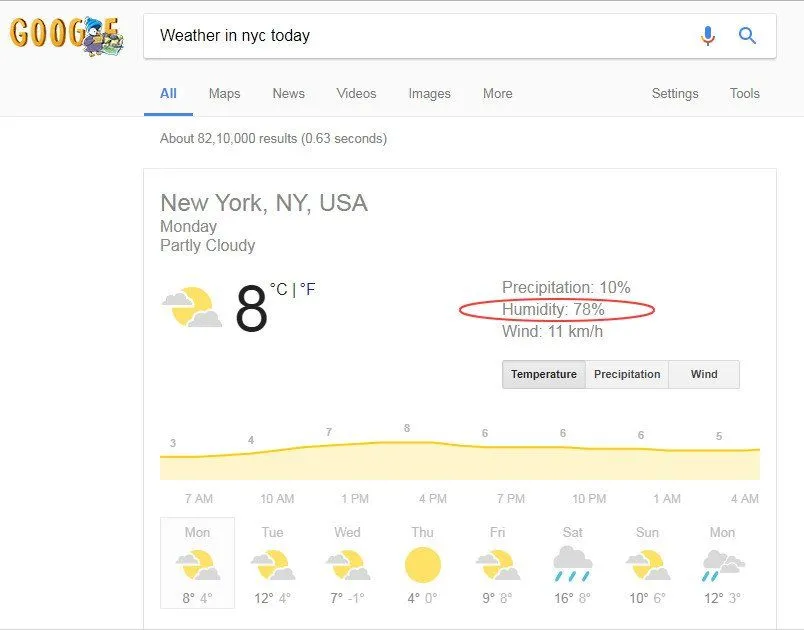
It shows the humidity in New York City to be 78%, but what exactly does that mean?
If you have ever paid attention, you might have noticed that the humidity values are sometimes even 100%. What’s that all about? Does that mean the air has become water, and people are breathing… water?
What Is Humidity?
Humidity, in simple words, measures how ‘wet’ the air is in a given place. More specifically, humidity is the amount of water vapor present in the air. Water vapor, as you well know, is the gaseous state of water and is, therefore, not visible to the naked eye.
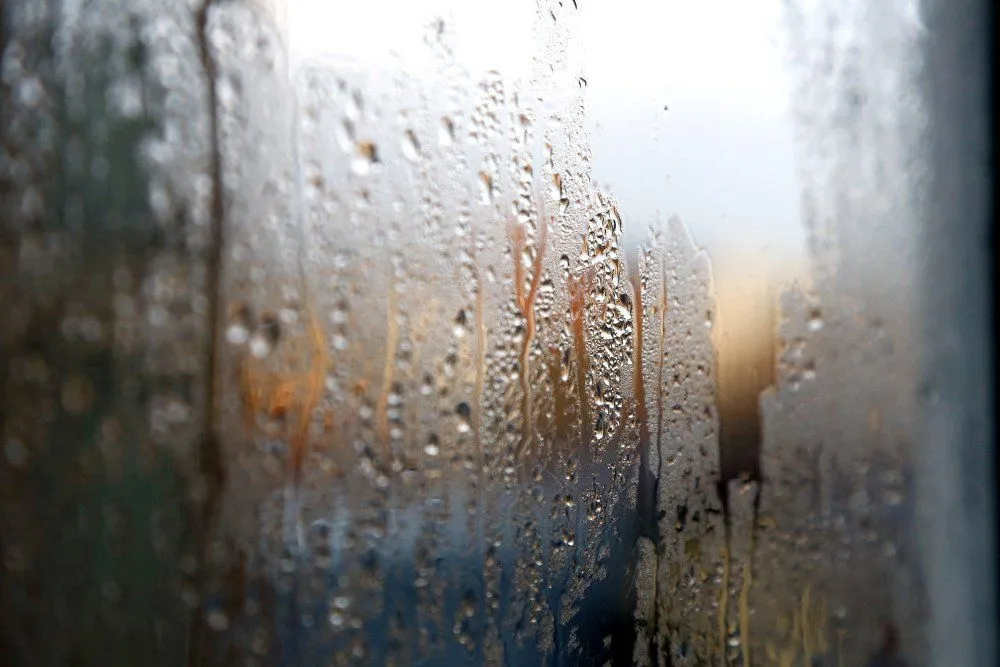
You might have heard people say that it’s not just the heat; it’s the humidity that makes them uncomfortable. This is because hot temperatures can feel even more unpleasant when more water vapor is in the air.
Note that humidity is a broad term that refers to three types: absolute, relative, and specific humidity.
Weather forecasters frequently use the terms absolute humidity and relative humidity when reporting weather conditions.
Types Of Humidity
Absolute humidity is the total mass of water vapor in a given volume of air. Mathematically, it is the mass of water vapor (mv) divided by the volume of the moist air mixture (V), and is usually expressed in grams of water vapor per cubic metre of air (g/m³).
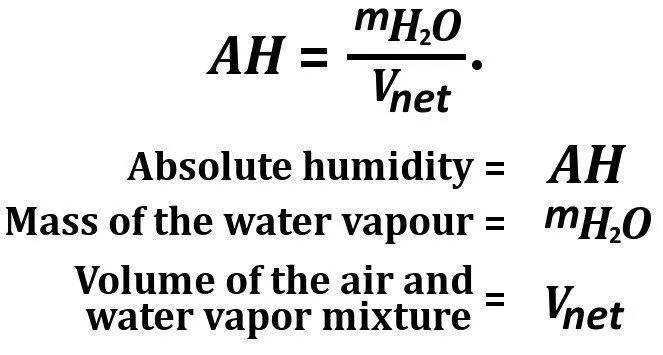
However, the calculation of absolute humidity does not consider the system’s temperature; the former’s value is affected by changes in the air temperature or pressure changes.
Specific humidity, on the other hand, is the ratio of the mass of water vapor to the total mass of the moist air parcel. It’s often casually referred to as the ‘moisture content’.
That being said, the type of humidity that is most relevant to our discussion is relative humidity.
Relative Humidity
Relative humidity is the ratio of how much water vapor is actually in the air to how much could be present before condensation sets in at the current temperature, expressed as a percentage. More precisely, it is the partial pressure of water vapor divided by the saturation vapor pressure of water at that temperature. So a relative humidity of 78% means the water vapor is at 78% of the saturation value for that temperature. (Strictly speaking, air doesn’t “hold” water like a sponge — saturation is a property of water and temperature, not of the nitrogen and oxygen sitting next to it — but the “capacity” shorthand is a handy way to think about it.)
Think of it this way: if you have a half-full glass of water (i.e., at 50%), you would say that the glass contains 50% of what it can hold. Relative humidity works on a similar intuition.
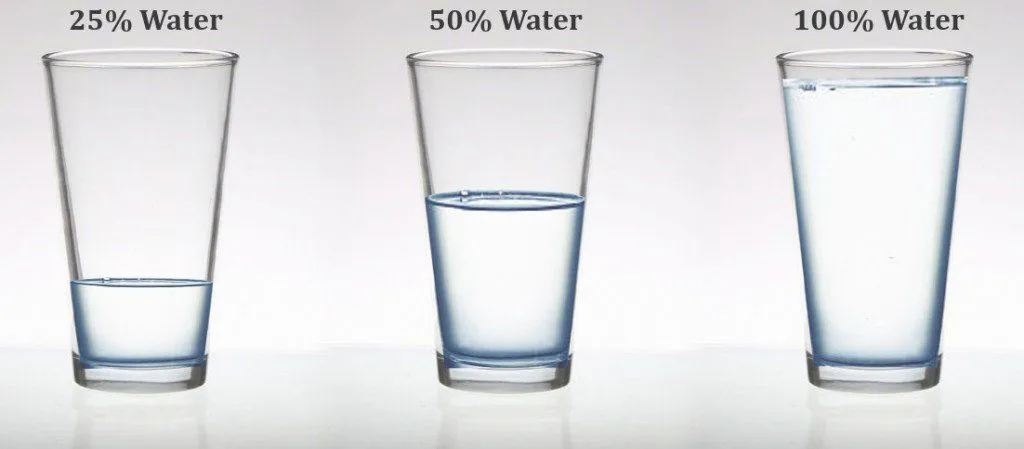
“100% Relative Humidity”
Relative humidity is a measure of how saturated the air is with water (as air can only carry so much moisture at a given temperature).
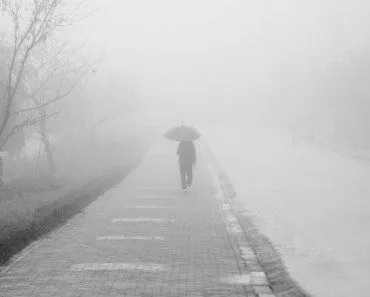
If the weather report shows the relative humidity value to be 100%, it doesn’t mean that air has become water; rather, it means that any additional moisture cannot enter the air and must remain as water. Fog is a good way to imagine what 100% relative humidity looks like.

When the water vapor in the air has reached the maximum amount possible at a given temperature, it is said to have 100% relative humidity. This does not mean the air has turned into water; just like a sponge fully saturated with water doesn’t itself become water, a relative humidity of 100% just means the air’s water vapor is at saturation equilibrium with liquid water. So leave your scuba gear at home!
Can Humidity Be More Than 100%?
Yes, briefly. This is called supersaturation, and it usually happens inside clouds. In the open atmosphere there are plenty of tiny dust, salt, and aerosol particles (called cloud condensation nuclei) for excess water vapor to condense onto, so relative humidity rarely climbs more than a fraction of a percent above 100% before fog or cloud droplets form. In completely clean, particle-free air, RH would have to climb several hundred percent before droplets formed on their own.
Does 100% Humidity Mean Rain?
Not really. 100% relative humidity at the surface most often produces dew or fog, not rain. Rain forms in saturated cloud layers high above your head, and it can fall through much drier air on its way down — it can be raining outside while the relative humidity at the ground is only 60% or 70%. (When rain evaporates completely before reaching the ground, it’s called virga.) So a humidity reading of 100% means saturation, not necessarily that you need an umbrella.
Last Updated By: Ashish Tiwari
References (click to expand)
- Relative Humidity: indicates how moist the air is.
- Green, J., & Dyer, I. (2009, January). Measurement of humidity. Anaesthesia & Intensive Care Medicine. Elsevier BV.
- Nguyen, J. L., Schwartz, J., & Dockery, D. W. (2013, June 18). The relationship between indoor and outdoor temperature, apparent temperature, relative humidity, and absolute humidity. Indoor Air. Hindawi Limited.