Garbage stinks because bacteria break down food and waste into sulfur gases like hydrogen sulfide (rotten eggs). Garbage bags help because their dense polyethylene has a low oxygen transmission rate, which also slows how fast those odor molecules diffuse through the plastic. Smell still leaks out slowly, and scented bags only mask it rather than eliminate it.
Every time there’s a bad smell in the office and we can’t pinpoint the exact source, we follow a protocol – everyone in the office clears out their desks, fills their trash bins and empties the contents in the ‘main’ trash bag of the office, which is subsequently carried out to the dumpster. As soon as this is done, the bad smell simply disappears!
It’s clear that the smell is usually due to half-eaten food sitting in someone’s desk from the previous day, but what’s really interesting is that once all the office trash is deposited in the main garbage bag, it doesn’t stink anymore! Clearly, the garbage bag does its work quite effectively.
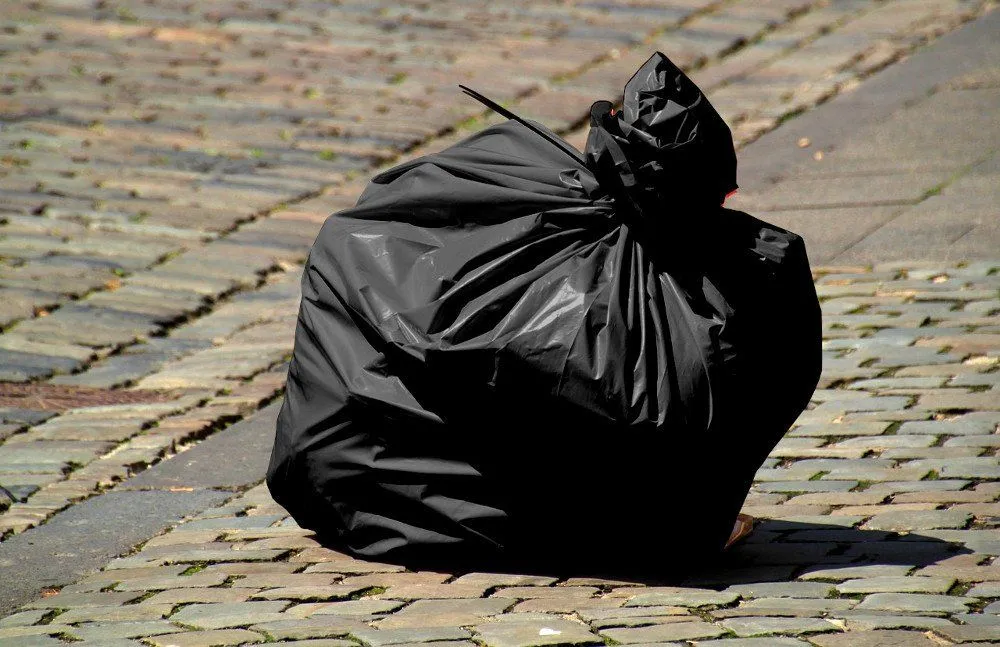
Before we get to the bag, it helps to know why garbage stinks in the first place. The moment food scraps and other organic waste start to rot, bacteria go to work on them, breaking proteins and other matter down into a cocktail of smelly gases. The worst offenders are sulfur compounds, especially hydrogen sulfide (the rotten-egg smell) and methanethiol (rotten cabbage). Our noses are exquisitely sensitive to these, so even a few molecules in the air are enough to make us wrinkle them. That, incidentally, is also why almost all garbage ends up smelling roughly the same, no matter what you threw out: the same handful of sulfurous gases dominate the bouquet.
So, what is it about garbage bags that makes them so good at containing such a wide range of strong and vile smells within their ‘plastic boundaries’?
This can be answered by looking at a few typical properties of garbage bags.
How Are Garbage Bags Made?
The disposable plastic garbage bag was invented in 1950 by Harry Wasylyk, a Canadian inventor from Winnipeg, working alongside Larry Hansen of Ontario. Wasylyk had apparently had enough of the old method of letting garbage pile up in germ-ridden metal containers. The earliest bags were green and sold to the Winnipeg General Hospital; Hansen worked for Union Carbide, which bought the idea and eventually brought it into homes under the Glad brand.
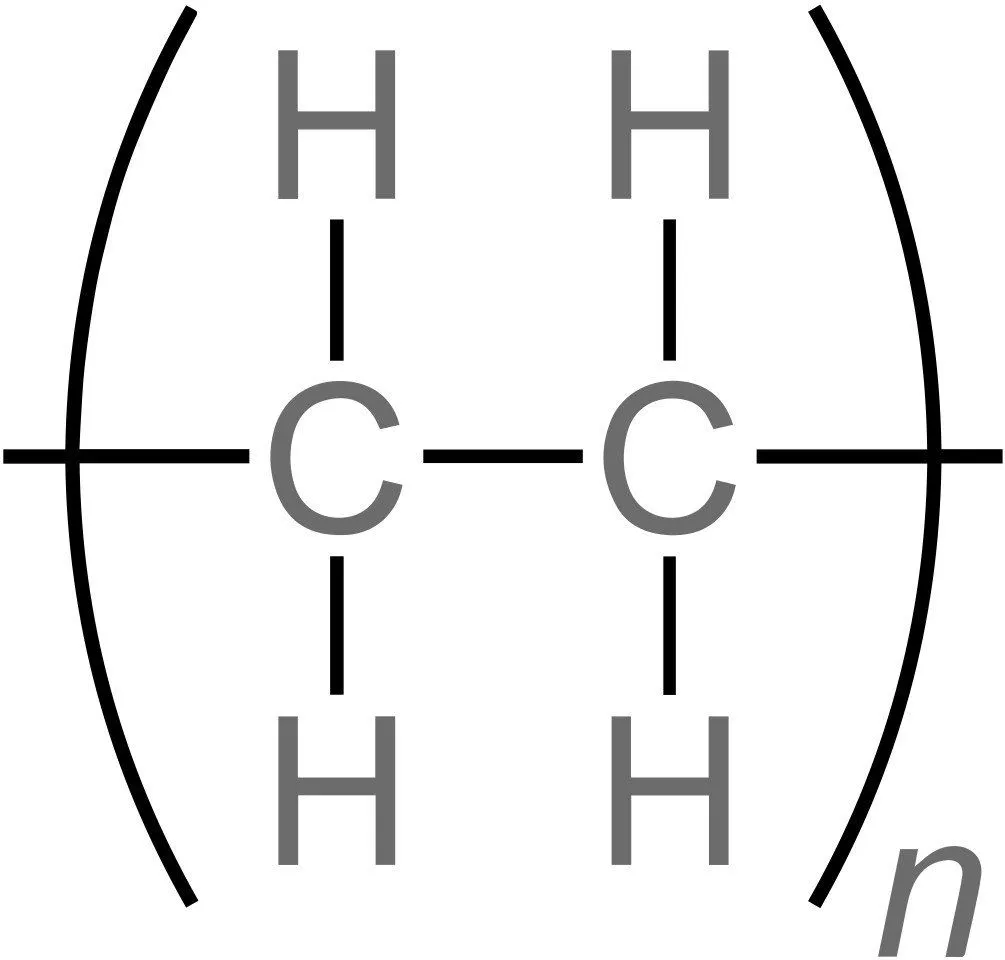
Garbage bags are made from polyethylene – a flexible but tough plastic commonly used in insulation and packaging. The thing about polyethylene that makes it such a perfect candidate as a garbage bag is that it’s resistant to moisture and many chemicals, and has superb insulation properties.
Garbage bags are created in large plants using heavy machinery. They are not produced individually, but are instead created in long tubes, then cut and separated to produce individual bags of different sizes.
How Do Garbage Bags Hold Foul Smells?
Many premium bags go a step further and are sold as ‘odor-control’ or scented bags. These build a fragrance into the plastic, often as tiny microcapsules that release scent as the bag is stretched or filled, and sometimes a layer designed to soak up odor molecules. Here’s the important caveat, though: a scented bag masks the smell rather than eliminating it. The fragrance simply competes with the stink for your attention. It does not chemically neutralize the sulfur gases the way an odor absorber such as activated charcoal or a sprinkle of baking soda does, both of which actually grab and cancel out the offending molecules.
Oxygen Transmission Rate
A big part of a bag’s smell-containing power comes down to how dense and tightly packed its plastic is, a quality engineers often gauge using something called the Oxygen Transmission Rate (OTR). The name is fairly self-explanatory: it is the steady-state rate at which oxygen gas permeates through a film of plastic at a given temperature and humidity. OTR specifically measures oxygen, not odor, but the two tend to go hand in hand, because a film tight enough to block oxygen also slows down the larger, heavier molecules that we smell.
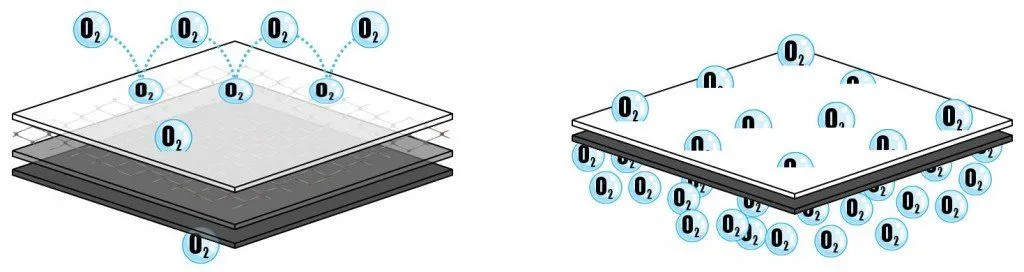
Some plastic films are made to have a very low OTR, so that they let as little oxygen as possible through their surface. This is achieved with the help of particular resins that are blended in the base film when a plastic object is manufactured.
Garbage bags, at least the good (and therefore pricier) ones, have a very low OTR, which means they only let oxygen and those tiny ‘foul-smelling particles’ seep through very slowly. So can smell pass through plastic at all? Yes, it can. No ordinary polyethylene bag is a perfect wall; odor molecules still diffuse through the film and out through any gaps at the tie, just slowly enough that the contents stay sealed away for the time it takes you to haul the bag to the curb.
That’s essentially why garbage bags are so good at containing even the worst smells from your daily rubbish!
Why Are Garbage Bags Black?
Have you ever wondered why so many garbage bags are black, when the plastic they’re made from is naturally a milky, see-through white? It isn’t about hiding the gloom of your trash (though that’s a happy bonus). The real reason is what goes into the bag before it’s ever filled. Many disposable bags are made partly or wholly from recycled polyethylene, and recycled plastic arrives as a jumble of granules in every color you can imagine. Blend all those together and you get a muddy, blotchy grey. Adding a strong black pigment is the cheapest way to mask that mess and turn the whole batch into a single, uniform color.

That pigment is almost always carbon black, an extremely fine powder of nearly pure elemental carbon made by burning hydrocarbons under controlled, oxygen-starved conditions. It’s a workhorse additive in the plastics world: besides coloring, it acts as an ultraviolet light stabilizer (soaking up UV that would otherwise make the film brittle) and as a low-cost filler. A tiny amount tints a lot of plastic, and the resulting opacity neatly hides whatever you’ve thrown away.
There’s an ironic downside, though. That same carbon black is the reason black plastic is so hard to recycle. Modern sorting plants identify different plastics by bouncing near-infrared (NIR) light off them and reading the reflection, but carbon black absorbs those wavelengths instead of reflecting them, leaving the bag essentially invisible to the scanner. The Association of Plastic Recyclers has held since 2018 (most recently reaffirmed in 2024) that NIR isn’t a reliable way to sort black plastics, which is why much of it is simply pulled out and sent to landfill.
Are Garbage Bags Toxic, And What About Scented Ones?
It’s a fair question to ask of something you handle every day and sometimes drape near food. The short answer for an ordinary, unscented bag is reassuring: plain polyethylene is chemically stable and largely inert, which is exactly why it’s trusted for food packaging too. Unlike soft PVC, polyethylene is flexible on its own and doesn’t need added plasticizers such as phthalates to stay bendy, so a basic bag isn’t leaching a cocktail of softeners onto your rubbish.

What about the carbon black that makes the bag black? On its own, carbon black is classified by the International Agency for Research on Cancer as Group 2B, “possibly carcinogenic to humans”. That sounds alarming, but the label rests on inhalation studies in rats and inadequate evidence in humans; the real-world concern is workers breathing the fine airborne powder in a factory, not you carrying a sealed, finished bag to the curb.
Scented “odor-control” bags are where it gets a little more interesting. Their fragrance is a blend of volatile organic compounds (VOCs), the very thing that lets you smell them. A 2011 study in Environmental Health Perspectives found that fragranced consumer products emit, on average, 17 VOCs each, with most releasing at least one compound flagged as toxic or hazardous, and almost none of those ingredients listed on the label (manufacturers can hide them under the single word “fragrance”). Many fragrances also rely on diethyl phthalate as a carrier, although regulators including the U.S. FDA currently don’t consider it a safety concern at the levels used. So scented bags aren’t something to panic over, but if you’re sensitive to perfumes or simply prefer fewer mystery chemicals, an unscented bag plus a little baking soda does the job without the bouquet.
References (click to expand)
- What Your Nose Knows. NIH News in Health. National Institutes of Health.
- Hydrogen Sulfide Toxicity. StatPearls. NCBI Bookshelf. National Library of Medicine.
- Polyethylene (PE): Properties, Structures, Uses & Facts. Encyclopaedia Britannica.
- Polyethylene: The Garbage Story. University of Washington.
- Carbon Black, Titanium Dioxide, and Talc. IARC Monographs, Vol. 93 (2010). International Agency for Research on Cancer.
- Carbon Black, Titanium Dioxide, and Talc (Exposure Data). NCBI Bookshelf. National Library of Medicine.
- Scented Products Emit a Bouquet of VOCs. Environmental Health Perspectives (2011). NCBI / PMC.
- Screening of Phthalate Esters in 47 Branded Perfumes. Environ. Sci. Pollut. Res. (2016). PubMed.
- Black Plastics and NIR Sorting (Association of Plastic Recyclers position). Waste Dive.