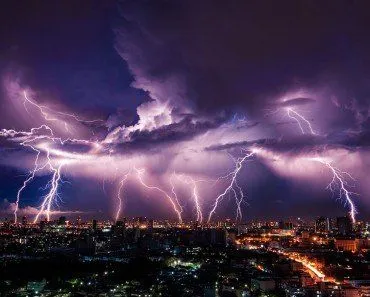
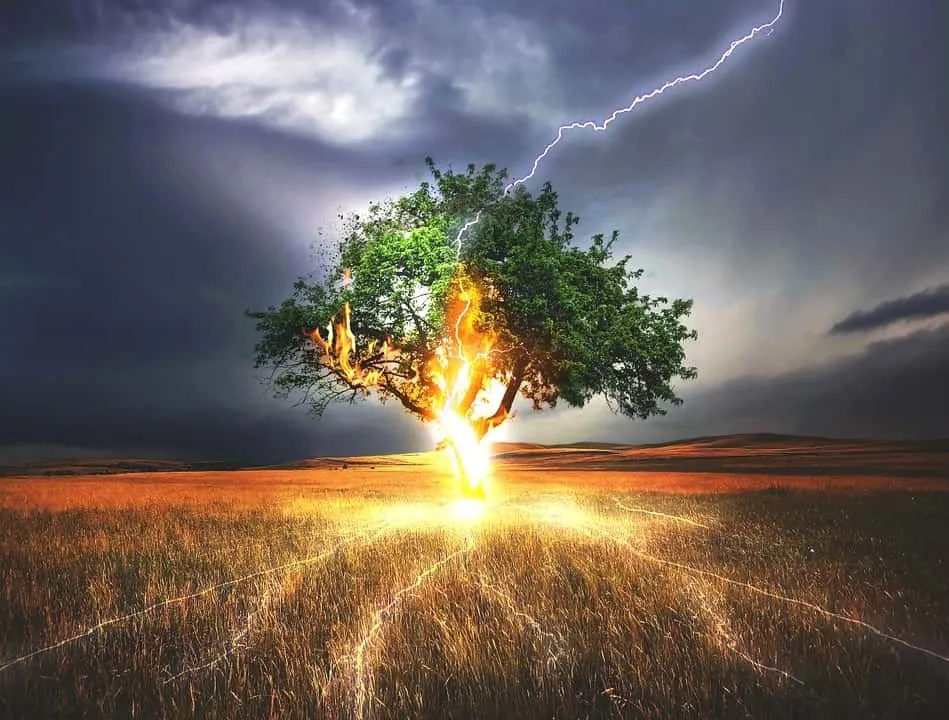
Trees explode when struck by lightning because wood is a relatively poor conductor of electricity, so as the bolt forces a current through the trunk it generates enormous heat (a lightning channel reaches roughly 30,000 K, about five times hotter than the surface of the Sun). The water and sap inside the wood flash to steam in microseconds, and the resulting pressure wave can blow the bark off or split the trunk apart entirely.
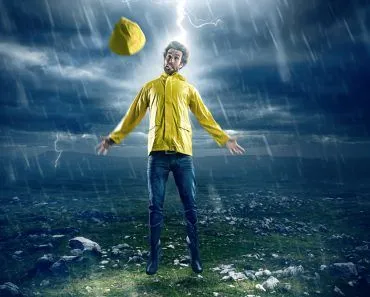
You’ve almost certainly seen cartoons and caricatures depicting people being struck by lightning. Similarly, you might have also seen pictures of trees (or even trees in real life) that have been struck by lightning. When humans are struck by lightning, it generally causes burns and several other injuries (some of which might even be fatal), but lightning-struck trees are often cut in half or in rare cases, they even explode! How does that work?
How does lightning cut trees in half, but in the case of humans, lightning strike victims don’t generally lose their limbs?
The answer to this question lies in how lightning interacts with humans and trees, respectively.
What Happens When A Human Is Struck By Lightning?
You might already know that a lightning strike is basically just a powerful flow of electrons (albeit the process of its buildup is quite interesting).
It’s obvious that lightning strikes are particularly dangerous for any living creature, including humans. The human body, or any other living thing, is simply not built to conduct hundreds of kilowatts of electricity!
When a lightning bolt strikes a human, an electric current that briefly peaks in the tens of thousands of amperes (with the bolt itself carrying around a billion joules of energy in just a few microseconds) courses through their body. This, needless to say, has rather unpleasant and painful effects on the body.
Interestingly, however, humans are reasonably good conductors of electricity, especially compared to wood. You might have heard that humans are composed of “70% water”; as such, the human body does not offer as much resistance to a huge electric current as you might expect. The body (and the fluids inside it) have decent conductivity once the lightning has punched through the relatively resistive outer skin; consequently, the passage of even a huge electric current does not generate as much heat as it would if it were to pass through a higher-resistance material (like a tree). A great deal of the strike’s energy also tends to flow over the wet outside of the body, a phenomenon called flashover, which is a major reason most lightning-strike victims actually survive.
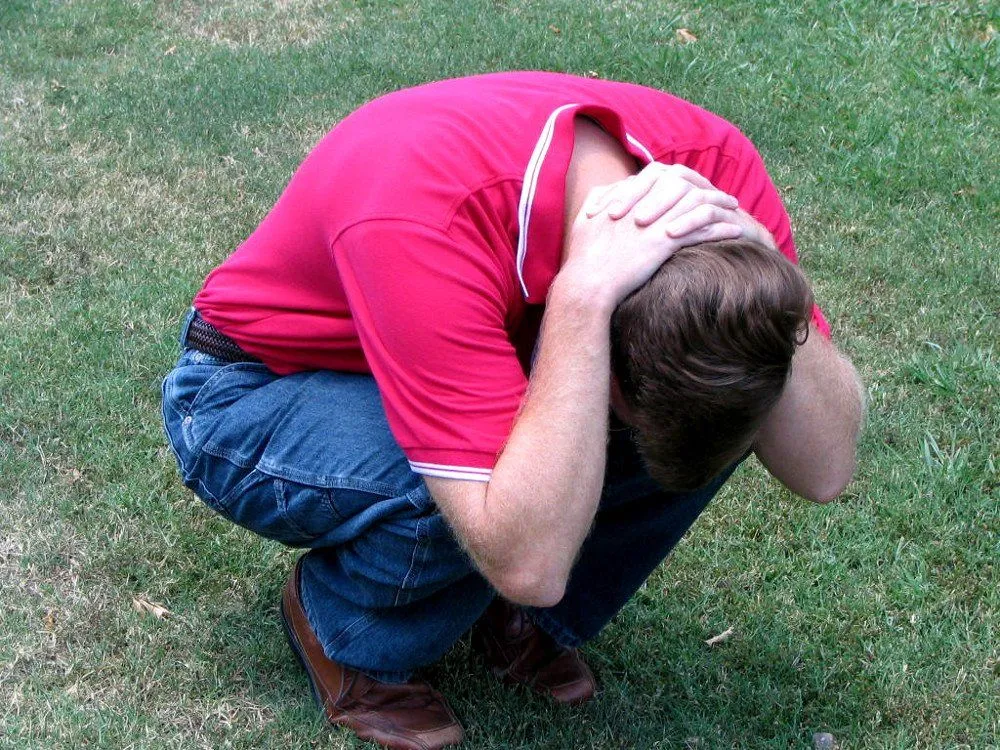
Thus, when lighting strikes a human, the body becomes a ‘passage’ for the former to run straight into the ground. However, since humans do offer some resistance, lightning victims are often known to suffer from severe burns, nerve tissue damage, shock or cardiac failure (some of these may even be fatal).
Now, let’s take a look at what happens in the case of trees.
What Happens When Lightning Strikes A Tree?
It is quite common for trees to be struck by lightning, and what’s even more unfortunate is that there is nothing they can do about it. A tree struck by lightning may behave in unpredictable ways: some trees look absolutely normal following a lighting strike, while others explode or burst into flames! The reason lightning strikes are (often) so brutal to trees is the resistance they offer to the flow of electricity as it passes through them.
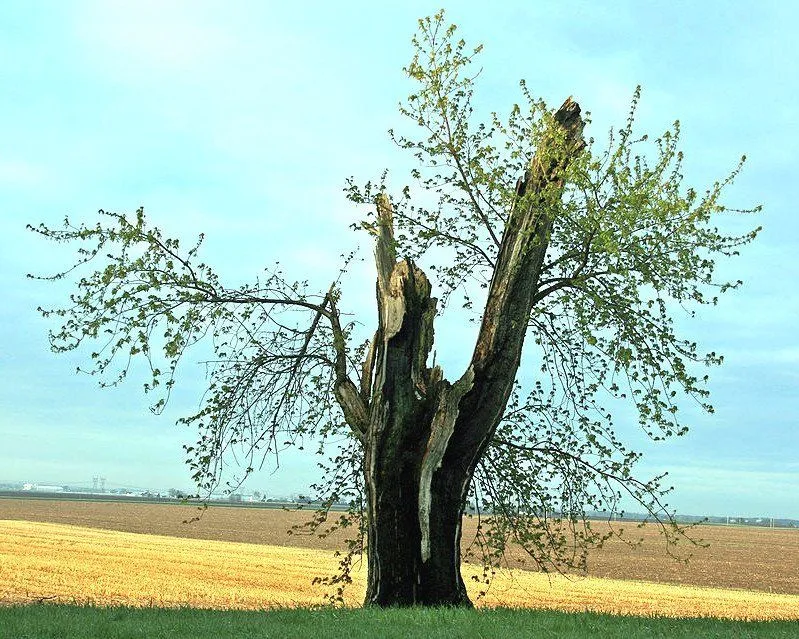
You see, unlike humans, trees are not good conductors of electricity. As such, they offer a lot of resistance to the flow of electricity through their ‘body’. You might recall from your high school Physics class that when there is high resistance to the flow of current, heat is produced in the system. The same thing happens in the case of trees.
The trees’ resistance to the flow of electricity causes a high heat built-up as lightning travels through a tree’s frame. Such insanely high temperature can sometimes cut trees in half.
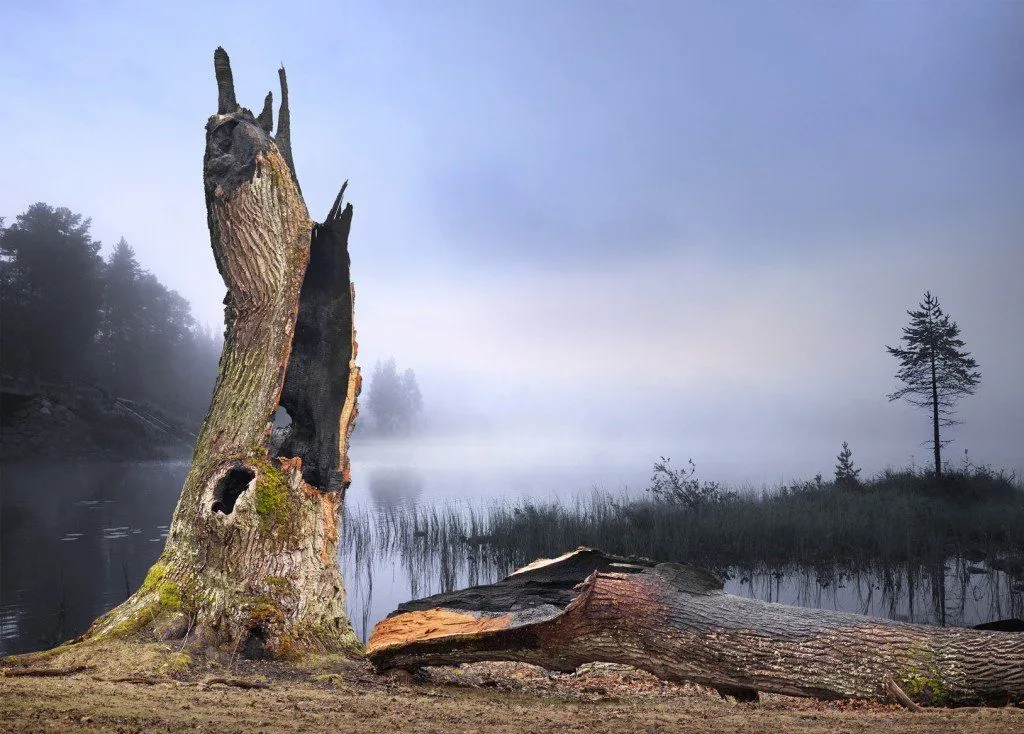
In fact, some trees will even burst into flames or explode following a lightning strike. This is because during a lightning strike, the sap in the bark of the tree is subject to extreme temperatures, many times hotter than the surface of the Sun, in fact! The electrical resistance causes the sap to be overheated into steam, which can make the tree explode instantaneously.
Why Does Lightning Strike Trees In The First Place?
Before a tree can explode, lightning has to choose it. So why do bolts seem so drawn to trees? It comes down to three things working together: height, isolation and moisture.

Lightning does not literally seek out trees, but it does tend to take the shortest, easiest route to the ground. As a thundercloud builds up charge, the tallest objects in a given area are the most likely to send up the faint upward streamers that reach toward the descending bolt and complete the circuit. The U.S. National Weather Service is careful to say that lightning does not always hit the tallest thing, only that it usually does, because that tall object is best placed to make the connection. A lone tree standing in an open field or on a hilltop has no taller neighbor to take the hit for it, which is exactly why safety guidance from NOAA and the USDA Forest Service warns you never to shelter under an isolated tree during a storm.
The third factor is what really sets trees apart from, say, a wooden fence post. According to the USDA Forest Service, the water and sap inside a living tree make it a far better conductor than dry timber, so even though wood is a poor conductor overall, a sap-filled trunk is a much more inviting path to ground than the surrounding air. Tall, alone and full of moisture, a tree effectively becomes a natural lightning rod, just one that has no protective wiring to carry the current safely away.
Does Every Struck Tree Explode (Or Even Die)?
The dramatic exploding-trunk videos are real, but they are the exception rather than the rule. Plenty of trees are struck and barely show it; others are killed instantly; and many fall somewhere in between, looking fine for days before quietly dying.

The classic visible sign is not an explosion but a long furrow running down the trunk, where superheated sap blew a strip of bark clean off and exposed the wood beneath. In some species the current follows the spiral of the grain and leaves a scar that twists around the trunk like a barber pole; in others it runs straight down and can split the trunk outright. Just as important is the damage you cannot see: extension foresters at North Carolina State and the University of Maryland note that a tree can look untouched yet have had its inner tissues and roots cooked, which is why a strike victim may suddenly wilt and brown weeks later. For that reason, arborists treat a fresh strike as a wait-and-see injury rather than an immediate verdict.
At the scale of whole forests, lightning is a serious killer. A peer-reviewed review of lightning's role in forests estimates that strikes damage more than 800 million trees and kill roughly 200 million trees in tropical forests every year, with each individual strike killing about 3.5 trees and damaging another 11.4 on average. Tellingly, lightning tends to take out the largest trees in a patch, so a single bolt can leave a lasting gap in the canopy. So no, not every struck tree explodes, but across the planet, lightning quietly reshapes forests on a massive scale.
Is There A Tree That Actually Benefits From Lightning?
Here is the genuinely surprising part: at least one tree appears to want the lightning. In a 2025 study published in the journal New Phytologist, ecologist Evan Gora of the Cary Institute of Ecosystem Studies and his colleagues tracked lightning strikes in the rainforest of Panama's Barro Colorado Nature Monument and found a tropical giant, Dipteryx oleifera (the tonka bean or almendro tree), that shrugs off direct hits.
Of nearly 100 trees the team watched get struck, more than half of the other species were badly damaged, and many died within two years. Every single Dipteryx oleifera that took a direct strike, by contrast, survived with only minor harm. Better still, the tree seems to weaponize the bolt. Because its tall crown stands above its neighbors and the current spreads through touching branches and vines, each strike killed an average of about 9 neighboring trees and stripped away roughly 78% of the parasitic woody vines (lianas) clinging to the Dipteryx canopy. By clearing out competitors that would otherwise crowd it and steal its light, a tree that gets hit roughly once every few decades can come out ahead. The researchers estimate this lightning tolerance could boost the tree's lifetime production of offspring many times over. It is a striking reminder that the same force that blows ordinary trunks apart can, for the right species, be turned into an advantage.
References (click to expand)
- Lightning Damage to Tree Might Not Be Instantly Apparent | North Carolina Cooperative Extension - wayne.ces.ncsu.edu
- Lightning Damage - Trees and Shrubs | University of Maryland Extension - extension.umd.edu
- When Lightning Strikes, Is The Tree Out? - Purdue University. Purdue University
- Lightning Safety - The University of Vermont. The University of Vermont
- TOP-10 MYTHS OF LIGHTNING SAFETY - emergencypreparedness.cce.cornell.edu
- Severe Weather 101: Lightning FAQ - NOAA National Severe Storms Laboratory
- Caring for Lightning-Struck Trees - Alabama Cooperative Extension System
- Lightning Impacts on Global Forest and Carbon Dynamics - PMC / NCBI
- Getting hit by lightning is good for some tropical trees - Cary Institute of Ecosystem Studies