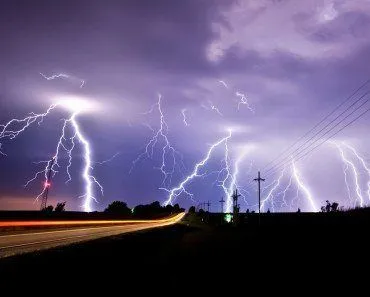
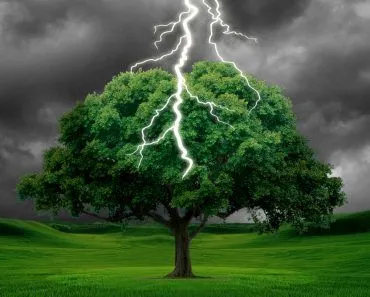
Lightning zig-zags because it does not travel through uniform air. The channel is carved out by a "stepped leader" that advances in short, jerky steps, each one jumping toward whichever nearby pocket of air is easiest to ionize. Since that path of least resistance is rarely a straight line, the bolt ends up jagged and branched.
Every time a storm begins rumbling in the sky, we on Earth are quite lucky to look up and see a sky full of lightning. Sometimes, you will see bolts of lightning even when it’s not raining. The sharp branches of lightning strikes look like an arsenal of sharp weapons stabbing the sky, all at the same time. For some, the image is majestic, while for others, it is utterly terrifying. No wonder people sometimes shudder when they hear a thunderclap!
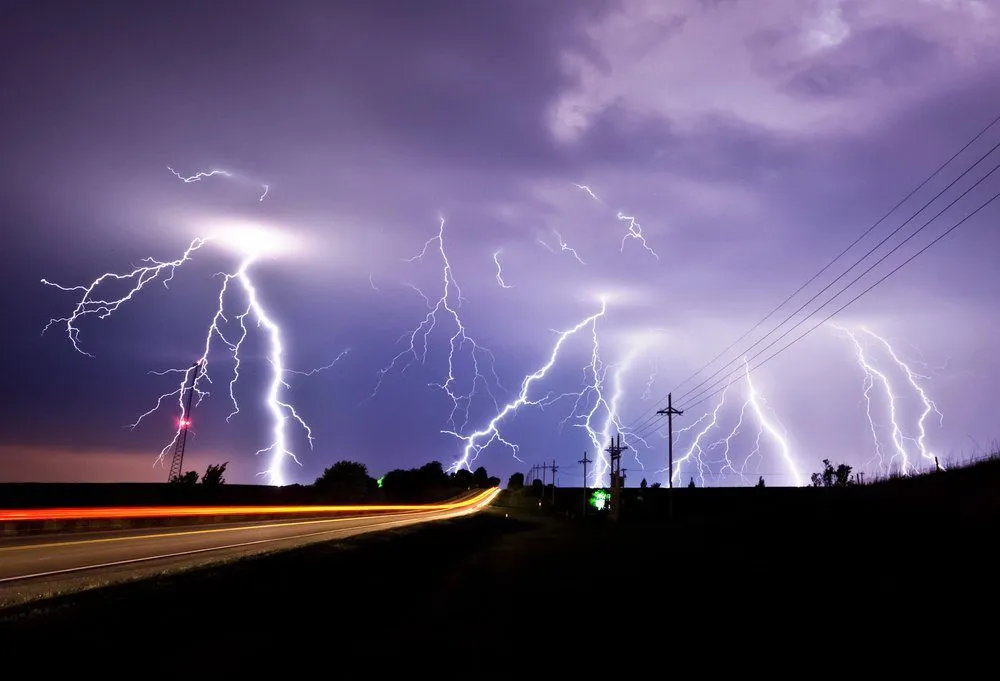
The shape of lightning is what intrigues most people (myself included!). Why is lightning in a zig-zag shape? Why don’t you ever see lightning in a straight line, a triangle, or even a circle, for that matter? Why is the ‘branched shape’ what we see every time lightning cuts through the sky?
What Is Lightning?
Lightning is basically an electric current (yes, like those we have in our houses, except lightning is thousands of times more powerful and dangerous). A lightning channel can heat the surrounding air to around 30,000 °C (54,000 °F), which is roughly 5 times hotter than the surface of the Sun! (Source: NOAA NSSL) Lightning is a type of electric current that, most of the time, forms inside the clouds, but it can also form between a cloud and the ground, producing the lancing line of light that we can see.
The upper part of a storm cloud is well below the freezing point of water, so water vapor there turns to ice. As the cloud builds, these tiny ice crystals and heavier, semi-frozen pellets called graupel constantly collide. Those collisions strip electrons from one and dump them onto the other, building up an electric charge. The lighter, positively charged ice crystals get carried to the top of the cloud, while the heavier, negatively charged graupel sinks toward the bottom. A bolt of lightning is created when this buildup in electrical charge is enough to punch a conducting channel between the two opposite charges. In the moment when those charges connect… Voila! A brilliant lightning strike!
Why Such A Weird Shape?
Why can’t lightning just be in a plain, straight shape?
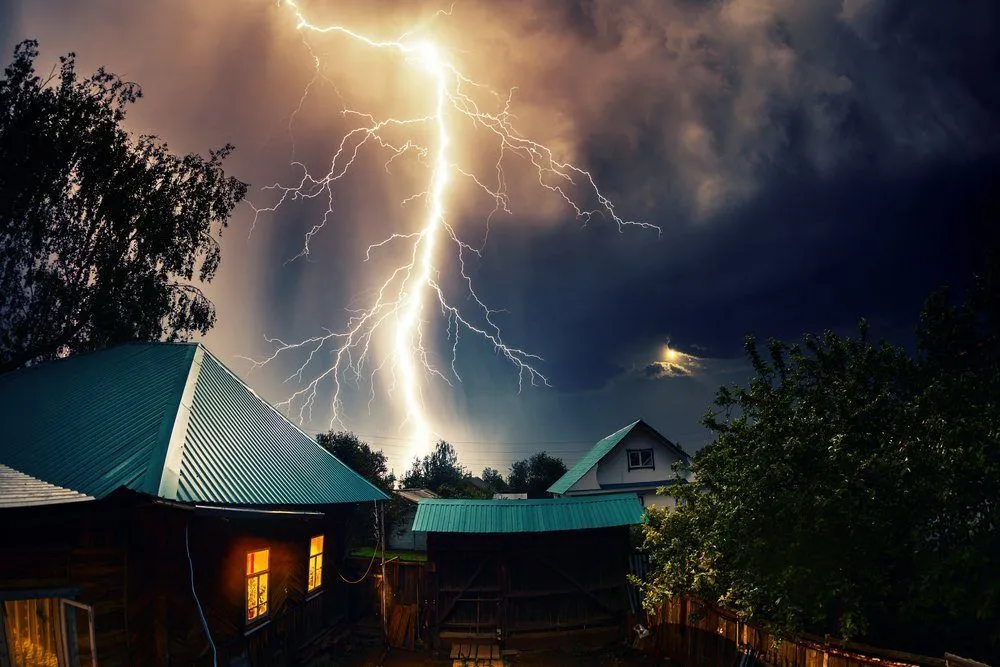
Just like humans tend to do, lightning likes to follow the path of least resistance, i.e., the path where there would be a minimal opposition to its flow.
To understand this, imagine that you have a heap/mound of dirt or sand. Now, when you pour water on it, right at the peak of the mound, how does the water flow downward? Does it always flow in a straight line? Is there a specific pattern to which it adheres?
No, of course not. There is no specific pattern or path that water takes to come down. The same thing is true in the case of lightning.
Air is made up of many things, including certain gases, dust particles, pollutants, and other substances. However, this mixture is not homogeneous, meaning that it is not uniform. Air is uneven and irregular, which is why when lightning is formed (due to the potential difference of the charges), it makes sure that the path it chooses is clear, or has the least possible resistance.
The path it chooses doesn’t have to be a straight line (remember, a straight line means ‘the least distance’ and not ‘the least resistance’). In fact, you will never see a perfectly straight bolt of lightning, at least not in the real world.
Here is what is actually happening, step by step. Lightning does not blaze a complete channel all at once. It starts with a faint, almost invisible feeler called a stepped leader, a thread of charge that pushes out from the cloud in a series of short, jerky hops of roughly 50 meters (about 165 feet) at a time, pausing for a fraction of a millisecond between each one. At every pause, the leader “sniffs out” the nearby air and jumps next toward whichever pocket is easiest to ionize. Because the air ahead is never uniform, each jump points in a slightly different direction, and stacking dozens of these randomly angled steps on top of each other is what gives the finished bolt its jagged, branching zig-zag.
Exactly why the leader travels in discrete steps rather than gliding smoothly is still being worked out. In a 2023 paper in the Journal of Physics D: Applied Physics, physicists John Lowke and Endre Szili proposed that the stepping is driven by a buildup of “singlet delta” metastable oxygen molecules at the leader tip, which strip electrons from negative ions and briefly make the air there far more conductive, allowing the next step to form. It is a promising explanation rather than settled fact, but it points to the same underlying truth: lightning advances through air whose conductivity varies from point to point, so its path can never be a clean straight line.
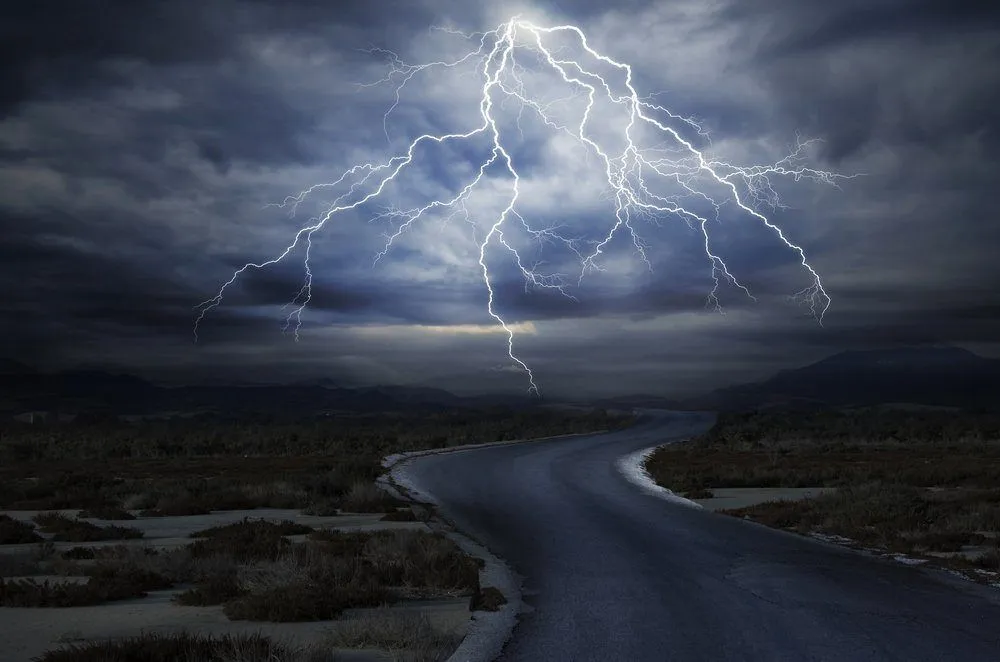
Does Lightning Travel Up Or Down?
This is another question about lightning that seems to confound many people, so just to clarify, lightning actually travels in both directions.
As the negatively charged stepped leader nears the ground, it draws upward-reaching fingers of positive charge, called streamers, out of tall objects below. When a streamer from the ground meets the descending leader, the circuit is completed and a brilliant surge of current, the return stroke, races back up the channel from the ground to the cloud. So even though the leader works its way downward, the dazzling flash you actually see is travelling upward.
Lightning is therefore a process defined by charge moving in both directions, downward and then upward. A single bolt is often several return strokes firing up the same channel in quick succession, which is why lightning so often appears to flicker.
In short, it would be fair to say that lightning travels both ways.
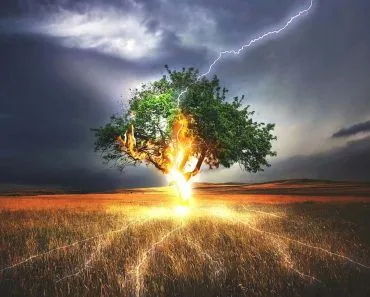
Also, don’t forget that lightning looks for the path of least resistance, so anything on the ground, such as tall buildings, towers, trees, or even humans may provide that path of least resistance for a strike. Given that fact, it would be a good idea to stay indoors when there are lightning strikes crackling all around you.
Update: As it turns out, lightning strikes are much more powerful over sea than land. According to a study published in Geophysical Research Letters, lightning strikes formed over sea water tend to be more powerful than the ones that occur over land. The findings reported in the study suggest that people living on or near the ocean may be at greater risk for lightning damage if storms develop over oceans and move on-shore.
Does Lightning Really Follow The Path Of Least Resistance?
You will hear it almost everywhere, including earlier in this article: lightning takes the path of least resistance. It is a handy phrase, but atmospheric scientists treat it as a rough shorthand rather than a literal account of what the bolt does.
The catch is that the stepped leader has no way of surveying the whole journey from cloud to ground and then picking the single easiest line. As the US National Weather Service puts it, the leader "does not take the path of least resistance from cloud to ground as it moves blindly toward the ground." The leader senses only the charges within roughly 50 meters (about 165 feet) of its tip, and it surges ahead in 50-meter segments based solely on the air immediately around it. In other words, it is not weighing up the best route over the kilometre or two below; it is making a string of blind, local decisions, each based only on the small patch of air right in front of it.
This is also why the tallest object around, such as a lone tree, does not always get hit. As Mike Crimmins, a climate scientist at the University of Arizona, explains, height and metal both matter, but "there could be other things going on in the atmosphere and on the surface so that the charge goes around the metal high point and strikes somewhere else." So "path of least resistance" is a fair metaphor for why a bolt steers around the most stubborn pockets of air, as long as you remember the real rule is closer to "path of locally least resistance, decided about 50 meters at a time." That blind, step-by-step search is exactly what stops lightning from ever drawing a clean straight line.
Can Lightning Curve Or Travel Sideways?
If a bolt can never be perfectly straight, can it bend the other way and curve, or even run sideways? In a sense, yes. Lightning is not locked into a single downward dash, and a few of its forms make that plain.

Ribbon lightning shows up in storms with strong cross winds and several return strokes down the same channel. The wind nudges each successive return stroke slightly to one side of the last, and because the strokes fire so quickly, the eye blends them into a smeared, parallel-banded "ribbon" rather than a single line.
A "bolt from the blue" is even stranger. According to NOAA's National Severe Storms Laboratory, this is a cloud-to-ground strike that starts inside the storm, exits out the side, and then travels horizontally away from the cloud for a few kilometres (a few miles) before finally arcing down to the ground, sometimes under a patch of sky that still looks clear and blue. Spider lightning, meanwhile, describes the long, horizontally crawling flashes that creep across the underside of large, flat stratiform clouds.
So lightning can fork, curve, and sprawl sideways across the sky. The one thing it cannot do is travel in a tidy straight line, because the stepped leader that carves its channel is always feeling its way through uneven air, one short hop at a time.
References (click to expand)
- Why are lightning bolts jagged instead of straight?. Scientific American
- Why doesn't lightning strike straight to Earth?. BBC Science Focus
- Severe Weather 101: Lightning Basics. NOAA National Severe Storms Laboratory
- How Lightning is Created. NOAA JetStream
- Lowke, J. & Szili, E. Toward a theory of 'stepped-leaders' in lightning. Journal of Physics D: Applied Physics (2023)
- Lightning and Thunder - www.hko.gov.hk
- Understanding Lightning: Initiation of a Stepped Leader. NOAA National Weather Service
- Separating lightning fact from fiction. University of Arizona News
- Severe Weather 101: Lightning Types. NOAA National Severe Storms Laboratory
- List of lightning phenomena. Wikipedia