Table of Contents (click to expand)
Drunk people hiccup because alcohol irritates the vagus and phrenic nerves that control the diaphragm, ramps up gastric acid secretion, and inflames the esophagus. Carbonated drinks like beer and champagne add to the problem by bloating the stomach with carbon dioxide, which pushes up against the diaphragm and triggers the involuntary spasms that produce the characteristic “hic” sound.
Homer, for as long as I’ve been watching The Simpsons, is almost always drunk. However, have you ever wondered why – other than the obvious slurring, impulsiveness and burping – does Homer break into hiccups? Hiccups are so indelibly associated with drunkenness that an actor portraying a drunk might forget to burp, but never to feign the hiccups. So… why does alcohol cause them?
Cause Of Hiccups?
The respiratory system is like a common air pump. Situated below the lungs is a flat, tile of muscle called the diaphragm, which descends or loosens when we inhale, enabling the lungs to expand and draw in air. The diaphragm then ascends or tightens when we exhale, forcing the lungs to contract and release that air. It is, of course, the brain that pulls and pushes on the pump. The brain sends signals through the nerves connected to the diaphragm to either move upwards or downwards.
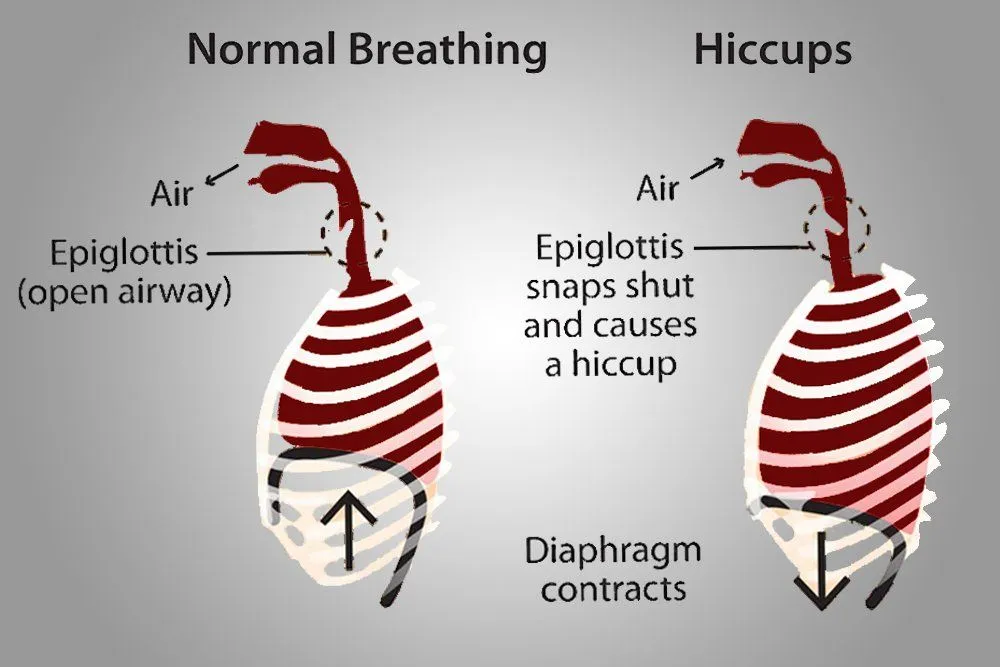
However, due to reasons still not fully understood, the brain will sometimes abruptly force the diaphragm down, causing the lungs to draw in a lot of air very rapidly. As that large volume of air rushes in, the glottis (the narrow opening between the vocal cords inside the larynx, or voice box) reflexively snaps shut. It is this sudden closure of the glottis that produces the characteristic “hic” sound. Basically, a hiccup is the result of an involuntary spasm of the diaphragm followed by an abrupt slamming-shut of the glottis that stifles your intake of air.
Triggers
While we don’t know the exact reason why the brain, in a capricious fit, forces the diaphragm to move down, researchers have narrowed the likely triggers down to a short list. The hiccup reflex itself rides on two nerves: the vagus nerve, which winds from your brain down to the abdomen via the esophagus and stomach, and the phrenic nerve, which is the dedicated wire that drives the diaphragm. Irritate either one and you can set the whole loop off. The usual suspects are an expansion of the stomach from excess gas, movement of stomach acid up the esophagus, sudden changes in stomach temperature (think an ice-cold drink chased by hot soup), and heightened emotions like elation or fear.
Note that alcohol can set off almost all of these proposed causes. Ethanol isn’t an acid itself (it’s a neutral alcohol), but it is a notorious irritant that inflames the lining of the esophagus, which is the burning and writhing you experience after a shot, and that irritation pokes at the vagus nerve running alongside it. Once it reaches your gut, alcohol (especially in dilute forms like beer and wine) actually ramps up the stomach’s production of its own acid (HCl) by triggering the release of gastrin and histamine, leaving the stomach lining inflamed and twitchy.
Furthermore, alcoholic beverages like beer and champagne are carbonated, meaning they are infused with a gas, namely, carbon dioxide. This carbon dioxide will expand the stomach and therefore probe the diaphragm above. This excess gas will not only make you profusely burp, but also trigger a vicious episode of the hiccups.
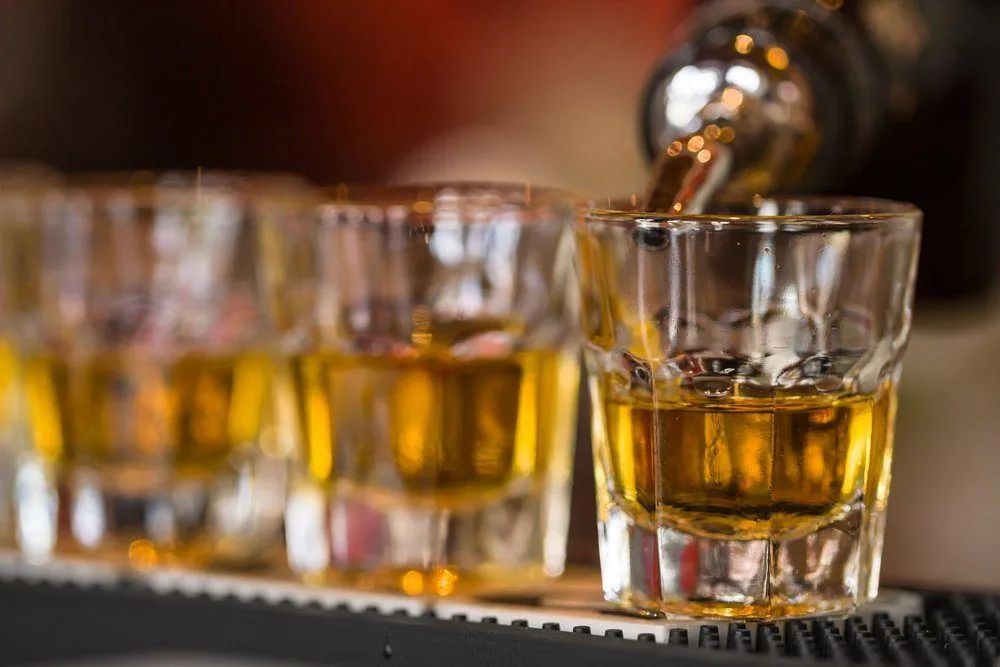
The odds of an onset of hiccups are worsened when the beverage is gulped, since you will not only be gulping alcohol, but also a large volume of air. This sudden increase disrupts your breathing pattern and, thus, the functioning of your diaphragm.
Unless, of course, you’re James Bond who, despite being an inveterate alcoholic, never “yelps” or “hics” while seducing gorgeous women or trash-talking his arch enemies.
How Long Do Drunk Hiccups Last?
Here is the reassuring part: the hiccups you get after a few drinks are almost always the harmless, short-lived kind. Doctors sort hiccups by how long they hang around. A bout is called acute if it lasts less than 48 hours, persistent if it drags on for more than two days, and intractable if it somehow refuses to quit for more than a month. Alcohol sits firmly in the acute camp. As one clinical reference puts it plainly, "most cases are transient and resolve within 48 hours", and acute hiccups are "typically benign and self-limiting, requiring no further workup."
In practice, drunk hiccups usually fade within a few minutes to an hour or so, often once you stop gulping, the carbonation works its way out of your stomach, and the alcohol stops irritating your esophagus and gut. Your diaphragm settles, the vagus and phrenic nerves stop firing off their false alarms, and the rhythmic "hic" simply peters out. So if you have ever timed your own post-drink hiccups and felt like they lasted forever, the clock was probably exaggerating, the episode almost certainly cleared up well inside that 48-hour window without you doing anything at all.
How To Stop Drunk Hiccups
Since drunk hiccups are an over-excited reflex loop rather than a disease, the classic kitchen-counter remedies are aimed at one thing, interrupting that loop. Most of the tricks your friends swear by work by raising the carbon dioxide level in your blood or by stimulating the vagus nerve, both of which nudge the runaway reflex arc back to normal. Physiological studies back this up, showing that the "frequency of hiccups decreasing as arterial PCO2 rises." That single fact explains why so many remedies look so silly.

The remedies clinicians actually list are refreshingly low-tech: briefly hold your breath, sip or gargle ice-cold water, breathe in and out of a paper bag (never a plastic one), swallow a spoonful of sugar, pull on your tongue, or bite into a lemon. Holding your breath and the paper-bag trick both let CO2 build up; the cold water and tongue-pulling jolt the vagus nerve. A word of honesty though, these maneuvers are "effective only in shortening an attack of acute hiccups and not in the treatment of persistent or recurrent hiccups." For a tipsy bout that is exactly the kind they handle best. And the most foolproof remedy of all is simply slowing down: stop chugging, ease off the fizzy stuff for a bit, and let your stomach deflate.
When Are Drunk Hiccups A Sign Of Something Serious?
A round of hiccups after a night out is nothing to lose sleep over. The picture only changes when the hiccups refuse to leave. Because the hiccup reflex rides on the vagus and phrenic nerves and loops through the brainstem, hiccups that stretch past the 48-hour mark can occasionally be the body's way of flagging an irritation somewhere along that pathway. As the medical literature warns, "persistent and intractable singultus may indicate a serious underlying disease," and an "investigation for organic causes is warranted in patients with persistent or intractable singultus." Acid reflux, an inflamed esophagus, and central nervous system problems are among the culprits doctors look for.
Alcohol ties into this in a second way. People who drink heavily over the long term can develop a genuinely twitchy hiccup reflex, since chronic alcohol use is recognized as one of the toxic and metabolic causes that can disrupt the normal hiccup reflex arc, which is part of why heavy drinkers sometimes seem especially prone to them. The bottom line is a simple one: the brief hiccups that show up with your second beer are just your diaphragm overreacting and will sort themselves out. But hiccups that carry on for more than two days, drinking or not, are worth a conversation with a doctor rather than another spoonful of sugar. (For the rare extreme of a bout that simply never stops, see whether a case of the hiccups can actually kill you.)