Spiderman's reflexes are superhuman, but real human reflexes are quick too. A spinal reflex fires in about 20-50 milliseconds, while a conscious reaction averages around 250 ms. We can't dodge bullets, but training can sharpen reaction time toward 120-150 ms.
We all know about Spiderman, one of the most popular superheroes in comic book history. The fictional character created by Stan Lee (the father of the Marvel universe) has many weapons and abilities to combat his enemies and protect himself.
However, his lightning-quick reflexes and the ability to dodge incoming threats are some of the most envied skills of any superhero. People around the world have tried to imitate Spiderman and replicate the actions of the superhero, but has anyone been able to develop the innate sense to detect danger and respond like him?
What Are Reflexes?
Reflexes are quick involuntary actions that living organisms perform in response to an external stimulus. A stimulus is simply a change in the surrounding environment or conditions outside the body. Reflex actions are unconscious movements that don’t involve the use of our brain, unlike other voluntary tasks that require management by the mind. Consider, for example, a situation when you touch a hot object with your hand. The temperature around your hand suddenly rises, indicating a change in the external conditions of the body. As a result, you remove your hand from the vessel immediately, even if you didn’t consciously tell your muscles to do so.
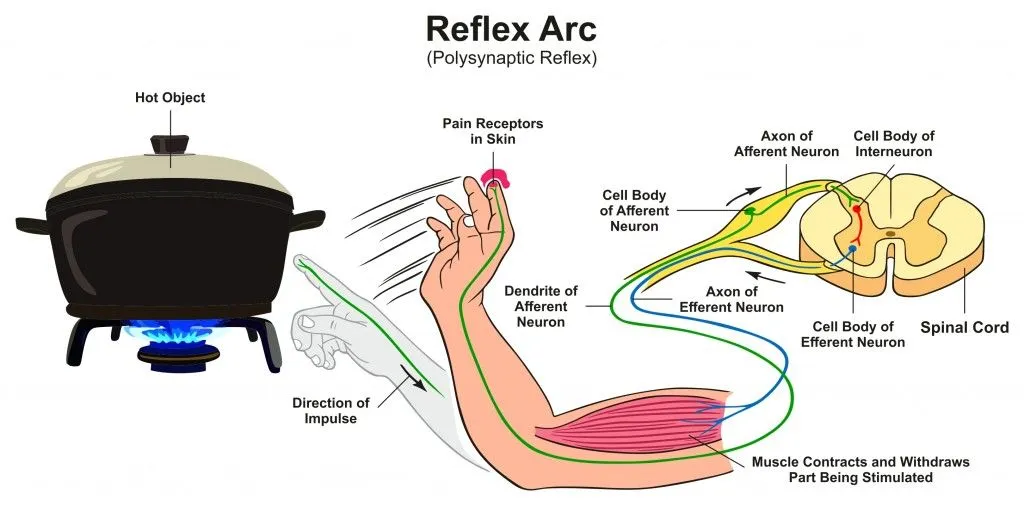
Reflexes work via neural signals or transmissions that travel from one nerve cell to another, delivering a specific message for a coordinated activity. Most reflexes don’t have to travel to our brain to be processed. This is why reflexes happen so quickly. A reflex action often involves a straightforward nervous pathway, also called a reflex arc. This reflex arc begins with receptors being excited. These receptors then send signals along a sensory neuron to our spinal cord, where the signals are passed on to special nerve cells called motor neurons. As a result, one of our muscles or glands will be stimulated, and the reflex action is performed.
How Fast Are Human Reflexes (And How Do They Compare To Spiderman)?
So, just how fast is fast? It helps to separate two things that often get lumped together. A true reflex, like yanking your hand off a hot pan, runs through the spinal cord and skips the brain entirely, so it fires in roughly 20 to 50 milliseconds (ms). A deliberate reaction, where your brain actually has to see something and decide to move, is much slower. Studies of simple visual reaction time put the average adult at about 250 ms (a quarter of a second), with most healthy people landing between 200 and 300 ms. If you have to choose between options (left or right, dodge or block), that climbs to 350 ms or more.
That gap is the whole point of a reflex arc: by letting the spinal cord pull the trigger, your body can act several times faster than your conscious mind ever could. Elite athletes, fighter pilots and pro gamers can shave their reaction time down toward 120 to 150 ms with relentless practice, but nobody crosses into the realm of literally dodging a bullet.
And Spiderman? His writers have never pinned an exact number on his reflexes, but the comics describe him reacting faster than the human eye can follow and dodging gunfire at point-blank range, which would require reaction times in the low single-digit milliseconds. That is comfortably beyond anything biology allows. Among the live-action versions, fans usually rank Tom Holland's MCU Spider-Man as having the sharpest, spider-sense-driven reflexes, but all of them are firmly in the superhuman bracket. In other words, our 250 ms is excellent for a primate; it is just not in the same universe as a radioactive-spider upgrade.
Do Humans Have Something Like A Spider-sense?
In his comics and movies, Spiderman is often seen dodging bullets and pumpkin grenades thrown by his archenemy, Green Goblin. In the process of evading such hazards, our hero is often helped by his so-called ‘Spider-Sense’, which is basically a sixth sense that helps him detect imminent dangers.
So, do humans have something similar to this ability?

Well, to be clear, there might not be any such thing as a spider-sense. Humans cannot sense danger of which we aren’t aware, nor can we dodge pumpkin grenades thrown at us from behind.
Having said this, we do have a spider-sense of our own (the ability to react to dangers that we are only aware of unconsciously). Our senses take in a substantial amount of information from our surroundings at all times, most of which is ignored or discarded in order to focus on the more important tasks at hand.
However, a team of researchers from New York University and the University of Edinburgh (Raio et al., Current Biology) recently proved that if some form of threat or danger appears in the periphery of our vision, we will immediately shift our attention and experience an immediate sympathetic response that protects us from the danger. While this is not exactly like a spider-sense, it certainly helps us in a number of ways.
Can We Improve Our Reflexes Through Exercise?
Proprioception is the perception or awareness of the position and movement of the body. Combined with our reflexes, enhanced proprioception can significantly help humans develop something similar to the lightning-quick reflexes of superheroes. The good news is that it’s actually possible to enhance these abilities through training and a proper diet.
Rock climbing and tree climbing are activities that can help one improve these abilities, in addition to hand-balancing exercises, such as handstand press-ups and planks.

Contralateral movements, which simply mean moving our right hand and left leg, or our left leg and right hand, help us make our central nervous system more efficient. The best contralateral exercise is a one-handed press-up with only one leg (the opposite one) touching the floor. Crawling also helps boost contralateral movements. Similarly, training for ambidexterity (using both your limbs simultaneously) may also assist in the same way as contralateral movements, namely by improving the communication between the left and right areas of the body and by enhancing our awareness of our non-dominant limbs. Thus, exercise can definitely help us to improve our reflexes, but whether we can reach a Spiderman-like level of reactivity or not is still to be seen.

Do Real Spiders Actually Have Fast Reflexes?
It is easy to forget that the "spider" half of Spider-Man is a real animal, and it turns out that actual spiders have some of the quickest reflexes in the entire animal kingdom. A few of them make our best 120 ms look positively sluggish. The current record-holders are the trap-jaw spiders (family Mecysmaucheniidae), a group of tiny hunters found only in New Zealand and the southern tip of South America. Using high-speed cameras, Smithsonian arachnologist Hannah Wood found that the fastest of them can snap their jaws shut in roughly 0.12 milliseconds, which makes them the fastest-striking arachnids known to science (Wood, Current Biology, 2016).

That speed is far too quick to come from muscle alone. Instead, the spider slowly builds up energy in its body and then releases it all in a single burst, in the same way an archer stores energy in a bent bow before letting the arrow fly. This power-amplification trick lets the strike accelerate faster than any spider muscle could manage on its own.
Other spiders lean on their senses rather than raw speed. The ogre-faced, or net-casting, spider (Deinopis) hangs upside down holding a stretchy silk net between its front legs. Cornell researchers Jay Stafstrom and Ronald Hoy showed that it can effectively "hear" a flying insect through sensors on its legs, picking up sounds from up to about 2 meters (6 feet) away across a range of 150 Hz to 10 kHz, and then throwing a backward, over-the-shoulder flip to snatch the insect out of the air in around 200 milliseconds (Stafstrom et al., Current Biology, 2020). Jumping spiders (family Salticidae), meanwhile, rely on eyesight: their large forward-facing principal eyes give them some of the best vision in the invertebrate world, which they use to stalk, range-find and pounce on prey with startling precision.
So while no spider is dodging bullets, the family that inspired Spider-Man really does field reflexes and sensory tricks that leave our quarter-second reaction time in the dust.
A Final Word
After reading this article, you might be driven to train to become a real-life Spiderman. However, you should know a few things first… Our reflexes help us in many ways, including protecting us against dangers that we may miss with our regular senses. These reflexes can be improved to a great extent by regular exercise and a proper diet, but dodging a bullet from ten meters away is far-fetched, even for those who have mastered the art of self-control and have heightened their reflexes beyond the average human.
Even so, the struggle for superhero skills isn’t over. Technology around us is quickly evolving, as is the average human being. Genetic engineering has made marvelous progress over the years, and a human-animal hybrid is not far from reality (Japan recently approved first human-animal embryo experiments). Basically, if scientists out there are a really into Marvel movies, a Spidey-human hybrid might be the first one walking the streets, or rather, swinging through the skies!
References (click to expand)
- Raio, C. M., Carmel, D., Carrasco, M., & Phelps, E. A. (2012, June). Nonconscious fear is quickly acquired but swiftly forgotten. Current Biology. Elsevier BV.
- What Are Reflexes? (for Kids) - Nemours KidsHealth. kidshealth.org
- What Are Reflexes? | amomentofscience - Indiana Public Media. WFIU
- Spider-Man (Peter Parker) In Comics Powers, Villains, Enemies. marvel.com
- Factors influencing the latency of simple reaction time. Frontiers in Human Neuroscience. PMC, NCBI.
- Physiology, Withdrawal Response. StatPearls. NCBI Bookshelf.
- Neuroanatomy, Neurons. StatPearls. NCBI Bookshelf.
- These Tiny Spiders Are the Fastest Known on Earth (trap-jaw spiders). Smithsonian Magazine.
- Buzz kill: Spiders 'hear' airborne prey via their legs. Cornell Chronicle.
- Jumping Spider. U.S. National Park Service.