The circulatory system is a network of blood vessels that transport blood throughout the body. The heart pumps blood through the arteries to the tissues of the body, and veins return blood from the tissues back to the heart. The circulatory system also helps to regulate the body’s temperature and pH.
Every minute, our heart pumps anywhere from 60-70 times on an average, pushing almost 1-1.5 gallons of blood throughout our body. As we all know, this is one of the most important factors of our survival. Picture an average human body of about 5’7″. Every cell in this vast body requires blood, even those at the farthest points. With every pump, the heart manages to ensure that every cell receives an adequate amount of blood. It cannot carry out such an important and complicated task on it’s own. This is where one of the most important systems of our body comes in. The circulatory system involves the circulation of blood throughout our body, and thus includes the transportation of gases, nutrients, waste products, etc. The basic components that comprise this system are the blood vessels (mainly arteries and veins), the blood itself, and the heart.
What Does The Circulatory System Do?
Strip everything else away and the circulatory system has three jobs: it moves blood around the body, it delivers oxygen and nutrients to every organ, muscle and tissue, and it carries away waste products such as carbon dioxide. That is why it is so central to survival. If the brain is cut off from blood flow, a person can lose consciousness within seconds, and lasting brain damage sets in after only a few minutes. The heart itself fails just as quickly without a fresh supply.

The scale of the network is hard to picture. Laid end to end, the blood vessels of an adult body stretch for more than 60,000 miles (about 96,500 km), and the heart pushes roughly 7,500 liters (about 2,000 gallons) of blood through them every single day. Alongside delivery and waste removal, the moving blood spreads heat from the core to the skin and back, which is how the system helps hold body temperature steady, and it also ferries hormones, antibodies and clotting factors to wherever they are needed.
Blood Vessels
The 2 main types of blood vessels are the arteries and veins. Arteries are characterized by being blood vessels that carry blood away from the heart and carry oxygenated blood to the other parts of the body. The veins are characterized by carrying deoxygenated blood towards the heart. However, there are exceptions to this, like the pulmonary artery and pulmonary vein. Therefore the actual definition of an artery is a blood vessel that carries blood away from the heart, while a vein is a blood vessel that carries blood towards the heart. Arteries and veins divide into smaller vessels to form capillaries. Basically, arteries divide to form arterioles, which further divide to form capillaries. These capillaries then combine to form venules, which further combine and form veins.
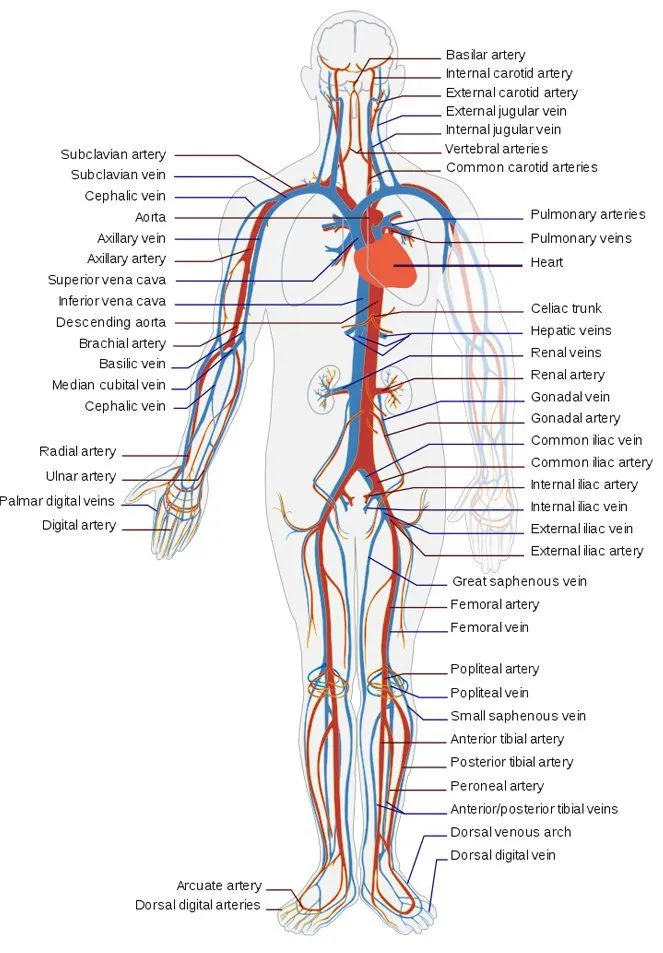
Blood is a fluid connective tissue that flows throughout our body. It is bright red in color. Although veins are often depicted as being blue in color, the blood flowing through them is still red in color. It carries out the exchange of gaseous products like oxygen, carbon dioxide, etc. Blood also transports various nutrients required by the various parts of the body and takes away the waste products that are generated. Apart from this, it also transports substances like antibodies, hormones, etc.
Heart
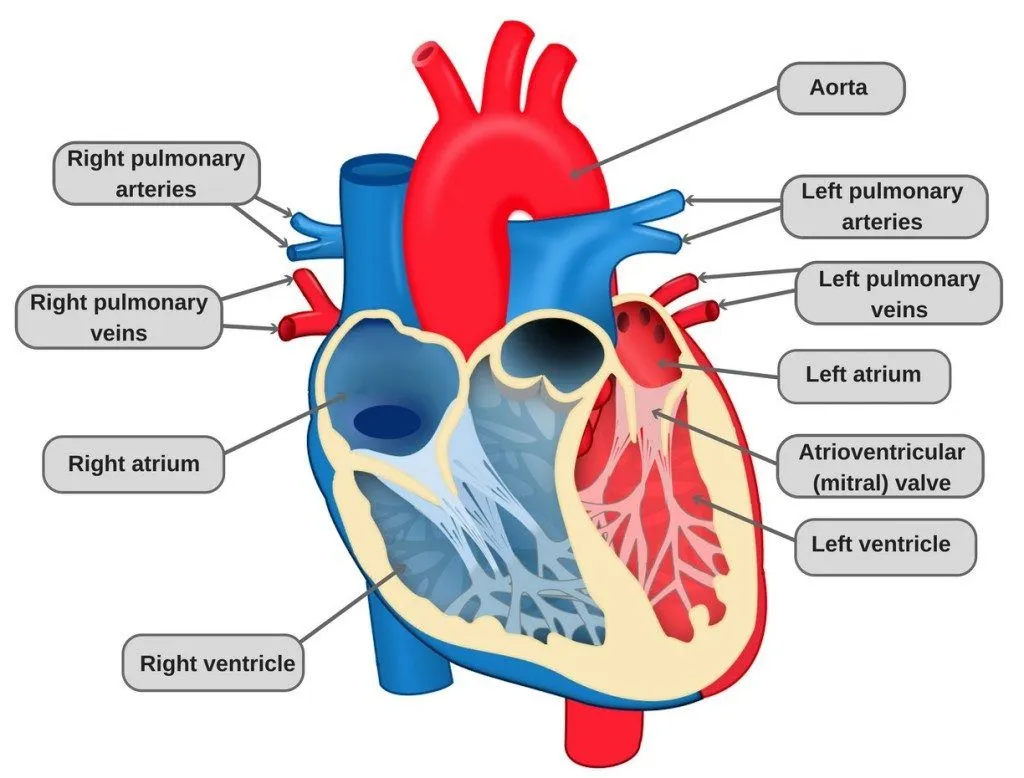
The human heart is a 4-chambered organ located in our chest. Although commonly perceived to be on the left side of the body, this is a misconception. It is roughly triangular and is located in the center of our chest, although it tapers to the left, giving only the illusion of its commonly believed location.
The 4-chambered design ensures maximum efficiency in the pumping and oxygenation of blood. The top 2 chambers are known as the auricles or atria, while the bottom chambers are called ventricles. Each auricle is separated from the corresponding ventricle by a valve. The 2 ventricles are separated by a muscular wall, known as the interventricular septum.
The right atrium receives the deoxygenated blood from the body. This is brought to it by the inferior and superior vena cava. The blood then flows down into the right ventricle. From here, it is sent to the lungs for oxygenation. This is done by the pulmonary artery – the only artery that carries deoxygenated blood. The blood, after oxygenation, is sent back to the left atrium via the four pulmonary veins, the only veins in the body that carry oxygenated blood. From here, it moves down into the left ventricle, which pumps it throughout the body via the aorta. At the opening of every blood vessel, there are valves that prevent the back flow, and therefore mixing of blood.
Double Circulation
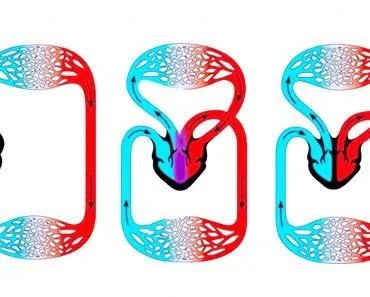
The mammalian heart is unique and efficient. It has a property called double circulation which reduces the load on the lungs, ensures adequate oxygenation and maintain pressure. The blood that comes from the body passes through the heart twice. It first enters the heart in the right auricle. From the right ventricle it is sent to the lungs for oxygenation. The lungs then send it back to the heart where it enters from the left auricle. Finally, it is pumped to the full body from the left ventricle. This is known as double circulation. If the blood followed a different route, the lungs would have to generate enough pressure to carry the blood against gravity to reach the extremities of our body. It would also risk damaging the lungs if the blood left the right ventricle itself under pressure.
Due to double circulation, the pressure of the blood is kept low as it exits the right ventricle to prevent tearing of the delicate tissue of the lungs. It also enables the left ventricle to generate enough pressure without having to worry about damaging the lungs.
While the heart accommodates the passage of huge amounts of blood every second, it cannot keep any of it for itself. There are blood vessels called the coronary artery and coronary vein that transport blood to and from the heart, ensuring that this key organ stays in top working condition!
What Are The Three Types Of Circulation?
Humans have what biologists call a closed, double circulatory system, and within it the blood follows three named routes. Knowing them turns the heart diagram from a tangle of tubes into a story.

Pulmonary circulation is the short loop between the heart and the lungs. The right ventricle pushes oxygen-poor blood to the lungs, where it drops off carbon dioxide and picks up oxygen, and the pulmonary veins return it to the left atrium. It runs at low pressure so the delicate lung tissue is not damaged.
Systemic circulation is the long loop that serves everything else. The left ventricle pumps oxygen-rich blood out through the aorta to the brain, organs, muscles and limbs, then the veins bring the now oxygen-poor blood back to the right atrium to start again. This is the higher-pressure side of the system, which is why blood pressure is measured in an artery of the arm.
Coronary circulation is the heart looking after itself. The two coronary arteries, the left main and the right coronary artery, branch off the aorta to feed the heart muscle, with the left side delivering most of the flow. Curiously, the heart muscle is squeezed so hard during each beat that it receives most of its own blood between beats, when it relaxes. Spent blood from the heart wall drains back into the right atrium through the coronary sinus.
How Does The Circulatory System Work With Other Body Systems?
The circulatory system never works alone. It is the body's delivery network, so it links up with almost every other system. Its closest partner is the respiratory system: the lungs load oxygen onto the blood and pull carbon dioxide off it, and the heart provides the pump that keeps that exchange flowing in both directions.
It teams up with the digestive system too. Nutrients absorbed through the wall of the gut are carried away in the blood and distributed to cells throughout the body. It partners with the urinary system, ferrying waste-laden blood to the kidneys, where it is filtered and the wastes leave as urine. It carries the chemical messengers of the endocrine system, so a hormone released in one place can act on a target far away. And it moves the white cells and antibodies of the immune system to wherever an infection breaks out. In short, the circulatory system is the shared highway that lets the body's organs act as one.
Why Are Veins Blue And Arteries Red In Diagrams?
Look at almost any circulatory system diagram, including the ones above, and the arteries are colored red while the veins are blue. It is a sensible convention, but it quietly misleads a lot of people, so it is worth spelling out.
The colors stand for what the blood is carrying, not its real shade. Red marks oxygen-rich blood, which mostly travels in the arteries, and blue marks oxygen-poor blood, which mostly travels in the veins. The two big exceptions are the pulmonary artery, which carries oxygen-poor blood, and the pulmonary veins, which carry oxygen-rich blood, so on a careful diagram those swap colors. The key point is that blood is never actually blue. As mentioned earlier, the blood in your veins is still red, just a darker, duller red because it is low on oxygen. Veins look bluish through the skin only because of the way light scatters in tissue before it reaches your eye, not because the blood inside them has changed color.
References (click to expand)
- Circulatory system.
- THE CIRCULATORY SYSTEM - www2.estrellamountain.edu
- How the Heart Works — NHLBI, NIH
- Circulatory system.
- Circulatory System. Cleveland Clinic.
- Physiology, Cardiovascular. StatPearls. NCBI Bookshelf.
- Physiology, Coronary Circulation. StatPearls. NCBI Bookshelf.
- Physiology, Pulmonary Circulatory System. StatPearls. NCBI Bookshelf.