The heart is a four-chambered muscle that pumps blood through the body. The right side of the heart receives deoxygenated blood from the body and pumps it to the lungs, where it is oxygenated. The left side of the heart then receives oxygenated blood from the lungs and pumps it out to the body. This four-chambered structure allows for an efficient system to oxygenate our blood, maintain adequate pressure, and prevent mixing of oxygenated and deoxygenated blood.
We humans have a tendency to take a lot of things for granted, but you probably already knew that. However, I’m going to point out another thing that we have seriously underestimated for a long time – the heart. For those who have knowledge about the structure of our heart, know that our heart is 4 chambered. It provides us with an efficient system to oxygenate our blood, maintain adequate pressure, and prevent mixing of oxygenated and deoxygenated blood.
Did you know that not all animals have this luxury? There are some who have only two or three chambered hearts. As expected, these decrease the efficiency of the whole system.
Two Chambered Heart
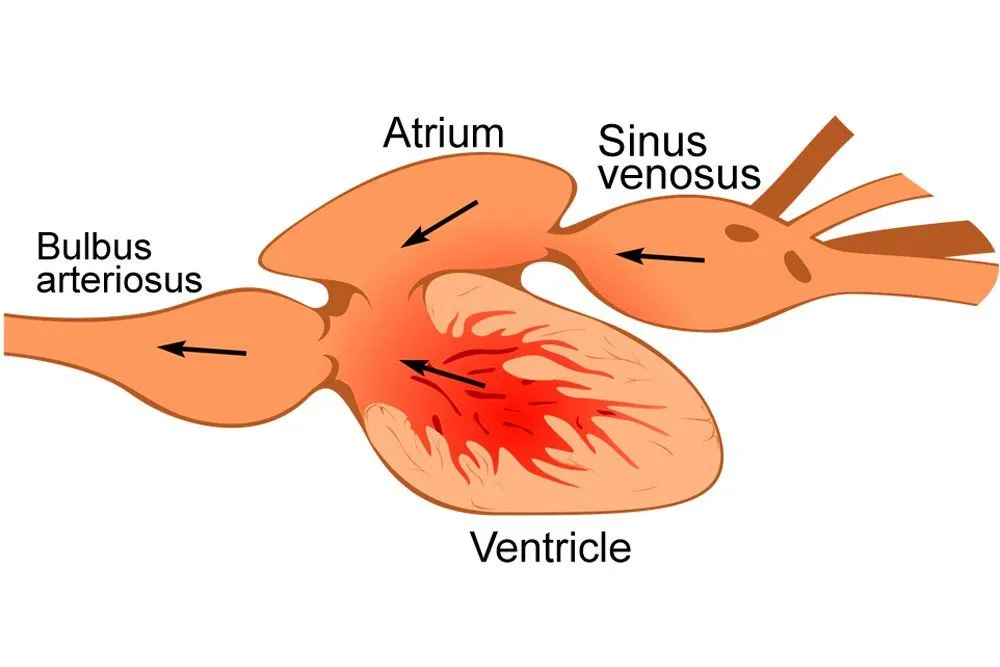
Some animals like fishes, have only a two chambered heart. Their heart consists of one auricle or atrium, and one ventricle. These are flanked by the sinus venosus (which leads to the atrium) and the bulbus arteriosus (which succeeds the ventricle).
The deoxygenated blood enters through the sinus venosus and into the atrium. From here it passes into the ventricle. When the ventricle pumps the blood out, the pressure is much higher than the gills, which is where the blood goes next. The gills are thin walled due to which there is the risk of them getting damaged under high pressure of blood. Therefore, the bulbus arteriosus adjusts the pressure of the blood exiting the ventricle.
While the reduced pressure prevents damage to the gills, the pressure must still be high enough afterwards to push blood through the rest of the body. Fish circulation therefore works on a careful balance between a pressure low enough to spare the gills but high enough to drive systemic flow. Unlike mammals and birds, fish have only single circulation: blood passes through the heart just once per loop around the body.
Three Chambered Heart
Amphibians (frogs, toads and salamanders) and most reptiles (every group except crocodilians) have a three-chambered heart: two atria and a single ventricle. This type is more advanced than that of fish, but not as advanced as the four-chambered hearts of mammals and birds. In reptiles, the ventricle has an incomplete muscular ridge that partially divides it into three sub-chambers, called cava: the cavum pulmonale on the right (which directs blood to the lungs), the cavum venosum in the middle (which collects blood from the right atrium and routes it onwards), and the cavum arteriosum on the left (which receives oxygenated blood returning from the lungs).
Deoxygenated blood enters the right atrium and moves into the right sub chamber of the ventricle. Due to incomplete separation though, it also leaks into and fills the left ventricle. The blood then moves up from the ventricle into the lungs for oxygenation. This comes back down and fills the third chamber – cavum arteriosum – temporarily shutting it off. The blood then moves into the left ventricle and from there the rest of the body.
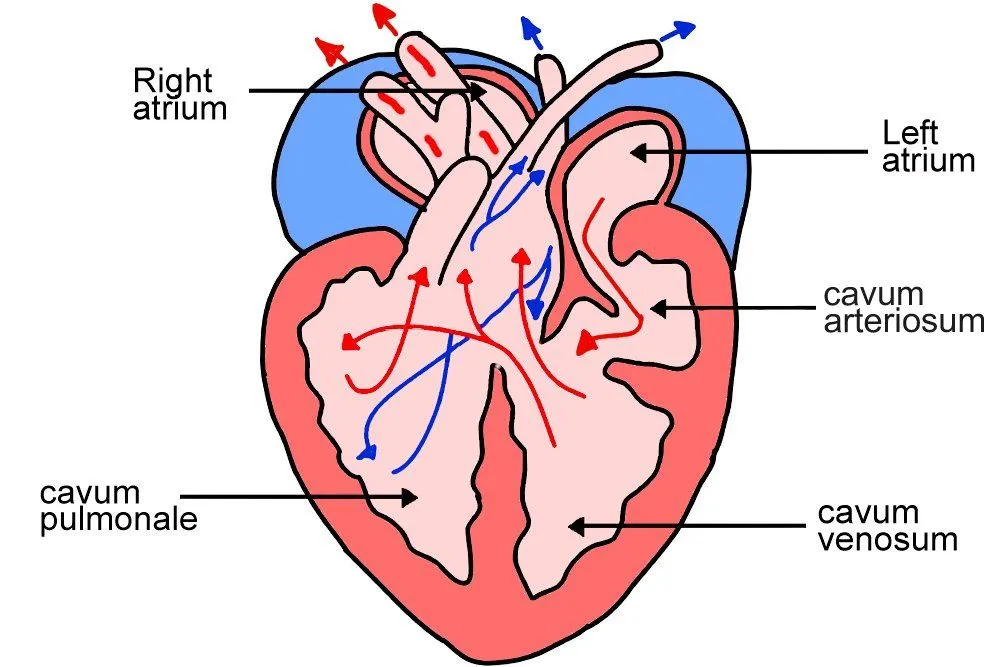
When all three ventricles are filled with blood, it is important to understand how the blood flows. As the ventricles contract, the blood from the right ventricle, followed by the left ventricle flow up into the lungs. While the left ventricle also has a blood vessel for carrying blood to the rest of the body, it doesn’t flow through there because of the resistance to blood flow. This resistance is higher than that in the blood vessel leading to the lungs. As the ventricles empty, it leads to the valve between the 2 ventricles being temporarily shut. As the ventricle continues contracting, the oxygenated blood from the third chamber now flows down into the left ventricle and then the rest of the body.
Reptiles have an incomplete double circulation. While there is some mixing of oxygenated and deoxygenated blood, the mixing is far less than physiologists once assumed: pressure differences and the muscular ridge in the ventricle keep most flows separate. Crocodilians take this even further: they have a fully four-chambered heart (with a small Foramen of Panizza linking the two outflow arteries), giving them the fully separated circulation usually associated with birds and mammals. The mammalian and avian heart is the most efficient design of all, allowing maximum oxygen delivery and stable systemic pressure.
Which Animals Have Two, Three, or Four Chambered Hearts?
If you have ever wondered exactly which animals fall into each group, here is the short version. The number of chambers tracks neatly with the major vertebrate classes, with one famous exception (the crocodiles).

- Two chambered hearts (one atrium, one ventricle) are found in fish: sharks, rays, tuna, salmon, goldfish and the rest of the bony and cartilaginous fishes. So yes, a fish heart has two chambers, not four, and that holds for the whole group.
- Three chambered hearts (two atria, one ventricle) are found in amphibians (frogs, toads, newts and salamanders) and in most reptiles (lizards, snakes, turtles and tortoises). The two atria keep the incoming blood streams separate, but the single shared ventricle is where some mixing happens.
- Four chambered hearts (two atria, two ventricles) are found in mammals (including us), birds, and, surprisingly, crocodilians (crocodiles, alligators, caimans and gharials). Crocodiles are the odd ones out among reptiles: their ventricle is fully divided, so they sit with the birds and mammals rather than with their fellow reptiles.
A handy way to remember it: heart complexity broadly increased over the course of vertebrate evolution, from the simple fish pump up to the fully partitioned heart of warm-blooded animals. Lungfish, air-breathing fish that sit near the base of the land-vertebrate lineage, even show the very start of this trend: their atrium is partly divided by a fold of tissue, hinting at the two-atria design that amphibians would later inherit.
Single vs. Double Circulation: Why the Chamber Count Matters
The reason chamber count matters comes down to how many times blood passes through the heart on each lap around the body. A two chambered fish heart drives single circulation: blood is pumped once, sent to the gills to pick up oxygen, and then carried straight on to the body before returning to the heart. The catch is that blood loses pressure as it squeezes through the fine gill capillaries, so it reaches the rest of the body moving relatively slowly.
Three and four chambered hearts run double circulation instead. Here the heart pumps blood twice per loop: once to the lungs (the pulmonary circuit) and once to the body (the systemic circuit), with a return trip to the heart in between. That second push restores pressure after the lungs, so oxygen-rich blood is delivered to the tissues quickly and at full force.
The trade-off in a three chambered heart is the shared ventricle, where oxygenated and deoxygenated blood can mix. In reptiles a muscular ridge and carefully timed pressure differences keep that mixing surprisingly low, but only the four chambered heart removes it entirely. Complete separation is what lets birds and mammals sustain the high, steady oxygen supply that an endothermic (warm-blooded) metabolism demands. It is no coincidence that the two groups with the most active, energy-hungry lifestyles are also the ones with the most thoroughly divided hearts.
References (click to expand)
- The fish heart - the pump - esi.stanford.edu
- Reptiles | Scholastic - www.scholastic.com
- Amphibians - Metabolic rate - Higher Biology Revision - BBC. BBC Online
- Overview of the Circulatory System. OpenStax Biology 2e (Lumen Learning).
- The vertebrate heart: an evolutionary perspective. Journal of Anatomy. PMC, NCBI.