Table of Contents (click to expand)
- A New Organ Found! What Is It?
- Where Is This Newly-found Organ Located?
- Interstitium Functions
- Why Was The Interstitium Discovered So Recently?
- An Even Newer Find: The Tubarial Salivary Glands (2020)
- The Latest Twist: A Fourth Brain Membrane (2023)
- And Before That: The Mesentery (2016)
- Why "Newest Organ" Is A Fuzzy Question
The newest candidate organ in the human body is the tubarial salivary glands, a pair of macroscopic salivary glands tucked deep in the nasopharynx (behind the nose), described in September 2020 by researchers at the Netherlands Cancer Institute. They were preceded by the interstitium, a body-wide network of fluid-filled spaces described in 2018, and the reclassified mesentery in 2016. None of these have been formally ratified as organs — there is no official body that does that — but each is a serious candidate. In 2023 scientists also proposed a fourth membrane wrapping the brain, the SLYM, though many anatomists dispute that it is a separate structure at all.
Looking at the incredible number of medical and technological feats humans have achieved up to this point, it feels a bit unbelievable if someone were to say, “Hey! Did you know that scientists found a new organ in the human body?”
Even so, this is precisely what has happened more than once in recent years — the interstitium was added to the list in 2018, and the tubarial salivary glands deep behind the nose were described in 2020. Believe me… I was shocked the first time I read it.

I couldn’t believe that we humans, who know so much about the world around us, the planet, the galaxy and beyond, didn’t know that we had missed an organ in our own body! How could we discover a new organ inside our body after all this time, having achieved so much in medical sciences and technology!
However, as my intense bout of excitement passed, I looked up this “new” organ, and this sudden “discovery” of a new organ started making more sense than it initially had.
So, let’s start with the “what” aspect of this whole thing.
A New Organ Found! What Is It?
The most-discussed candidate of the last decade is the interstitium, identified in human tissues by Petros Benias, Neil Theise and colleagues in Scientific Reports in March 2018. It is a contiguous fluid-filled space that exists between a structural barrier, such as the skin, and internal structures, like organs and muscles. Basically, it’s a network of microscopic, fluid-filled sacs threaded through almost every part of the body.
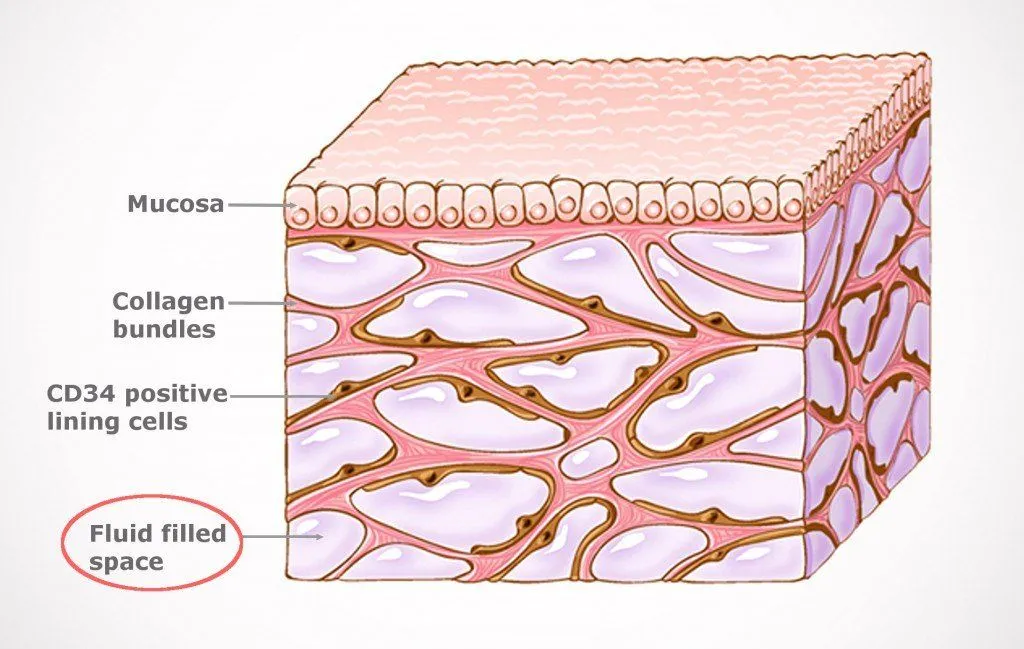
It’s interesting to note that the interstitium is not an “organ” per se, at least in the sense that our “regular” organs (e.g., heart, lungs, liver etc.) are. The interstitium is actually a vast structure present everywhere in our body, but it’s so extensive that it could be dubbed as an organ in its own right.
Where Is This Newly-found Organ Located?
As mentioned earlier, the interstitium is not a singular solid organ that could be held in your hand; rather it’s a network of very small, fluid-filled sacs.

You may already know that just beneath our skin is a layer of tissue. This layer also lines some vital organs, including the lungs, the urinary and digestive tracts, and a significant portion of the circulatory system. In the past, it was thought that this was nothing more than a dense layer of connective tissues, but recent findings published in a respected journal reveal that the tissue is actually a network of tiny interconnected compartments!
Interstitium Functions
Scientists are not entirely sure about the functions of the interstitium, but we do know that these sacs act as little shock absorbers for the body. In simple terms, these fluid-filled spaces prevent tissues from tearing when the organs they cover, such as the heart, muscles and blood vessels, pulse or dilate as part of their daily function.
Why Was The Interstitium Discovered So Recently?
Medical researchers published their findings regarding the interstitium in the journal Scientific Reports in March 2018. The question is – how could something so significant have gone unnoticed for all this time?

Until now, we could not identify the interstitium as a separate entity because of the means that we used to study the stuff beneath the skin. The traditional method involved examining fixed tissue on microscopic slides. Fixed tissue is prepared by scientists after treating it with chemicals, slicing it thinly and then draining away any remaining fluids. This caused the fluid-filled sacs to collapse, leaving only the supportive connective tissue visible.
Recently, thanks to the new technique of probe-based confocal laser endomicroscopy, which was performed by researchers at New York University, a different kind of microscopic image can be generated. While examining the bile duct of a cancer patient, researchers found this network of fluid-filled sacs.
This is how the interstitium was finally found and identified as a separate entity than connective tissues…. better late than never!
An Even Newer Find: The Tubarial Salivary Glands (2020)
Two years after the interstitium paper, a team at the Netherlands Cancer Institute led by Matthijs Valstar and Wouter Vogel ran into an unexpected anatomical surprise. They were scanning 100 prostate-cancer patients with a high-sensitivity PSMA PET/CT technique, looking for tumour spread, when their software lit up a pair of structures deep in the back of the nose, sitting over the torus tubarius (the ridge that marks the opening of the Eustachian tube). When they followed up with cadaver dissections, they confirmed that the lit-up area was a pair of macroscopic salivary glands of a kind that had not been described before. They published the finding in the journal Radiotherapy and Oncology in September 2020, calling them the tubarial salivary glands.
Why nobody had spotted them before is part anatomical (they sit in a region that is hard to see during a standard dissection) and part technical (you really need the modern molecular imaging used in cancer staging to make them pop out from the surrounding tissue). The discovery has practical consequences for cancer treatment: radiation aimed at nearby tumours that accidentally damages these glands appears to be linked to chronic dry mouth and swallowing problems in head-and-neck cancer patients.
It is worth flagging that not every anatomist agrees these qualify as a brand new "organ." Several letters to Radiotherapy and Oncology argued that the structure is really an extension of already-known diffuse nasopharyngeal seromucous glandular tissue. They are best described as a potential new organ, with the consensus still settling.
The Latest Twist: A Fourth Brain Membrane (2023)
Just when you think the list is settled, along comes another candidate. In January 2023, a team led by Kjeld Møllgård and Maiken Nedergaard reported, in the journal Science, a thin membrane wrapping the brain that nobody had catalogued before. They named it the subarachnoid lymphatic-like membrane, mercifully shortened to SLYM.

Your brain is cushioned by the meninges, the three protective layers long taught as the dura mater, the arachnoid mater and the pia mater. The researchers described SLYM as a fourth layer, a delicate sheet only a few cells thick, sitting in the space just beneath the arachnoid. In both mouse and human tissue they found that it splits the fluid-filled subarachnoid space into two separate compartments and acts as a tight barrier, blocking anything larger than about 3 kilodaltons from crossing. They also spotted immune cells stationed on its surface, hinting at a role in the brain’s defenses.
Is it an organ? That is a stretch, and even calling it a fourth membrane is contested. Several groups have argued that SLYM is not a distinct structure at all, and that the apparent extra compartment is an artifact created when tissue is chemically fixed and decalcified for imaging. Møllgård, Nedergaard and their colleagues have since published follow-up work defending the finding. For now the SLYM sits exactly where the interstitium and the tubarial glands sit: a genuinely new piece of human anatomy that experts are still arguing over.
And Before That: The Mesentery (2016)
The trio of recent "new organ" stories actually starts a little earlier. In 2016, J. Calvin Coffey at the University of Limerick published a paper in The Lancet Gastroenterology & Hepatology arguing that the mesentery — a continuous double fold of peritoneum that anchors the intestines to the back wall of the abdomen — should be re-classified as a single distinct organ rather than the fragmented set of bits and pieces it had been taught as for centuries. Gray’s Anatomy, the classic medical reference, updated its description to follow in 2017.
Why "Newest Organ" Is A Fuzzy Question
You might be wondering why this keeps happening. The honest answer is that there is no central authority — no FDA, no global anatomy committee — that formally ratifies "this is now an organ." Terminologia Anatomica, maintained by FIPAT, standardizes the names of body structures but doesn’t adjudicate whether a given structure deserves the label "organ." Some scientists demand a single discrete structure with a unified function (heart, kidney, liver). Others happily accept a body-wide network like the interstitium. Acceptance happens informally: a structure earns "organ" status by being included in Gray’s Anatomy, picked up by medical-school curricula, and accumulating peer consensus over the years. That is why headlines tend to soften the new entrants into "potential" or "proposed" organs rather than confirmed ones.
References (click to expand)
- Benias PC, Wells RG, Sackey-Aboagye B, et al. Structure and Distribution of an Unrecognized Interstitium in Human Tissues. Scientific Reports, 27 March 2018.
- Valstar MH, de Bakker BS, Steenbakkers RJHM, et al. The tubarial salivary glands: A potential new organ at risk for radiotherapy. Radiotherapy and Oncology, September 2020.
- Coffey JC, O’Leary DP. The mesentery: structure, function, and role in disease. The Lancet Gastroenterology & Hepatology, November 2016.
- Feinstein Institute researcher defines a part of the body as an organ. The Feinstein Institutes for Medical Research.
- Møllgård K, et al. A mesothelium divides the subarachnoid space into functional compartments. Science, 6 January 2023.
- An “outer subarachnoid space”: fact or artifact? A commentary on the SLYM 4th meningeal membrane. Fluids and Barriers of the CNS, 2024.