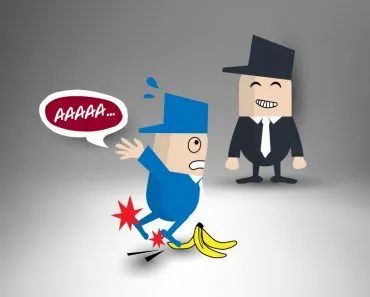
Making someone laugh is hard because humor is deeply personal: scientists have several competing theories (incongruity, superiority, relief) but still no consensus on what the brain registers as ‘funny.’ A joke also has to clear each person’s unique mix of mood, culture and past experience, and most laughter is actually social bonding, not a reaction to jokes at all.
“Knock, knock!
Who’s there?
Rufus.
Rufus who?
Rufus the most important part of your house.”
Chances are, you didn’t laugh.
Even so, knock-knock jokes have made people laugh since the 1930s. The one above appeared in a 1936 issue of an Iowa newspaper, The Rolfe Arrow, during the year the format went viral across the US and UK. The wordplay itself can be traced back to the drunken Porter scene in William Shakespeare’s Macbeth. Despite that, it probably wasn’t funny enough to crack you up.
If laughter is so common an experience, then why does it seem so difficult to make someone laugh? To get to the heart of this, we have to find out what makes us laugh in the first place.
Laughter Is A Natural Behavior

Laughter isn’t always followed by jokes. Babies as young as two months old begin to cackle, giggle and laugh before they learn to speak. It isn’t something they learn while growing up, nor is it something they deliberately do. Even children who are born deaf and blind can laugh.
According to laughter expert Robert Provine, a professor of psychology and neuroscience at the University of Maryland, Baltimore County, “Laughter is primitive, an unconscious vocalization.” That means that you don’t decide what to find hilarious. Certain things just get you laughing. The ability to laugh is hardwired into our brains.
Thus, when someone is not actually amused, but still tries to ‘fake laugh’ at a joke, it may not work. Research shows that people can tell the difference between real laughs and fake ones.

What Makes Something Funny?
Scientists and philosophers have been grappling with this question for centuries.

What do Homer Simpson and Phil Dunphy of Modern Family have in common? They are the typical dads of modern sitcoms: cute, well-meaning but incompetent, clueless, and at times, the epitome of buffoonery. According to the superiority theory of humor, this is what makes them funny.
Thinkers of the past, such as Plato, Aristotle, Hobbes and Descartes, shared the view that people are amused when they get to feel superior to others. This explains why oddballs, misfits, dimwits, goofy and deranged characters (how can we forget Mr. Bean?) make us laugh.
Freud, the father of modern psychology, suggested that people find forbidden things amusing. He saw laughter as a valve to release built-up tension (e.g., repressed impulses of violence in your mind). Think about physical comedy like Jackie Chan’s action-packed slapstick movie scenes, where people strike each other and fight to generate laughs!
This doesn’t explain certain forms of humor, such as knock-knock jokes, where the joke-teller introduces incongruity (i.e., a mismatch) in the reader’s mind by using words with the same sound, but different meanings (Roofus, roof is) in the punchline. This aligns with the incongruity theory of humor, which was set forth by two major philosophers, Immanuel Kant and Arthur Schopenhauer.

The incongruity theory of humor points out that when two incompatible things or ironic concepts (i.e., absurd, out of the ordinary, what is expected to happen vs. what we actually see happening) are placed together, it becomes really funny. In Charlie Chaplin movies, we find some nice examples of incongruity, i.e., when he uses the tablecloth as a handkerchief or a person as an armrest. The scenes violate our expectations somehow, arousing laughter. Have you seen the Austin Powers movies? By violating the prevailing norms of the espionage genre, the movies become flat-out hilarious.
A piece of media can involve more than one type of humor. The movie Dumb and Dumber can be explained using a combination of theories, such as relief, superiority and incongruity.
Basically, there are plenty of theories on humor, but is there a guaranteed, fool-proof way to make someone laugh? You’ll be lucky if you find one, because all people are different.
People Perceive Things Differently
Laughing is universal, but not what ‘triggers’ that laughter. Our reaction to humor can be affected by a number of variables, including the context of the information, our culture, religion, attitudes, quirks, idiosyncrasies and past experiences.

Laughter isn’t a learned behavior; how you pay attention to and process a joke or a funny situation is primarily the result of your learning. We try to control our ‘urge’ to laugh (like other instinctive behaviors) in a situation or occasion that we might consider inappropriate.
At the 94th Academy Awards, actor Will Smith slapped comedian Chris Rock, who had just made a joke about his wife. Bizarre game shows may be hilarious to Japanese audiences, but few Americans find them equally funny. Similarly, racist jokes may draw laughter from a few, but would be scorned by many. Thus, it goes without saying that funniness can be subjective. We can clearly see this with the ongoing debate that audiences today are easily offended and often too sensitive to appreciate humor.

Most Laughs Aren’t About Jokes
Now here comes the fun part.
Maybe your joke is really witty and adheres to the most prominent theories of humor, but it still doesn’t mean someone will laugh.
We may tend to think of humor and jokes as the only reason for laughter, but a survey by Provine reveals that only 10%-20% of the laughs we have are induced by joke-like remarks.
We laugh mostly to build relationships and to bond with people around us. Like small talk, laughter has a key social function. Laughter releases neurochemicals that create a sense of connection and belonging, coupled with the warm fuzzy feelings of happiness, mirth, and joy. Perhaps that’s why Mindy Kaling says, “The best kind of laughter is laughter born of a shared memory.”
Hence, with a growing rise in relationship problems and a general lack of emotional intimacy in modern life, making someone laugh seems to be quite a challenge, but when you do get a chuckle out of someone, it feels good!
Why Do Some People Rarely Laugh?
Sometimes the joke lands, the timing is perfect, everyone else is in stitches, and one person just… isn’t. If that person is you, or the someone you are trying to charm, it helps to know that laughter is a social signal, not a direct readout of how funny you found something. You can be genuinely amused on the inside and still not make a sound. Researchers who study laughter treat a person’s private sense of ‘how funny’ something is as separate from the outward laugh, and the two often come apart.
Personality plays a big part. More extraverted people tend to smile and laugh more quickly, more often and more intensely, while quieter, more introverted people may register the same joke with a small internal glow rather than a belly laugh. Their sense of humor is no less real; it is simply expressed at a lower volume.
There is also a genuine trait called gelotophobia, the fear of being laughed at, first described by German psychotherapist Michael Titze in 1996 and later studied in more than 70 countries by psychologist Willibald Ruch and his colleagues. People high in gelotophobia find it hard to tell friendly laughter apart from mockery, so laughter does not lift their mood the way it lifts most people’s, even though they come up with jokes at a perfectly normal rate. The trait is closely tied to introversion and shyness. So when someone ‘isn’t laughing’, it often says more about their wiring and how safe they feel than about your material.
So How Do You Actually Make Someone Laugh?

If there is no fool-proof joke, what can you actually do? The science points less towards better punchlines and more towards better rapport. Laughter is famously contagious, but it spreads best between people who already like and trust each other; we catch a laugh far more readily from a friend than from a stranger. That is why comedians warm up a crowd first, and why the same quip that dies in a tense meeting kills at a relaxed dinner. Building a little comfort does more work than any single line.
A few things reliably help. Laugh genuinely yourself, because your own laugh invites theirs. Lean on shared context: Robert Provine’s research found that most everyday laughter follows ordinary conversation rather than jokes, so an inside reference or a callback to a shared memory tends to land better than a polished gag. And play with surprise by gently violating what the other person expects, the same incongruity we met earlier.
Then there is the one near-universal trigger: tickling, which draws laughter not only from human babies but from chimpanzees, gorillas, orangutans and even rats. It only works, of course, with people who feel safe and comfortable with you. One caution runs through all of this: trying too hard tends to backfire. Laughter is play, so the more relaxed and low-stakes you keep things, the more likely it is to bubble up on its own.
A Final Word
Whether you find something funny or not, remember that laughter comes with an array of physical and psychological benefits. Good laughs can keep your heart healthy and make your immune system stronger, which is certainly no laughing matter.
So, next time you get the chance to have a laugh (whether it’s a snicker, giggle, chortle or helpless belly laugh) with your loved ones, just let loose and do it!
References (click to expand)
- Provine R. R. (2001). Laughter: A Scientific Investigation. Penguin
- Humor, Laughter, and Those Aha Moments. Harvard Medical School
- Jiang, T., Li, H., & Hou, Y. (2019, January 29). Cultural Differences in Humor Perception, Usage, and Implications. Frontiers in Psychology. Frontiers Media SA.
- Riem, M. M. E., van IJzendoorn, M. H., Tops, M., Boksem, M. A. S., Rombouts, S. A. R. B., & Bakermans-Kranenburg, M. J. (2011, December 21). No Laughing Matter: Intranasal Oxytocin Administration Changes Functional Brain Connectivity during Exposure to Infant Laughter. Neuropsychopharmacology. Springer Science and Business Media LLC.
- Bryant, G. A., & Aktipis, C. A. (2014, July). The animal nature of spontaneous human laughter. Evolution and Human Behavior. Elsevier BV.
- When You Bust Out Laughing | Psychology Today. Psychology Today
- Mitchell, A. G. (2009, August 24). Greek Vase-Painting and the Origins of Visual Humour. []. Cambridge University Press.
- (2014) Incongruity Theory and the Explanatory Limits of Reason. The University of Vermont
- Robert Provine: the critical human importance of laughter, connections and contagion. Philosophical Transactions of the Royal Society B.
- Ruch, W., & Proyer, R. T. (2009). Who fears being laughed at? The location of gelotophobia in the Eysenckian PEN-model of personality. Personality and Individual Differences.
- Gelotophobia. Wikipedia.