The most ticklish parts of the body (the soles of the feet, armpits, ribs, and neck) are packed with sensitive nerve endings and are also the most vulnerable, least protected spots. When they are touched, the brain treats it as a possible threat: the hypothalamus triggers a fight-or-flight response, while the laughter and squirming act as an instinctive defense that shields the exposed area.
Of all the mysterious behaviors of the human body, few things are as strange and hotly debated as our response to being tickled. While that may sound strange, the uncontrollable laughter, spasms, and panicked squirming when certain parts of our body are gently touched or tickled is very weird.
The thing is, the bottom of your foot may send you into a cackling fit, but the same pressure on your forearm probably won’t elicit anything close to the same reaction. Why is there such a dramatic difference, and what makes certain places on our body so much more vulnerable to being tickled?
The Science Of Tickling: Not All Fun And Games
Some of the greatest scientific minds of past generations have taken a stab at explaining human reactions to being tickled, and despite the laughter that inevitably accompanies being tickled, experts have determined that being tickled is not related to humor. There are a number of connections between laughter and being tickled, most of which relate directly to nerve stimulation and brain activity, not some great anatomical joke.
When the nerve endings in your skin are stimulated, they engage two different parts of the brain: the somatosensory cortex, which analyzes touch, and the anterior cingulate cortex, which processes pleasurable (and unpleasant) feelings. Furthermore, when we laugh as a result of our tickle reflex, the hypothalamus kicks into action and launches the fight-or-flight response. The sensitive areas of our body that are commonly ticklish are also the most vulnerable to attack and the least protected (e.g., bottom of the feet, armpits, rib cage). Therefore, when they are stimulated, the instinctive laughter may act as a natural sign of submission to one’s attacker, which may cause the unpleasant stimulation to cease. The squirming that often accompanies a tickle attack may also be an instinctive defense mechanism to compress that part of the body and make it less open to attack.
The areas that are “ticklish” are also the site of high nerve concentrations, such as the bottom of the feet, which are packed with Meissner’s corpuscles, which are highly sensitive nerve receptors linked to the somatosensory cortex. This increased sensitivity, as mentioned in the paragraph above, may help us react faster when a threat is detected (or felt) at those points on the body. Tickling an animal teaches the body to react quickly when a threat approaches a sensitive area, and also provides negative reinforcement if a person fails to react (being tickled mercilessly until you cry, for example…)
Where Are The Most Ticklish Spots On The Body?
Ask people to point to their most ticklish spot and you tend to get the same answers, no matter the era. When psychologists G. Stanley Hall and Arthur Allin canvassed people all the way back in 1896, the soles of the feet and the armpits topped the list, and modern surveys of adults land in exactly the same place. Just behind those two come the ribs and sides, the neck, the stomach, and the groin. In other words, the body's "tickle map" has barely shifted in more than a century.

It also depends on which kind of tickle you mean. The helpless, laugh-out-loud sort of tickling (gargalesis) clusters tightly on a handful of spots like the feet, armpits, and torso, while the milder, itch-like knismesis can be felt much more broadly across the skin. And reassuringly for the curious, the most ticklish zones come out roughly the same whether you are looking at men or women.
So why these particular patches of skin? You would think the answer is obvious (lots of nerves, thin or exposed skin), but every neat theory springs a leak. Raw nerve density does not single out the soles and armpits as the body's finest touch detectors; your fingertips are far more sensitive to a gentle touch, yet they barely tickle. The "vulnerable in a fight" idea trips over the hands, which are exposed in any scuffle but not remotely ticklish. Even "thin skin" fails, because the eyelids are among the thinnest skin you have and almost nobody is ticklish there. A recent review of the science put it bluntly: despite all those consistent surveys, there is still no theory that satisfactorily explains why these specific spots are the ticklish ones. Ticklishness sits alongside oddities like goosebumps as a built-in quirk of the body we can describe in detail but still cannot fully explain.
The Social Side Of Tickling
While that may explain the physical reaction that we have to tickling, the bizarre blend of pleasure and pain is still a bit of a mystery. Scientists have been fascinated by the social aspects of tickling for many years, primarily because tickling is one of the first physical interactions that mothers have with their children. Tickling a baby is a primal interaction within humans, as well as other primates and mammals, and helps to develop social, cognitive, and emotional bonds.

This early method of communication carries over into childhood social interactions as well, and tickle fights are common between children, again helping to establish social interactivity and commonality. Furthermore, a relatively safe activity like a tickle battle helps children learn about sensitive, vulnerable parts of their body, imprinting an unconscious response to those areas, which may explain why we laugh or flex our muscles even when we are simply threatened with tickling, before any physical contact is made.
Of course, not everyone reacts the same way, and some people barely seem ticklish at all. A lot of that comes down to your mood in the moment: when you feel calm and safe, a tickle can register as playful, but if you are tense, annoyed, or on guard, the same touch may not land the same way. Individual skin sensitivity and nerve function play a role too, and people with reduced sensation may feel little or nothing. Despite the common assumption, ticklishness barely runs in families. A twin study found that genetics accounts for only a small fraction of how ticklish a person is, with environment and state of mind doing most of the work.
But Why Can’t I Tickle Myself?
A great deal of the tickle reflex is based on surprise and a foreign object or person coming in contact with those sensitive areas. When you try to tickle yourself, your cerebellum (the part of the brain that coordinates movement) predicts exactly how hard, where, and how fast your own fingers will press, and it uses that prediction to dampen the sensation before it ever reaches the somatosensory cortex. With no surprise and no perceived threat, the fight-or-flight response isn’t engaged. Essentially, you can’t startle yourself, so tickling yourself becomes nearly impossible. Researchers have even confirmed this with a tickling robot: when they added a delay of just 200 milliseconds between a person’s hand movement and the resulting touch, the prediction broke down and the self-tickle suddenly started to work.
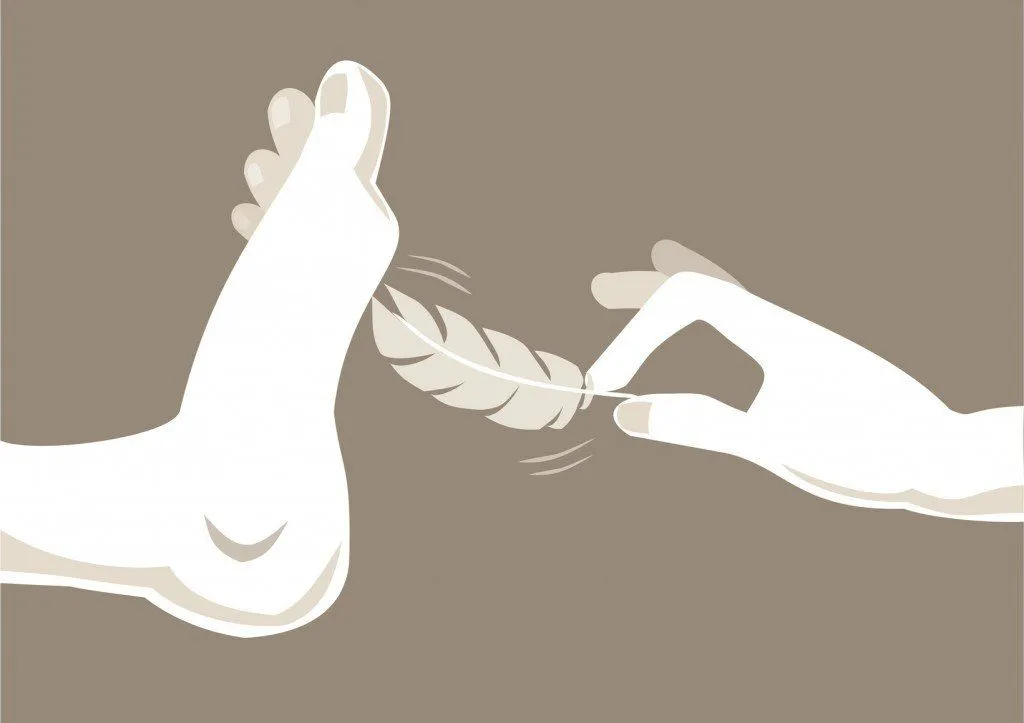
That being said, there are two different types of tickling reflex, terms coined back in 1897 by psychologists G. Stanley Hall and Arthur Allin: gargalesis and knismesis. The former is the more intense tickling done by other people, concentrated on the ribs, armpits, and toes, and it is the kind that produces helpless laughter. Knismesis describes the reaction we have to light stimulation on the skin, which often generates an “itch” rather than a tickle. It can be hard for us to generate the laugh-inducing gargalesis on ourselves (with the occasional exception, like on the roof of our mouth), but knismesis can be artificially generated. Lightly brushing a feather or another object on a ticklish area of the body can generate that familiar “itch”, but will rarely have us rolling on the floor, convulsing uncontrollably, as we might do during a full-on tickle assault.
Now you know… next time someone comes into your personal space to tickle you, perhaps they are just trying to socially bond with you, or reminding you to do a better job of protecting your vulnerable areas!
References (click to expand)
- Why are people ticklish? | SiOWfa15: Science in Our World. The Pennsylvania State University
- Why can not you tickle yourself? - UCSB Science Line. The University of California, Santa Barbara
- The mystery of ticklish laughter. - Christine Harris. The University of California, San Diego
- The extraordinary enigma of ordinary tickle behavior: Why gargalesis still puzzles neuroscience. Science Advances (PMC, NIH).
- The importance of skin area and gender in ticklishness. Svebak, 2021. Scandinavian Journal of Psychology.