Table of Contents (click to expand)
Chroma key (color keying) makes one color in the footage transparent so a different background can be dropped in behind the subject. Green and blue are used because they are farthest from human skin tone. Green is now preferred: digital camera sensors capture twice as much green detail, and green needs less light and keys cleaner. Blue came first, on film.
If you’ve ever loved an action/sci-fi movie so much that you couldn’t stop yourself from checking out its ‘behind-the-scenes’ videos, then you have probably noticed a rather unusual thing about the movie sets: a lot of green! With the exception of the actors and a few props scattered around them, the entire background seems to be draped in sheets of green (or blue).
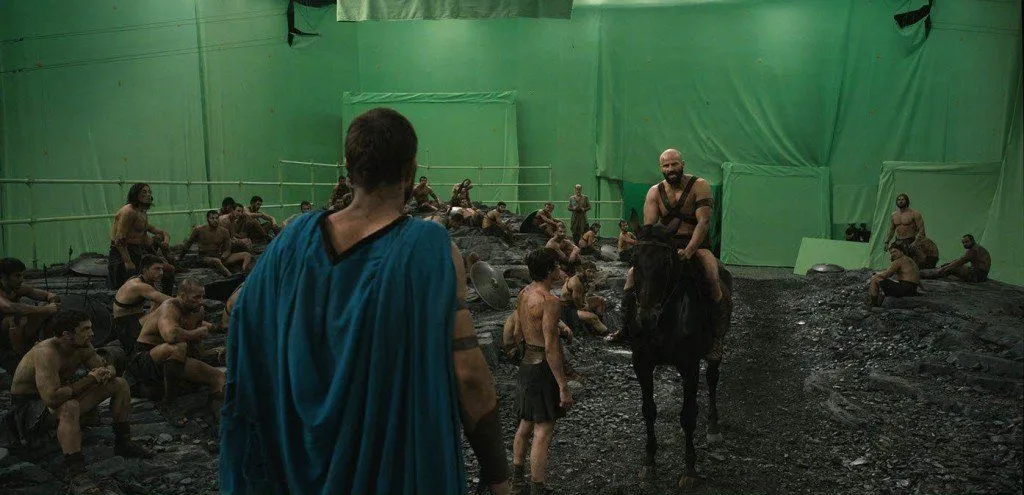
Do you know the reason why movie makers insist on covering their sets with this highly unusual hue of green while shooting a film?
Visual Effects And Animation

Since you’re most likely to see the use of green or blue screens in action, fantasy or sci-fi movies – or during weather forecast reports – it doesn’t take a rocket scientist to figure out that the green screen must have something to do with the one element that is common in all of these different media – visual effects and animation.
While shooting videos that involve a lot of visual editing, you need to consider a few things, namely things that will facilitate editing in the later stages of post production – during the shooting itself. For instance, let’s assume that you want to shoot an action scene from a superhero movie. More specifically, you want to show the actors running through ruins and constantly evading aerial attacks. You can’t actually recreate the scene in the real world, since you can’t make actors dart through actual bomb strikes (unless you want to spend millions of dollars on every take and likely end up in prison), but at the same time, you want to make the scene look as authentic as possible.
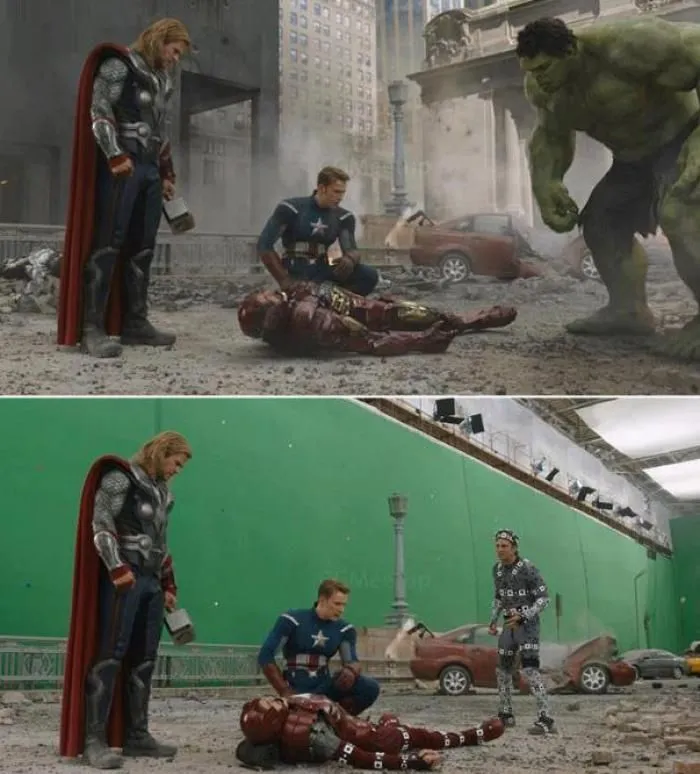
So, what you need to do is strategically place a few broken objects (e.g., damaged automobiles, rocks etc.) around the actors and install a big green screen behind them, in place of all the elements that you want to capture in the video (including the actors and props). After you’ve shot the video in this manner, the green in the background can then be replaced by any image or video during post-production to simulate a ruinous environment or aerial explosions using a technique called Chroma Key.
Chroma Key
Chroma Key is a visual effects technique widely used during post-production to superimpose images and videos on top of an image/video stream based on color hues. Also known as color keying, it makes a selected color range in the foreground ‘transparent’, which subsequently allows for the insertion of a separately filmed piece of footage or image in the selected area.
Since the rise of popularity of animation in movies and TV, this technique has become a goldmine for digital graphic experts and designers in the motion picture, newscasting and video game industries. Although it can be used in a number of ways depending on the graphical requirements, it’s primarily used for editing out (removing) the real background and replacing it with another image/footage (typically a digitally-enhanced one).

For example, during a weather report telecast, the host stands in the foreground with an almost featureless background and a big green screen at the back while filming the report. However, during post-production, the green background is edited out to include maps, shapes and various animations.
Why Do They Specifically Use Green?
There’s no hard and fast rule, either technologically or ethically, about using a particularly colored screen when you want to apply Chroma Key. You can use any color, such as yellow, purple, red, or pink, to use this feature. There’s no obligation to use the color green.
That being said, why is green the most commonly used color in videos and movies involving a lot of visual effects?
There are a few reasons behind this. The most basic one is the fact that green ‘stands out’ reasonably well while filming any footage. Consider this: if anything in the foreground has the same hue as the color you want to key out (in this case, green), then it will be keyed out too. For example, if the subject is wearing a green badge on his body, then that portion would be keyed out while editing, making it look like as if there’s a hole in his body. This is why you want to choose a screen with a color that has very little chance of matching anything in the foreground.

Since there’s no green in a human’s skin tone or clothing, it offers a better contrast between the subject and the background and can therefore be keyed out easily, without affecting the other elements of the picture.
Another reason green is used is that it carries the highest luminance of the three color channels (RGB). The human eye is most sensitive to green, so it contributes the largest share of perceived brightness, which makes a green screen easy to light up evenly and brightly while needing less light than a blue one. The flip side is ‘green spill’: that same bright green bounces off the screen and tints the edges of your subject (look closely and you’ll often see a green halo around hair). Spill is the reason crews fuss over lighting and over keeping actors well away from the screen, because if the lighting and the subject’s distance from the screen aren’t optimized before shooting, the spill becomes a headache to clean up in post.

Most digital cameras today are built around CMOS image sensors, which sit beneath a Bayer filter (a mosaic of tiny color filters) to capture color. That mosaic is laid out in a repeating block of two green filters for every one red and one blue, so half of all the photosites on the chip record green, while red and blue each get a quarter. Bryce Bayer designed it that way on purpose: our eyes resolve detail and brightness through green far more than through red or blue. The upshot is that a green screen lands on the channel the camera samples most densely, so editors have roughly twice as much green information to work with during post-production, which produces a cleaner key and finer pictures.
Why Was Blue Used First?
If green is so convenient, why do older films lean on blue? Because for decades, the technology hadn’t caught up to green yet. The first proper chroma key process was actually a blue screen, developed by Larry Butler for the 1940 fantasy The Thief of Bagdad, which won the Academy Award for Best Special Effects. Blue was the natural pick on photochemical film: it is just as far from skin tone as green, and the blue-sensitive layer of the color film stock of the day held the finest grain, giving the cleanest matte. Blue screens carried Hollywood through classics like Star Wars and Superman.
The switch to green came with the rise of electronic video and, later, digital cameras. Television studios started favoring green backdrops as early as the 1970s (partly because newsreaders kept turning up in blue suits), and as digital sensors with their green-heavy Bayer filters took over from film, green simply gave editors a stronger, brighter, lower-noise signal to key from. Blue still gets used today (for instance, for night scenes, or when an actor has to wear green), but green has become the default backdrop for modern visual effects.
The use and popularity of green screens touches almost every domain related to virtual media, ranging from educational fields to anything that requires a more immersive and captivating form of information broadcasting. It goes without saying that if it weren’t for those giant green screens, heroes like Iron Man and Spiderman wouldn’t have looked nearly as cool!