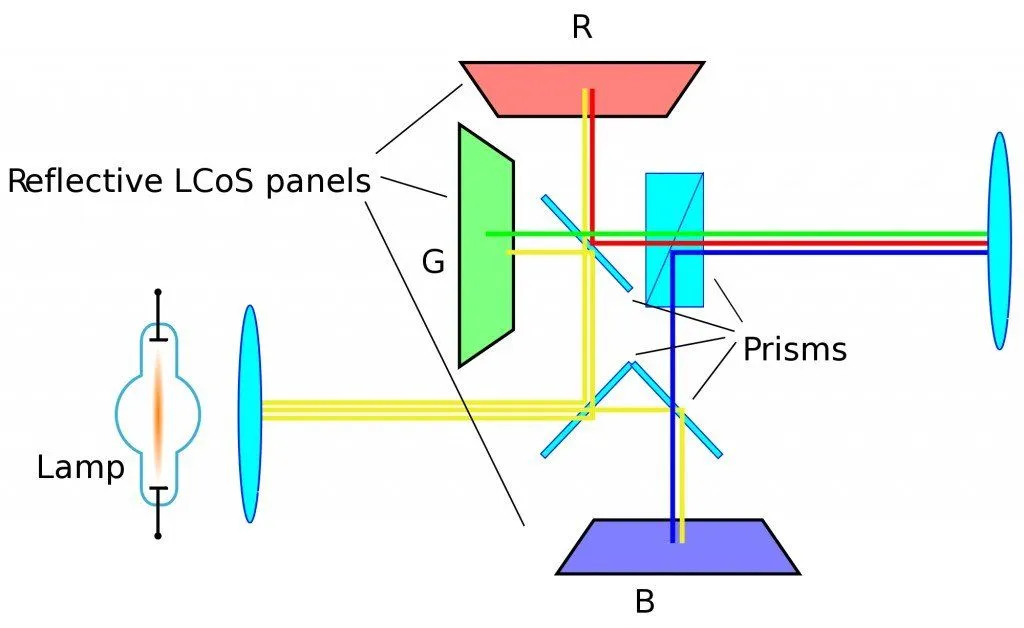
A projector enlarges a small image and throws it onto a screen. A bright lamp, LED, or laser shines through a tiny image-forming device (an LCD panel, a DLP chip covered in roughly two million microscopic mirrors, or a reflective LCoS panel), and the resulting picture is sent through a projection lens. The image-forming device controls which pixels are bright and which are dark, and colour is built up either by splitting the light into red, green and blue beams or by spinning a colour wheel.
When you go to the movies and experience the big screen and its larger-than-life characters, have you ever wondered how the images are produced on the screen? Well, as you may know, the answer to that is projectors. Projectors help to improve the viewing experience of movies, but their utility doesn’t stop at movie theatre. Projectors are also used in board rooms, conferences, classrooms, and many other places to improve the overall user experience. So, how does such a versatile piece of technology work?
The Physics: How A Projector Blows Up The Image
Whether the picture starts life on an LCD panel, a DLP chip, an LCoS panel, or (in older machines) a film frame, that image-forming surface is tiny. Turning it into a wall-sized picture is a job for the projection lens, and it comes down to some neat optics. A projector lens is a converging (convex) lens, and the whole trick lies in where you place the object relative to the lens's focal point.
When an object sits farther from a converging lens than one focal length, the rays passing through it bend inward and actually cross on the far side, forming a real image that can be caught on a surface. That is exactly what a screen is for: a refraction-based real image can be projected, whereas the upright, enlarged image you peer at through a magnifying glass is a virtual one that cannot be thrown anywhere. Place the object between one and two focal lengths from the lens and the real image emerges inverted and magnified, landing beyond twice the focal length. The nearer the panel creeps toward the focal point, the larger and more distant the projected image grows.
Two everyday quirks fall straight out of this. Because the lens flips a real image top to bottom, a slide or film frame is loaded upside down so the picture lands the right way up. And the reason sliding the projector backwards makes the image swell is captured by the throw ratio, defined as the throw distance divided by the width of the projected image. A typical living-room projector has a throw ratio of about 2, a short-throw model sits at 0.4 or less, and an ultra-short-throw “laser TV” hugs the wall with a ratio well below that. Focusing is simply nudging the lens a hair closer to or farther from the panel until the sharp real image falls exactly on the screen. In that sense a projector is really just a controlled, powered-up version of the old camera obscura: a lens throwing a real image.
LCD Projectors
There are several types of projectors on the market today; the most common are LCD, DLP, and LCoS, and they are increasingly paired with LED or laser light sources instead of the older mercury-vapour (UHP) lamps. We will start with LCD projectors, because they were the model that set the stage for projectors as a large-scale commodity, and the principle is the easiest to picture.
To understand an LCD projector, let’s start from the point where the light beam itself begins. The first thing that happens is the production of an intense beam of white light. The beam of light is then reflected off a group of mirrors, which includes two dichroic mirrors. The dichroic mirrors have a special coating on them that only reflects light of one type of wavelength. The white light hits the mirrors and each one reflects a beam of either red, blue or green light.
The beams of red, blue and green pass through an LCD, which is composed of thousands of tiny pixels. An exciting contradiction arises here… how can a crystal be liquid? An LCD is a substance that exhibits some properties of a solid and some properties of a liquid. Tending more towards the side of a liquid, the LCD has a unique feature where it can either block light or allow light to pass through when electricity is passed through it. In the projector, there are three LCD screens. The three LCD screens are responsible for projecting the same image or moving images on a grayscale. When the colored light passes through these three screens, they relay three versions of the same scene: one tinted red, one tinted green, and one tinted blue.
So, how does the image eventually emerge in its proper color? The tinted images pass through a dichroic crystal, which leads to the birth of a million colors!
DLP Projectors
The newer kid in town, which has largely replaced LCD in consumer projectors, is DLP. The first digital micromirror device (DMD) was built and demonstrated in 1987 by Texas Instruments physicist Larry J. Hornbeck (the underlying patent followed in 1991), and Hornbeck received an Academy Award for the invention’s impact on cinema in 2015. A modern DMD is a silicon chip carrying up to about two million tiny aluminium mirrors in a square grid; each mirror is just a few microns across, far smaller than the width of a human hair. Every mirror sits on a tiny hinged yoke that can be electrostatically tilted, typically about ±12°, by a CMOS memory cell beneath it.
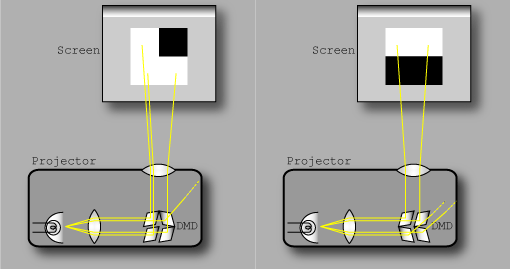
An electronic circuit is also present, which helps in deciding the orientation of each mirror. A bright source of light is then shined on the DMD and the electronic circuit individually tilts each mirror back and forth. If a mirror is tilted towards the lamp, it shines the light towards the screen. This one mirror is representative of one pixel. If a mirror is tilted away from the source of light, it cannot reflect the bright source of light, thereby leaving the screen space empty or dark.
Each mirror works individually, and the two million mirrors go on to build a high-resolution image. But how is the color formed, you may ask? To add color to the images, the DLP uses an extra bit of technology that consists of a colored wheel placed in the path of the light reflected by the mirrors of the DMD. The wheel consists of the colors red, blue and green. The combination of these colors when bounced onto the mirror and merged gives rise to an endless variety of colors in high definition. Finally, a lens collects all the beams of light to produce the final image.
So, the next time you kick back with a bucket of popcorn in the theatre, you will better appreciate how that movie magic is created!
LCoS Projectors
A third image-forming technology you may have come across (especially on premium home cinema projectors from Sony and JVC) is LCoS, short for Liquid Crystal on Silicon. LCoS sits halfway between LCD and DLP: like LCD it uses liquid crystals to control each pixel, but like DLP the image-forming surface is reflective rather than transmissive. The liquid-crystal layer sits on top of a mirrored silicon chip, so light passes through the crystals, bounces off the mirror, and passes through the crystals again on the way out. This double pass through the crystals gives LCoS very high contrast and a smoother “pixel grid” than either competing technology, which is why it is popular on high-end home theatre and pro AV projectors.
LED And Laser Projectors
Until the late 2000s nearly every projector used an ultra-high-pressure (UHP) mercury-vapour lamp as its light source. These bulbs are bright but they run hot, dim with age, and typically need to be replaced every 2,000-5,000 hours. Most projectors sold today have moved to LED or laser light sources instead, paired with the same LCD, DLP, or LCoS image-forming engines described above.
LED projectors use banks of red, green, and blue LEDs to either replace the white lamp and colour wheel, or to provide the three primary colours directly. They are dimmer than UHP lamps (typically a few hundred to a couple of thousand ANSI lumens) but compact, energy-efficient, and good for around 20,000-30,000 hours. That makes them the standard light source in pico/pocket projectors and most portable home models.
Laser projectors use red, green, and blue laser diodes, or a single blue laser paired with a phosphor wheel that produces yellow light, which is then split, to generate even brighter and more saturated colour. Most digital cinema projectors installed since the late 2010s, including the IMAX laser systems in major theatres, are laser DLP rigs. At home, ultra-short-throw “laser TV” units sit a few inches from the wall and throw a 100-inch image with no lamp to replace; the laser light engine is rated for upwards of 20,000 hours.
How Does A Film (Reel) Movie Projector Work?
Every projector described above is digital, but for roughly a century the movies ran on physical film: a long strip carrying thousands of separate photographs pulled past a bright lamp. So how does a string of still frames turn into smooth motion? The secret is that the film does not glide past the light continuously. Each frame is yanked into position, held dead still while it is projected, and then jerked on to the next one, 24 times every second.

That stop-start shuffle is called intermittent movement. In 35mm and 70mm projectors it is produced by a Geneva drive, better known as the Maltese cross mechanism, which converts the motor's steady spin into a stepped motion: it advances the film by exactly one frame, then locks it motionless for the rest of the cycle. Smaller-gauge projectors use a simpler claw that hooks into a sprocket hole, pulls the film down one frame, and retracts.
While the film is actually moving, you must not see it, or the picture would smear into a blur. So a rotating shutter sweeps in and blocks the lamp during every pull-down; light reaches the screen only when a frame is sitting still in the gate. Cleverly, these shutters are built to interrupt each frame two or even three times (a flicker rate of 48 or 72 hertz) even though only 24 frames pass each second, which lifts the flickering above the rate your eye can notice. Your brain then knits the rapid run of stationary frames and unnoticed dark gaps into one seamless moving image, a stitching effect long attributed to persistence of vision. Digital LCD, DLP, and laser projectors have all but retired the reels, yet that whirring mechanical dance ran cinema for generations.
References (click to expand)
- LCD projector - Wikipedia. Wikipedia
- Digital Light Processing - Wikipedia. Wikipedia
- How Do Projectors Work - Gadget Review. gadgetreview.com
- Larry Hornbeck, inventor of the Digital Micromirror Device. National Inventors Hall of Fame.
- Digital micromirror device. Wikipedia.
- Liquid crystal on silicon. Wikipedia.
- Lens. Wikipedia.
- Throw (projector). Wikipedia.
- Movie projector. Wikipedia.
- Geneva drive. Wikipedia.