Table of Contents (click to expand)
Most laser pointers are red because a red beam (around 650 nanometers) can be made directly by a single inexpensive semiconductor diode. Other colors, such as green at 532 nanometers, need extra crystals and a frequency-conversion step, which makes them costlier. Red diodes are the simplest and cheapest to mass-produce, so red pointers dominate the shelves.
All of us, at some point in time, have come across a laser. Cashiers at the supermarket use them to scan the barcode on your groceries. Professors use them to draw students’ attention to specific items of a presumably mundane presentation. Cat owners use them to distract their munchkins and turn them into YouTube sensations.

Basically, we’re all quite familiar with the little red dot from some area of life, which got me thinking, why red? We have natural light that splits into seven of its constituent colors when we pass it through a prism. Why then, do most laser pointers just give us one of the seven colors?
Long story short, it’s simply cheaper to produce laser pointers that emit a red light over any other variations. Brilliant minds who have developed laser pointers in other colors, but red laser pointers continue to make the most economic sense. Therefore, they’re the product of choice for mass production and thus the most popular item on the shelf.
So, why is it cheaper to produce a red laser pointer than a laser of any other color? To understand this, let’s look into what these laser pointers actually are and how they work.
What Is A Laser?
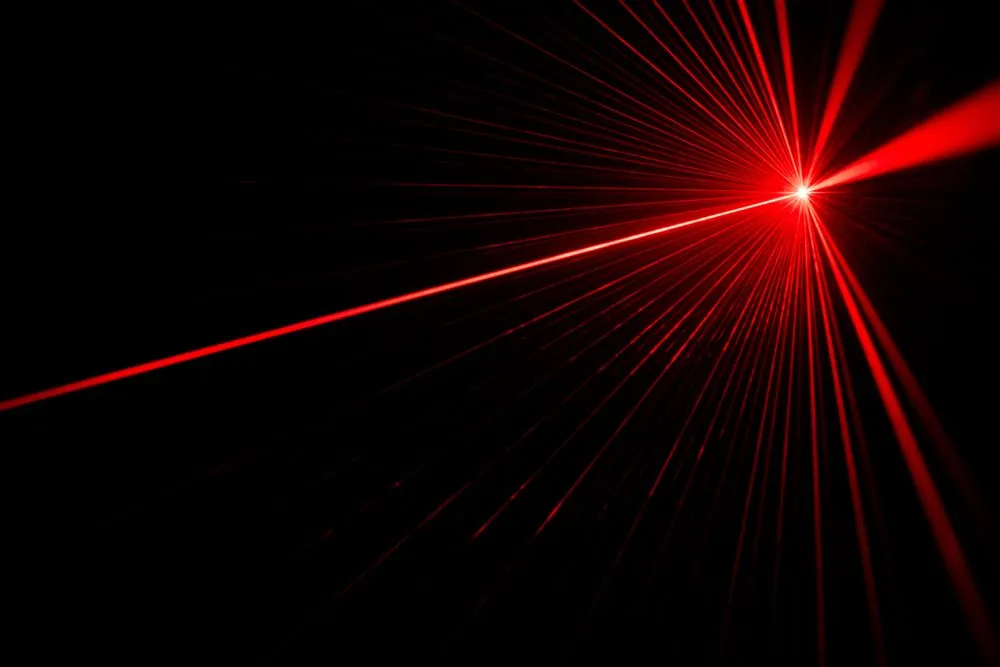
A laser is essentially a highly focused light source with amplified brightness. In fact, the word laser is an acronym that stands for Light Amplification by Stimulated Emission of Radiation (LASER).
A laser is produced when the electrons of certain materials, such as glass, crystal, diamond, etc., are energized by the absorption of energy from an electric current. Energized electrons jump from lower orbitals to higher orbitals within the atom. As they return to ‘normal’, i.e. ground state, these previously energized electrons release energy in the form of photons. All of the photons released during this interaction tend to be ‘coherent’ – the crests and troughs of every light wave match up precisely, so they’re all of the same color.
Pumping And Population Inversion
As more energy is supplied to the glass/crystal, several electrons are energized. This is known as pumping. They move as one to a higher energy state and then back to the ground state. This phenomenon is called population inversion. Population inversion leads to a larger burst of energy, which creates a sort of avalanche of light, known as stimulated emission. This huge burst of energy, concentrated at a single point, becomes a laser light.
Who Invented The Laser?
The first working laser was built by a physicist named Theodore Maiman, who fired it on 16 May 1960 while working at Hughes Research Laboratories in Malibu, California. His laser used a rod of synthetic ruby, silvered at the ends, which were cut in such a way that the beam of light would ricochet inside it, gaining brightness before coming out the other side. The contraption emitted a narrow, bright beam of red light with a wavelength of 694 nanometers.
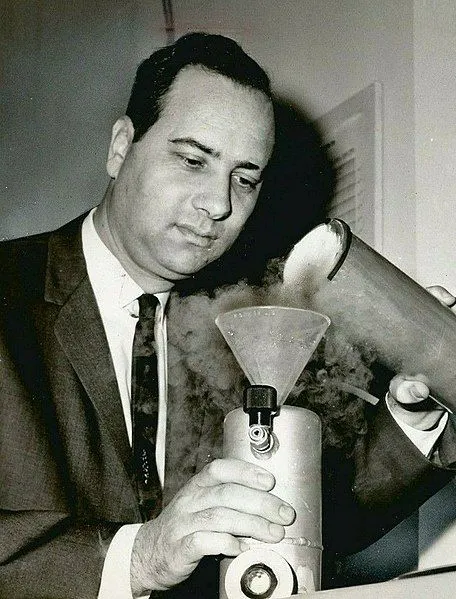
Amusingly, when Maiman showcased his findings to the scientific community, the laser was famously termed “a solution looking for a problem”. Clearly, they weren’t looking hard enough for problems yet, as his research paper was rejected by the popular science journal, Physical Review Letters. Subsequently, another equally selective physics journal, Nature, agreed to publish his findings, which led to what some might call a “laser boom”.
How Do Different Laser Pointers Work?
Different methods are used to produce different color lasers. The red laser is produced using a simple semiconductor diode. This consists of two semiconductors placed together, one on top of the other. One layer is doped to have a shortage of electrons (it has positively charged ‘holes’), known as a p-type semiconductor. The adjacent layer is doped to have an excess of electrons, called an n-type semiconductor. Stacked together, the two form what is called a p-n junction. The visible-red diodes in modern pointers are typically built from aluminum gallium indium phosphide (AlGaInP); plain gallium arsenide diodes emit invisible infrared light rather than red.
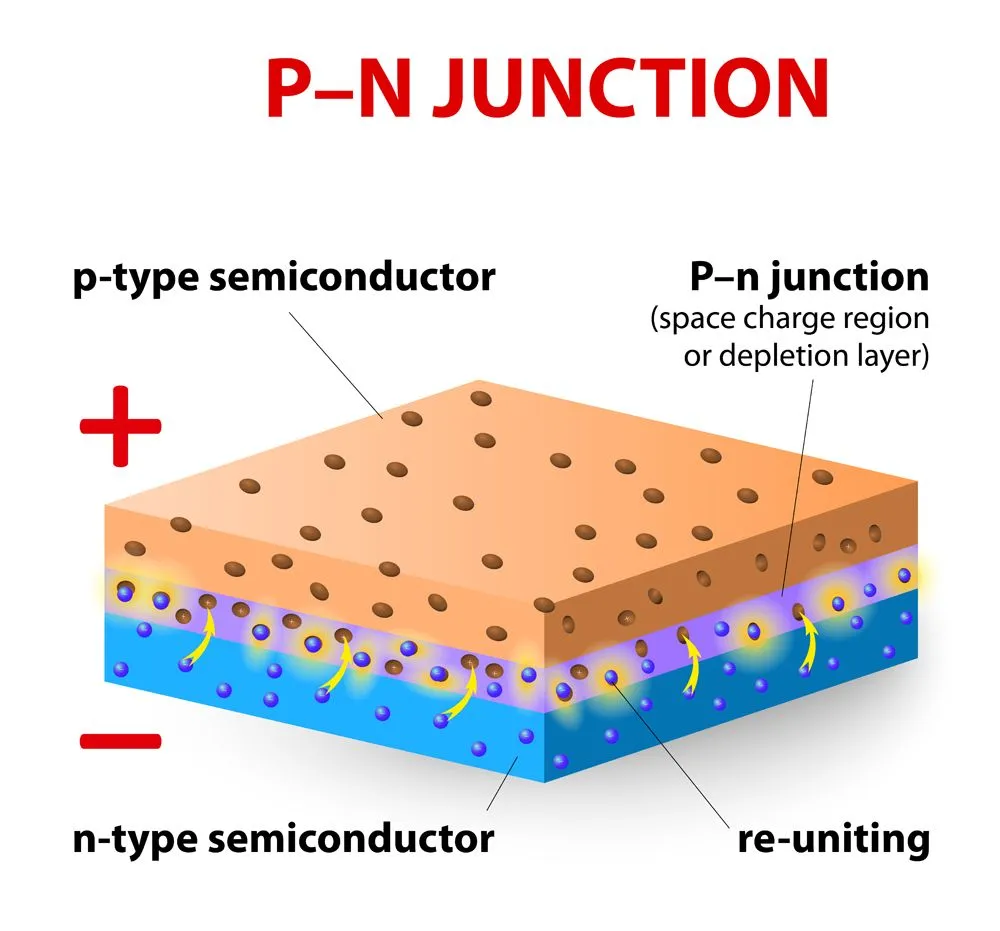
When a current passes through the p-n junction, electrons are injected from the n-type layer and drop into the empty ‘holes’ on the p-type side. Each time an electron and a hole recombine, the lost energy is released as a photon, and the color of that light depends on the energy gap of the material. The two ends of the junction are polished into mirror-like reflective facets, so the photons get trapped and bounce back and forth. As explained earlier, the junction eventually reaches a population inversion, leading to stimulated emission; this builds up and emerges from the junction as laser light.
Why Are Most Laser Pointers Red?
The light that emerges from the cheap diode in a shelf-bought pointer is typically around 650 nanometers, with common variants running from roughly 635 to 670 nanometers. That puts the beam squarely in the red part of the visible spectrum.
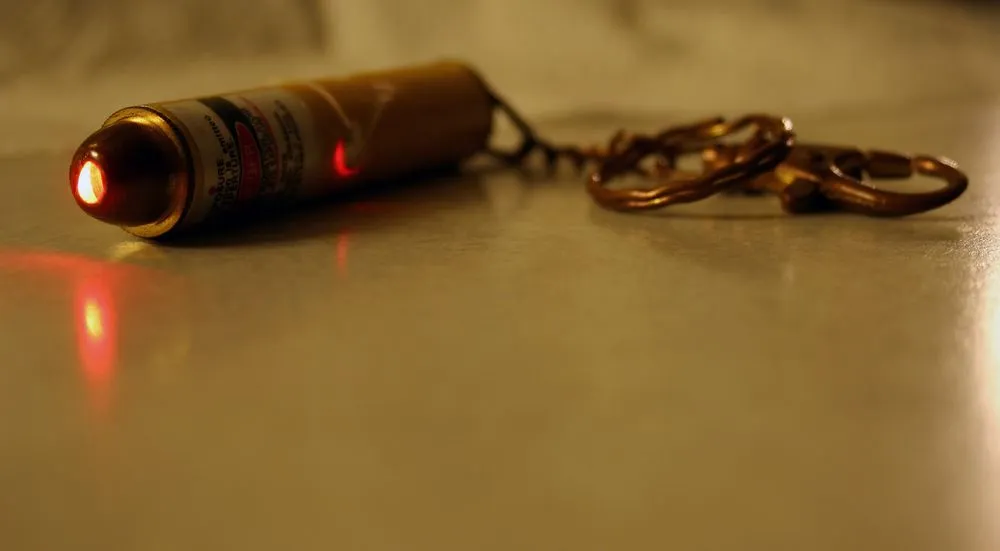
However, a green laser is actually the more captivating light source, because the human eye is most sensitive to wavelengths near 555 nanometers, right in the green. For the same output power, a green beam looks far brighter than a red one and appears to reach much greater distances, which is why green is preferred for things like laser pointers meant to be seen at a distance.
So if green is brighter, why is it not the default? Because a green beam cannot be made directly by a cheap diode; it takes several steps. The standard green pointer is a diode-pumped solid-state (DPSS) laser.
First, an infrared semiconductor diode emits light at about 808 nanometers. This light is absorbed by a neodymium-doped crystal (such as Nd:YVO4), which lases at 1064 nanometers, still in the infrared. That beam is then passed through a frequency-doubling crystal (typically KTP), which halves the wavelength so the light emerges as a green beam at 532 nanometers.
Clearly, producing a green laser light requires a few more specialized components, so red laser lights are the most cost-effective to produce and still remain the most popular variety of laser on the market.
References (click to expand)
- Theodore H. Maiman, A Biographical Memoir. National Academy of Sciences
- The Danger Of Green Laser Pointers - MIT Technology Review. MIT Technology Review
- NIF's Guide to How Lasers Work. Lawrence Livermore National Laboratory
- How do you focus regular light to make it a laser beam?. West Texas A&M University
- The first laser - The University of Chicago Press. The University of Chicago Press
- Report on LASER DIODE TECHNOLOGY AND APPLICATIONS Submitted to Dr. Andres La Rosa Portland State University Physics 464 March 8, 2005 by Jason Hill - web.pdx.edu:80
- Laser Pointer Safety - ehs.harvard.edu. Harvard University
- Laser Pointers | Environmental Health and Safety. Iowa State University of Science and Technology