Table of Contents (click to expand)
- Need for precautionary measures in electronic usage
- Structure of an Electrical Circuit
- Capacitors
- Why does the 30-second rule still apply?
- What actually gets reset when you power-cycle a frozen device?
- Why does unplugging your router or modem fix the internet?
- Can a capacitor still shock you after the device is unplugged?
The "wait 30 seconds before plugging it back in" rule exists so the bulk capacitors in the device’s power supply have time to discharge through their bleeder resistors, draining the residual voltage from filter capacitors so volatile memory and latched logic states fully clear before the device powers back up. The 30-second figure isn’t a strict engineering threshold — it’s a conservative IT-support rule of thumb, comfortably longer than the typical RC discharge time constant in most consumer electronics.
Electricity was introduced into homes in the late 1800s, beginning with Edison’s Pearl Street Station in 1882. Electrical appliances, however, took a few more decades to reach the same prevalence. Earl Richardson invented his lightweight electric clothes iron in 1903 (commercialised in 1905, eventually branded Hotpoint); the first electric toaster was produced by Crompton & Company in the UK around 1893, and General Electric’s D-12 (designed by Frank Shailor and released in 1909) became the first commercially successful version. From there, electrical appliances became daily-use items across the globe. In the post-World War II economic expansion, dishwashers and clothes dryers became the norm. Other factors, such as the Rural Electrification Act[1] signed by President Roosevelt on May 20, 1936, accelerated the spread of electronics into daily life.
Need for precautionary measures in electronic usage
This meteoric rise, however, also led to some hesitation in the general public about bringing these appliances into their homes. This toaster made by General Electric in 1908 should give you some idea as to why this was the case. The exposed resistance wires would glow red hot when in use and force the users to utilize the full range of motion their fingers possessed to avoid getting burned. Such design flaws took some time to fix and, simultaneously, led to lawmakers holding manufacturers liable for any personal harm caused by their electronic products.
These conditions subsequently led to manufacturers realizing the importance of advising customers to take precautionary measures while using electronics. This is also why you see shock advisories on the back of product boxes. One such precaution was to wait for 30 seconds after you’ve unplugged an electronic device before plugging it in again.
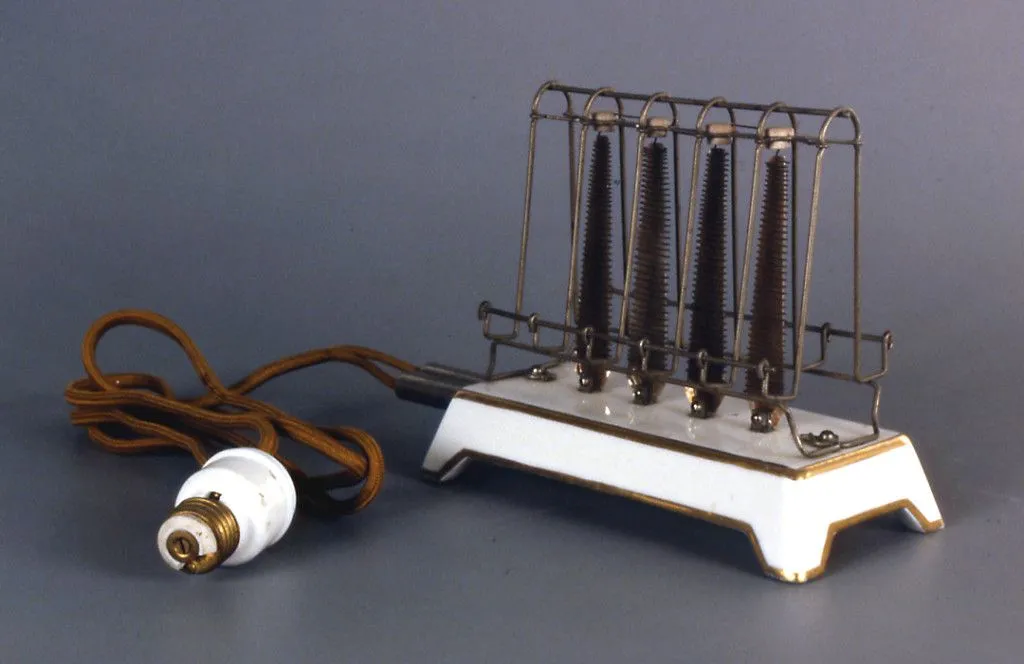
The precaution to wait 30 seconds before re-plugging electronics arose from concerns posed by design flaws, such as the case of the G.E. toaster. You see, the glowing red-hot wires understandably failed to inspire any confidence among its users regarding the safety concerns they had. Furthermore, when the toaster was either done toasting or unplugged, these red-hot wires took their sweet time in cooling down and returning to their natural shade of grey. This phenomenon, however, is not caused by a mere design flaw in a toaster. The 30-second rule is still advised in modern electronics.
The short answer to the question “Why?” would be: It takes time for the current to dissipate from the electrical circuit running through the device in question. If you’re unplugging a device, you probably want all the capacitors to discharge completely. The longer, more comprehensive answer would require a basic understanding of the structure of an electrical circuit and the role that capacitors play.
Structure of an Electrical Circuit
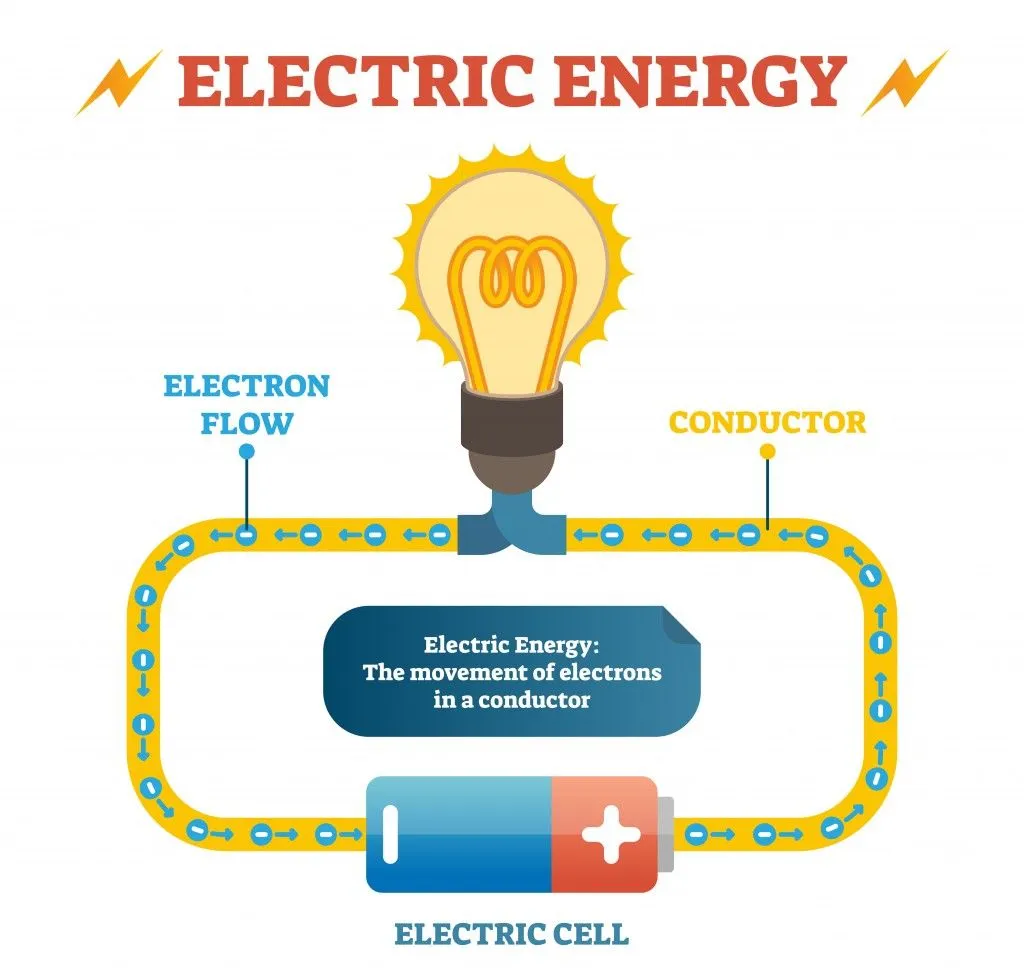
An electrical circuit consists of two types of elements: Active and Passive[4] elements. Active elements supply current to the cell. Examples of such elements would be DC generators or Current and Voltage sources, such as cells. Passive elements are those parts that regulate or work on the current already flowing through a circuit. They do not produce any current of their own. A capacitor is a passive element. They’re considered to be one of the three primary passive elements, along with resistors and inductors.
Capacitors
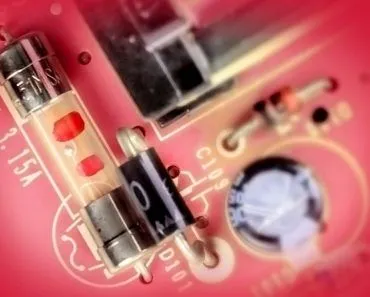
The primary function of a capacitor[5] in an electronic device’s circuit is to regulate the voltage. A capacitor stores energy as electric charge on a pair of conducting plates separated by a dielectric. When connected to a DC source, current flows briefly to deposit charge on the plates and then stops once the capacitor’s voltage matches the supply voltage — in steady state, capacitors actually block DC. They readily pass AC, with an impedance that decreases as frequency increases (XC = 1/(2πfC)). The amount of charge a capacitor holds per volt of applied voltage is its capacitance, measured in farads (C = Q/V); the stored quantity itself is the charge Q (in coulombs), and the energy held in the capacitor is E = ½ CV2. This buffering action protects the rest of the circuit from short-lived voltage spikes and dips.
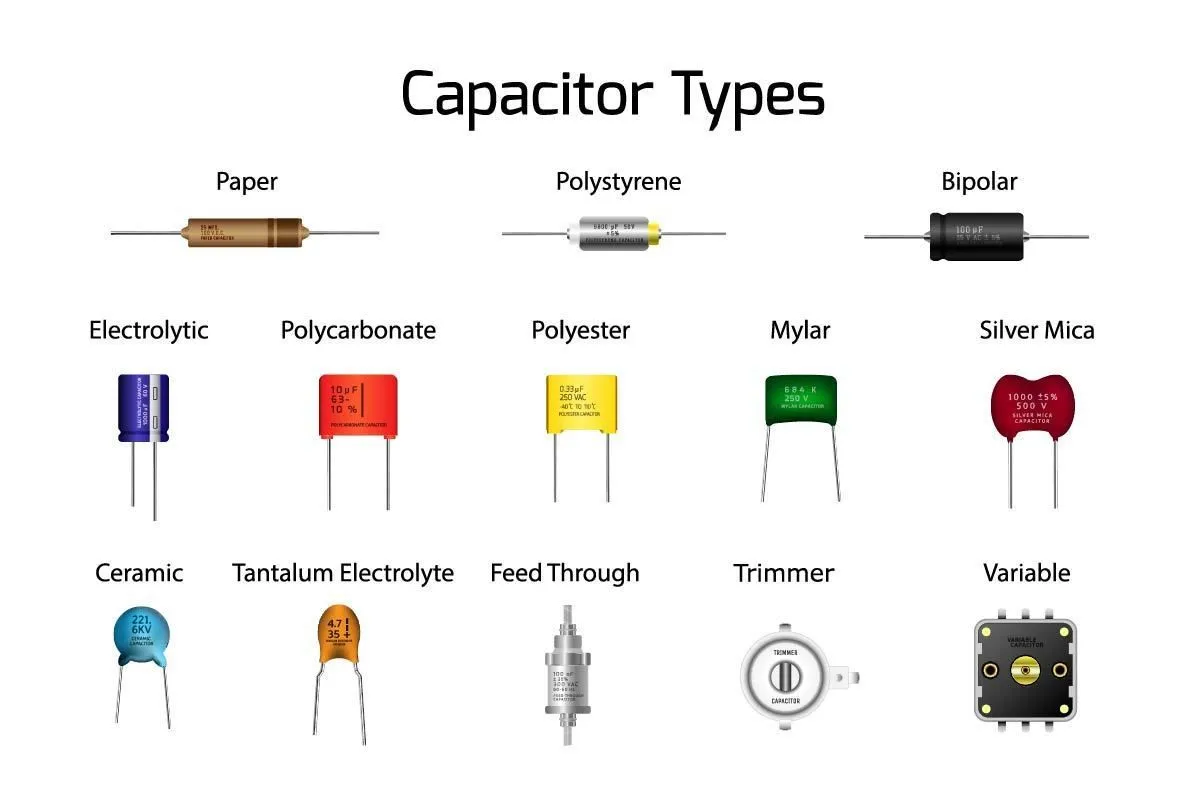
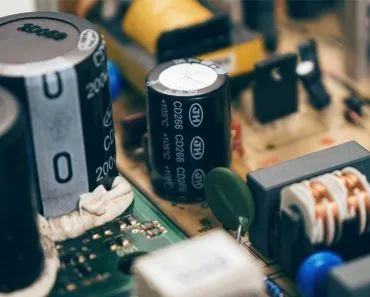
Capacitors are everywhere in modern electronics. A modern flagship 5G smartphone contains well over 1,000 multilayer ceramic capacitors (MLCCs)[6] — typically 1,000 to 1,300 or more — packed into a few square centimetres of motherboard. Most of them are tiny decoupling capacitors sitting next to integrated circuits, supplying the brief, microsecond-scale current spikes that ICs draw faster than the main power regulator can respond, and so smoothing out voltage transients on the supply rails. (They do not, contrary to popular myth, "boost" battery life: the energy stored in all of a phone’s decoupling caps put together is millions of times smaller than the energy in the battery.) But because they hold real charge, even after a device is unplugged its capacitors retain some stored charge until they discharge through the surrounding circuit.
If you’re unplugging an electronic device, the reasonable assumption would be that you’re power-cycling[7] to reset the device. This could be for a multitude of reasons, such as the device freezing, overheating or malfunctioning. As long as the charge in the current, which includes the capacitance throughout the circuit, hasn’t dissipated entirely, the device won’t be reset. Furthermore, you might end up risking a charge imbalance, although most modern electronics can handle that without breaking a sweat. Even so, why put our precious devices through the ordeal at all?
Why does the 30-second rule still apply?
Nowadays, we’re surrounded by electronics wherever we go. Electrical circuits that require shock advisories are found in devices all around us. From washing machines, induction stoves, and PCs to mobile phones, most of our daily functioning involves an object containing electric circuits. Advancements have obviously been made, but electronics are still man-made objects that are undeniably fallible.
No electronic device is immune to failure. Overcharging and voltage imbalances are still very much possible. Therefore, even today, general electronic-usage etiquette applies. To stop dangerously high residual voltages lingering on bulk filter capacitors, mains-powered supplies often include a small bleeder resistor across the capacitor; the voltage decays as V(t) = V0 e–t/RC, falling to about 37% after one RC time constant and to a negligible level after roughly five. For most consumer electronics, that brings residual voltage to safe (and reset-friendly) levels well within 30 seconds — which is why 30 seconds remains the standard buffer period before you plug a device back in.
What actually gets reset when you power-cycle a frozen device?
When a phone, laptop or smart TV freezes, the problem is usually not a broken part but a tangle in its working memory. A program has hung, a process has wedged itself into a stuck state, or leaked memory has slowly piled up until everything grinds to a halt. None of that lives on the permanent storage that survives a shutdown; it lives in the device's RAM, and RAM is volatile, meaning it only holds data while it is powered.

Why volatile? Most RAM is DRAM, which stores every bit as a tiny packet of charge in a microscopic capacitor. Those packets leak away within milliseconds, so a refresh circuit reads and rewrites every cell thousands of times a second just to keep the data alive. Cut the power and the refreshing stops, so the contents fade and the stuck state goes with them. Interestingly, the fade is not instant: a 2008 Princeton study famously showed that DRAM can keep its contents for several seconds to a minute or more after the power is pulled. That is exactly why a hurried tap of the power button can drop you straight back into the same frozen mess, because the old state had not finished draining. Giving the device a clean break of a few seconds lets the volatile memory empty out completely, so every program restarts from a blank slate. This is the software half of why "turn it off and on again" works so reliably, and it sits right alongside the capacitor discharge we have already covered.
Why does unplugging your router or modem fix the internet?
The most common reason people pull a plug, count to thirty and push it back in is a dead internet connection, and the box on the other end is almost always a router or modem. A router is really a small computer that never gets switched off. Run anything for weeks on end and its memory slowly fills with stale connection data, half-open sessions and the occasional software glitch; it can also simply overheat. Power-cycling clears that working memory and lets the hardware cool down, the very same reset described above.

There is a networking bonus too. When a modem powers back up it has to rebuild its link to your internet service provider from scratch and request a fresh IP address lease using DHCP, the protocol that hands out addresses on a network. Those leases are temporary by design, so a clean restart often lands you a healthy connection in place of one that was quietly falling apart. How long should the box stay unplugged? The usual guidance is 30 to 60 seconds. The lower bound is the same 30-second logic running through this whole article: it gives the volatile memory time to drain and the power-supply capacitors time to bleed down, so the device genuinely powers off instead of half-sleeping. If your trouble began after a power cut, lean toward the longer end. And if your modem and router are separate boxes, switch the modem on first and wait for its lights to settle before powering the router, so the router can pull a good address once the modem is back online.
Can a capacitor still shock you after the device is unplugged?
We have seen that capacitors keep some charge after a device is unplugged. In everyday gadgets that leftover charge is small and harmless, and the bleeder resistors drain it to safe levels well within the 30-second window. But not every capacitor is so polite. Inside appliances with a high-voltage stage, the bulk capacitors can store enough energy to injure or even kill, and they can hold it for minutes, hours, or days if a bleeder resistor has failed.

The textbook example is a microwave oven. Its high-voltage capacitor charges to a few thousand volts to drive the magnetron that cooks your food. The U.S. Consumer Product Safety Commission warns that the shock hazard from a microwave oven "still exists even after the oven is disconnected from the power source," and it has linked do-it-yourself microwave repairs to electrocution deaths, recommending that such work be left to professionals. Older tube televisions, camera flash units and many switch-mode power supplies carry similarly hefty capacitors. So treat the 30-second rule for what it is: a way to get a clean reset for ordinary, plug-into-the-wall use. It is not a green light to open up a high-voltage appliance. Anyone servicing one has to discharge those capacitors deliberately first, and should assume they are still live until proven otherwise.
References (click to expand)
- Nishino, A. (1996, June). Capacitors: operating principles, current market and technical trends. Journal of Power Sources. Elsevier BV.
- Sarjeant, W. (1990). Capacitors. IEEE Transactions on Electrical Insulation. Institute of Electrical and Electronics Engineers (IEEE).
- Hertzmann, P. (2020). The Wire That Made Cooking Electric. Technological University Dublin.
- Härtel, H. (1982, January). The Electric Circuit as a System: A New Approach. European Journal of Science Education. Informa UK Limited.
- Halderman, J. A., et al. (2008). Lest We Remember: Cold Boot Attacks on Encryption Keys. 17th USENIX Security Symposium.
- Droms, R. (1997). Dynamic Host Configuration Protocol. RFC 2131. Internet Engineering Task Force (IETF).
- Electrocution Hazard with Do-It-Yourself Repairs of Microwave Ovens. Publication 5061. U.S. Consumer Product Safety Commission.