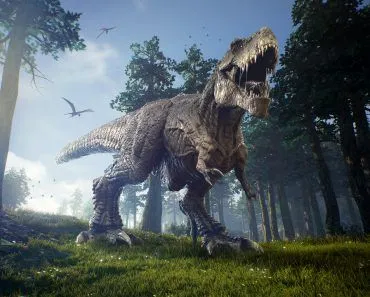
No, modern snakes don't have legs, but their ancestors did. Snakes started losing their legs over 100 million years ago after mutations broke an enhancer that controls the Sonic hedgehog limb-building gene. Pythons and boas still keep tiny leg nubs, and python embryos briefly grow leg buds before development stalls.
We all feel for snakes. As cool as they are, with their venom-filled fangs or their rib-crushingly powerful constriction, most of us still can’t get over the fact that they have no legs. Yet, for an animal that has colonized every continent aside from Antarctica, snakes might be grateful for their leg-less existence.
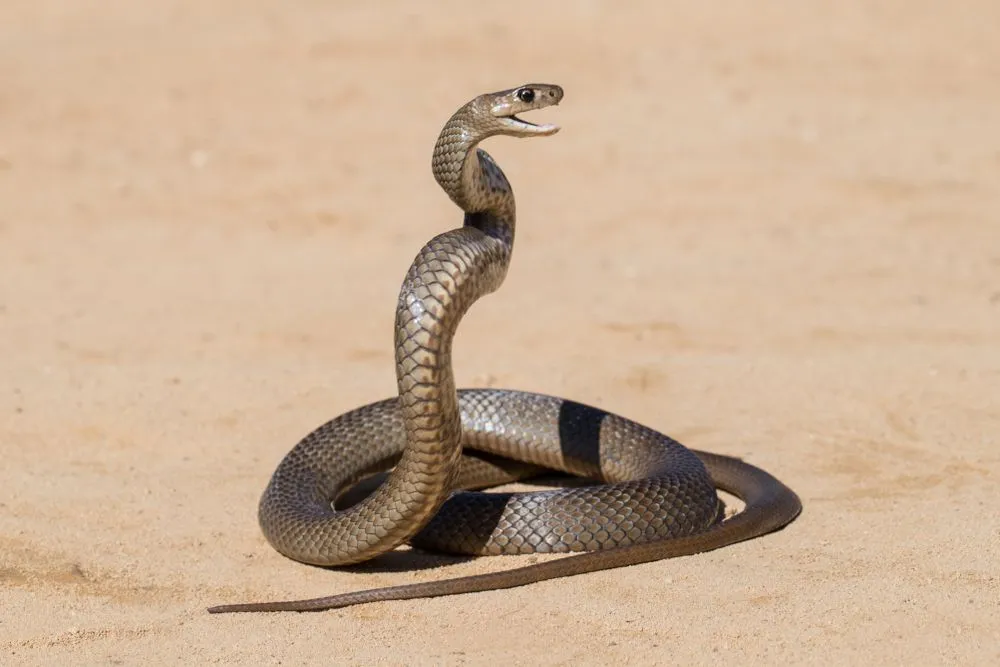
Snakes are some of the most common animals in the world. From the tropics to the temperates, they do pretty well for themselves in most parts of the globe. Given their impressive range, they’re obviously highly successful in most habitats. Be it water, on the ground, deep within the earth, or even high up in the canopies, snakes are everywhere! So how did they achieve this magnificent expansion of range and habitat?
Have Snakes Always Been Legless?
Ancient snakes did have legs. The oldest known snake fossils, including Eophis underwoodi from Middle Jurassic England, push the snake lineage back to roughly 167 million years ago, and several of those early forms still bore small limbs. Today, by contrast, most snakes have no legs at all (think cobras and vipers), while pythons and boas only have tiny, redundant vestiges, the little black "spurs" tucked near the base of the tail.

So, what happened between then and today?
Researchers at the University of Florida zeroed in on Sonic hedgehog (Shh), the gene famously named after the Sega character back in 1993, which controls limb development in all four-limbed vertebrates. In a 2016 paper in Current Biology, Francisca Leal and Martin Cohn showed that in snakes, the genetic switch that turns Shh on in the limb bud is broken in some very specific ways.

All limbed vertebrates carry Sonic hedgehog, but in snakes, the version of the limb enhancer that powers it is largely silent. Stranger still, in pythons it briefly flickers on during early embryonic development, just long enough to start a leg, but then shuts down before that leg can finish forming.
What Does This Mean?
We can draw quite a few conclusions from this strange on-and-off behavior of the Shh gene.
The main one is that the brief flash of Shh activity in python and boa embryos is what produces their vestigial leg buds. The gene fires, a tiny femur and the cellular outline of an entire leg skeleton get sketched out, and then the signal cuts off long before any of that turns into a working limb.
The pattern also points to two evolutionary paths taken by snakes. "Ancient" snakes like boas and pythons still show this brief activation of Shh in the embryo, whereas more "recent" snakes like cobras and vipers don't activate it in the limb bud at all.

In both "ancient" and "recent" snakes, the reduced or non-existent activity of Shh in the limb bud comes down to mutations in a stretch of DNA called the ZRS (a limb-specific enhancer that tells Shh when and where to fire). Leal and Cohn found three deletions in the python ZRS that knock out key transcription-factor binding sites; in more advanced snakes like cobras and vipers, the ZRS has decayed so far that it's barely detectable at all.
Does this mean that "ancient" snakes have an edge over more "recent" ones?
Not at all. The legs of a python are about as useful as a wheel on a ship. They're just small black nubs with claws (often called spurs). Males do put them to one use during mating, gently rubbing the female with them as part of courtship, but beyond that, the spurs mostly just offer a window into the evolutionary history and genetic plumbing that define snakes.
Do Snakes Have Arms, Hips or Leg Bones?
Here is where things get interesting. If you go hunting for a snake's arms, you will come up empty every single time. Front limbs are nonexistent in all known snakes, and so is the shoulder (pectoral) girdle that would normally anchor them. Whatever leg remnants a snake carries are strictly leftovers of its hind limbs, never its arms.

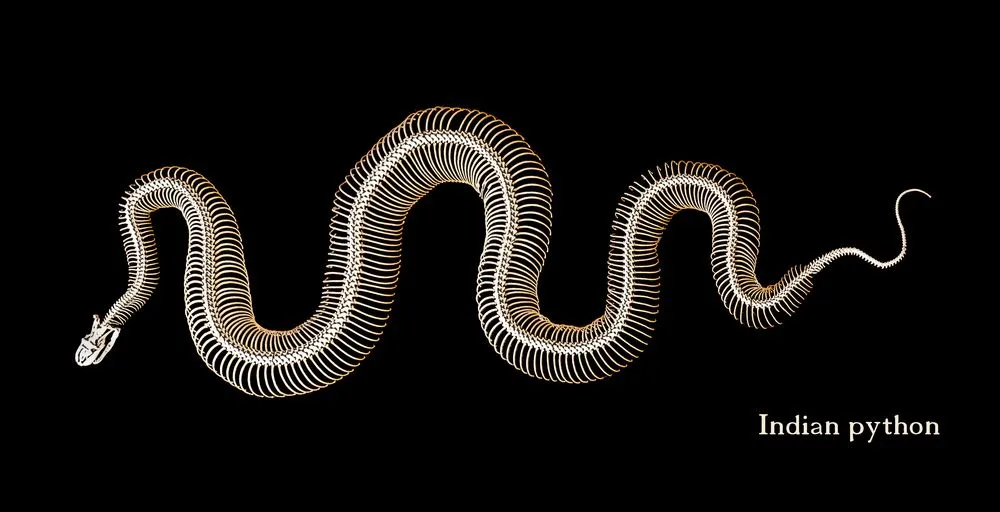
Hips and leg bones are a different story, and the answer flips depending on which snake you pick up. In the vast majority of living species (the colubrids, cobras, and vipers most people picture), the skeleton is just the skull, a small hyoid, a long vertebral column, and ribs. No pelvis, no thigh bone, nothing. The heavier-bodied, more primitive snakes kept a little more of the old blueprint. Pythons and boas still carry a reduced pelvic girdle and a shrunken thigh bone (femur) tucked into the body wall, capped by the small claw-like spur that pokes out on either side of the cloaca. A few blind snakes (families Typhlopidae and Leptotyphlopidae) hang on to pelvic remnants too.
Both male and female pythons and boas grow these spurs, but they are noticeably larger in males, who use them during courtship to nudge and stroke their partner. So a python genuinely does have a pair of tiny leg bones. They just do not really go anywhere.
Did “Ancient” Snakes Evolve Before “Recent” Snakes?
"Ancient" here just refers to a branch of the snake family tree, not a snake's literal age. An "ancient" lineage isn't necessarily older in geological terms than a "recent" one. Take, for example, two fossil snakes from the Late Cretaceous, Dinilysia patagonica and Najash rionegrina. Both lived in what is now Patagonia roughly 90 to 95 million years ago. Dinilysia patagonica was a terrestrial snake that lacked external limbs, while Najash rionegrina still carried well-developed hind legs and a pelvic girdle (small, but bony and articulated, rather than the fully load-bearing legs of a lizard). New three-dimensional skulls of Najash described in a 2019 Science Advances paper showed that early snakes hung on to those hind limbs for tens of millions of years, so leg loss wasn't a one-step event so much as a long, drawn-out fade.
Based on other fossils of extinct snakes from that time, what we can confidently say is that these leg-bearing snakes didn't actually use their hind legs for any meaningful locomotion (no walking, no swimming, no climbing). So, as early as the Late Cretaceous, snakes were already well into the process of trading a legged body plan for a leg-less one. A 2021 reanalysis even reclassified Tetrapodophis amplectus, a celebrated "four-legged snake" from 2015, as a long-bodied marine lizard (a dolichosaur) rather than a snake at all, which trimmed back the gallery of confirmed legged snakes but didn't change the broader story.
Why Did Snakes Go Leg-less?
Snakes are evolutionary rogues. For a long time, the leading hypothesis was that snakes lost their legs after their ancestors switched to a burrowing, underground lifestyle. Living in tight spaces, limbs are a liability. Think of it this way: how much easier would it be to fit into a tiny nook, crevice, or hole without four radiating structures (legs and arms) poking out from the sides of your body?
That subterranean story is still on the table, but it now has competition. The 2019 Najash work argued that the ancestors of modern snakes weren't tiny, blind burrowers at all, but larger, big-mouthed surface-dwellers whose hind legs were already shrinking. Other researchers have proposed an aquatic origin instead. What everyone agrees on is that once snakes had the long, tapered, leg-less body plan, they ran with it. The shape complemented other modes of locomotion, like swimming, and even let them use their belly scales to grip and climb vertical surfaces.
In an article published on the Florida State Parks website, Keith Morin, a park biologist at the Florida Department of Environmental Protection, said it best:
“From the way they move, to the places they can go and some of the methods of subduing prey, like constriction, having legs would simply get in the way. Over millions of years they gradually lost legs, and they’ve even lost shoulders and hips. Evidence of older species with limbs can be found in the fossil record and in the boas (Boidae), a more primitive family that still has remnants of limbs.”
So yes, snakes do benefit from a lack of legs. However, as with most things in evolution, the answer isn’t always a clear one-liner. A legless form isn’t the only reason or evolutionary advantage that snakes picked up along the way; other morphological changes like tapering and elongation of their bodies also helped. After all, remember that snakes are true evolutionary rogues!
How Do Legless Snakes Move Without Legs?
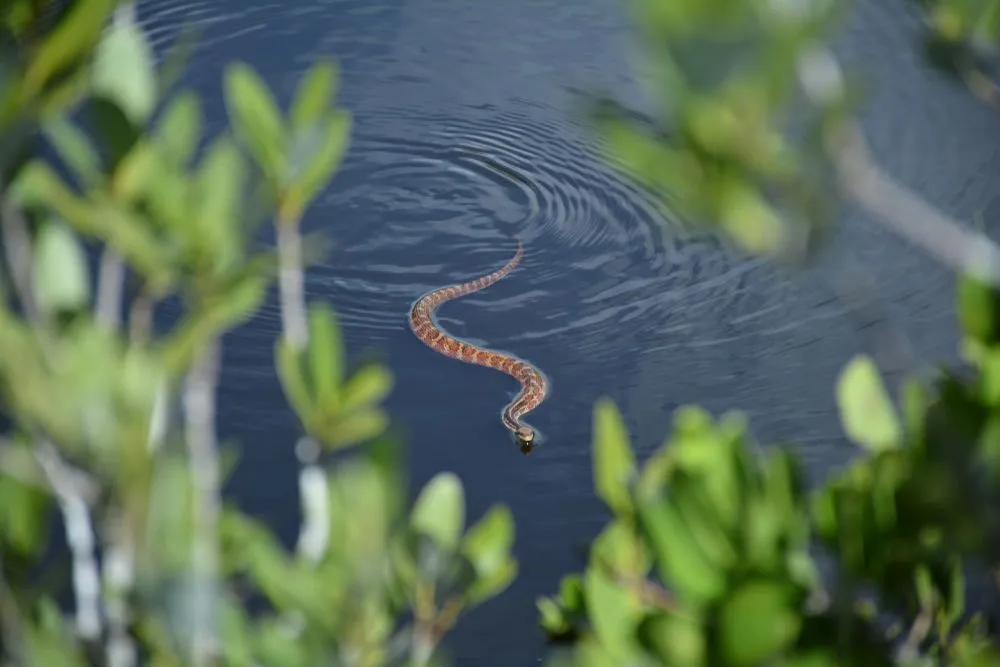
Losing every limb sounds like a mobility disaster, yet snakes get around on land, through water, up trees, and deep underground. They manage it with a handful of distinct gaits rather than a single, generic "slither." Herpetologists generally sort snake locomotion into four modes.

Lateral undulation is the classic S-shaped crawl. Waves of side-to-side bending travel down the body from head to tail, and every curve pushes back against small bumps and irregularities in the ground (or against the water), driving the animal forward. It is the default gait on most surfaces, and it is also how snakes swim.
Concertina movement is the accordion trick. The snake anchors part of its body, reaches the front end forward, then hauls the rear up behind it. It is slow, but it is ideal for tight burrows and for climbing, where there is something firm to brace against.
Rectilinear locomotion is the near-invisible creep favored by heavy-bodied pythons and boas. Instead of throwing the body into curves, the snake ripples the skin of its belly, using the broad ventral scales (scutes) a little like tank treads to inch forward in a dead-straight line.
Sidewinding is the desert specialist's move. A sidewinder lifts loops of its body clear of the hot, loose sand and flings them sideways, leaving those tell-tale parallel J-shaped tracks. It is quick, and it costs surprisingly little energy. Not every snake uses all four styles, but between them, a legless body turns out to be remarkably versatile.
Which Other Animals Get Around Without Legs?
Snakes are the most famous legless animals, but they are nowhere near the only ones, and several of their limbless neighbors are not even snakes. Ditching legs is one of evolution's favorite tricks: within the squamate reptiles (the group that holds both lizards and snakes), a long, limb-reduced, snake-like body has evolved independently at least 25 separate times.

Some of the best impostors are the legless lizards. The European legless lizard (also called the sheltopusik) and the slow worm look and slither almost exactly like snakes, yet they are true lizards, giving themselves away with eyelids and external ear openings that no snake possesses. Then there are the amphisbaenians, or worm lizards, a group of more than 200 mostly limbless burrowers; one odd genus, Bipes, even keeps a pair of stubby, mole-like front legs purely for digging.
Legs have disappeared well beyond the reptiles, too. Caecilians are limbless, mostly soil-dwelling amphibians that look a lot like oversized earthworms, and plenty of eels and eel-like fish have pared themselves down to a fin-fringed, legless body plan. The pattern is hard to miss: when an animal makes its living in dense grass, loose soil, or narrow crevices, legs are often more of a liability than an asset.
References (click to expand)
- Leal, F., & Cohn, M. J. (2016). Loss and Re-emergence of Legs in Snakes by Modular Evolution of Sonic hedgehog and HOXD Enhancers. Current Biology.
- Garberoglio, F. F., et al. (2019). New skulls and skeletons of the Cretaceous legged snake Najash, and the evolution of the modern snake body plan. Science Advances.
- Caldwell, M. W., et al. (2015). The oldest known snakes from the Middle Jurassic-Lower Cretaceous provide insights on snake evolution. Nature Communications.
- Zaher, H., et al. (2009). The anatomy of the upper Cretaceous snake Najash rionegrina Apesteguía & Zaher, 2006, and the evolution of limblessness in snakes. Zoological Journal of the Linnean Society.
- Marvi, H., et al. (2016). Snakes move their scales to increase friction. Biotribology.
- Why Don't Snakes Have Legs? Florida State Parks.
- Snake. Wikipedia.
- Pelvic spur. Wikipedia.
- Jayne, B. C. (2020). What Defines Different Modes of Snake Locomotion? Integrative and Comparative Biology.
- Bergmann, P. J., & Morinaga, G. (2019). The convergent evolution of snake-like forms by divergent evolutionary pathways in squamate reptiles. Evolution.
- Limbless vertebrate. Wikipedia.