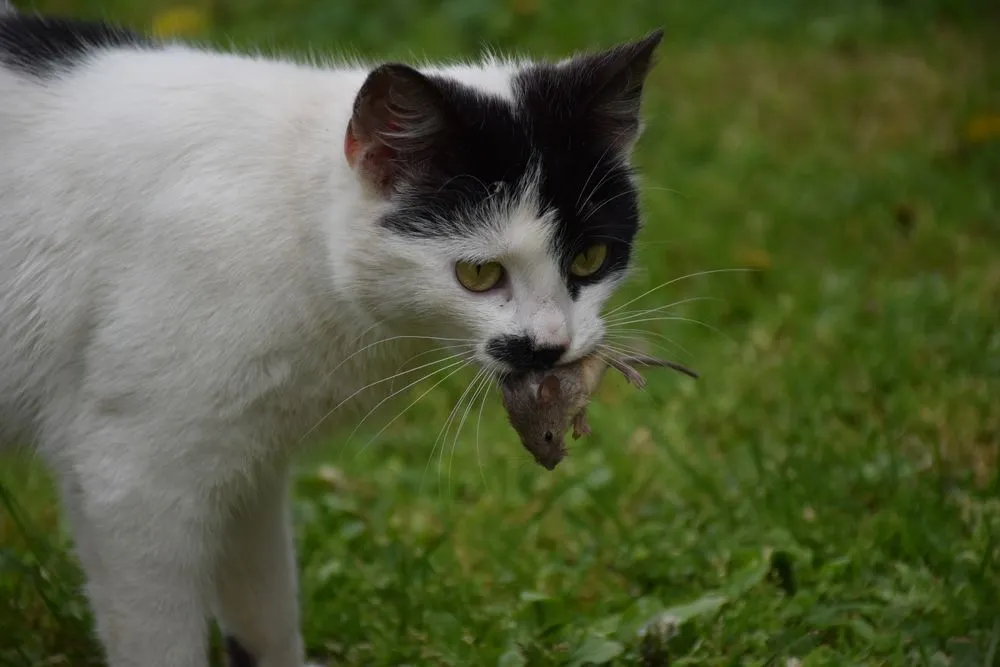
Dogs and cats bring us their kills (and often kill animals without eating them) because they still carry the predatory instincts of their wild ancestors, where killing is separate from hunger. They then haul the prey home, the place they feel safest. The popular idea that pets are "teaching" us to hunt is appealing but not well supported by evidence.
It’s deep-clean Sunday. You’ve reorganized all your cabinets and vacuumed your entire house. It’s taken hours, but everything is exactly where it should be and your house is cleaner than a hospital.
You sit down, ready to finally relax, as you wonder to yourself, “Hmm…I haven’t seen my cat in a while. I wonder where he is?”
Naturally, you set out to look for your cat.
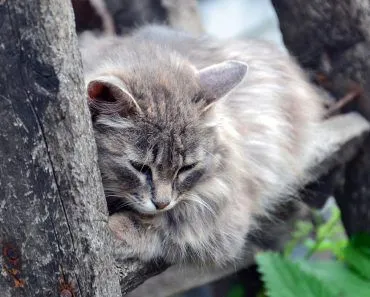
To your absolute horror, you follow a trail of blood and entrails to your bedroom. There, proud as can be, you find your cat playing with what’s left of a dead mouse. With a lack of remorse, your cat walks over to you with the strut of royalty and presents you with her kill, as if she’s doing you a favor.
If this sounds familiar, don’t worry, your cat isn’t psychotic. Nor is she actively trying to undermine your cleaning efforts. In fact, this is quite a common feline (and canine!) behavior. Let’s explore why our cats and dogs present us with their kills.
It’s All About Instinct
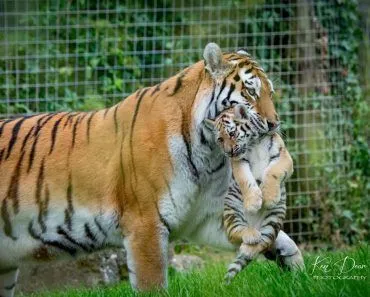
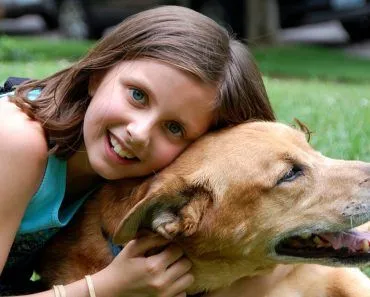
Dogs have lived alongside us for at least 15,000 years (some genetic estimates push it back to 30,000), and cats joined the household roughly 10,000 years ago. Yet despite all that time on the couch, both still carry deep-rooted hunting instincts. Wild felids and canids, particularly females, are very accustomed to hunting for themselves. Domestic cats and dogs are no different.
We might look at our pet cats and dogs and see fluffy little cuddle buddies, but make no mistake… they’re still very, very good at hunting. The crucial thing to understand is that the urge to hunt is hardwired, and it’s separate from hunger. A well-fed pet will still stalk, chase, and kill, simply because the instinct fires on its own.
This is why dogs so often kill an animal and then walk away without eating it (the question many baffled owners type into a search bar). Researchers describe hunting as a “predatory motor sequence”, a chain of behaviors that runs roughly search, stalk, chase, grab-bite, kill-bite, and only then dissect and eat. Domestication didn’t erase these steps so much as scramble them. In many dogs the chase and the kill-bite still fire strongly, while the final “eat” stage is muted or skipped entirely, so the prey ends up dead but untouched. It isn’t cruelty or “killing for fun” in any human sense; it’s an instinct sequence playing out only halfway.
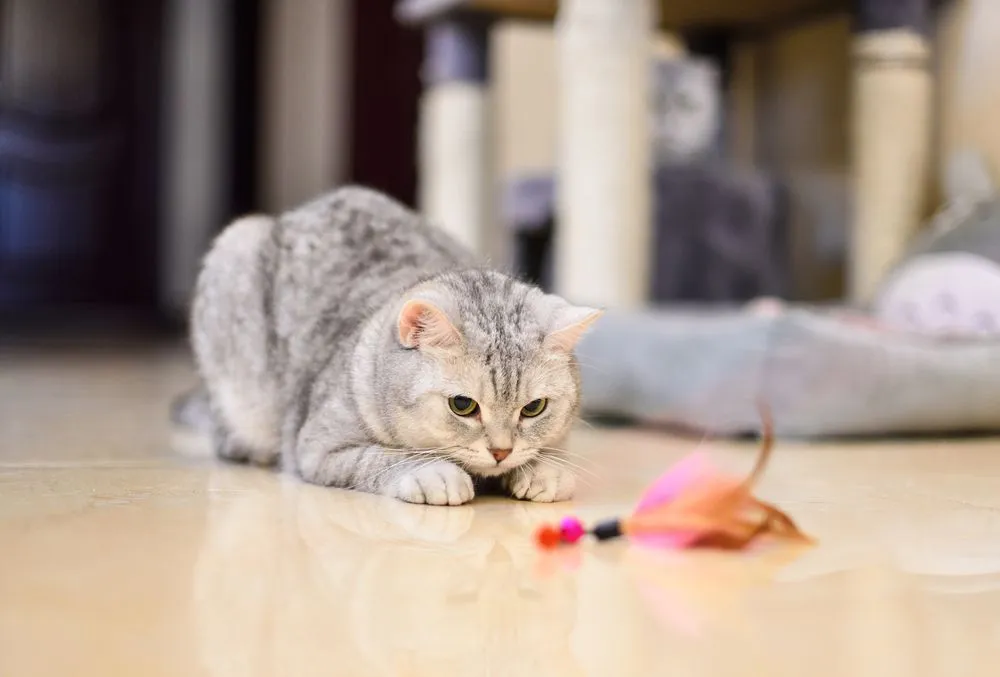
So why bring the catch to us? The most popular explanation is the maternal-teaching idea: in the wild, a mother cat brings dead or injured prey back to her kittens to teach them how to finish off and eat a meal, and the theory goes that your cat sees you as a hopelessly incompetent kitten in need of a lesson. It’s a charming story, and it fits how queens behave with their young. The honest answer, though, is that this is a hypothesis, not an established fact. Vets and behavior researchers caution that we can’t ask cats what they’re thinking, and there’s no direct evidence that pets intend to instruct us.
A simpler, better-supported explanation is that pets are just doing what wild predators do with a catch: take it somewhere safe. Your cat or dog regards your home as the safest, calmest spot in its territory, so prey gets dragged indoors rather than left exposed in the open. Either way, both readings point to the same comforting fact: these animals do treat us as part of their social world. Dogs appear to slot human companions into something like a family or pack, and cats can form genuine attachment bonds with the people they live with.
One thing worth clearing up: cats are essentially solitary hunters, not pack hunters. Feral cats may cluster into loose colonies around a shared food source, and queens will help raise one another’s kittens, but they don’t coordinate a hunt the way a wolf pack or a lion pride does. When your cat brings home a mouse, it caught that mouse alone.
A backhanded compliment
Why Do Dogs Kill Cats And Rabbits But Don’t Eat Them?
The most common version of this question lands in a search bar the moment an owner steps outside and finds the family dog standing over a dead rabbit, cat, or bird, the body completely untouched. It looks baffling, and a little sinister. If the dog didn’t want a meal, why kill at all?

The key is that a hunting dog is neither angry nor hungry. Veterinary behaviorists file this under predatory behavior, and they are careful to point out that it is not really aggression in the everyday sense. An emotional, defensive snap comes with growling, raised hackles, and a surge of stress hormones. Predatory behavior has none of that. As the veterinary reference library VCA Animal Hospitals puts it, it is not considered true aggression, as it is exhibited without emotion. It is a cool, automatic routine switched on by movement, not by rage or an empty stomach.
Remember the predatory motor sequence from earlier (search, stalk, chase, grab-bite, kill-bite, and only then dissect and eat). A darting cat or a bolting rabbit trips the chase-and-grab links, and once the kill-bite fires the routine can simply stall. Researchers who catalogued this sequence in domestic dogs found that pets very often perform only fragments of it, with the final dissect-and-consume stage muted or missing entirely. So the animal ends up dead but uneaten, not because the dog is cruel, but because the last link in the chain never switched on.
Do dogs actually eat cats, then, or just kill them? Overwhelmingly the latter. Dogs are not natural cat-hunters looking for a dinner, cats are nowhere in a dog’s normal diet, and a well-fed pet has no reason to eat what it catches. That is exactly why the body is usually left where it fell. None of this makes the behavior harmless (it is obviously fatal for the prey, and a strong prey drive is why introductions between dogs and smaller pets need real care), but the motive is instinct, not malice.
Do Dogs And Cats Kill For Fun? The Science Of Surplus Killing
The other thing worried owners type out is blunter: is my pet killing for fun, or for sport? The honest answer sits somewhere between yes and no, and there is a proper name for the thing they are describing. It is called surplus killing.

The zoologist Hans Kruuk put the term into the scientific literature in a 1972 paper in the Journal of Zoology, after watching spotted hyenas in East Africa and red foxes in England kill far more prey in a single burst than they could ever eat. The most familiar example is the fox in the henhouse: turned loose among penned birds that cannot flee, a fox may kill almost the whole coop and carry off only one. It looks like slaughter for its own sake, which is why the behavior even picked up the nickname henhouse syndrome.
Kruuk’s explanation, though, was mechanical rather than moral. A carnivore’s sense of being full switches off searching and hunting, but it does not switch off the kill response. Put easy, defenseless prey right in front of a satiated predator and it will keep killing, because the trigger (helpless, moving prey) is still firing even though the appetite is gone. Kruuk noted that this piles up specifically when prey is both abundant and unable to escape, such as during deep snow, a calving season, or inside a raided pen.
So when a house cat leaves a neat row of mice by the back door, or a dog kills a rabbit it never touches, you are watching the domestic echo of surplus killing. It is not entertainment or spite in any human sense. The animal is running an instinct shaped by a world where a full belly today was no guarantee of a meal tomorrow, so a shot at easy prey was simply never passed up. (We dig into where that line between hunting and killing really sits in our piece on whether animals only kill for survival.)
Conclusion
Next time your pet presents you with a dead (or in some gruesome cases, alive) mouse, try to see past the blood and guts. Whatever the exact motive, it’s a sign of how comfortable your pet feels in your house.
Even in the wild, after a successful hunt, predators will often hide their spoils in safe locations, such as dens or bushes. Modern-day cats and dogs treat their homes the same way. After a successful hunt in the yard, pets will often drag their spoils into places where they feel most comfortable, which, flatteringly, turns out to be wherever you are.
It isn’t fully feasible to eliminate this behavior entirely, but veterinarians always recommend keeping pets indoors unless you can keep an eye on them.
In fact, both veterinarians and conservationists alike recommend minimizing this behavior as much as possible. This is because domestic and feral cat and dog populations pose huge threats to local wildlife species.
In Australia, many local councils have introduced 24-hour cat containment rules as part of broader wildlife management policies. This might seem like a drastic step, until we consider the stats. Feral cats in Australia are estimated to kill more than 1.5 billion native mammals, birds, reptiles and frogs every year, and they have played a major role in roughly 25 of the continent’s mammal extinctions since European arrival in 1788, about two-thirds of the native mammals lost in that time.
References (click to expand)
- Why do cats bring their owners dead animals? - Live Science
- Why Do Cats Bring Dead Animals to Me? - Everhart Vet. everhartvet.com
- Vitale, K. R., Behnke, A. C., & Udell, M. A. R. (2019, September). Attachment bonds between domestic cats and humans. Current Biology. Elsevier BV.
- Andics, A., Gácsi, M., Faragó, T., Kis, A., & Miklósi, Á. (2014, March). Voice-Sensitive Regions in the Dog and Human Brain Are Revealed by Comparative fMRI. Current Biology. Elsevier BV.
- Legge, S., Woinarski, J. C. Z., Dickman, C. R., Murphy, B. P., Woolley, L.-A., & Calver, M. C. (2020). We need to worry about Bella and Charlie: the impacts of pet cats on Australian wildlife. Wildlife Research. CSIRO Publishing.
- Holmes, B. J., & Neil, D. T. (2012, December). “Gift Giving” by Wild Bottle nose Dolphins (Tursiops sp.) to Humans at a Wild Dolphin Provisioning Program, Tangalooma, Australia. Anthrozoös. Informa UK Limited.
- Benz-Schwarzburg, J., Monsó, S., & Huber, L. (2020). How dogs perceive humans and how humans should treat their pet dogs: Linking cognition with ethics. Frontiers in Psychology, 3587.
- Feral cats - Invasive Species Council (Australia)
- Kruuk, H. (1972). Surplus killing by carnivores. Journal of Zoology.
- Broseghini, A., Lõoke, M., Guérineau, C., Marinelli, L., & Mongillo, P. (2024). Ethogram of the predatory sequence of dogs (Canis familiaris). Applied Animal Behaviour Science.
- Fear vs. Aggression in Dogs - VCA Animal Hospitals. vcahospitals.com