Table of Contents (click to expand)
Toxoplasma gondii is a mind-controlling parasite that can only reproduce inside cats. In rodents, it reliably erases the fear of cats and even creates an attraction to cat urine, making infected rats easier prey. Claims that it makes people reckless or “crazy” are far weaker, and several large studies have found no such effect in humans.
Genetic studies estimate that our feline friends were first domesticated around 10,000 years ago in the Fertile Crescent, where early farmers welcomed wildcats that hunted the rodents raiding their grain stores. Since then, humans and cats have come to share a long history together. We’ve worshipped them and valued their lives over ours (legend has it that Persia even won a battle against Egypt by carrying cats into the fight, since the cat-revering Egyptians would not risk harming them), mummified them, written extensively about them, made them bearers of bad luck and even practitioners of the dark arts.
Today, we consume cat videos and memes by the droves and obsess over whether cat people are better than dog people. Some people love cats so much that we call them ‘Crazy Cat People’.
However, might this close relationship with cats actually have changed us? Do we really become “crazy” because of our cat overlords? The answer to these questions is a unicellular parasitic protozoan – Toxoplasma gondii.

Toxoplasma gondii‘s Life Cycle
Toxoplasma gondii is a protozoan parasite. Lovingly known as toxo, this parasite is as sneaky as sneaky gets.
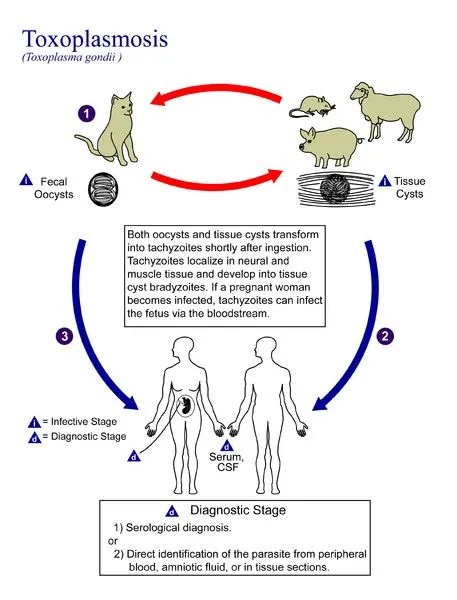
It can only sexually reproduce in the intestines of cats, but it cannot mature there. Thus, the baby toxo, also called oocysts, are excreted along with the cat’s feces.
Out there in the open environment, the freshly shed oocysts take a few days to “sporulate” and become infectious, then wait for their ‘intermediate’ host (the animal host in which parasites can mature and multiply). These oocysts are remarkably hardy and can survive in soil or water for well over a year. The intermediate host comes in contact with these baby toxo by eating something that had oocysts in it. The oocysts, once within the host, mature inside the tissue cells of the animal. To complete the toxo’s life cycle, the intermediate host is preyed upon and eaten by the cat.
These sorts of life cycles with multiple hosts serving different functions are seen throughout the living world, but toxo has some additional features that put it a cut above the rest.
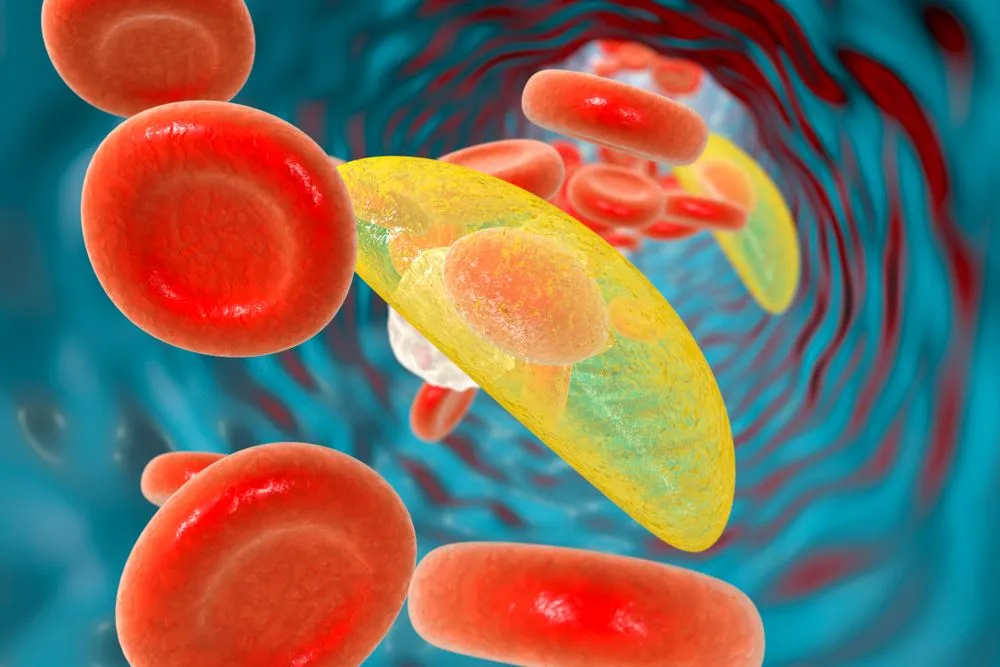
Toxo Can Infect Many Different Animals
Toxo isn’t playing the same game as most other parasites. Oh no… Toxo has several tools up its sleeve to make sure that it ends up in the right place at precisely the right time.
When tiny baby toxos have been released in the feces of the cat, they lie in wait for their intermediate host. These middlemen are meant to be the common prey of cats, such as rodents and birds.
However, toxo isn’t too finicky when it comes to who it will infect. It infects just about any warm-blooded animal that has been unfortunate enough to have consumed it through contaminated water, dirt or, in the case of humans in particular, through eating meat infected with toxo.
Scientists have observed that some strange things happen when toxo enters and settles into its non-feline hosts.
Imagine that a rat has ingested some oocysts and is now infected. Once within the rat, toxo crosses over from the intestine into the blood, then makes its way to its final maturation ground–the muscle cells and the CNS. Here, within these muscle and neuronal cells, it settles, transforming from an oocyst to a tachyzoite and multiplying.
How Does Toxo Change Its Host’s Behavior?
It seems logical that anything infecting the nervous system is bound to cause some changes in it. Toxo, it seems, deliberately and subtly alters neurons and other nervous cells (astrocytes, microglia) that it infects, which causes the rat (in our case) to perform in some bizarre and ridiculous ways. Scientists have been perplexed by the ingenious behavioral puppetry that toxo performs for its benefit.
The rat seems to react slower to danger, and isn’t as scared of a cat or other new things as it was pre-toxoplasmosis, it develops a strange attraction (or decreased dislike) for cat urine and feces, and it may affect their memory and learning.
These symptoms would make any normal rat worry about their infected compadres. All these uncharacteristic rat behaviors make it easier for the rat to be eaten by a cat. In this round, evolution favored the parasite over the host.
Toxo In Humans
Toxo was discovered in 1908 on two separate occasions: by Charles Nicolle and Louis Manceaux at the Pasteur Institute in Tunis, who found it in a North African rodent called the gundi (Ctenodactylus gundi, hence the name gondii), and by Alfonso Splendore, who independently spotted it in a rabbit in Brazil that same year. Since then, we’ve learned that toxo can cause serious illness in people with a compromised immune system.
In the 1930s and 1940s, scientists realized that toxo caused serious abnormalities in a developing fetus. The connection to cats being toxo’s definitive host only came in the 1960s. In individuals with compromised immune systems, like those who have AIDS, toxo can cause blindness and brain lesions and abscesses.
Today, toxo is a remarkably common infection. Worldwide, an estimated one-third of people carry it, although rates vary widely by region (in the United States, roughly 11 to 12 percent of people test positive). Toxoplasmosis can be dangerous for people with weakened immune systems, such as those with AIDS, causing brain abscesses and blindness. Toxo can also harm a developing fetus and cause developmental abnormalities, which is why pregnant women are advised to avoid cleaning the cat litter box.
In spite of this being a widespread disease, it has gotten little attention because it remains latent in most humans. Only 10-20% of those with an infection show symptoms (source). For the average Joe, toxoplasmosis can manifest mild flu-like symptoms, but rarely more than that. That being said, what about the non-symptomatic cat person?

Behavioral Changes In Humans Caused By Toxo
Toxo, even while remaining latent in humans, has been linked to some intriguing behavioral changes. Some researchers have reported that infected people are slightly more reckless and less fearful. A widely cited 2002 study from the Czech Republic found that drivers infected with toxo were involved in more traffic accidents than their uninfected counterparts.
Other studies have implicated toxo in a higher likelihood of psychiatric disorders, such as schizophrenia. The proposed mechanism is plausible: toxo carries a gene for tyrosine hydroxylase, an enzyme that helps produce dopamine, a key neurotransmitter in movement, reward, and fear processing.
Here, though, it pays to be skeptical. The human findings are far shakier than the dramatic headlines suggest. Most are correlational, the effect sizes are small, and they have proven hard to reproduce. Notably, a 2016 study that followed more than 800 people in New Zealand from birth to age 38 found no link between toxo infection and impulsivity, personality, criminal behavior, or psychiatric disorders. So while the parasite clearly rewires the brains of rodents, the case that it turns cat owners “crazy” remains unproven.
Since it was discovered in 1908, T. gondii has shown us the manipulative powers that nature holds. This unicellular parasite has managed to infiltrate the land and even the seas (by infecting sea otters). There are many mysteries as to how toxo actually affects its host’s behavior and the repercussions that this can have on humans.
How Does Toxo Affect Cats?
In cats, toxo doesn’t seem to do much harm at all. Cats can develop toxoplasmosis, but once a healthy cat is infected, it usually mounts a lasting immunity and sheds the parasite’s oocysts only briefly, often just once in its life. Curiously, we still know very little about whether toxo alters the behavior of cats themselves. Citizen-science efforts like the Toxo Project at the University of Nebraska Omaha are trying to find out, comparing the behavior of pet cats that have been exposed to the parasite with those that have not.
One thing is certain, your cat will still be the boss of your house, with or without toxo.
References (click to expand)
- Mendez, O. A., & Koshy, A. A. (2017, July 20). Toxoplasma gondii: Entry, association, and physiological influence on the central nervous system. (M.-J. Gubbels, Ed.), PLOS Pathogens. Public Library of Science (PLoS).
- Dubey, J. P. (2008). The History of Toxoplasma gondii – The First 100 Years. Journal of Eukaryotic Microbiology. Wiley.
- Flegr, J., Havlícek, J., Kodym, P., Malý, M., & Smahel, Z. (2002, July 2). Increased risk of traffic accidents in subjects with latent toxoplasmosis: a retrospective case-control study. BMC Infectious Diseases. Springer Science and Business Media LLC.
- Cats in the Ancient World. World History Encyclopedia.
- Toxo Project, Department of Psychology. University of Nebraska Omaha (UNO).
- Berdoy, M., Webster, J. P., & Macdonald, D. W. (2000). Fatal attraction in rats infected with Toxoplasma gondii. Proceedings of the Royal Society B. The Royal Society.
- Sugden, K., et al. (2016). Is Toxoplasma gondii Infection Related to Brain and Behavior Impairments in Humans? Evidence from a Population-Representative Birth Cohort. PLOS ONE.