Table of Contents (click to expand)
When it’s freezing cold outside and you throw a cup of boiling water into the air, the water droplets rapidly evaporate into vapor that immediately condenses into a cloud. The cloud looks like snow, but it’s actually just water vapor.
It’s freezing cold outside and you decide to take a cup of boiling water outside and throw it into the air. Instead of falling to the ground and searing a hole in the already-fallen snow… Boom! It magically turns into snow!
Have you ever seen this happen before? In recent years, this has become all the rage to videotape, particularly in regions that aren’t used to such extreme temperatures.
These videos go viral every winter when some bored soul sitting in the confines of a heated room gets the crazy idea of recording this bizarre experiment and sharing it on social media.
However, have you every wondered why water at its boiling temperature can miraculously convert into snow in the blink of an eye?
Exactly… I had the same reaction. It’s pretty hard to believe.
But wait a minute! Can you do this anytime and anywhere when it’s freezing cold outside?
The Conditions
Not exactly. This transformation doesn’t really work that way. There are certain conditions that need to be fulfilled in order to create snow from boiling water.
Two conditions to be precise, and if they’re both present, then you should be able to create snow from boiling water:
1) Water should be boiled at 100° C (or 212° F)
2) The outside temperature should be very cold, in the range of (-20° to -30°C or below 0°F) Wow… that is awfully cold!
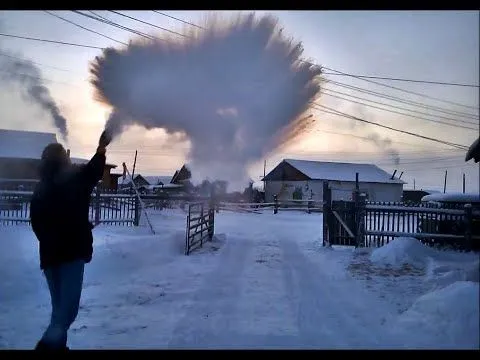
When boiled water is thrown into air at such a cold temperature, it instantly turns into snow and simply drifts away.
However, be careful when trying out this cool-looking phenomenon, and don’t throw the hot water straight up or onto other people. The above phenomenon would not work if the water temperature is less than 100°C (212° F) or if the outside temperature is not cold enough (outside the range of -20° to -30°C, or below 0°F). In other words, if these conditions are not satisfied, you may end up hurting yourself or others with the boiling water.
This is such an unbelievable phenomenon, however, that people go outside in these freezing temperatures, stand in the snow, and throw water to make even more snow! What can I say! Humans can be very difficult creatures to understand.
See the video (below) of a woman having quite a good time at a temperature of -30°C.
Why Does Boiling Water Turn Into Snow?
Boiling water is closer to the point of evaporation than cold water. Cold air is very dense, which makes its capacity to hold water vapor molecules very low. Therefore, when hot water is thrown into extremely cold air, the smallest droplets are able to cool and evaporate in a dramatic cloud before they reach the ground.
In reality, the white cloud isn’t made of true, six-armed snowflakes. It’s a mix of water vapor, condensed micro-droplets and tiny flash-frozen ice crystals, closer to ice fog than to falling snow. Whatever you call it, it still looks like a magic puff of snow, which is why these clips go viral every winter.
As it turns out, sub-zero temperatures aren’t all bad. You can’t make “real” snow this way (the trick won’t work with cold water, by the way, because cold water doesn’t atomize or evaporate fast enough to drive the cloud), but a giant puff of ice fog from a kettle looks pretty cool. (And no, this isn’t the Mpemba effect. That’s a separate, still-debated claim that hot water freezes faster than cold water under certain conditions.)
Just remember to be careful! Don’t burn yourself or anyone else while trying to make the next viral video!
How Cold Does It Have to Be?
This is the question everyone asks, so let’s nail it down. The trick really kicks in once the air drops to roughly -30 °C (-22 °F) or colder. University of Minnesota climatologist Mark Seeley puts the practical floor at minus 22 °F, and even admits he was surprised it worked at a temperature that “warm”. In Minnesota, he says, they don’t bother trying the experiment until it hits minus 30 °F (around -34 °C). The exact number isn’t fixed, because drier air makes the effect easier. A humid -25 °C day might fizzle while a bone-dry one dazzles.

Why such a brutal threshold? It comes down to how much water vapor cold air can hold. The colder the air, the less moisture it can carry, so the boiling water’s vapor has nowhere to go and instantly condenses into a visible cloud. Around -30 °C the air is so “full” that the puff appears the moment the water leaves your cup. At a milder -10 °C the air still has plenty of room for the vapor, so the cloud is faint or doesn’t form at all.
One serious warning before you grab the kettle: pediatric trauma nurse Brad Winfrey of Children’s Mercy Kansas City cautions that this stunt is “not worth the risk of severe burns”. Boiling water can cause third-degree scald burns in seconds, especially on children’s thinner skin, and a sudden gust can blow it straight back at you. If you must try it, throw the water away from yourself and anyone nearby, never overhead.
Does Water Evaporate in Cold Weather?
Yes, water evaporates at every temperature, not just when it’s warm. Evaporation is simply fast-moving molecules escaping a liquid’s surface, and that happens whether it’s a summer afternoon or a freezing morning. Cold just slows it down, because fewer molecules have the energy to break free. That’s why a puddle on a frosty day dries up far more slowly than one in July, but it still dries.
What about below freezing, when there’s no liquid water at all? Ice and snow can skip the liquid stage entirely and turn straight into vapor, a process the NOAA National Weather Service defines as sublimation: “the transition of a substance from the solid phase directly to the vapor phase… without passing through an intermediate liquid phase.” It’s how a thin layer of snow can quietly vanish on a sunny, dry, sub-zero day without ever melting into slush. Dry air, sunshine and wind all speed it along.
And the flip side, turning water into steam, only needs 100 °C (212 °F) at sea level, the boiling point. But you don’t need a rolling boil to see vapor, because the warm, moist air above any hot drink is already shedding water molecules (the same vapor that makes your breath visible on a cold day). In the boiling-water-to-snow trick, the water is right at that boiling point, which is exactly why it sheds vapor so explosively the instant it meets the frigid air.
References (click to expand)
- How to Make Instant Snow From Boiling Water - chemistry.about.com:80
- In weather this cold, you can make snow out of boiling water. Grist
- Boiling Water Freezing When You Throw it in the Air at -40 .... metabunk.org
- How Can Boiling Water Turn into Snow? Live Science
- Sublimation. NOAA National Weather Service Glossary
- The dangers of tossing hot water into freezing air. Fox Weather