Table of Contents (click to expand)
Mushrooms make it rain by launching spores into the atmosphere. Coated in water-attracting sugars like mannitol, these spores act as condensation nuclei that pull in water vapor and seed cloud droplets, which then grow heavy enough to fall as rain. The effect is strongest over forests, where spores are most abundant.
The kingdom ‘Fungi’ is a group of enigmatic organisms. They can’t be neatly classified as plants or animals, yet they have been around for an astonishingly long time. Fossils found in the Canadian Arctic suggest fungi may be roughly a billion years old, far older than the first land plants. Because of their odd position in the tree of life, much about fungi is still being worked out. In fact, the largest living organism on Earth is a fungus! This “humongous fungus,” a honey mushroom (Armillaria ostoyae) in Oregon’s Malheur National Forest, sprawls across roughly 2,385 acres (965 hectares), an area larger than 1,600 American football fields, and is thought to be thousands of years old.
Most of that fungus stays hidden underground as a vast network of root-like threads. What we call a “mushroom” is just the fruiting body, the part that pushes above the soil to do one job: spread spores. And it is those spores, as we’ll see, that quietly help make it rain.
How Are Clouds Formed?
We know that the atmosphere has water in the form of water vapor constantly floating around, which affects the humidity of an area. The molecules of water have an intrinsic ability to coalesce into larger groups. As these groups start getting bigger, they give rise to liquid water, which is manifested in the atmosphere in the form of water droplets. However, the speed at which water vapor molecules vibrate normally keeps them from clumping together. Only below a certain temperature do the molecules slow down enough to allow water droplets to form.
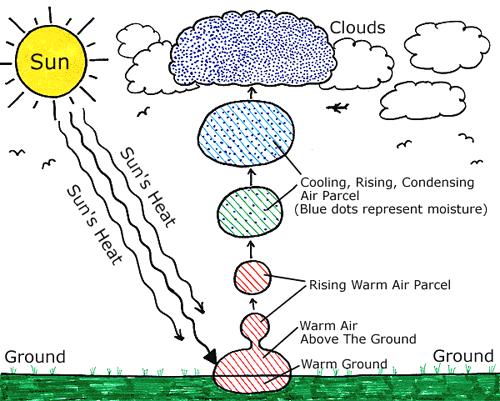
Basic Could Formation. Source- climate.ncsu.edu
The condensation of water molecules is helped along by the presence of small particles suspended in the atmosphere along with air. The particles act as the basic structure or nuclei on which water molecules can stick and easily coalesce. This process is called Cloud Seeding. Although “seeding” often describes human-engineered attempts to control the weather, clouds really do need condensation nuclei to form precipitation. Therefore, when the concentration of suspended particles in the air is high, it is easier to obtain water droplets. When the droplets increase to a sufficient number, they come together to form clouds. The concentration of water in the clouds continues to increase for a long time until the clouds can no longer support their own weight. This is when water in the form of rain falls down to the surface.
How Do Mushrooms Come Into the Picture?
The suspended particles responsible for Cloud Seeding are often biological in origin, such as bacteria, pollen, dry plant fragments and, most importantly, spores from mushrooms.
As you might know, mushrooms are the reproductive organs of fungi. Their main objective is to release as many ‘spores’ into their surroundings as physically possible. This is of utmost importance for their survival, because these spores populate the species.

Magnified Image of Mushroom Spores. Source- pinterest
A single mushroom can “catapult” up to 30,000 spores per second, flicking each one off the gill at launch speeds of roughly 1.8 m/s (4 mph). That initial kick matters: it has to be hard enough to clear the still air trapped between the gills so the spore can catch a breeze. Mushrooms don’t rely on brute force alone, though. As water evaporates from the cap, it cools the surrounding air and stirs up gentle convection currents, tiny self-made breezes that lift the spores up and away. Added together across the planet, it has been estimated that fungi release on the order of 50 million tons of spores into the atmosphere every year.

A Mushroom releasing spores. Source-dannyboston.blogspot.in
Once launched, many of these spores are carried upward by the wind into the cloud-bearing layers of the atmosphere, where they act as particles that water vapor can condense onto. Here is the clever part: a mushroom spore is coated in mannitol and other hygroscopic (water-loving) sugars, the very substances it used to fling itself off the gill in the first place. Those sugars make the spore an excellent magnet for moisture. In a 2015 study published in PLOS ONE, Maribeth Hassett, Mark Fischer and Nicholas Money used an environmental electron microscope to watch water droplets reform on spores held in humid air, exactly the behavior expected of a cloud condensation nucleus. Mushroom spores are not the only reason clouds form, but they can certainly give the process a push.
How Effective Are the Spores?
In areas where the mushroom population is high, weather phenomena are very dependent on mushrooms’ ability to disperse spores into the atmosphere. The effect of spore ‘rainmakers’ is the efficient production of rain over forests, even during warmer months. Alternately, if climate change reduces rainfall in these rain forests, mushroom spore formation would drop and the water scarcity problem would get even worse!

Not much room for mushrooms….
This is especially interesting because we can now observe the complete circle between the responsibilities and the necessities of fungi. Most fungi are adapted to grow in humid and damp areas. The fact that they are highly responsible for rain in such areas just goes to show how well nature works when left alone.
Rainmaking fungi sounds like good news for the climate, but it’s not the full story of fungi’s effect on climate. Saprotrophic fungi decompose a variety of carbon sources, including petroleum, leaf litter, wood, and food products. This process converts that carbon into carbon dioxide, one of the greenhouse gases that drives global warming. Therefore, the farming of fungi to induce rain in drought-stricken areas is not recommended by scientists.
Whatever the case, it’s clear that fungal spores are doing a lot more than we currently give them credit for. Next time you order pizza with mushroom just make sure that you’re indoors. Just kidding, get an umbrella…

I’ll just leave this here. Source- imgflip
References (click to expand)
- Hassett, M. O., Fischer, M. W. F. & Money, N. P. (2015). Mushrooms as Rainmakers: How Spores Act as Nuclei for Raindrops. PLOS ONE.
- Mushrooms as Rainmakers: How Spores Act as Nuclei for Raindrops (full text). PubMed Central, NCBI.
- Made by Rain, Mushrooms Also Make It. Scientific American.
- Strange but True: The Largest Organism on Earth Is a Fungus. Scientific American.
- MinuteEarth (2016). How Mushrooms Make It Rain. YouTube.