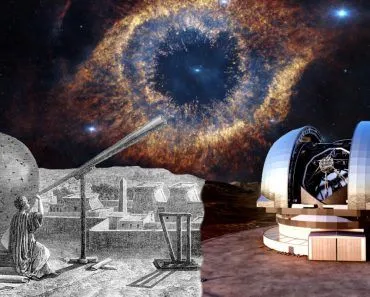
Radio astronomy is the branch of astronomy that studies celestial objects by the radio waves they emit. Using radio telescopes, it reveals stars, galaxies, quasars, pulsars and cold gas clouds that visible light cannot show. Karl Jansky first detected cosmic radio waves from the Milky Way in 1932.
To observe the universe in all its entirety and glory, we need knowledge of not just what shows up in the night sky, but also what celestial objects are made of. Every object out there in the universe emits radiation, which is very telling about its constituent parts. It gives evidence of presumed events in the past and also indicates events that might unfold in the future.
What Is Radio Astronomy?
Radio Astronomy is the branch of astronomy that studies the radio frequencies of objects in space. The radio waves given out by these objects shed light on their inherent cosmic makeup. The first person to detect these waves was Karl Jansky, who in 1932, while hunting for the source of static on transatlantic radio links at Bell Telephone Laboratories, pinned down a faint hiss coming from the center of the Milky Way. A few years later, in 1937, an amateur named Grote Reber built the first dedicated radio telescope (a 9-meter or 30-foot dish) in his Illinois backyard and made the first radio maps of the sky.
Be it stars, whole galaxies, quasars, pulsars or even masers, everything gives out radio waves. Radio Astronomy is carried out by using radio telescopes with massive antenna-like structures.
What Are Radio Waves?
Radio waves are yet another type of wave on the electromagnetic spectrum. Each wave gives off a large number of cycles (the culmination of one peak and one trough equals one cycle). The waves move forward by covering short distances in one cycle. They sit at the low-frequency, long-wavelength end of the spectrum, roughly 104 Hz up to about 3 × 10¹¹ Hz (300 GHz), with wavelengths ranging from a few millimeters to many kilometers, which is also why they are so good for long-distance communication.
Techniques To Carry Out Radio Astronomy
In terms of what device has to be used to analyze the object in space, the power of the signal (a consequence of the distance from Earth) is critically important. Either a radio telescope is simply placed in the direction of the celestial object or a more complex cocktail of multiple overlapping telescopes is used to achieve the required resolution.
Due to the presence of various gases and vapors in the Earth’s atmosphere, the level of detail that can be achieved is reduced. The interference restricts the signals to certain areas of the atmosphere. Building observation laboratories in far-off places is one way to scale down this interference.
- Radio telescopes: Radio telescopes are the simplest devices that can detect radio waves, but their shortcoming is their size. In order to detect very faint signals, the radio telescopes must be massive, with very large apertures, which is not exactly practical and buildable everywhere. The precision associated with radio telescopes is also not entirely appropriate for every neighborhood or region on the planet.
- Radio interferometry: Radio interferometry uses the principle of multiple radio telescopes being put to use for the same object, which eliminates the lack of accuracy involved in using just one radio telescope. The signals from the various telescopes are combined and timed precisely, such that they all observe the same point in the sky at once. Two primary goals that this method meets is the detection and collection of a stronger signal and an unparalleled increase in resolution. The idea is to collectively create one giant telescope without actually building one. The distance between any two of the dishes is called a baseline, and the longer that baseline, the finer the detail the array can resolve, so spreading dishes farther apart sharpens the image of the object. Pushed to the extreme, very long baseline interferometry (VLBI) links dishes on different continents to mimic a telescope nearly the size of Earth.
What Are The Major Radio Telescopes And Observatories?
A handful of instruments have come to define what radio astronomy can do. The largest single dish on the planet is China's FAST (the Five-hundred-meter Aperture Spherical Telescope), which has held that title since the 305-meter (1,000-foot) Arecibo dish in Puerto Rico, an icon for half a century, collapsed in December 2020.
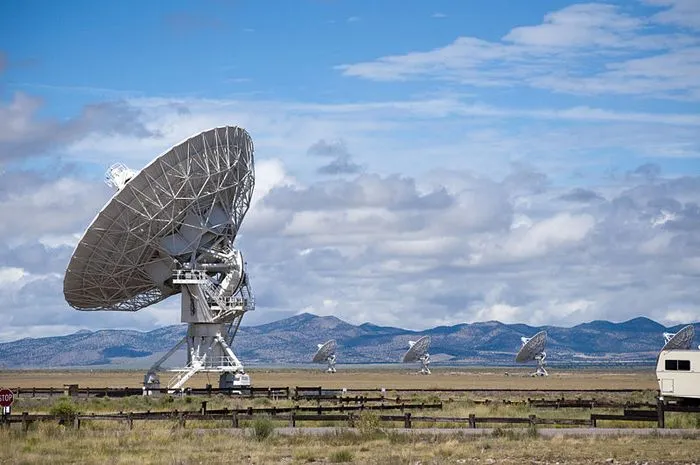
For the highest detail, though, raw size is not enough, which is where interferometry takes over. The Very Large Array (VLA) in New Mexico ties 27 movable 25-meter dishes into one instrument and has been a workhorse of radio astronomy since 1980. Stretch the same idea across the globe and you get the Event Horizon Telescope, a network of radio dishes on several continents that acted as one Earth-sized eye to capture the first-ever image of a black hole (the giant at the heart of galaxy M87, released in 2019) and, in 2022, Sagittarius A*, the black hole at the center of our own Milky Way.
And radio astronomy is still getting bigger. The Square Kilometre Array (SKA), whose construction officially began in December 2022 across South Africa and Australia, will eventually combine thousands of dishes and well over a hundred thousand antennas into the most sensitive radio observatory ever built.
Significance Of Radio Astronomy
Contrary to optical astronomy, which allows us to see the “hot” universe, radio astronomy is mostly used for observing the “cold” universe. Because radio waves are so much longer than visible light, a single radio dish actually has poorer resolution than an optical telescope of the same size, which is exactly why astronomers link many dishes together as an interferometer to claw that resolution back. The key uses of Radio Astronomy are:
- Aids in the detection and analysis of hidden celestial objects that are not visible otherwise, owing to dust and gas clouds
- Aids in understanding the key elemental constituents of stars and complete galaxies
- Helps to intricately study the gas and dust clouds
- Helps to traverse the farthest points of the universe, which is impossible with just an optical telescope
- Gives an idea about how the universe came to be, how it has evolved over the millennia, and where we are headed
- Tells us more about the black holes present at the centers of galaxies
When Radio Astronomers look for radio waves, they can even see the otherwise dark parts of the sky. What doesn’t strike a chord to our eyes means something far more significant to a radio telescope. One of their most beneficial uses is studying the birth of stars amidst dense clouds of dust and gases.
By patiently collecting the faint radio waves a celestial object naturally gives off, even the minutest of details can be mapped out and analyzed further. The superposition of multiple data points enables astronomers to create a virtual image of the object in discussion.
What started out as a mere hiss every time the center of our galaxy rose has now panned out into something extremely important. Radio Astronomy is now helping us determine facts about distant stars and planets that are crucial in understanding the core characteristics of the universe. Clearly, visible light is not enough to weave the full story of a celestial object!
References (click to expand)
- Basics of Radio Astronomy by Diane Fisher Miller.
- Why radioastronomy? - www.iram-institute.org
- The Science of Radio Astronomy.
- Karl Jansky | Biography, Discovery, & Facts. Britannica.
- Radio telescope - Interferometry and Aperture Synthesis. Britannica.
- Astronomers Capture First Image of a Black Hole. Event Horizon Telescope.
- Astronomers Reveal First Image of the Black Hole at the Heart of Our Galaxy. NSF.
- SKA Observatory Celebrates Start of Telescope Construction. SKAO.