Table of Contents (click to expand)
Regulus, or Alpha Leonis, is the brightest star in the Leo constellation and the 21st brightest in the night sky, lying about 79 light-years away. It is actually a quadruple star system, but only its blue-white primary, a rapidly spinning star roughly four times wider than the Sun, is visible to the naked eye.
When you look up into the blanket of night from a remote location, the ocean of stars is breathtaking, but there are definitely a few that stand out, either for their brightness, their unique hue (often planets), their juxtaposition to other stars, or some combination of all these factors. One such “upper echelon” star is Regulus, with the proud title of the 21st brightest star in our sky, and the brightest point in the legendary Leo constellation.
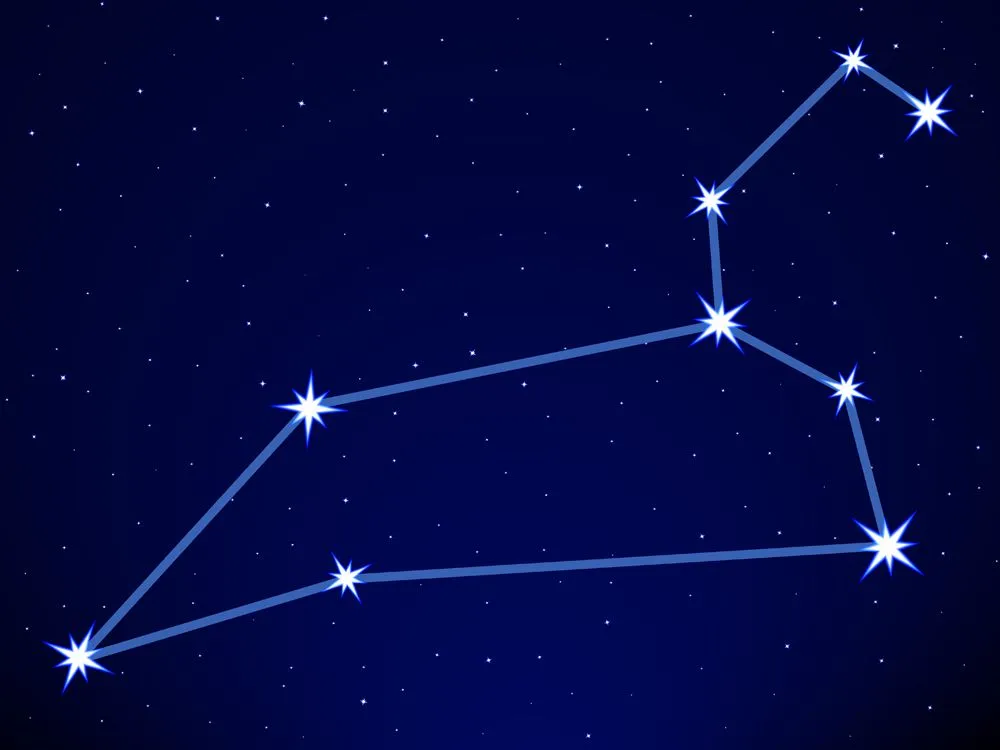
However, this main sequence star, located roughly 79 light-years from our solar system, has more to it than meets the eye, namely that it is a quadruple star system, although one of the stars has never been directly observed! This bright beacon of the night sky has also been earning attention and mythological significance for thousands of years, often in a regal or leonine context. To this day, Regulus remains a point of study for astronomers, and a gleaming signal of spring.
What Is Regulus?
Regulus is the common name for Alpha Leonis, often shortened to Alpha Leo, a blue-white star that is roughly four times wider than the Sun, and about 150 times as bright! Despite being around 79 light-years from Earth, and not even in the hundred closest star systems, it is the 21st brightest object in the night sky.
Alpha Leo may dominate this star system, but it is not alone. This blue-white star has a close companion, though the pair is technically known as a spectroscopic binary, as the companion has never been directly observed. It is likely a pre-white dwarf, which is thought to have slowly fed its mass into Regulus (Alpha Leo), spinning it up and allowing it to grow to such an impressive size and brightness. The other two stars in the system, Regulus B and Regulus C, form a close pair of their own, with the former being visible with binoculars, and the latter requiring a high-level telescope to detect. However, when you’re staring up at the constellation of Leo, admiring the blue-white twinkle of the Regulus system, Alpha Leo will outshine them all.

Considering the star from a physical perspective, it is something of an anomaly, as it is spinning very rapidly. To provide some context, our Sun rotates once every 25-35 days, depending on the area (the surface rotates at variable speeds), at an equatorial velocity of about 2 km/s (1.24 miles per second). Regulus, on the other hand, whips around at roughly 317 km/s (197 miles per second), completing one rotation in less than 16 hours. Because of this incredibly fast rotation, this star is not a perfect sphere, but rather a squashed, oblong shape.
That frantic spin also gives the star a lopsided temperature. Because the squashed equator bulges outward, it ends up cooler than the poles, an effect known as gravity darkening. The poles glow at a searing 14,500 °C (about 26,000 °F), while the puffed-out equator is cooler at roughly 10,700 °C (around 19,300 °F). Either way, Regulus runs far hotter than our Sun, whose surface cooks along at a comparatively mild 5,500 °C (about 9,940 °F). Experts believe that if Regulus were rotating only about 10% faster, gravity would no longer be able to hold the star together, and it would tear itself apart.
As they say, the brightest stars burn out fast, and this isn’t only true for child stars in Hollywood. Incredibly bright stars like Regulus produce and use huge amounts of energy, burning through their internal resources (e.g., hydrogen, helium, etc.) relatively quickly. While Earth’s beloved star still has about 5 billion years of life left, the far heavier Regulus is racing through its fuel and is already nearing the end of its main-sequence life, despite being only a few hundred million years old.
The Legends And History Of Regulus
Often referenced as the kingly star, Regulus has long been linked to royalty. It is visible in the night sky for the majority of the year, except for one month on either side of August 22; this permanent presence, as well as its key placement in the legendary Leo constellation, may have something to do with connotation.

Regulus marks the lower end of the Sickle of Leo, as well as the “heart” of the Leo Constellation. Regulus itself translates roughly to “Little King”, perhaps since it was already ensconced in the “king” of the jungle, and thus had to be diminished in name to “little”. This star has been casually known by many names throughout history, including Cor Leonis (heart of a lion) and Rex. In mythological terms, the Leo constellation was believed to be the Nemean Lion from Hercules’ trials. Around the world, these stars connoted powerful beasts, including mountain lions, dragons, horses and even one of Daniel’s lions from biblical lore.
A Final Word
Regardless of culture or geographic placement, Regulus has affixed itself in the astronomical culture and tradition of humanity. It may not be the brightest or biggest star in the sky, but it draws the eye, and sparks the imagination. And in the astronomical blink of an eye, when it finally reaches the end of its dramatic life, the night sky will lose a true king of the cosmos!
References (click to expand)
- Rappaport, S., Podsiadlowski, P., & Horev, I. (2009, May 22). The Past And Future History Of Regulus. The Astrophysical Journal. American Astronomical Society.
- Gies, D. R., Dieterich, S., Richardson, N. D., Riedel, A. R., Team, B. L., McAlister, H. A., … Baade, D. (2008, July 3). A Spectroscopic Orbit for Regulus. The Astrophysical Journal. American Astronomical Society.
- Fuhrmann, K., Chini, R., Kaderhandt, L., Chen, Z., & Lachaume, R. (2016, April 3). Evidence for very nearby hidden white dwarfs. Monthly Notices of the Royal Astronomical Society. Oxford University Press (OUP).