Table of Contents (click to expand)
Betelgeuse is a red supergiant star in Orion, around 550-700 light-years from Earth, that is expected to die as a supernova within roughly the next 100,000 years. Its explosion will briefly shine as bright as the full Moon in our sky, but it is far too distant to harm life on Earth.
When you hear someone talk about Betelgeuse, the first thing you think of may be the undead prankster from the movie of the same name (Beetlejuice).
 However, if you’re in a room full of astronomers and the word Betelgeuse comes up, they’re likely talking about the star with that same name, one of the brightest celestial objects that we can see in our sky. It is also the subject of some fascination because there are those who believe that it could spell destruction for our planet and species!
What Is Betelgeuse?
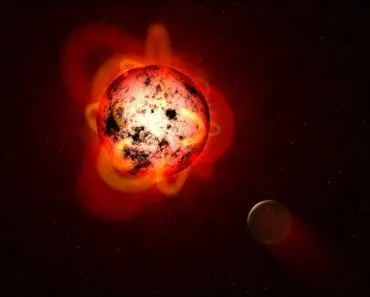
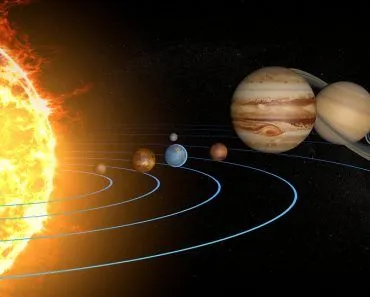
Betelgeuse is a Class M red supergiant, roughly 100,000 times more luminous than our Sun (counting all the infrared light it pours out) and somewhere between 15 and 20 times more massive. This powerful star sits in the constellation Orion, and modern estimates place it about 550-700 light-years away from our solar system. It is also one of the largest known stars, with a radius of roughly 700 times that of the Sun, which works out to a diameter of around 1 billion kilometers (about 650 million miles). This massive size means that if Betelgeuse sat where our Sun does, it would extend past the orbit of Mars and out toward the orbit of Jupiter, completely engulfing Earth without a second thought. Good thing it’s not our next-door neighbor!
Its age has been estimated at about 10 million years, and for a star as massive as Betelgeuse, that means it is approaching the end of its lifetime. “Approaching the end” is a relative term, of course, since we’re talking about cosmological time, which is measured in millions or even billions of years, rather than centuries, like human life! Although it has up to 20 times the mass of the Sun, larger stars burn through their fuel much faster than smaller stars. For example, our sun is already 4.6 billion years old, and isn’t expected to run out of hydrogen (fuel) for another 5 billion years.
Betelgeuse, however, is guzzling its fuel and pumping out light at an incredible rate, making it the 10th brightest star in the night sky for most of the year, and in the infrared scale, there is nothing brighter! While all of these facts about Betelgeuse mean that it is a brilliant, unique and wildly luminous star in our sky, it also means that when it runs out of fuel, it’s going to go out in truly dramatic fashion. Yes, you guessed it… Betelgeuse is going to go supernova!
If you have followed the star in the news, you may remember its strange behavior in late 2019 and early 2020, an episode astronomers now call the “Great Dimming.” Over a few months, Betelgeuse lost more than half of its visible brightness, slumping to the faintest level ever recorded for it. Skywatchers wondered whether this was the long-awaited countdown to its explosion. It was not. Studies using the European Southern Observatory’s Very Large Telescope and NASA’s Hubble Space Telescope showed that the star had belched out a huge cloud of gas, which cooled into dust and temporarily veiled part of its surface, like a giant sneeze drifting across our line of sight. Betelgeuse returned to its normal brightness by the spring of 2020, very much alive and still ticking toward its eventual end.
The Death Of Betelgeuse
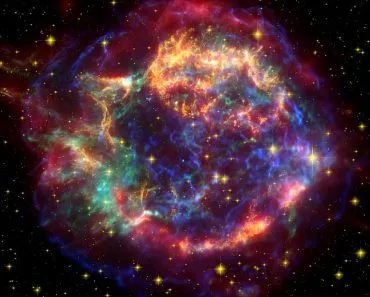
One of the most dramatic celestial events in our universe is a supernova, the explosive death of a massive star. Once all of the fuel in such a star has been expended through nuclear fusion, it will collapse under its own massive weight. At a certain point, however, once the density at the core becomes untenable, it rebounds outwards in a devastating supernova.
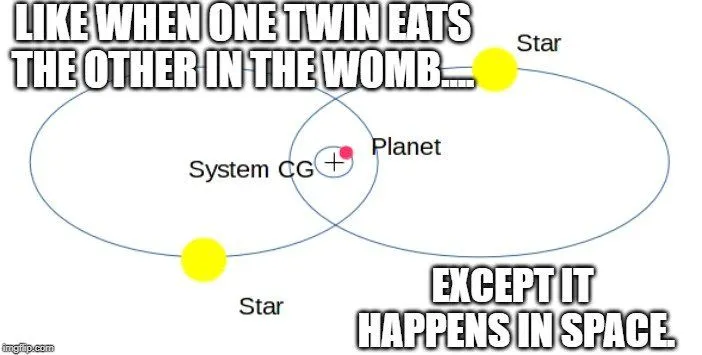
Considering that Betelgeuse is one of the largest stars we’ve ever detected, its eventual explosive end could also be one of the most spectacular supernovae in millions of years. The actual explosive collapse of the core happens in mere seconds, but the radiation that is then pushed out into the universe may remain at peak luminosity for weeks or months before finally dropping off and dimming. Since Betelgeuse is such a massive star, and will explode due to core collapse, it is categorized as a Type II supernova. Type Ia supernovae, on the other hand, are believed to be caused by mass being drawn onto a white dwarf when a star is in a binary system.
Some superluminous supernovae can be brighter than an entire galaxy of stars, and given the size of Betelgeuse, it is going to put on quite a show when it finally goes! As mentioned earlier, this star is definitely approaching the end of its life, and is expected to go supernova at some point in the next million years. That being said, estimates about star life spans and death dates are just that… approximations. There is also some debate between astronomers as to the life expectancy of the star, with some saying that the star is nearing its peak size, and could collapse at some point in the next 100,000 years, a veritable blink in cosmological time scales. In truth, Betelgeuse could blow up tomorrow, but that doesn’t mean that the world is going to end.
Betelgeuse may be very close to us, a few hundred light-years away, in relative terms to other objects that are millions of light-years distant, but several hundred light-years is still a staggering distance. The nearest star system to Earth is Alpha Centauri, coming in just over 4 light-years away, meaning that it takes more than four years for the light from those stars to reach our eyes on Earth! In fact, Betelgeuse may have already gone supernova, and the light of the explosion simply hasn’t reached us yet!
However, for those of you who have just been flung into a panic at the meaningless of the universe and the inevitable destruction of Earth at the hands of the Betelgeuse supernova, don’t worry. Even if it does generate one of the largest supernovae ever, Betelgeuse is still far enough away from our planet that it wouldn’t be our death knell. The physical ejection of material from the explosion would eventually reach Earth, but it would be cooled off long before hitting our atmosphere, and would have a negligible effect. The radiation from such a massive explosion would have slightly more of an impact, but not enough to blow away or ionize our atmosphere. What we would get instead is a front-row seat to a spectacle: for a few weeks or months the supernova would blaze about as brightly as the full Moon, casting shadows at night and remaining visible even in broad daylight, before slowly fading from view.
 It is difficult to predict the effects of a supernova with 100% accuracy, but we do know that more than one supernova has gone off in our cosmic neighborhood within the past few million years. Those nearby explosions appear to have occurred even closer to us than Betelgeuse, and they don’t seem to have caused any lasting harm to life, according to the fossil record from that period. Some chemical evidence (such as radioactive iron-60 buried in ocean sediments) points to their occurrence, but we can find no proof of any dramatic or climatic effects on the planet.
A Final Word
Betelgeuse still has a few surprises left in it. Astronomers had long suspected that something was tugging on the giant, because its brightness rises and falls on a slow, roughly six-year rhythm on top of its faster pulsing. In 2024 and 2025, observations using NASA modeling and the Gemini North telescope in Hawaii turned up the likely culprit: a small companion star orbiting astonishingly close to Betelgeuse, nicknamed “Betelbuddy” (and proposed to be formally named Siwarha). It appears to be a young star of around 1.5 solar masses, circling within the bloated outer atmosphere of the supergiant. The detection is still tentative rather than rock-solid, and gravity is expected to drag this little companion into Betelgeuse within the next several thousand years. So even before the big explosion, Betelgeuse may quietly swallow a star.
The next time someone brings up Betelgeuse at a party, you’ll be able to calm everyone’s nerves and explain that, while that star’s eventual death will make for one incredible sight, the odds of it happening within any single human lifetime are tiny (very roughly a tenth of a percent), and even on those minuscule odds, it almost certainly won’t have any harmful effect on our pale blue dot!
References (click to expand)
- What is Betelgeuse? Inside the Strange, Volatile Star. NASA Science
- Betelgeuse: Size, Dimming, Companion and Facts. Encyclopaedia Britannica
- Mystery of Betelgeuse's dip in brightness solved. European Southern Observatory (ESO)
- NASA Scientist Finds Predicted Companion Star to Betelgeuse. NASA
- Supernovae. NASA Goddard Space Flight Center (Imagine the Universe)
- Betelgeuse: The Eventual Supernova. Space.com
- Betelgeuse will explode someday. EarthSky
- Betelgeuse. Wikipedia