The reason stars appear to be stationary if the galaxy is constantly moving is because they are moving at a very slow pace compared to their distance from us. Even though they are moving fast in absolute terms, their motion is negligible when considered on galactic scales.
If you are into stargazing and astronomy, in general, then you probably know that the Milky Way, i.e., the galaxy of which we are a part, is constantly moving. Our planet, the sun, the solar system and our entire galaxy is constantly revolving. More specifically, the arms of the galaxy are moving through space, so the sun and our solar system travel with them.
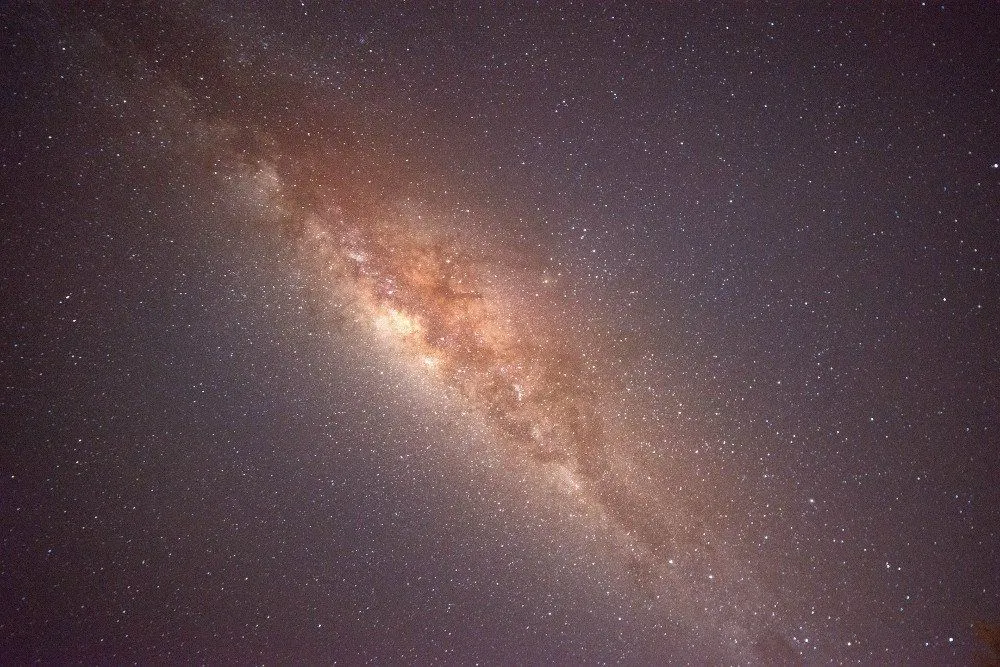
Many of the stars that we see in the night sky reside in the Milky Way. Now, we know that the Milky Way is constantly moving, right? So, it only stands to reason that the stars it consists of also move in space. That, in turn, would mean that the relative positions of these stars must change in our night sky. Yet, as you know all too well, that doesn’t happen, i.e., the stars in our night sky seem rather ‘fixed’ in their place. Why is that?
Why do stars seem to be motionless if the galaxy is constantly moving?
As it turns out, there is a very simple reason behind it.
It’s very easy for such questions to pop up in your head, especially when you look at things from a mere mortal’s perspective. However, once you know and understand how insanely huge the universe is, you begin see the ‘light’.
The Motion Of Stars
It’s true that stars seem absolutely motionless, like sitting ducks in the vast expanse of the blackness of space. Even so, the truth is that every star you see in the night sky is, in fact, constantly moving.

It’s interesting to note that it was the knowledge of the motions of stars in external galaxies that led to the idea of dark matter in the universe; this connection is because their motion indicated that the mass present within their orbit couldn’t be accounted for by only the visible matter (Source).
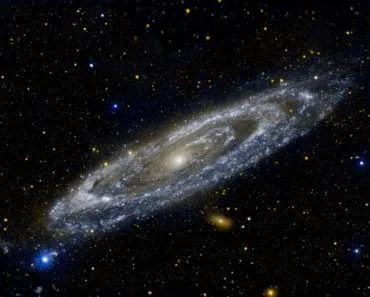
Our galaxy not only rotates around its own axis but is also drifting through space, and for decades astronomers said it was on a collision course with the Andromeda galaxy. (Newer Hubble and Gaia data from 2024-2025 actually put that closer to a 50-50 chance over the next 10 billion years.)
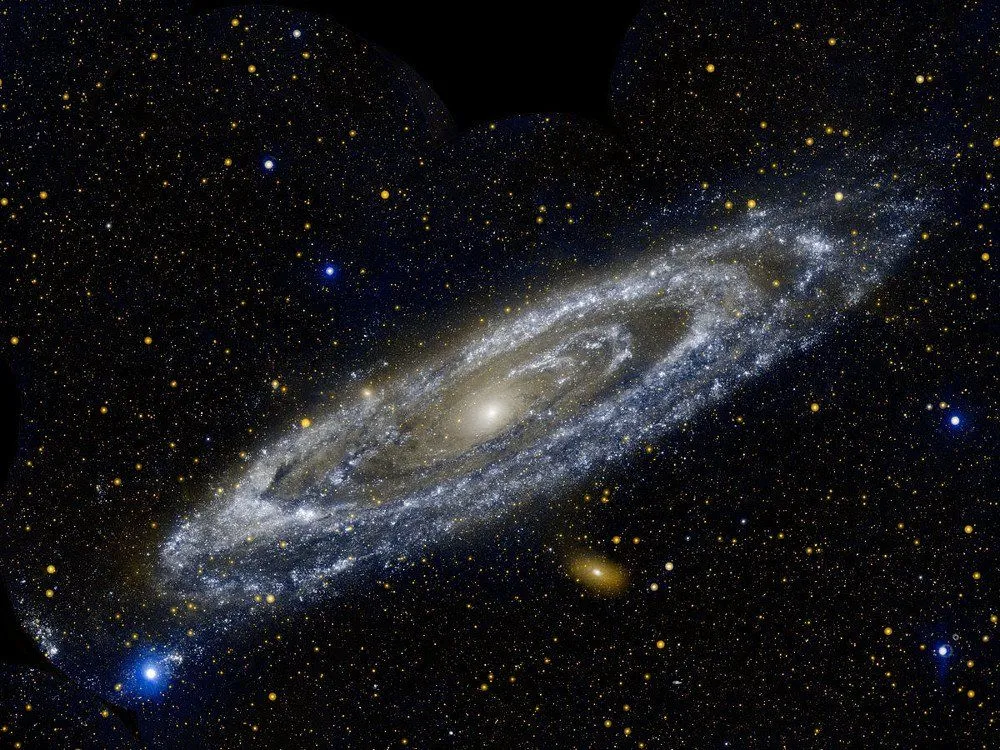
However, the aforementioned motions of our galaxy are relatively slow. Even under the older 4-5 billion-year collision estimate, the encounter is so far off in the future that it gives you some idea of how slow galactic motion is on human timescales.
These movements occur at the rates of a few kilometers per second, which would be considered quite fast by most people, but when you factor in the massive distances involved, these speeds become negligible in comparison!
Enormity Of Galactic Distances
It’s true that everything in the universe is moving quite fast, but everything is also insanely far apart. Think about it: the light from the sun, which zooms by at a staggering pace of 670,616,629 mph, takes more than 8 minutes to reach our planet, 5 hours to reach Pluto and more than 400 years to reach the North star!
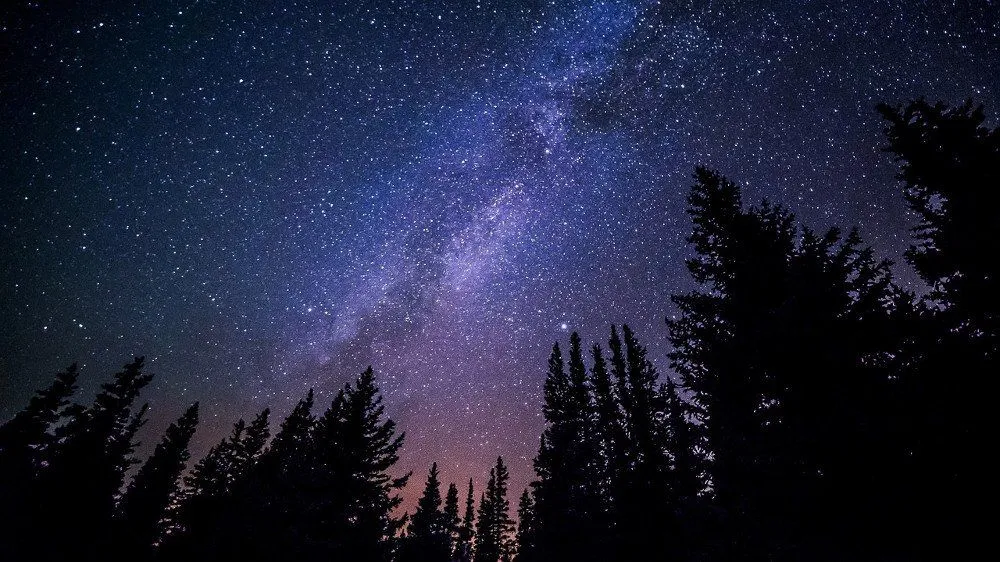
Now, stars move at the pace of a few tens of kilometers per second, which is quite fast if you think about it from our mere Earthling perspective. However, that’s virtually negligible when considered on galactic scales.
We shouldn’t forget that even the nearest stars are situated awfully far away (at least a few light-years) from us. Thus, their motion over a period of 60-70 years (the length of an average human’s life) is so small compared to their distance from us that they seem to be fixed in the same spot.
For instance, consider a nearby star that is situated 10 light-years away from Earth. The star moves through space at a speed of 10 km/s. A quick calculation will tell you that over a period of 100 years, the star would have moved around 30 billion kilometers. That sure is a lot of distance!
But remember… that same star is located 90,000 billion kilometers away from us. So, do you think that the distance of 30 billion kilometers (that it moved in 100 years, i.e., the lifespan of a particularly healthy human being) would be noticeable when viewed from a distance of 90,000 billion kilometers?
No, it wouldn’t. Not even close.
And that’s why stars appear to be stationary in the sky, despite the fact that they, and the galaxy, are both moving extremely fast through space.
Is The Milky Way Itself Stationary Within The Universe?
This is the natural follow-up question, and the short answer is a firm no. Nothing in the cosmos sits perfectly still, and that includes our entire galaxy. The trick is realizing that motion is only ever measured relative to something else. There is no special, absolute landmark in space that you can plant a flag in and call "at rest", so the honest answer to "is our galaxy stationary?" depends entirely on what you compare it to.

Start close to home. Our sun (and everything riding along with it) is sweeping around the center of the Milky Way at a brisk clip. NASA puts our average speed at roughly 828,000 km/h (about 230 km/s, or 515,000 mph), yet a single lap around the galaxy still takes around 230 million years. One "galactic year" ago, the dinosaurs had not even shown up yet. You can read more about what sits at the centre of the Milky Way that we are all orbiting.
Now zoom all the way out. The closest thing astronomers have to a cosmic "rest frame" is the cosmic microwave background (CMB), the faint afterglow left over from the early universe that fills the sky in every direction. Because we are moving through it, that glow looks very slightly warmer in the direction we are heading and cooler behind us, a lopsided pattern called the CMB dipole. Measuring it tells us our whole neighborhood of galaxies (the Local Group) is barreling along at around 600 km/s toward the constellation Centaurus. So no, the Milky Way is not parked anywhere. It just happens to be moving slowly enough, and the universe is big enough, that you would never notice from your backyard.
What Is Proper Motion, And Which Star Moves Fastest?
Astronomers actually have a name for the tiny sideways drift of a star across our sky: proper motion. It is the apparent angular motion of a star relative to the more distant background stars, and it is measured in arcseconds (or, more often, milliarcseconds) per year. To picture an arcsecond, slice the full Moon's width into about 1,800 thin strips, and one strip is roughly an arcsecond. So even a "fast" star creeps across the sky by an almost laughably small amount each year.

The record holder is Barnard's Star, a dim red dwarf about 6 light-years away. The American astronomer E. E. Barnard measured its proper motion in 1916 at a whopping 10.3 arcseconds per year, the largest of any known star. That still sounds tiny, and it is: at that rate it covers only about a quarter of a degree (roughly half a full Moon's width) over a human lifetime. A more typical star drifts at around 0.1 arcseconds per year, so it would take a century just to budge by 10 arcseconds.
Stack that crawl up across the whole sky and you get the bigger payoff: the constellations do change shape, just over many thousands of years rather than within a lifetime. If you are curious about how the familiar patterns slowly warp, we cover exactly that in whether the constellations will always look the same.
If A Point Of Light Slowly Moves Among The Fixed Stars, What Is It?
Here is a puzzle skywatchers run into all the time: most of the sky looks frozen, but one bright dot seems to shift its position from one night to the next, sliding past the "fixed" stars. If a point of light wanders like that over days and weeks, it is almost certainly not a star at all. It is a planet.

The word "planet" comes from the Greek for "wanderer", and that is exactly how the ancients spotted them. Night after night, the five naked-eye planets shifted in a generally eastward direction against a backdrop of stars whose positions stayed put. The reason is distance, again. Planets are right next door in our own solar system, so their orbital motion (and ours) is easy to notice over weeks. The stars sit trillions of kilometers away, so their far larger true speeds shrink into invisibility. Planets occasionally even appear to loop backward for a while, an illusion called retrograde motion that happens when Earth overtakes a slower outer planet in its orbit. (One more culprit worth ruling out: a steady point of light that glides clear across the sky in a few minutes is usually a satellite, not a planet.)
References (click to expand)
- Does the Sun move around the Milky Way?? - Starchild (NASA). The National Aeronautics and Space Administration
- across the Milky Way - how big is our universe?. The Center for Astrophysics | Harvard & Smithsonian
- Brad's Astronomy Pages | Western Washington University. Western Washington University
- Apocalypse When? Hubble Casts Doubt on Certainty of Galactic Collision. NASA
- Cosmic Microwave Background Dipole. COSMOS - Swinburne University of Technology
- Proper motion. COSMOS - Swinburne University of Technology
- Barnard's Star. NASA Astrobiology
- Lecture 6: Motions of the Stars. The Ohio State University, Department of Astronomy