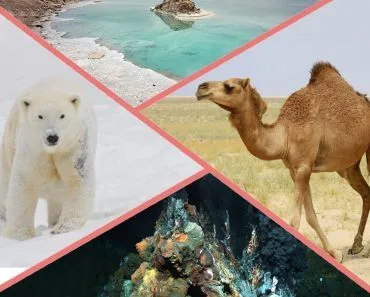
Life in deserts is hard due to the scarcity of food and water. However, plants, animals and humans have adapted in various ways to survive a life in deserts.
Can you imagine living in the scorching heat of a desert? If you’ve ever spent any time in one, it feels like it can’t sustain any life due to its arid climatic conditions. So how do certain plants and animals survive in such weather?
Yes, there are living things apart from camels and cacti in the desert! In fact, there is a history of thriving civilizations in our planet’s deserts with a total population of nearly 1 billion people!
If you think deserts are a waste of land and lack any useful resources, think again! Deserts have massive oil reserves, especially in the Arabian Desert (Middle East), which is a very economically useful resource.
By the end of this article, your view will be forever changed about the utility of deserts. But before we dig into the clever adaptations of plants, animals and humans, let’s answer the questions most people actually ask: why is life out here so hard, and why does anyone choose to call these realms “home”?
Why Is Life In The Desert So Difficult?
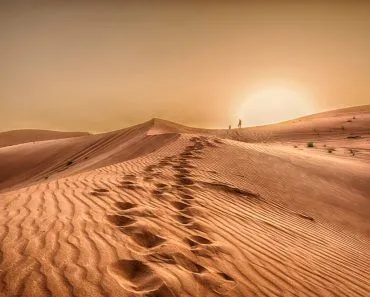
A desert is, by definition, a place of scarcity. Geographers classify a region as a desert when it receives no more than about 25 centimeters (10 inches) of rain a year. The driest places on Earth get almost none: parts of Chile’s Atacama Desert see less than 2 millimeters (0.08 inches) of precipitation annually. With so little water, and humidity near zero, every living thing here is constantly fighting to hold on to moisture.

Punishing heat, then bitter cold: Hot deserts can reach blistering daytime temperatures of up to 54 °C (130 °F). Yet because dry desert air holds almost no moisture to trap heat, that same air loses warmth rapidly after sunset. In the Chihuahuan Desert, for instance, days can climb past 37 °C (100 °F) while nights drop below freezing (0 °C or 32 °F). Surviving a single 24-hour cycle here means coping with both extremes.
Water is the limiting resource: Plants, animals and people all run into the same problem first. Without reliable rainfall there is little surface water, few crops can grow unaided, and food is correspondingly scarce. This relentless shortage of water and food is exactly why so many desert societies stayed mobile rather than putting down roots in one spot, as we’ll see next.
Where And Why Do People Live In Deserts?
Despite all of that, deserts are far from empty. Around 1 billion people, roughly one-sixth of Earth’s population, live in desert regions. So where do they actually settle, and why would anyone choose to live here?

They cluster around water. People don’t spread evenly across a desert; they concentrate wherever water reaches the surface. Around 90 major inhabited oases dot the Sahara alone, and the great river valleys that cut through deserts, such as the Nile, support dense populations and farming along their banks. The Colorado River does the same across the Sonoran and Mojave deserts of the American Southwest.
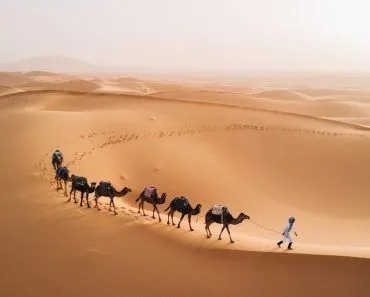
They follow grazing and trade. Many desert peoples have historically been nomadic herders, moving flocks of sheep, goats and camels between scattered patches of water and grazing land. Deserts also sat astride ancient trade routes, with camel caravans carrying salt, gold and other goods between distant towns.
They go where the resources are. Modern deserts hold valuable resources that draw permanent settlement, most famously the massive oil reserves of the Arabian Desert in the Middle East, along with minerals mined in arid regions worldwide.
Adaptation Of Plants In Deserts
Plants in the desert face two relentless challenges: extreme heat and very little water. To survive, they have evolved a fascinating set of adaptations.
Water storage: Cacti and succulents store water in thick, fleshy stems and leaves. A mature saguaro cactus can hold hundreds of gallons of water, which it draws on slowly during droughts.
Reduced leaves and waxy coatings: Many desert plants have small or needle-shaped leaves to minimize water loss through transpiration. A waxy cuticle on leaves and stems further reduces evaporation.
Deep or wide root systems: Mesquite and acacia trees can send taproots more than 30 metres (100 feet) deep to reach groundwater, while creosote bushes spread shallow roots over a wide area to capture even small amounts of rainfall.
CAM photosynthesis: Cacti and other succulents use crassulacean acid metabolism (CAM), opening their stomata only at night to absorb CO2, which dramatically reduces water loss during the hot day.
Dormancy and ephemeral life cycles: Some desert wildflowers complete their entire life cycle in a few weeks after rare rainstorms, leaving seeds that can survive years of drought.
Adaptations Of Animals In Deserts
Desert animals have evolved equally impressive strategies to deal with extreme temperatures and water scarcity.
Behavioural adaptations: Many desert animals are nocturnal or crepuscular (active at dawn and dusk), avoiding the brutal midday heat. Reptiles like lizards and snakes bask in the morning sun for warmth and seek shade or burrows when temperatures spike.
Water conservation: The kangaroo rat is so efficient at conserving water that it can survive its entire life without drinking, extracting all the moisture it needs from the seeds it eats. Camels can survive for weeks without water and are able to drink up to 100 litres in just 10 minutes when water is available.
Body cooling: Fennec foxes and jackrabbits have oversized ears packed with blood vessels that radiate heat away from the body. The horned lizard can squirt blood from its eyes as a startling defence mechanism.
Burrowing: Animals like the desert tortoise, scorpions, and many rodents spend most of the day in cool underground burrows, where temperatures can be 20–30 °C cooler than the surface.
Specialised feet: Camels have wide, padded feet that prevent them from sinking into soft sand, and the sandfish lizard "swims" through sand using its smooth scales.
Adaptations Of Humans In Deserts
Clothing
Clothing for desert-dwellers is usually white to reflect sunlight and the person is covered fully, only exposing their face and hands. This is done to protect the individuals from heat, sand, wind and bitterly cold nights.
The preferred desert clothing is loose and versatile. A long, full-sleeved robe is called thobe, a sleeveless cloak is called abaya, a pullover shirt is djebba and a rectangular piece of cloth used to cover the head is called kaffiyeh.
Shelter
It is already difficult to find natural shelter in the deserts. Manmade shelters include cliff-dwellings constructed with thick walls and small windows to allow limited sunlight to enter, while also keeping away sand and dust. Since the day and night temperatures in the desert vary greatly, this type of shelter provides good insulation and limits the change in temperature between day and night inside the walls.
Nomadic – Nature
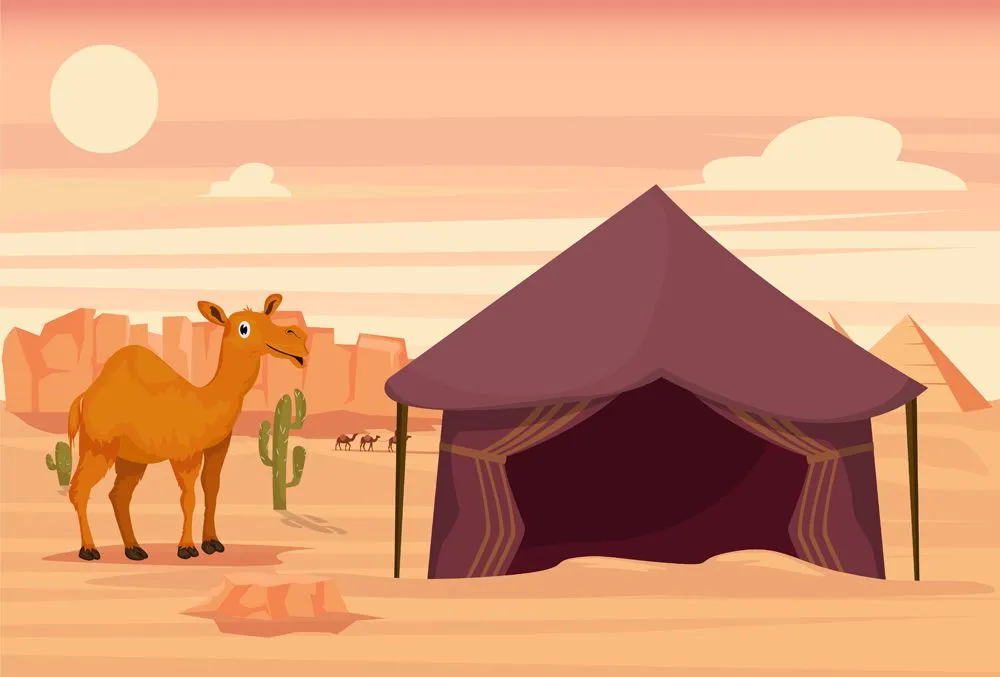
The scarcity of food and water in the desert led many civilizations to live as nomads. This means they have no permanent settlements. They make tents from thick cloth to keep dust and sand out, but this still allows a cool breeze to pass through the cloth. The tents are portable and can be carried on pack animals, such as camels, donkeys and horses. These nomads graze animals like sheep and goats.
How Do People Find Food And Water In The Desert?
If water and food are so scarce, how do desert communities actually feed themselves? The answer comes down to making the most of every available source.

Water from below the surface. Much of a desert’s water is hidden underground in aquifers. Where that groundwater reaches or nears the surface, an oasis forms, and people sink wells to reach it elsewhere. Rivers fed by distant mountains, such as the Nile, carry water across the desert from wetter regions far away.
Food from oases and irrigation. Irrigated oases are the breadbaskets of the desert. Date palms are the classic oasis crop, providing a sweet, energy-rich, long-keeping fruit, and farmers also grow figs, olives, oranges and grains in the shelter and shade the palms provide. These pockets of green can support surprisingly productive small-scale farming.
Food on the move. Nomadic herders rely on their animals rather than on fields. Sheep, goats and camels turn the sparse desert vegetation into milk, meat and other staples, and the herds can be walked to fresh grazing as each patch is used up. Trade then fills the gaps, exchanging dates, salt or livestock for grain and goods brought in from outside the desert.
So, do you still feel like deserts are lifeless? I’m sure your opinion has changed since the top of this article… Although life in deserts is undeniably tough, it has led to magnificent adaptations by both plants and animals, which shows us that once again, life will always find a way!
References (click to expand)
- Desert Plants and Adaptations - Earth Floor: Biomes. cotf.edu
- Deserts guide for KS3 geography students - BBC Bitesize. BBC Online
- Desert - National Geographic Education. National Geographic
- Deserts, Explained - National Geographic Education. National Geographic
- Chapter 2. The World's Drylands. Food and Agriculture Organization of the United Nations (FAO)
- Date Palm Cultivation: Introduction. Food and Agriculture Organization of the United Nations (FAO)