Yes. When you look at the stars, you are looking into the past, because light takes time to travel. Sunlight reaches Earth in about 8 minutes and 20 seconds, so you always see the Sun as it was 8 minutes ago. A star 5 light-years away (seen with the naked eye or a telescope) appears as it was 5 years ago.
Time travel has fascinated us for generations, and we see it in movies, television shows, and popular fiction dating back centuries. Who isn’t intrigued by the idea of hopping into some state-of-the-art machines that can shoot you back to your favorite memory as a child, except it isn’t really a memory at all, but the real event taking place right in front of your eyes? What if you could travel to the future to see what has become of you and the people you love? The possibilities are simply too fantastic and mind-boggling to consider. As appealing as the concept is, it is also quite confusing at times, thanks to the Theory of Relativity, which was put forth by the great German scientist, Albert Einstein.
Now, what would you say if I told you that you time-traveled every day?
The Sun And The Speed Of Light
Now, I don’t mean that you’re jumping in some time-traveling car and zooming into the past or future; no, there is a very different kind of time travel that you experience every day (or at least night) of your life. Let me tell you a bit more about how this works.
Light travels at 300,000 kilometers per second. That is inconceivably fast – faster than most people can even comprehend. This extreme speed is the reason you don’t have to wait for the light to appear when you switch on a bulb in your room; as soon as the bulb is on, light fills the room. In other words, you never have to ‘wait’ for light to reach you.
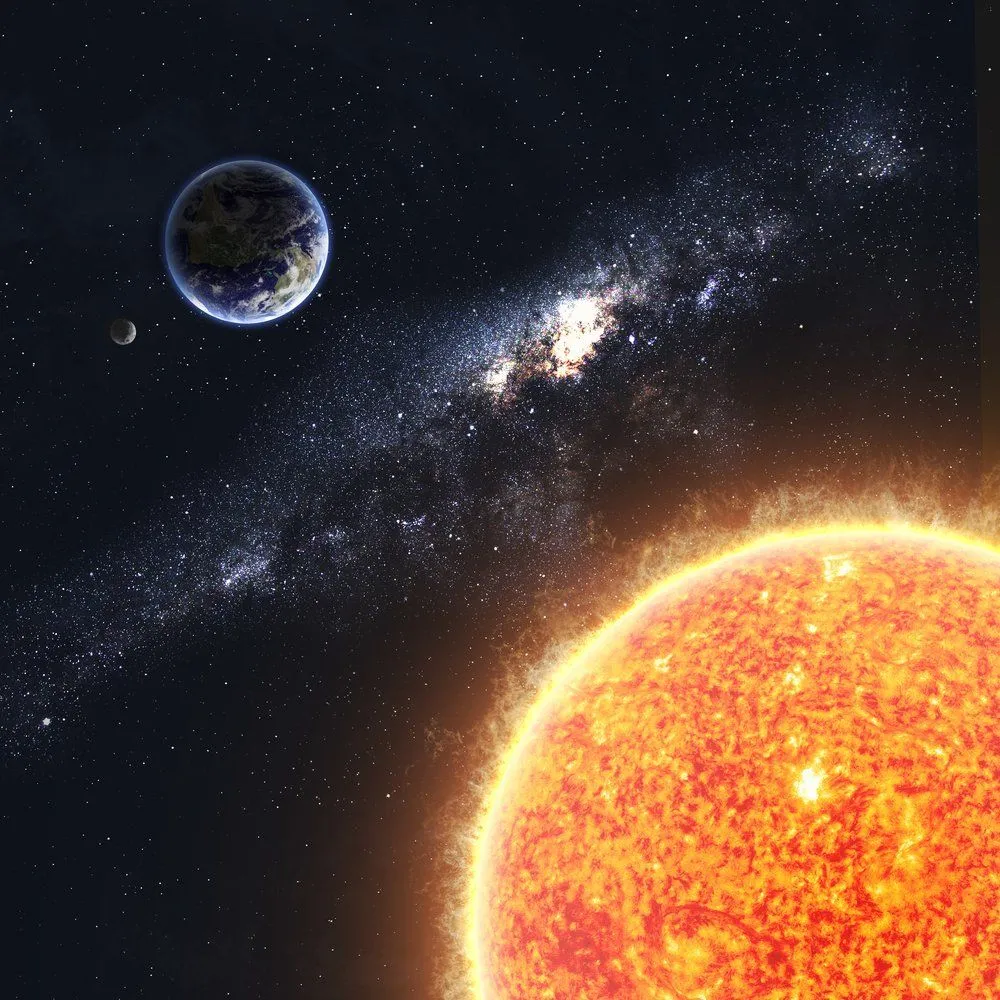
However, this is not the case with our Sun. The Sun is awfully far away from Earth (about 150 million kilometers, or 93 million miles, to be more specific). Light rays from the Sun have to cover that distance before they reach Earth to warm our skin and light our skies. It turns out that this journey takes about 8 minutes and 20 seconds (close to 500 seconds). Simply put, despite its extreme speed, sunlight still needs more than 8 minutes to get here.
How Does This Relate To Time Travel?
Consider this: when you are looking at the Sun (although you shouldn’t look at it directly!) you are not actually looking at the present moment. Instead, you are looking at what the Sun looked like a little over 8 minutes ago. As explained above, this is because those same light rays striking your eye took roughly 500 seconds to reach Earth. In other words, by the time they got to us, the Sun had already moved 8 minutes into its own future.
You could make your friends residing on the Sun a lot richer by helping them place bets on sporting events, if only you had friends on the Sun, of course!
Looking Through A Telescope
Things become much more interesting when you put a telescope between your eyes and the celestial bodies above us. Suppose that you look at a celestial body that is 5 light-years away from Earth (one light-year is the distance light travels in a year, roughly 9.46 trillion kilometers, or 5.88 trillion miles). What are you looking at in that case? Surprising as this might sound, you are looking at how that celestial body appeared 5 years ago! Pretty cool, huh?
There are many stars and celestial bodies that are very, very far away from us. So when we look at them through a telescope, or even with the naked eye (the stars that decorate the night sky), we are actually looking into the past, more specifically, their past! Proxima Centauri, the closest star to the Sun, sits about 4.24 light-years away, so its light reaches you over four years late. Betelgeuse, the bright red shoulder of Orion, sits somewhere around 500–700 light-years away (distance estimates still vary), meaning the photons hitting your eye tonight left the star centuries before the telescope was even invented. And the most distant galaxy yet confirmed by the James Webb Space Telescope, MoM-z14, is so far off that we see it as it was less than 300 million years after the Big Bang, about 13.5 billion years ago.
And all this time, you’ve been craving that DeLorean from Back to the Future, when all you needed to do was look up and embrace a bit of wonder!
What Color Is The Sun Really?
Since we have spent this whole article staring at the Sun's light (figuratively, please), here is a question that trips up almost everyone: what color is the Sun actually? Most of us would say yellow, and every child's drawing agrees. But the honest answer is that the Sun is white. Astronauts who have looked at it from orbit, above the air, describe a brilliant white disc, and photographs from the International Space Station and the Apollo Moon landings back them up.

Here is the curious part. The Sun's surface (the photosphere) sits at roughly 5,500 °C (about 5,778 K, or 10,000 °F), and a glowing object at that temperature pours out its peak intensity at a green wavelength, near 500 nanometers. So if anything, the Sun is a touch "green" at its brightest point. Yet you never see a green Sun, because it does not emit only green. It floods every visible wavelength at once, and when red, green and blue all arrive together, your three types of cone cells blend them into white. NASA's "yellow dwarf" label is a spectral classification (the Sun is a G2 main-sequence star), not a literal description of the color your eye registers.
So why does it look yellow from your backyard? Blame the same atmosphere we met earlier. Air molecules scatter short blue and violet wavelengths far more strongly than long red and orange ones (this is Rayleigh scattering, the very reason the daytime sky is blue). With some of the blue stripped out and flung across the sky, the light that travels straight from the Sun to your eye is left looking warmer, a little yellow or, near sunset, deep orange. The Sun did not change color; our air edited it on the way in. If you want to go deeper, we break this down in how many colors we can see the Sun in.
How Long Would It Take To Travel One Light-Year?
Once you accept that a star 5 light-years away shows you 5-year-old news, the next thought is irresistible: could we just go there and see for ourselves? This is where the numbers get humbling. A light-year is the distance light covers in a year, roughly 9.46 trillion kilometers (5.88 trillion miles), and light is doing that at exactly 299,792,458 meters per second (about 300,000 km/s, or 186,000 miles per second). Nothing we have ever built comes remotely close.

Take NASA's Voyager probes, the fastest-receding objects humans have ever launched. They are racing outward at more than 35,000 miles per hour (about 56,000 km/h). At that blistering pace, NASA estimates the Voyagers will need nearly 40,000 years just to cover roughly two light-years and drift past the outer edge of the Sun's influence. That works out to the better part of 20,000 years for a single light-year. Proxima Centauri, the nearest star beyond the Sun at 4.24 light-years, would be tens of thousands of years away at Voyager speed.
So no, you cannot pop over for a look. The light is the only messenger fast enough to make the trip, and even it takes years. When you stand under the night sky, you are not just looking into the past; you are receiving the only postcard those distant suns will ever be able to send you, and it left home a very long time ago.
Could You Outrun The Light And Catch The Past?
If looking at a star is genuinely seeing its past, a tempting loophole appears: what if you flew away from Earth faster than light, overtook the photons that left here years ago, and watched your own history replay in front of you? It is a wonderful idea, and physics shuts the door on it firmly.
The speed of light is not just "very fast." In Einstein's special relativity, it is the universe's absolute speed limit for anything carrying mass, energy or information. The reason is built into the math: the energy needed to accelerate a massive object climbs without bound as its speed approaches that of light, heading toward infinity at the limit itself. No finite engine, no imaginable fuel, can supply infinite energy, so a spaceship (or you) simply cannot reach light speed, let alone beat it.
And there is a deeper reason the universe guards this limit. As the University of California's long-running Physics FAQ lays out, if any object or signal could travel faster than light, then in some other observer's frame of reference it would be moving backward in time. Allow that, and you allow genuine messages into the past and the paradoxes that come with it. The cosmic speed limit is also a causality limit. So when you gaze at the stars, you are stuck reading old light at the pace light chooses to deliver it. You can look into the past all you like; you can never sprint ahead and re-edit it.
References (click to expand)
- Why is looking out into space the same as looking back in time? (Beginner) - Curious About Astronomy? Ask an Astronomer - curious.astro.cornell.edu
- How can the Hubble Space Telescope look back in time? - spaceplace.nasa.gov
- What is a light-year? - NASA Science
- NASA’s James Webb Space Telescope Finds Most Distant Known Galaxy - NASA Science
- Much of the sun's light is green. Why does it look yellow? - Science News Explores
- Sun Facts - NASA Science
- Voyager - Did You Know? - NASA Science
- Is Faster-Than-Light Travel or Communication Possible? - UC Riverside Physics FAQ