Cherenkov radiation is the result of a particle moving faster than the speed of light in a medium. This radiation is faint, but can be seen in the form of a blue glow in the water around a nuclear reactor. This is the equivalent of a sonic boom in the case of light.
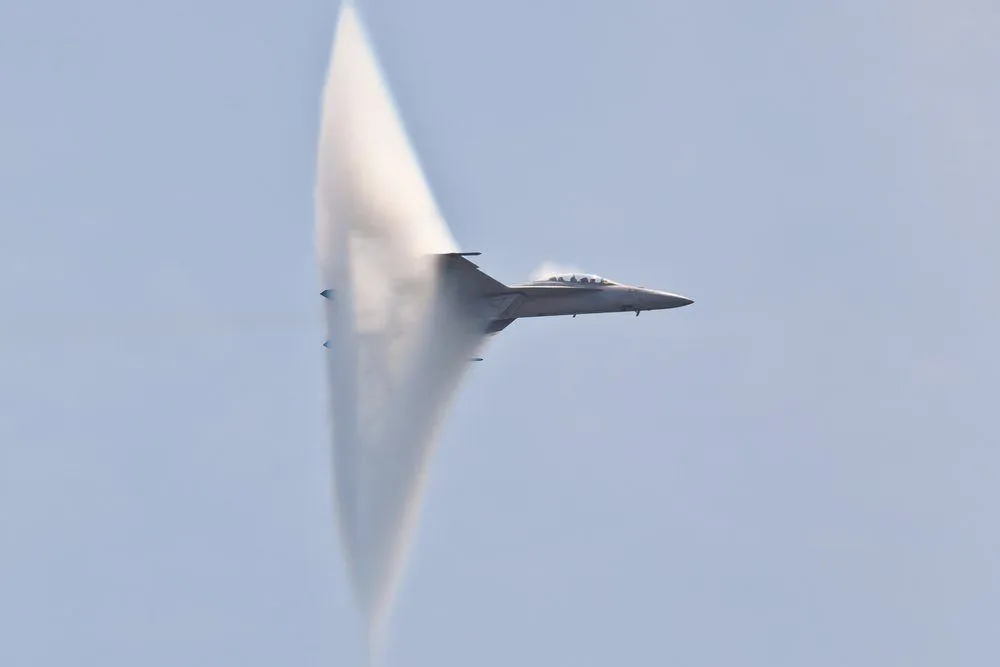
When a military aircraft passes overhead at the speed of a few machs, you will inevitably hear a loud boom in the sky. That’s caused by a physical phenomenon called a sonic boom, which is obviously related to sound. Have you ever wondered if there is an analog to a sonic boom in the case of light?
What’s The Equivalent Of A Sonic Boom In The Case Of Light?
Short answer: Unlike sound, light does not need a medium in which to travel (it can travel through a vacuum). Therefore, there is no analog to a sonic boom in the case of light. However, a sonic boom occurs when something travels faster than sound; similarly, something interesting occurs when something travels faster than light in a given medium.
But first things first…
What Is A Sonic Boom?
Sound waves produced from a stationary source spread out uniformly, like ripples in a lake. However, as the sound source starts moving, the waves in front of the object tend to bunch up, increasing their frequency. As a result, an observer standing ahead of an object will hear a higher pitched sound than someone standing behind the object. This increase in the apparent frequency of sound waves is called the Doppler effect.
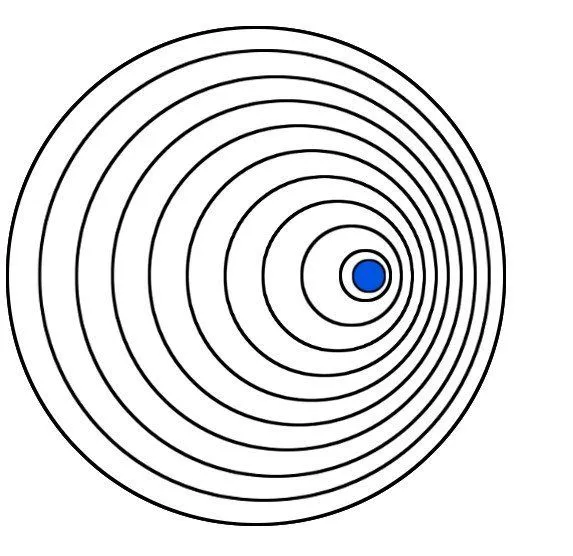 This same phenomenon is why an ambulance’s signal sounds different as it passes you by.
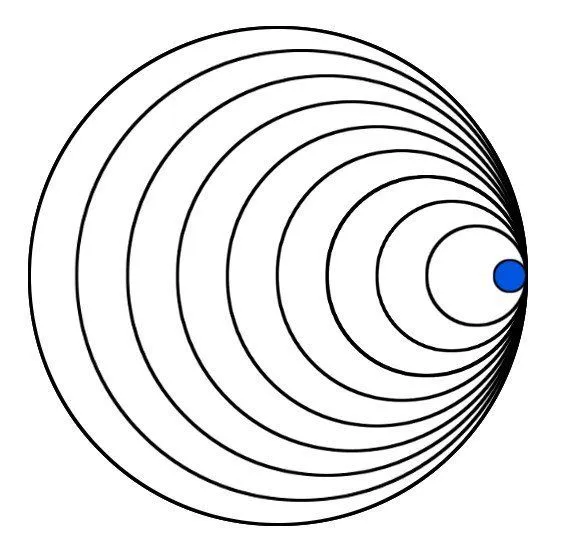
When an object (sound source) moves at the speed of sound itself (in air, that is about 343 meters per second, or 1,235 km/h / 767 mph, at roughly 20 °C (68 °F)), then the sound waves preceding the object will clump together at the same point, producing a very loud sound as that wall of sound waves hits the observer standing ahead (or below).
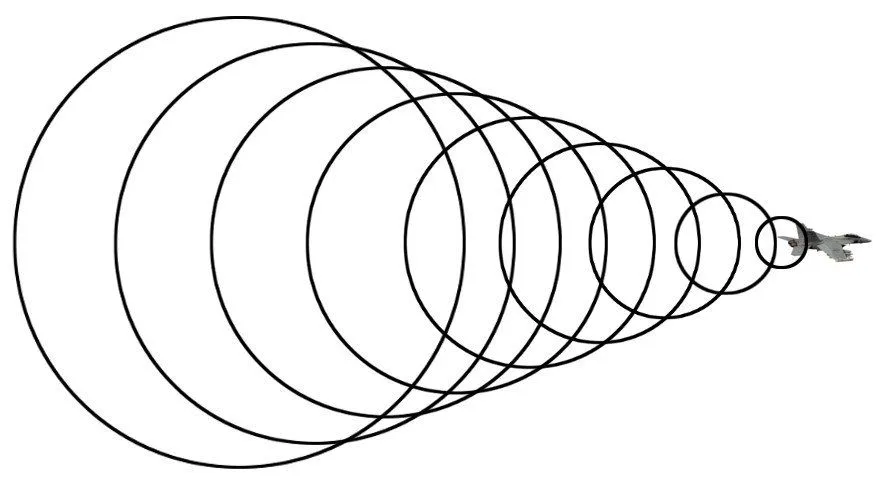
 That being said, things change dramatically once an object “breaks the sound barrier”, or in other words, travels faster than the speed of sound. In this case, the sound waves produced by the object do not have enough time to spread out in front of it, because it is traveling faster than the sound waves that it creates.
Such an object is said to be going at a “supersonic speed”, and creates an intense wavefront that causes the sonic boom, that characteristic loud, booming noise when a supersonic fighter jet passes overhead.
Is There A Sonic Boom Equivalent In The Case Of Light?
Sound is a mechanical wave, which means that it needs a medium to travel. It travels pretty well through air, solid objects and even water, but it cannot travel through a vacuum. As we just saw, a sonic boom occurs when an object travels faster than the speed of sound and compresses the air that is immediately in front of it.
Light, on the other hand, is an electromagnetic wave, which means that unlike sound, it doesn’t require a medium to travel. Also, nothing travels faster than the speed of light in air (or in a vacuum).
So, practically speaking, there isn’t a sonic boom equivalent for light in air or a vacuum.
Can Anything Travel Faster Than Light In A Given Medium?
Definitely.
Although it’s true that nothing travels faster than light in a vacuum, light isn’t always traveling in a vacuum. Also, the speed of light is reduced when it travels through certain media, such as water, glass etc. In those media, there can be particles that move faster than light in the particular medium (although never faster than the speed of light in a vacuum).
How much does light actually slow down? You just divide its vacuum speed by the medium’s refractive index. Water has a refractive index of about 1.33, so light in water crawls along at roughly 299,792 km/s ÷ 1.33 ≈ 225,000 km/s (about 140,000 miles per second), only about three-quarters of its vacuum speed. In ordinary glass, with an index near 1.5, light slows to about 200,000 km/s. That leaves plenty of room for a high-energy particle to outrun the light around it, without ever breaking the universal vacuum speed limit.
Cherenkov Radiation
When this happens, i.e., when a particle moves faster than the speed of light in a medium, a faint form of radiation is produced in the medium. This radiation is called Cherenkov radiation. It is named after the Soviet scientist Pavel A. Cherenkov, who first demonstrated it experimentally in 1934. The theory behind it was worked out a few years later, in 1937, by his colleagues Ilya Frank and Igor Tamm. All three shared the 1958 Nobel Prize in Physics for the discovery and interpretation of the effect.
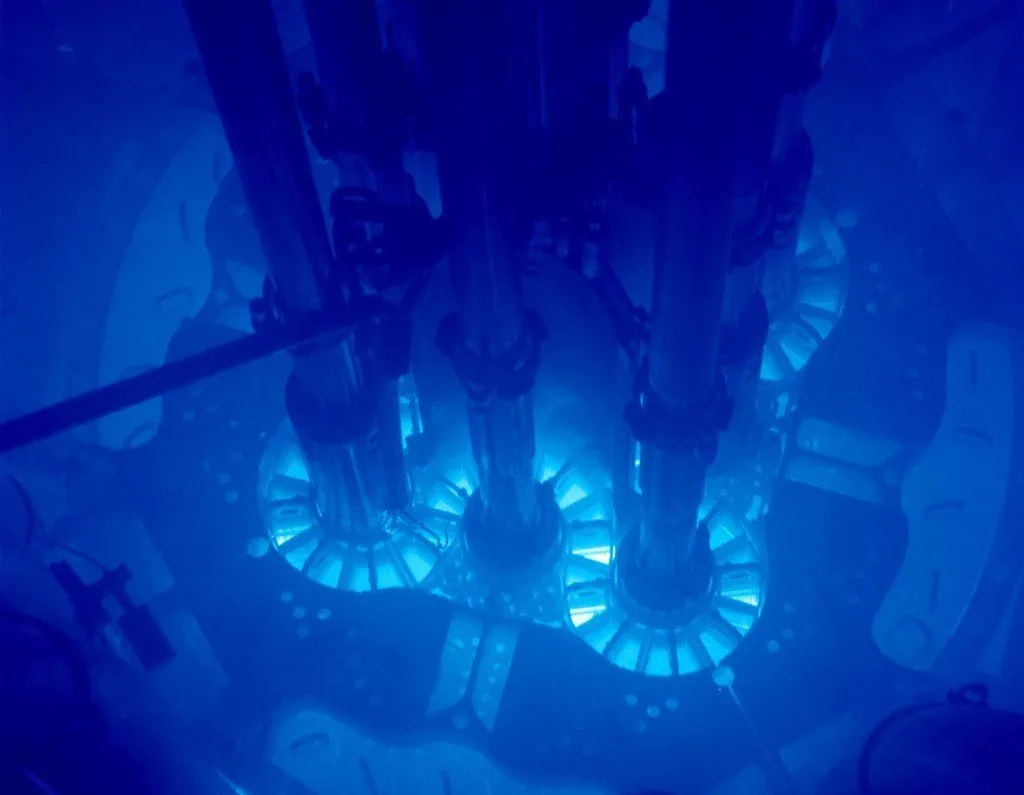
In the image given above, the faint glow in the water around the core of a nuclear reactor is produced courtesy of Cherenkov radiation. This happens because the beta particles (ultra-fast electrons) emitted by fission products tear through the water faster than light itself can travel in water. As each electron races past, its electric field briefly displaces the electrons in the surrounding water molecules, polarizing them. When those displaced electrons snap back into place, they release that energy as photons of light.
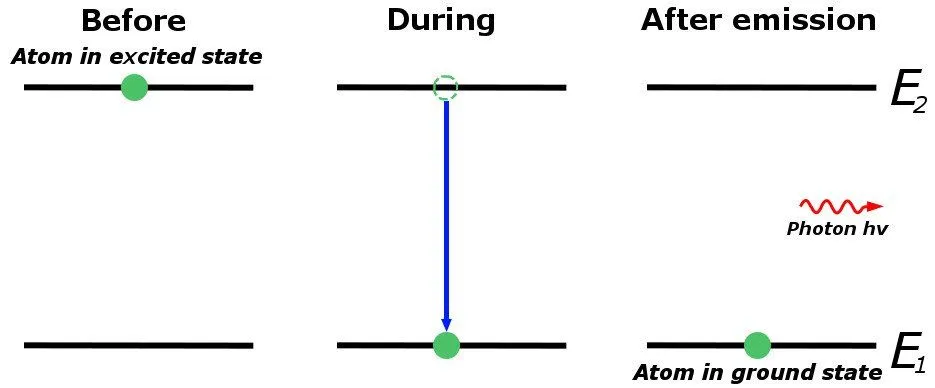
Since these fast-moving electrons travel faster than light in water, the photons they leave in their wake do not have time to spread out ahead of them. Instead, they pile up into a coherent wavefront, much like the sound waves bunching up in front of a supersonic jet. These in-phase photons reinforce one another (constructive interference) along a cone-shaped shock front, imparting that faint but clearly visible bluish glow to the water surrounding the reactor. Why blue, and not some other color? Cherenkov radiation is emitted more strongly toward shorter wavelengths, and a large share of it actually falls in the ultraviolet, which our eyes cannot see at all. Of the light that is visible, our eyes are more sensitive to blue than to violet, so what we perceive is that signature electric-blue glow.
In a way, therefore, you can say that Cherenkov radiation is an analog to a sonic boom, with a few technical differences. Of course, there’s also the most obvious difference: Cherenkov radiation doesn’t produce a huge boom when it occurs! for more watch this :
References (click to expand)
- Sonic boom - Wikipedia. Wikipedia
- Cherenkov radiation - Wikipedia. Wikipedia
- Is there an equivalent of the sonic boom for light? - UCR Math. The University of California, Riverside
- 5.2 Constructive and Destructive Interference - UConn Physics. The University of Connecticut
- The Doppler Effect and Sonic Booms. The Pennsylvania State University
- Does Cerenkov radiation travel faster than light? (Intermediate) - Curious About Astronomy? Ask an Astronomer - curious.astro.cornell.edu
- Cherenkov Radiation, Explained. U.S. Department of Energy, Office of Nuclear Energy.
- The Nobel Prize in Physics 1958 (Cherenkov, Frank and Tamm). NobelPrize.org.
- Cherenkov radiation. Encyclopaedia Britannica.