Table of Contents (click to expand)
A proton is a tiny, electrically charged particle, so external electric and magnetic fields in a particle accelerator can push it to 99.9999999% of light speed. A rocket is enormous and electrically neutral, so no outside field can grab it. It must carry and burn its own fuel, and the energy needed to reach near light speed grows without limit.
Think of the last time you went to a grocery store, stocking up things in your cart. Now, what if you were to push the cart so hard that you practically had to run to keep up with it?
Not only is that not doable in a grocery store with limited space, but it seems pointless too, right?
Allow me to present a hypothetical scenario. Imagine if it were possible to apply such great force to a cart that its speed kept increasing until it reached the speed of light.
Yes, it’s absolutely impossible!
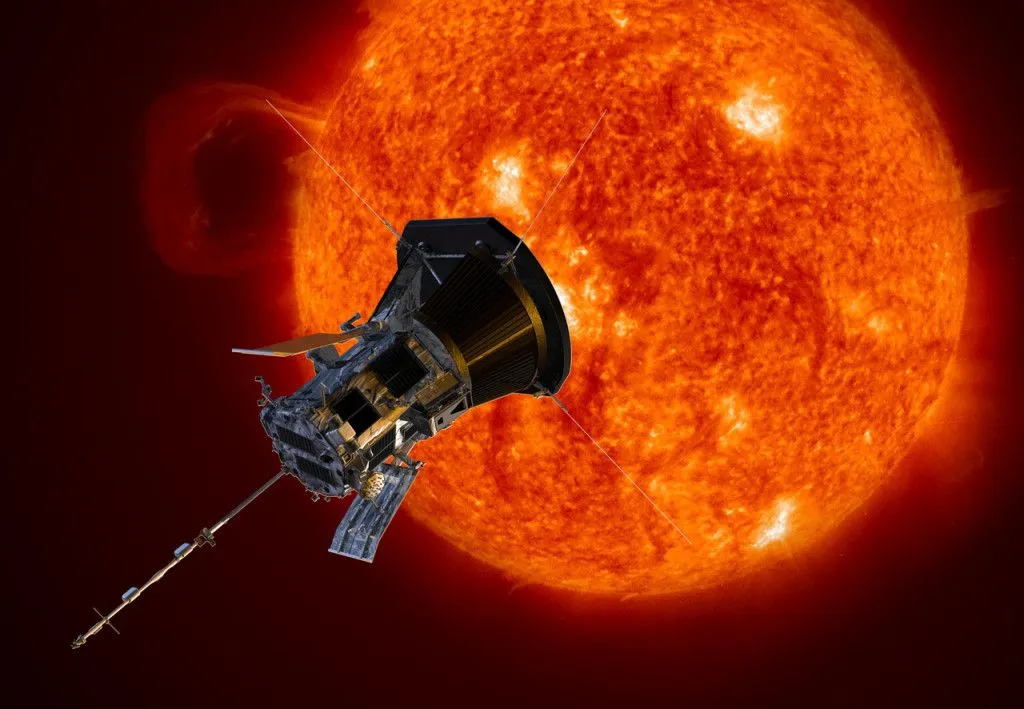
The speed of light in vacuum is 1,079,252,848.8 kilometers per hour (about 670 million mph), while the fastest man-made object is NASA’s Parker Solar Probe. On 24 December 2024 it reached roughly 692,000 km/h (430,000 mph) as it skimmed the Sun, thanks largely to the Sun’s enormous gravitational pull. (Source) That is still only about 0.064% of light speed.
Here’s an interesting thing though – we have particle accelerators that make subatomic particles like protons and electrons go almost as fast as light.
Can we then use the same principle of accelerating objects and apply it to huge objects, like a car, airplane or rocket?
What Happens When You Keep Increasing An Object’s Speed?
You may likely have heard of Einstein’s mass energy equivalence equation. If you haven’t, here’s what it looks like:
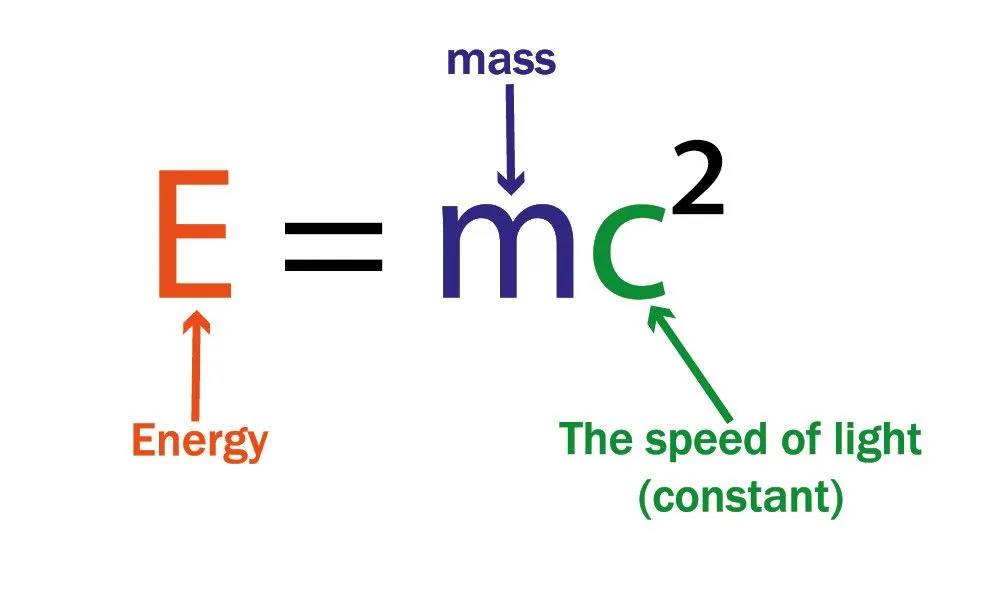
In simple terms, the concept states that energy and mass are two sides of the same coin. Here is the part that matters for our cart: as you push any object faster and faster, the energy you have to pour in to gain each extra bit of speed keeps climbing. (Older textbooks described this as the object’s mass increasing with speed. Today, physicists prefer to say the object’s rest mass stays exactly the same, while its energy and momentum shoot up, controlled by a number called the Lorentz factor.)
The catch is that this energy does not just climb steadily. As your speed creeps toward the speed of light, the energy needed races toward infinity. To actually reach the speed of light, you would need infinite energy, which is why nothing with mass can ever quite get there.
So, if you accelerate a shopping cart to extremely high speeds (and we are talking only a couple thousand kilometers per hour to start feeling silly), you will soon need a power source far beyond anything you could push by hand.
But if that’s the case, how do subatomic particles travel so fast inside particle accelerators?
How Do They Accelerate Particles In Particle Accelerators To Such High Speeds?
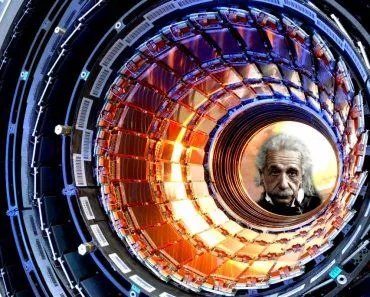
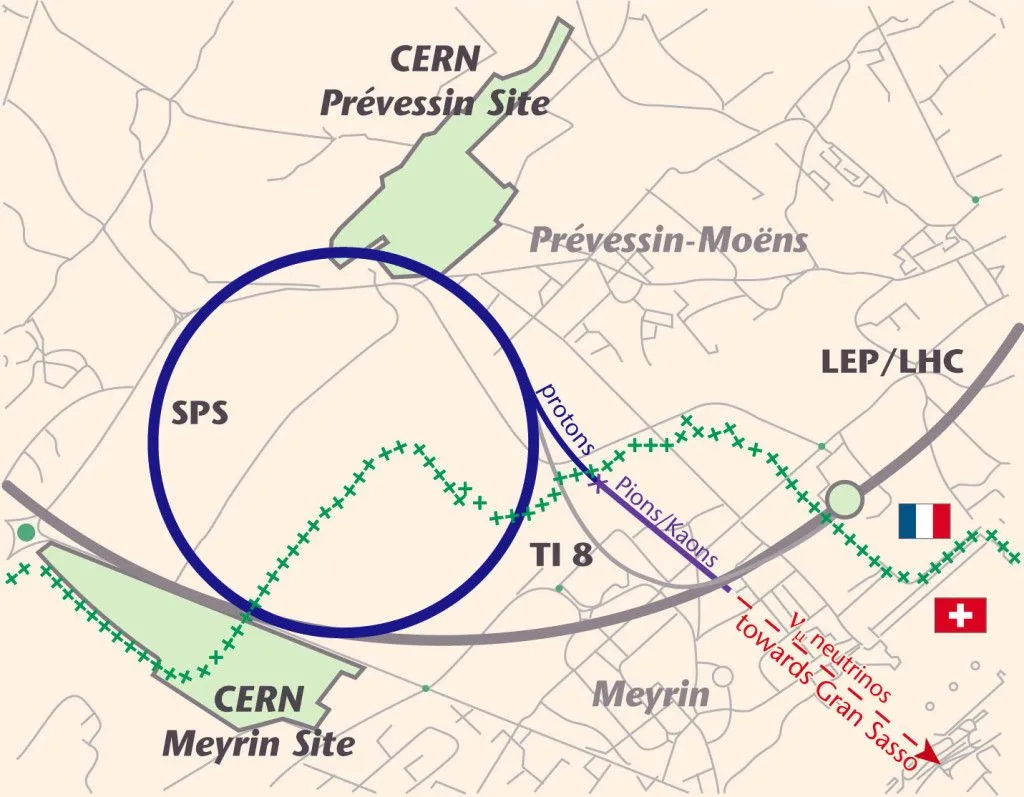
Particle accelerators, as the name suggests, accelerate small, charged particles, like electrons and protons to extremely high speeds – almost as fast the speed of light. Particle accelerators can be of different shapes and sizes, the smallest one can fit the palm of your hand, while the biggest one is so huge that it crosses the borders of two countries – France and Switzerland.
We have made a short video to help understand what a particle accelerator is and how it works,
At CERN, the Large Hadron Collider uses electric and magnetic fields to accelerate protons around a 27-kilometer (17-mile) ring until they reach close to the speed of light. In its current run, each beam is pushed to an energy of 6.8 tera-electronvolts, which works out to a staggering 99.9999999% of light speed, or about 0.99999999c. At that point each proton is trailing light itself by only a few meters per second.
Two things make this possible. First, the mass of a proton is tiny: 1.67262192 × 10⁻²⁷ kilograms.
Do you realize how light that is? It’s so light that a single strand of hair holds billions upon billions of protons.
Second, and more importantly, a proton carries an electric charge. An electric field exerts a force on anything charged (the rule is force = charge × field strength, or F = qE), so the field can grab the proton and shove it forward. The energy comes from the wall socket, not from the proton, and the LHC has kilometers of powerful magnets and accelerating cavities to keep that shove going lap after lap. The proton itself just rides along. Also, note that these protons travel through the vacuum inside the ring, so there is no air to slow them down.
But if you take the same idea and apply it to macroscopic objects like cars or rockets, the whole thing unravels in the blink of an eye.
Challenges Of Accelerating Rockets To Nearly The Speed Of Light
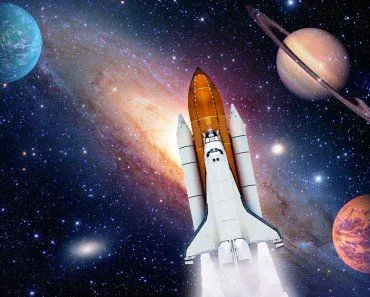
Just the idea of increasing the speed of a rocket to almost as fast as the speed of light is so impossibly bizarre and otherworldly that I have to re-iterate that this is a hypothetical scenario – a thought experiment, if you will.
There are detrimental challenges to accelerating something as big as a rocket to almost the speed of light.
1 – Rockets Are Heavy (To Begin With)
Rockets are large and heavy. Japan holds the world record for the smallest orbital rocket, the JAXA SS-520-5, which weighed just 2,600 kilograms (5,732 lb). (Source) That is the lightest orbital rocket ever flown, and yet it’s still as heavy as a large car. A proton outweighed by a strand of hair is one thing; hurling 2,600 kg to even a fraction of light speed would take more energy than all of our current technology can muster.

2 – The Energy Needed Races Toward Infinity
Even setting weight aside, special relativity stacks the deck against you. As we saw earlier, the energy required to accelerate any object grows faster and faster as it nears the speed of light, heading toward infinity as the speed approaches c. A rocket already starts out heavy, and you simply can never build a power source large enough to finish the job. (Physicists describe this as the rocket’s energy and momentum diverging; its actual rest mass never changes.)
3 – A Rocket Can’t Be Pushed From Outside, So It Has To Carry Its Own Fuel
This is the deepest difference of all. A proton works inside an accelerator because it is electrically charged, so the machine’s external fields can grab it (remember F = qE). A rocket is electrically neutral, so no outside field can push on it. With nothing external to lean on, a rocket can only move forward by throwing mass out the back, then riding the recoil. It has to carry every kilogram of that fuel with it.
And here lies the trap, captured by the Tsiolkovsky rocket equation, Δv = ve × ln(m0/mf). The speed you gain depends only on the logarithm of your mass ratio, so going faster demands exponentially more propellant. To carry that propellant you need more propellant, and so on. Engineers call this the “tyranny of the rocket equation,” which is why a launch vehicle is roughly 85–90% fuel by mass. Now try to reach a fair slice of light speed. With a chemical fuel that exhausts at about 4 km/s, the mass ratio needed for a final speed of just 10% of light speed (30,000 km/s) is e(30,000/4), which is e7500, a number with more than 3,000 zeros. There are only about 1080 atoms in the entire observable universe, so you would run out of matter to use as fuel long before your rocket got moving. The numbers don’t bend, no matter how clever the engineering.
In summary, a proton races to near light speed because it is featherlight and electrically charged, so a giant machine can grab it from the outside and supply all the energy. A rocket, car, or shopping cart is heavy and electrically neutral, so it has to carry and burn its own fuel, and the energy required to approach light speed climbs toward infinity. No amount of clever engineering can get around either limit.
Before we close this exciting thought experiment, consider this analogy: a basketball and our planet are both round. While we can bounce and dribble a basketball, can we do the same with our planet?
References (click to expand)
- Chernyaev, A. P., & Varzar, S. M. (2014, October). Particle accelerators in modern world. Physics of Atomic Nuclei. Pleiades Publishing Ltd.
- Rossi, L., & Bottura, L. (2012, January). Superconducting Magnets for Particle Accelerators. Reviews of Accelerator Science and Technology. World Scientific Pub Co Pte Lt.
- Brüning, O., Burkhardt, H., & Myers, S. (2012, July). The large hadron collider. Progress in Particle and Nuclear Physics. Elsevier BV.
- The Large Hadron Collider. CERN.
- Ideal Rocket Equation. Beginner's Guide to Aeronautics, NASA Glenn Research Center.
- NASA's Parker Solar Probe Makes History With Closest Pass to Sun. NASA.