Table of Contents (click to expand)
The decimal (base 10) number system has ancient roots, with Egyptians counting in powers of 10 as early as 3000 BC. It has continuously become more relied upon, precise and pivotal in our everyday life.
As a child, I often wondered what the significance of that one dot between two numbers was…. didn’t we all? To me, it meant breaking down a certain number into its constituent parts, but decimals have a far greater impact on how we perceive not just mathematics, but also life around us. That instant thought of imagining “half” as 0.5 is no coincidence; decimals are an integral part of any habitat. Without further ado, let’s take a deeper dive into this expansive and revolutionary territory!

What Is A Decimal?
Any search engine would bring back the definition of “decimal” as the simplest way of writing fractions whose denominators can be expressed in terms of powers of 10. A more easily understandable explanation is that a decimal is used to express any and every number that is not whole. Simple!
A decimal can be thought of as the mathematical equivalent of an atom in science. Every object can be broken down further to the atomic level, just as every numeric quantity can be broken down to its smallest state with the help of a single dot placed between two numbers.
A Sneak Peek Into The Many Uses Of Decimals
It is impossible to not use the concept of decimals almost every single day. A decimal point allows us to understand and make use of the full spectrum of numbers lying between two whole ones. This gives us the leverage to deal in smaller or larger numbers according to our particular needs.
For example, Adam goes to a shop to buy one notebook, but the notebooks only come in a pack of two and cost $5 per pack. In this scenario, Adam would simply divide 5 by 2 which is $2.5 and leave the shop with one notebook, as was his plan. Imagine a world where the decimal did not exist… you’d simply have to buy extra items and only in whole numbers!
Other examples of the inevitable use of decimals are:
- measuring length
- measuring weight
- calculating the exchange value of currency
The Origin Of Decimals
The very first method of counting began with the usage of 10 fingers, which ultimately led to the ideation of the basic 10 digits – 0, 1, 2, 3, 4, 5, 6, 7, 8, 9. This is called the decimal or denary system. This system is the most commonly used number system in the world, though not the only one!
Some ancient chronological milestones in the evolution of decimals include:
- 3500-3000 BC, the earliest usage of a close relative of the decimal system by the Iranian Elamites in Proto-Elamite texts
- 2900 BC, Egyptians start counting in powers of 10
- 2600 BC, Indus Valley civilization begins the usage of decimal ratios in their standardized system of weights
- 1400 BC, Chinese manuscripts shed light on the existence of a possible decimal system when making calendars
- 1000 BC, the Indian Yajur Veda names successive powers of 10 up to 1012 (parardha)
- 300 BC, Indian mathematician Pingala describes a binary system in his Chandahshastra, with conversions to and from the decimal system
- 250 BC, Archimedes takes the power of 10 to 1080,000,000,000,000,000
- 100 CE, Chinese mathematicians develop sophisticated decimal arithmetic in the Nine Chapters on the Mathematical Art
- 1440s CE, Italian astronomer Giovanni Bianchini becomes the first known person to use decimal point notation, as discovered in a 2024 study published in Historia Mathematica
- 1585 CE, Simon Stevin publishes De Thiende, systematically introducing decimal fractions to European mathematics
Contrary to popular belief that the base 10 number system was the system for all civilizations in the past, many of the first civilizations to ever exist actually used very peculiar number systems.
The Babylonians used a base 60 system, the noteworthy remnants of which can be felt even today in the form of 60 seconds in a minute, and 60 minutes in an hour. They also had a base 12 system in place, which was closely related to base 60. The Roman numeral system was an additive base 10 system, and the Mayans made use of the base 20 system. Throughout history, it is enticing to see that so many different and articulate number systems existed simultaneously, or even centuries apart, but the one that stuck around was the denary system.
Who Invented The Decimal System?
So who actually invented decimals? The honest answer is that no single person did. What we use today is really two inventions stacked on top of each other, and they arrived centuries apart.
The first piece is the base-10 place-value system with its all-important zero, and it took shape in India. The oldest dated Indian document using place-value notation goes back to 594 CE, and the first undisputed inscription containing a zero appears at Gwalior in 876 CE, where the number 270 is written in a form startlingly close to what we use now. From there the idea travelled outward: Indian astronomical texts (probably Brahmagupta’s) reached the court of the Abbasid caliph al-Mansur around 776 CE and were translated into Arabic, the Persian mathematician al-Khwarizmi wrote a treatise on these “Indian numerals” (the Latinised version of his name gave us the word algorithm), and in 1202 CE the Italian mathematician Fibonacci spread the system across Europe in his Liber Abaci. Even then, Europe was slow to abandon Roman numerals, and the new digits only became standard around the 15th century.
The second piece is the decimal fraction, the part written after the dot. The earliest known treatment belongs to the 10th-century mathematician al-Uqlidisi, who worked in Damascus and around 952–953 CE wrote a book on Hindu arithmetic in which, as historians describe it, he “uses decimal fractions as such, appreciates the importance of a decimal sign, and suggests a good one.” The idea reached a wide European audience much later, when the Flemish engineer Simon Stevin published De Thiende in 1585.

And what about Archimedes, who lived back in the 3rd century BCE? Decimals as we know them simply did not exist in his day. In his short work The Sand-Reckoner, Archimedes built an ingenious scheme to name numbers as vast as the grains of sand needed to fill the universe, reaching roughly 8×1063, but it was based on powers of a “myriad of myriads” (108) and contained no decimal point and no decimal fractions at all.
Why Do We Need Decimals?
The title of this article makes a promise, so let’s answer it head-on: why do we actually need decimals? It comes down to two superpowers that the system hands us almost for free.
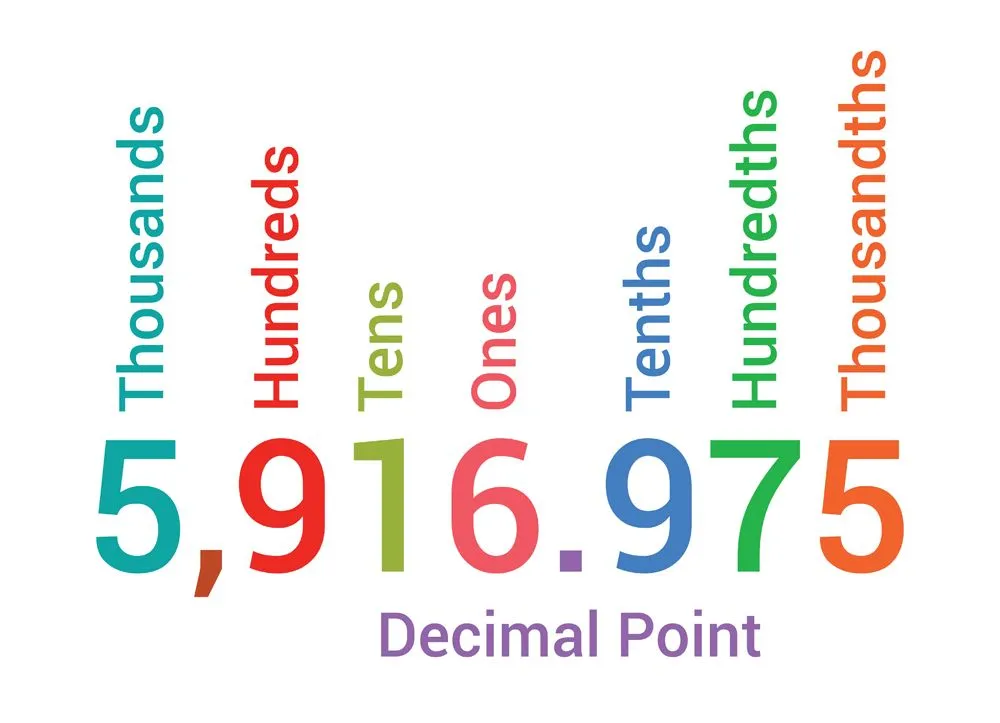
The first is place value. With just ten symbols (0 through 9), we can write any number imaginable, because the position of a digit decides its worth. The 2 in 20 means two tens; the same 2 in 200 means two hundreds. That single trick is why columns of figures line up so neatly, and why addition, subtraction, multiplication and division follow the same tidy rules no matter how large the numbers grow. Compare that to Roman numerals, which have no place value at all and where even simple arithmetic becomes a chore.
The second superpower lives on the right side of the dot. Decimal fractions let us describe quantities that fall between whole numbers with as much precision as we like. Half a pizza becomes 0.5, a third of a metre becomes 0.333…, and a machinist can specify a part to 0.01 mm without inventing a new style of fraction each time.

This is exactly why the metric system is built entirely on powers of 10. The prefixes do the heavy lifting: milli means one-thousandth (0.001), centi means one-hundredth (0.01), and kilo means one thousand, so 10 millimetres make a centimetre, 100 centimetres make a metre, and 1,000 metres make a kilometre (0.621 mi). Converting between units is then nothing more than sliding the decimal point left or right, far simpler than juggling the 12s and 16s of older measuring systems. Put the two superpowers together and you have the reason decimals turn up everywhere, from the price tag at the shop to the readout on a digital kitchen scale: they give us one consistent language for counting whole things and measuring fractional ones.
Decimal Vs Hexadecimal
If the number system functions on a small base, such as base 2 in binary, then expressing a simple number like 90 – 1011010 also becomes a painstaking task; similarly if the number system works on a base that is too large, like base 16 in hexadecimal system, then the calculations become far too complex and there is no position for range.
The decimal number system falls somewhere in the middle, where the scope of calculation is immense. It is neither too small nor too complex, which essentially allows us to establish a trade-off between overly intertwined base systems and base systems that are incapable of solving bigger problems. Other number systems have relevance, but the decimal number system proves to be most viable, given the unending scope of human error.
Decimals are an invariable part of our lives and we unknowingly come across immeasurable instances where they are used. Be it in math period in school, buying vegetables from the vendor, or even investing in mutual funds, decimals are essential and everywhere.
The unfathomable level of precision that the decimal point has made possible is extensive and far-reaching. It has opened numerous doors of research and advancement for mankind alike and its applications will only increase in the future!
References (click to expand)
- A Brief History of Numbers: How 0-9 Were Invented. Casio Computer Co., Ltd.
- History and Metric System. The University of Melbourne
- HISTORICAL ORIGIN OF THE DECIMAL SYSTEM - UF MAE. The University of Florida
- Al-Uqlidisi biography. MacTutor History of Mathematics, University of St Andrews.
- Indian numerals. MacTutor History of Mathematics, University of St Andrews.
- The Arabic numeral system. MacTutor History of Mathematics, University of St Andrews.
- Archimedes of Syracuse (incl. The Sand-Reckoner). MacTutor History of Mathematics, University of St Andrews.
- Metric (SI) Prefixes. National Institute of Standards and Technology (NIST).
- Decimal system. Encyclopaedia Britannica.