A circle is divided into 360 degrees for three reasons: (1) 360 is a highly composite number with 24 divisors, so it splits evenly into halves, thirds, quarters, fifths, sixths, eighths, ninths and tenths (far more than 100 can); (2) the Sumerian-Babylonian sexagesimal (base-60) system fit six equilateral triangles into a circle, giving 6 × 60 = 360; and (3) it’s close to the ~365 days the Sun takes to return to the same position, so the Sun moves about one degree per day.
The other day, I helped my 12-year-old cousin with his math homework. His homework had questions about the area of a circle with a certain radius and circumference. The questions seemed quite simple, and we were able to solve them all in 15 minutes.
What annoyed my cousin all the time, however, was, why was a complete circle 360 degrees? Why not something simpler like 10 degrees or 100 degrees? All calculations would have been so easy; wouldn’t that be more convenient?
Hypothesis 1: Mathematical Reasons
You may wonder what mathematical reasons there might be for using 360 degrees to represent a complete circle since 360 always seems to cause difficulties in calculating the answers to your math homework.
But actually, it is the ideal solution. A number like 10 or 100 would have been mathematically more uncomfortable.
The number 360 is divisible by every number from 1 to 10, except 7. It is actually divisible by 24 different numbers: 1,2,3,4,5,6,8,9,10,12,15,18,20,24,30,36,40,45,60,72,90,120,180 and 360 itself. These 24 numbers are called the divisors of the number 360.
This is the highest number of divisors for each positive integer up to its own value of 360. In contrast, the number we often wish would be the value for the full circle (100) has only 9 divisors.
This property of the number 360 makes it a highly composite number. Numbers are said to be highly composite if they are positive integers with more divisors than any smaller positive integer has. Highly composite numbers are considered good base numbers with which to perform common calculations.
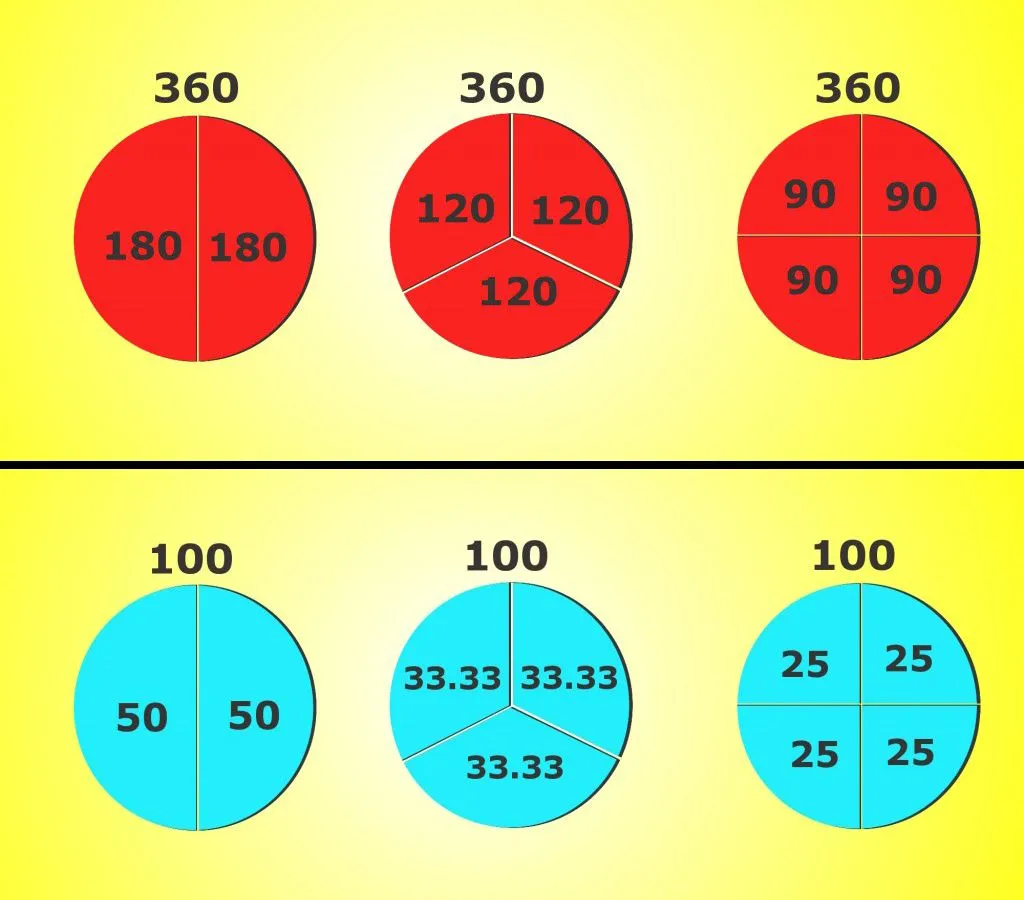
For example, 360 can be divided into two, three and four parts and the resulting number is a whole number. The resulting numbers are 180, 120 and 90.
However, dividing 100 by three doesn’t end in a whole number. Instead, it provides a decimal value of 33.3 recurring, which makes performing calculations difficult. Calculations using 360 actually become pretty simple once you’re smart enough to do them in your head and can put down the calculator.
But is this the whole justification? Was this the only reason why our ancestors decided to break a circle in 360 degrees?
Hypothesis 2: The Length Of A Year
Have you ever wondered why there are exactly 365 days a year? Why not use a more convenient number like 300 or 400?
Okay, there is no mathematical reason for this, but it is just an observation made by our ancestors, and these observations also contributed to a circle being closed by 360 degrees.
The ancient astronomers, especially the Persians and Cappadocians, noticed that it took the sun 365 days to return to exactly the same position.
In other words, the Sun appears to move about one degree per day along the ecliptic as seen from Earth. Persians used intercalary months to compensate for the extra days. Moreover, the lunar calendar has a total of 355 days, while the solar calendar has 365 days. And, which number sits perfectly between the two and is a composite number?
Yes… 360!
Hypothesis 3: Historical Reasons
Another theory that suggests why a full circle is 360 degrees comes from the Babylonians. The Sumerians and Babylonians famously used the Sexagesimal number system.
The sexagesimal system is one with a base value of 60, while the current system we use is known as the decimal system and has a base value of 10. So once we reach the 10th number, we start repeating the symbols of earlier numbers from 0 to 9 to form new numbers.
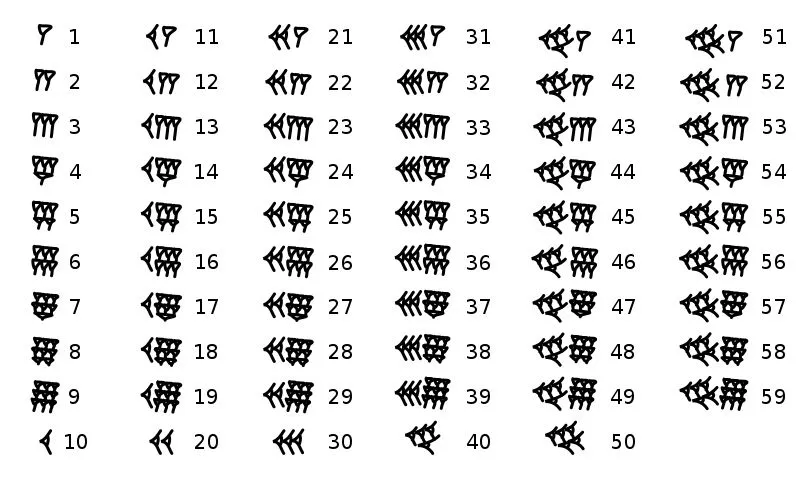
The Babylonians had 60 different symbols to make numbers with. Why should they use 60 again?
Because 60, like 360, is a highly composite number with up to 12 factors. Just as we can count 10 on our fingers for the decimal system, we can also count up to 60.
Start by counting the knuckles of the 4 fingers (not the thumb) on your right hand. 12, right?
Now, on the other hand, raise any of those fingers to remember that you finished one iteration and got the number 12. Now, repeat the same procedure as many times as the number of fingers remaining on the left hand.
The number you will end up with is 12 knuckles x 5 fingers = 60.
But Anyway… Why 360?
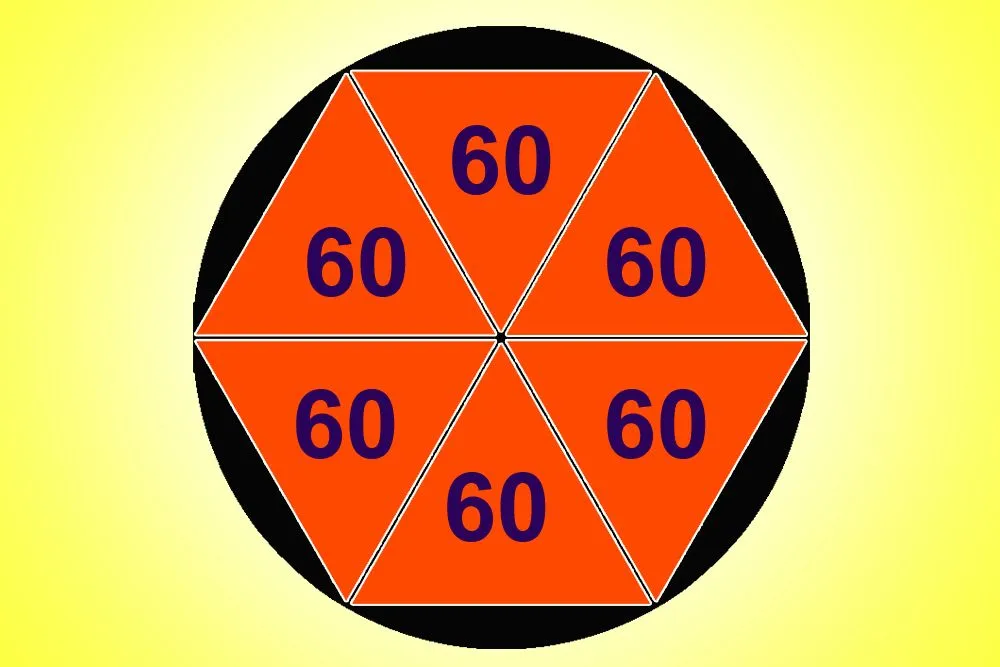
If we were to draw an equilateral triangle with the length of sides equal to the radii of the circle and place one of its vertexes at the center of the circle, then we could fit a total of 6 such equilateral triangles inside a circle. Since the Babylonians used the sexagesimal numeral system, they considered each triangle to have a base value of 60. Thus, 6 triangles x 60 base value again gives us a value of 360.
The Indian Context
There is even evidence that a circle in the Rigveda from India was divided into 360 parts.
Twelve spokes, one wheel, navels three.
Who can comprehend this?
On it are placed together
three hundred and sixty like pegs.
They shake not in the least.
(Dirghatamas, Rigveda 1.164.48)
Next time someone asks you this question, I hope you have something to say!
How Many Degrees Are In A Circle (And Half A Circle, And A Quarter)?
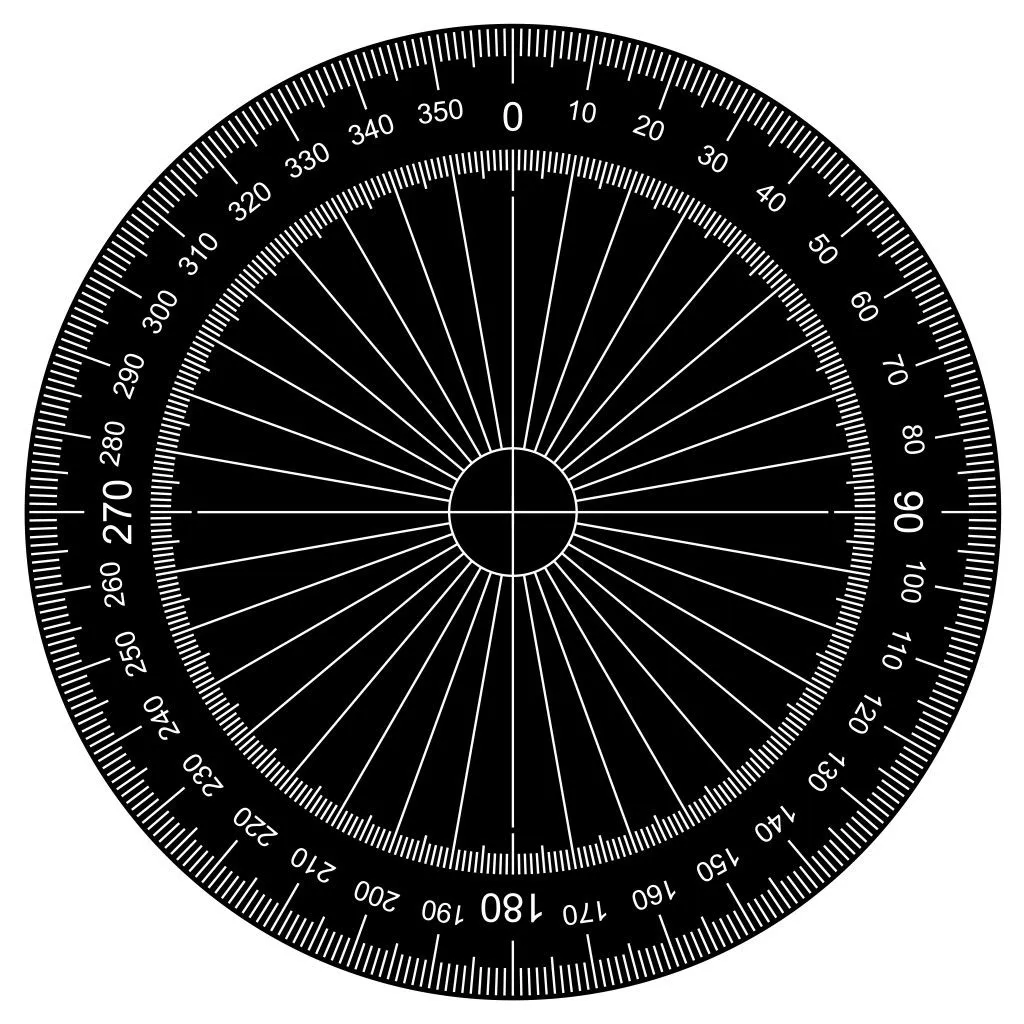
So far we have talked a lot about why a circle is split into 360 parts. But plenty of people just want the plain numbers, so here they are. A full circle, one complete trip all the way around and back to where you started, is 360 degrees. Halfway around, a straight line, is 180 degrees. A quarter of the way, the square corner you see on a sheet of paper, is 90 degrees, which we call a right angle. Three quarters of the way around is 270 degrees.

This trips a surprising number of people up, so it is worth saying clearly: a full circle is 360 degrees, not 180. The 180 figure is half a circle, a straight angle. The reason the question even comes up is the humble protractor. A classroom protractor is usually shaped like a half-disc and only goes from 0 to 180, so it looks as though 180 is "all the way." It is not. It only covers half the turn, and you have to flip it over to measure the other 180 degrees. Stack the two halves and you get the full 360.
Each individual degree, then, is one 360th of the whole turn. Slice the circle into 360 equal wedges and one of those thin slices is a single degree. That is why the answer to "how many degrees in a circle" is always the same friendly number you have now met three different ways: 360.
Are There Other Ways To Measure A Full Circle? Radians And Gradians
Degrees are not the only game in town. Mathematicians and engineers regularly slice a circle up using completely different units, and once you have seen them, the "why not 100?" question gets an interesting twist.
The unit a physicist or higher-maths student reaches for is the radian, and it is the official SI unit for angles. Instead of counting arbitrary slices, a radian is defined by the circle itself: take the radius, bend that exact length around the rim of the circle, and the angle that arc opens up at the center is one radian. Because the circumference of any circle is 2π times its radius, a full circle works out to exactly 2π radians, roughly 6.28. That makes one radian about 57.3 degrees, and a half circle is π radians, which is just another way of writing 180 degrees.

Then there is the gradian, also called the gon or grad. This one is the system your cousin was really asking for, because it does use a round, decimal-friendly number. A full circle is 400 gradians, which makes a right angle a tidy 100 gradians and one gradian equal to 0.9 degrees. It was dreamed up in France around the time of the French Revolution, during the same metric, decimalize-everything push that gave us the meter and the kilogram. The decimal logic is appealing, yet the gradian never caught on for everyday use. Today you mostly meet it in surveying and some European engineering, where carving a right angle into a clean 100 parts is handy. So a 100-step circle does exist, just measured a slightly different way than your homework imagined. If number bases fascinate you, it is worth a detour to read why we arguably should be counting in base-12 instead of base-10.
References (click to expand)
- Cajori F. (2007). A History of Mathematical Notations. Cosimo, Inc.
- Dennis Rawlins: Contributions - DIO. dioi.org
- László Fórizs 2016 [2003]: Apāṁ Napāt, Dīrghatamas and Construction of the Brick Altar. Analysis of RV 1.143 - www.academia.edu
- A072938 - OEIS. The On-Line Encyclopedia of Integer Sequences
- The NIST Guide for the Use of the SI, Chapter 4 (radian as the SI unit of plane angle). National Institute of Standards and Technology
- Gradian. Wikipedia
- Turn (angle). Wikipedia
- Cajori F. (2007). A History of Mathematical Notations. Cosimo, Inc.