Table of Contents (click to expand)
Masks don't work like sieves. Their tangled fibers trap particles smaller than the pores through four physical mechanisms: inertial impaction, interception, diffusion (Brownian motion), and electrostatic attraction. Particles near 0.3 microns are the hardest to catch (the "most penetrating particle size"), yet an N95 still filters at least 95% of them.
If Doctor Who flew back in his T.A.R.D.I.S to the year 2020, he would spy quite an interesting sight: young and old alike sporting masks. And once they became commonplace, people set about turning them into a fashion statement. Have you seen the patterns and designs that people have come up with?
For a long time, face masks (apart from industrial and theatrical purposes) have been exclusively used by the medical and research industries.
The COVID-19 pandemic changed that almost overnight. Demand for disposable face masks surged into the tens of billions of dollars in 2020, and one market analysis tracked the segment expanding sharply through the early pandemic years. From plain patterns to rhinestone-studded masterpieces, from branded ones to basic DIYs, face masks were suddenly everywhere. For better or worse, they had become a global fashion trend.
Not So Long Ago History
In the 19th century, Louis Pasteur in France and the surgeon Joseph Lister in Britain helped establish that tiny invisible microbes were the cause of many diseases. Building on this germ theory, the German bacteriologist Carl Flügge showed in the 1890s that respiratory droplets we expel while speaking, coughing, or sneezing carry bacteria.
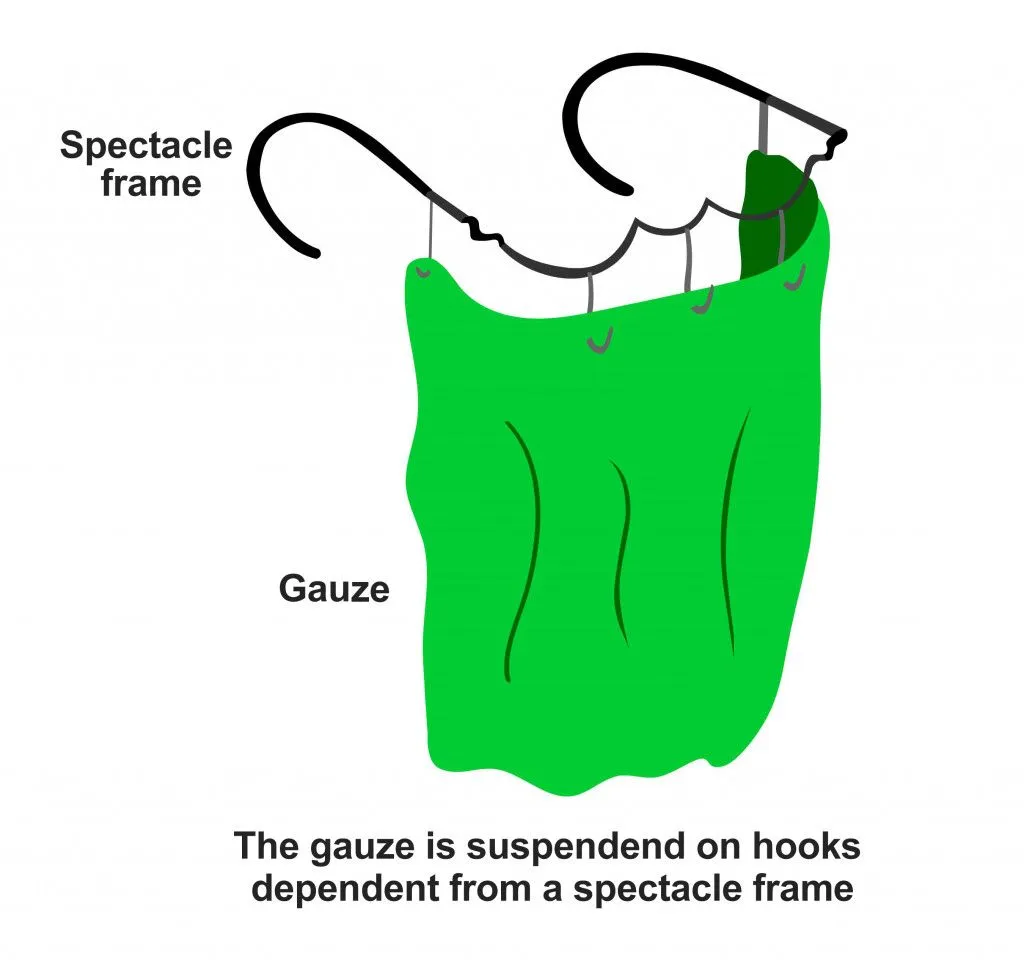
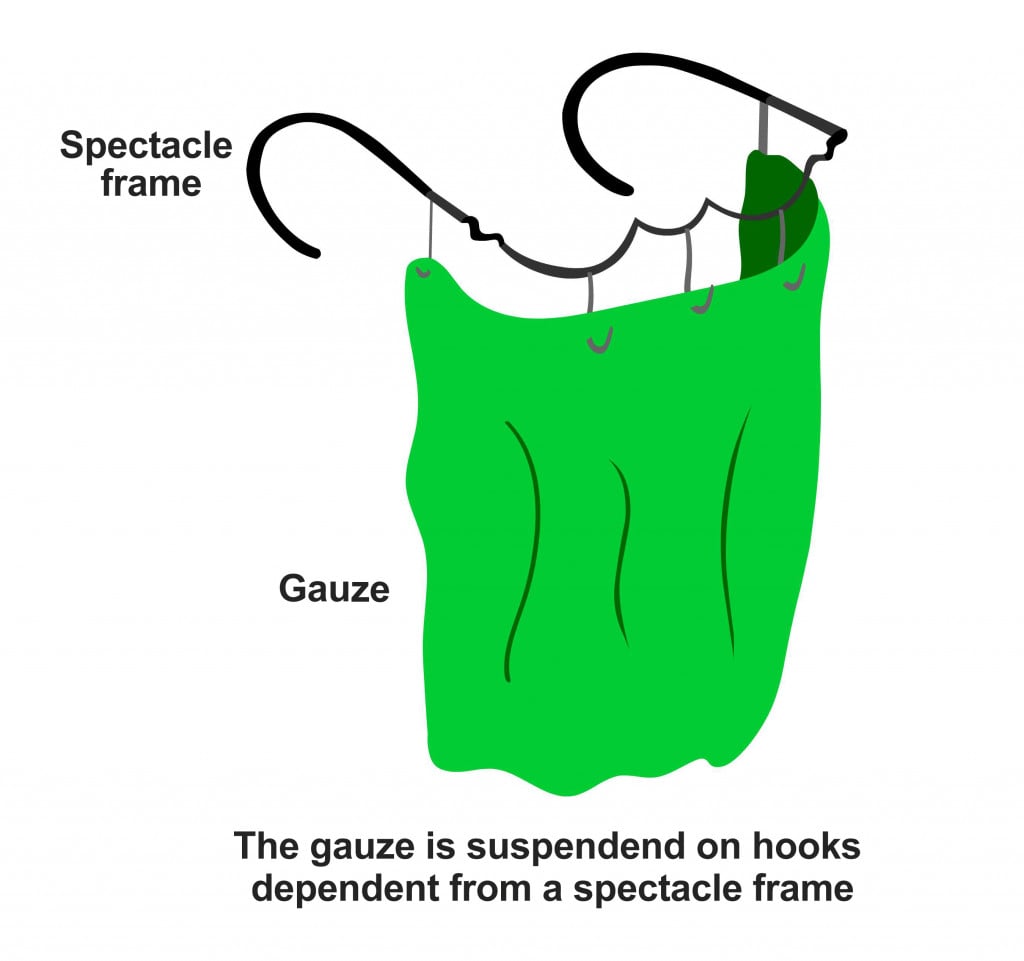
This understanding deepened when the world was hit by two major epidemics: the Manchurian plague of 1910–11 and the Spanish flu of 1918–19. Surgical masks used back then were made from several layers of cotton gauze held in place by a metal frame. By the 1930s, reusable masks were giving way to disposable ones, and by the 1960s they were being mass-produced from synthetic materials.
A Brief History Of Face Masks
The earliest known record of a mask-like object was found in the 6th century; images of people with cloths covering their mouths were found on the doors of Persian Tombs. In the 12th century, during the Yuan Dynasty in China, servants were known to place a silk scarf over their noses to prevent them from smelling their master’s food.
However, it was with the great plague of the 14th century that masks took a spookier turn. Plague doctors wore beak-like gear (that earned them the name beak-masks) that held scented materials like cinnamon and mint leaves to ward off miasma’ or blight that had contaminated the air. However, it was the 19th century that caught on to using masks for prevention against disease.

Plague Doctor’s Beak mask & Cross-section of beak mask (Photo Credit : Shutterstock)
Not so long ago history
In the 19th century, Louis Pasteur in France and the surgeon Joseph Lister in Britain helped establish that tiny invisible microbes were the cause of many diseases. Building on this germ theory, the German bacteriologist Carl Flügge showed in the 1890s that respiratory droplets carry bacteria.
This was further understood when the world was hit by two major epidemics, the Manchurian plague of 1910–11, and the Spanish Flu of 1918–19. Surgical masks used back then were made from several layers of cotton gauze and held in place by a metal frame. By the 1930s, reusable masks were replaced by disposable masks, and by the 1960s, they were being made in bulk from synthetic materials.
Why Do We Need Masks?
Once Carl Flügge showed that respiratory droplets could carry pathogens, it sent a wave of awakening through the medical community. The idea of ‘masks for infection prevention’ became popular among doctors and, eventually, the public.
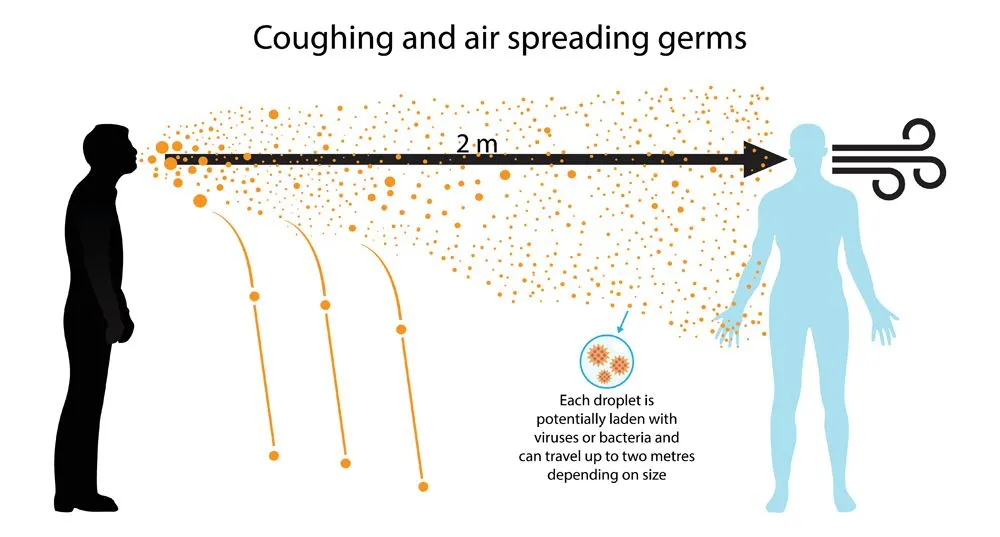
Science has since shown that transmission through the air can take place in two main ways. It can happen through large droplets that tend to settle quickly onto nearby surfaces, or through smaller aerosols (a suspension of tiny solid or liquid particles) that linger in the air after we sneeze, talk, or cough.
One study using particle image velocimetry measured the initial speed of air leaving the mouth during a cough at roughly 15 m/s (about 54 km/h or 34 mph) for men, with women coughing a little slower. That is comparable to a car on a city street!
The same study found that coughing pushed air out far faster than ordinary speech. And because the smallest particles fall most slowly, they linger in the air the longest.
So a single cough can spread its contents across a surprising distance. And since microbes don’t exactly come in neon colors, you can never tell where they might be lurking or floating!
Do Our Modern Masks Really Keep Germs At Bay?
Microbes span a huge range of sizes. A typical bacterium, such as E. coli, is only about 1-2 microns across, while most viruses are far smaller still, often 0.02-0.3 microns. (There are oddball giants at both ends: the bacterium Thiomargarita magnifica, described in 2022, can grow to a centimeter long, and so-called giant viruses such as Pithovirus reach about 1.5 microns, but these are rare exceptions.) For everyday respiratory pathogens, we are dealing with particles well under a few microns.
Now compare that to the mask. Pores in a standard cotton mask are roughly 80 microns wide. Surgical masks are made of finer synthetic fibers, with effective openings on the order of a few microns. For comparison, a human hair is about 50-70 microns thick.
If the pores are so large, especially in a cotton mask, bacteria and viruses would still be able to enter fairly easily, right? So how do these types of masks still work?
The trick is that a mask doesn’t work like a kitchen sieve, where anything smaller than the holes sails straight through. A mask is a dense, tangled mat of fibers, and air has to weave a twisting path around them. That gives the fibers several chances to grab a particle, and the effect compounds when multiple layers are stacked: the more layers, the higher the filtration capacity.
Filter scientists describe four mechanisms by which those fibers capture particles. Inertial impaction catches the largest particles (roughly 1 micron and up): they are too heavy to follow the bending airstream, so they barrel straight ahead and slam into a fiber. Interception snags mid-sized particles that follow the airflow but pass close enough to brush against a fiber and stick. Diffusion traps the smallest particles, and electrostatic attraction pulls charged or polarizable particles onto charged fibers. Let’s look at the last two more closely.
On a microscopic scale, particles are pushed around by the molecules they are immersed in. For a virus or bacterium drifting in air, the surrounding gas molecules and dust constantly bump into it from every direction.
Smaller particles experience greater force, as they are lighter, and will take on a random pattern of motion. This is called Brownian motion. All microscopic molecules show such random motion due to being hit randomly by gas molecules (or other fluid molecules like water, oil, etc.).
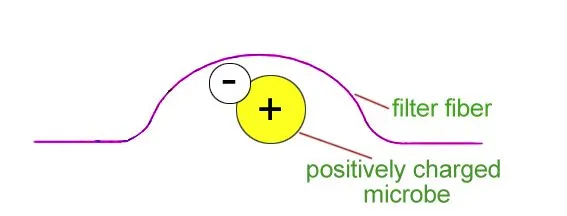
When air flows through the fibers of the mask, it takes up space, which causes fibers to expand in a circular shape. This creates a micro pocket in the fiber structure. With the air flowing in and the Brownian motion pushing the microbe around randomly (represented by the violet line in the image below), the microbe’s chances of getting trapped by the fiber are much higher.

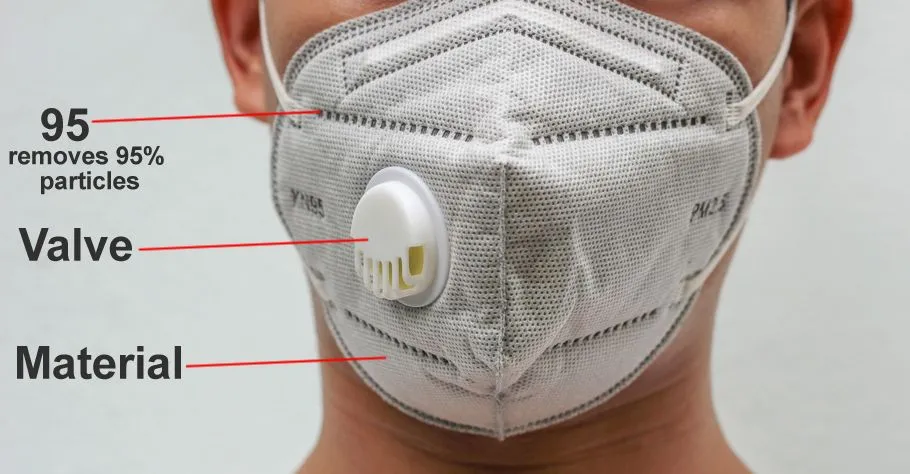
Another type of mask that the National Institute for Occupational Safety and Health (NIOSH) certifies for healthcare workers is the N95 respirator. The N stands for ‘not resistant to oil,’ meaning it is rated for use where oily aerosols are not present (oil can degrade the charge on the fibers). The 95 means it filters at least 95% of airborne particles in NIOSH testing.
That test uses 0.3-micron particles on purpose, because 0.3 microns is the hardest size of all to catch, the so-called most penetrating particle size. Larger particles get caught by impaction and interception, smaller ones by diffusion, but particles near 0.3 microns slip between those effects. An N95 stops at least 95% even at that worst case, and it actually performs better for particles both larger and smaller. The respirator’s filter is non-woven polypropylene fiber that has been turned into an electret, a material holding a long-lived electrostatic charge (usually applied by corona charging). The effect is a bit like running a comb through your hair and watching it pick up tiny scraps of paper.
Because the electret fibers carry a built-in charge, they tug on passing particles, whether the particle is charged or just polarizable, and pull them onto the fiber surface. Combined with the random Brownian jostling that nudges small particles into the fibers, this gives the mask its high filtration efficiency.
Apart from surgical masks and N95 respirators, public-health agencies such as the CDC and WHO have recommended cloth and disposable masks for the general public. A homemade cloth mask isn’t as protective as a surgical mask or an N95, but it is reusable and can still help, especially when it uses several layers of tightly woven fabric and fits snugly. As a rough ranking, the CDC notes that loosely woven cloth offers the least protection, well-fitting surgical masks and KN95s offer more, and a properly fitted NIOSH-approved respirator such as an N95 offers the most.
You can read the CDC’s current guidance on choosing among masks and respirators here.
Now, the next time you reach for a mask, you can be confident that it’s doing far more than its pore size alone would suggest!
References (click to expand)
- The evolution of face masks - Global Times. The Global Times
- Strasser, B. J., & Schlich, T. (2020, July). A history of the medical mask and the rise of throwaway culture. The Lancet. Elsevier BV.
- Matuschek, C., Moll, F., Fangerau, H., Fischer, J. C., Zänker, K., van Griensven, M., … Haussmann, J. (2020, June 23). The history and value of face masks. European Journal of Medical Research. Springer Science and Business Media LLC.
- Kwon, S.-B., Park, J., Jang, J., Cho, Y., Park, D.-S., Kim, C., … Jang, A. (2012, June). Study on the initial velocity distribution of exhaled air from coughing and speaking. Chemosphere. Elsevier BV.
- How Surgical Masks are Made, Tested and Used - Thomasnet. The Thomas Register of American Manufacturers
- Respirators and Mask Types and Performance. NIOSH, Centers for Disease Control and Prevention.
- N95 Respirators and Surgical Masks. The Centers for Disease Control and Prevention
- An overview of filtration efficiency through masks: mechanisms of aerosol penetration. Bioactive Materials. PMC, NCBI.
- The world's largest bacteria are visible to the naked eye (Thiomargarita magnifica). Natural History Museum.