Table of Contents (click to expand)
A Michelson interferometer works by using a beam splitter to divide one beam of light into two. Each beam travels down a separate arm, reflects off a mirror, and returns to the splitter, where the beams recombine. The resulting interference pattern reveals tiny differences in the two path lengths, down to a fraction of a wavelength.
An interferometer is an experimental tool used for investigative purposes in science and engineering. They are often used to make very small measurements at scales that are hard to perceive with the human eye or most measuring instruments. There are certain interferometers that can make staggeringly small measurements: LIGO, the gravitational-wave observatory, can detect a change in the length of its 4 km (2.5 mi) arms smaller than 1/10,000th the diameter of a proton (about 10-19 m). The person who invented the interference machine was Albert Michelson, and remarkably, he did so in the 19th century, building his first interferometer in 1881. It was, in fact, the Michelson-Morley experiment of 1887 that disproved the presence of a luminiferous aether, which physicists had believed existed up to that point as the medium through which light traveled. The fact that the aether was disproved paved the way for the theory of special relativity and the birth of modern physics. Michelson would go on to win the 1907 Nobel Prize in Physics, becoming the first American to win a Nobel in the sciences. Now, let’s look at the configuration of the Michelson interferometer.
What Is An Interference Pattern?
To better understand the working and construction of an interferometer, let’s look at what interference is. If you’ve ever thrown a stone into a body of water, then you already know what interference is. When the stone plops into the water, concentric waves move away from the stone’s point of entry. If two or more of these concentric circles intersect, then the resulting shape of the wave changes. The change in shape of the resulting wave from the two previous intersecting waves is known as interference.
The principle of interference is quite intuitive and easy to understand. The figure above shows two different kinds of interference: total constructive interference and total destructive interference. Total constructive interference occurs when the peak of one wave merges with the peak of the secondary wave; they add together and a new wave is formed. In total destructive interference, the peak of one wave meets the valley of another wave of equal magnitude; when this occurs, the two waves cancel each other out.
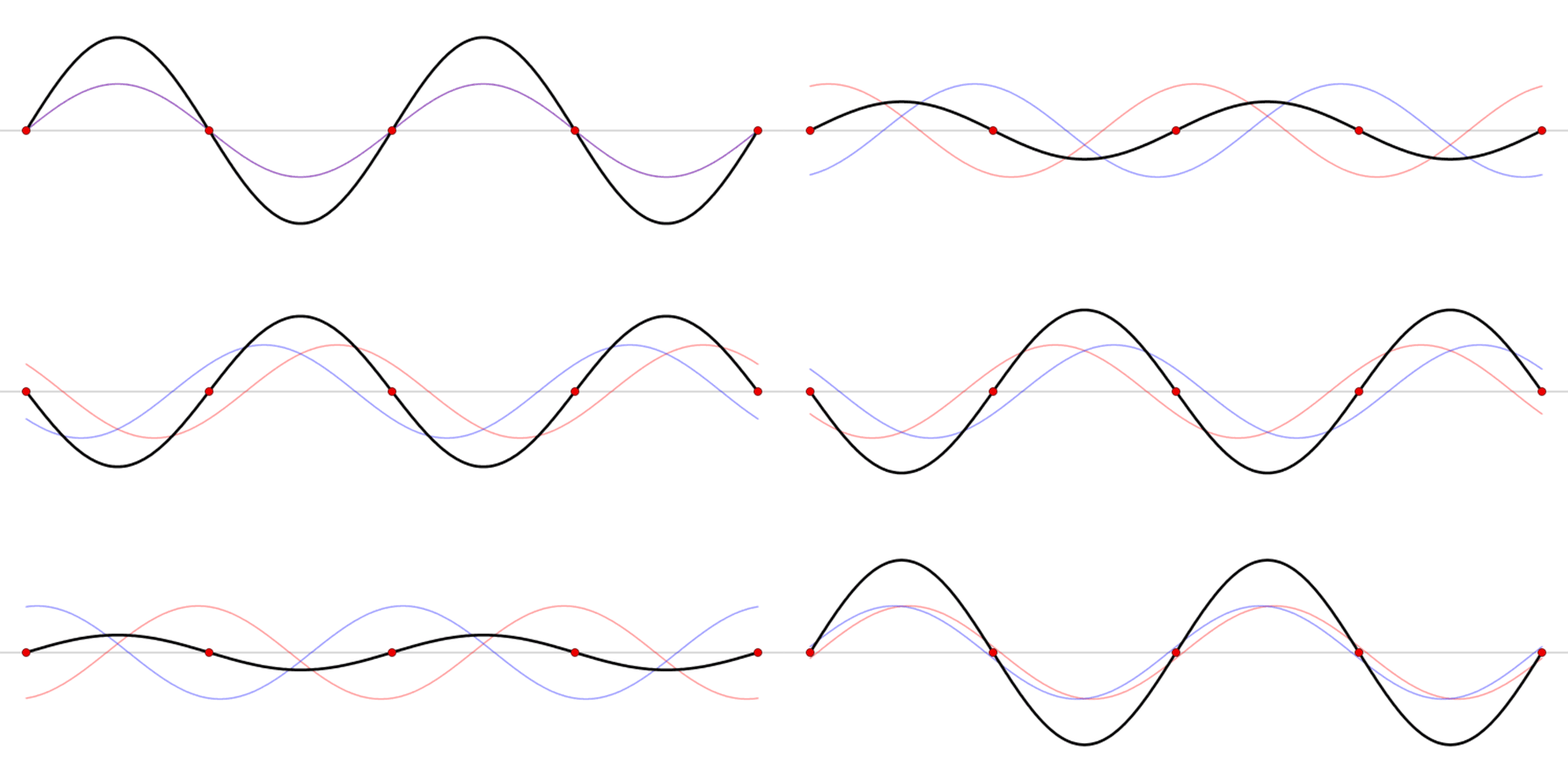
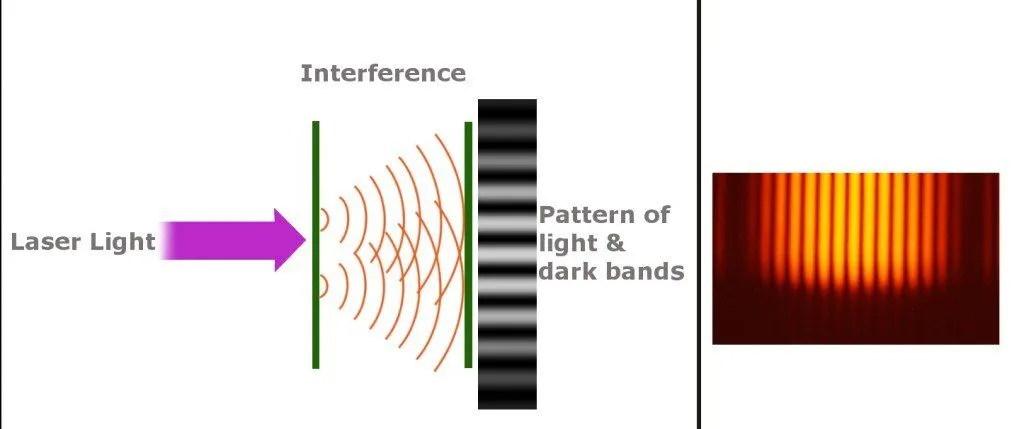
The extent to which one wave is in step with another is called a phase. When the constructive or destructive interference is shone on to a screen, it creates light and dark patterns that are known as an interference pattern. The interference pattern created by the interferometer is what researchers study to understand the results of the experiment.
Configuration
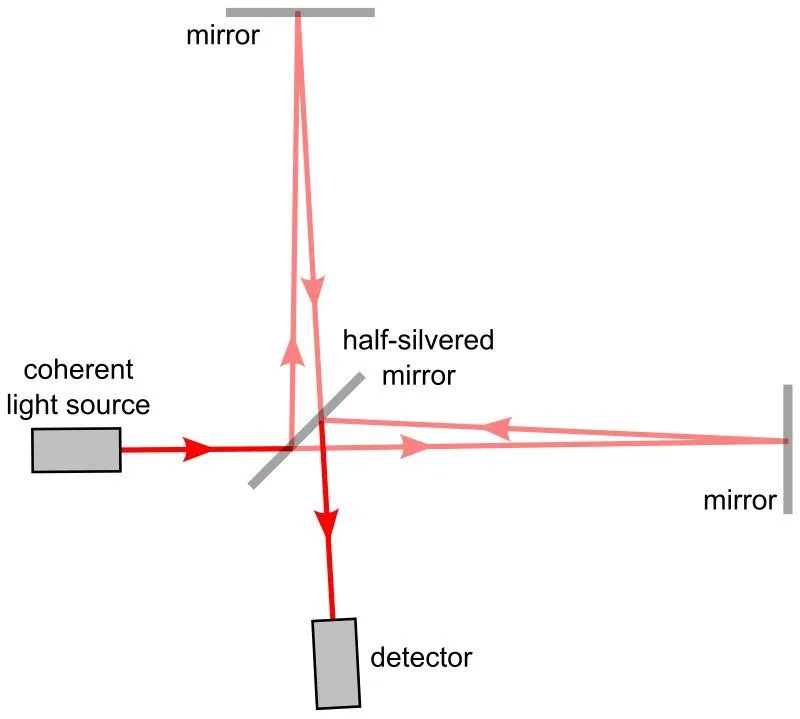
In a Michelson interferometer, a laser beam passes through a beam splitter; as the name implies, it splits the beam into different beams. One beam of light passes straight through, while the other beam of light is reflected at an angle of 90o from the other beam. This occurs at point C. Each beam travels down an arm of the interferometer and encounters a mirror. The mirrors reflect the two beams back to the beam splitter. The point where the two beams of light combine at C’ is the point where the interference pattern occurs.
The interference pattern is reflected from point C and the interference pattern is deflected to a detector. If there is an angle present between the two returning beams, the recorder will record it as a sinusoidal fringe pattern. If there is no angle present and the returning beams are in perfect spatial alignment, then no interference pattern will be formed and only a beam of constant intensity will be produced. However, such a perfect alignment of the beam is difficult to achieve in laboratory settings and requires extreme precision.
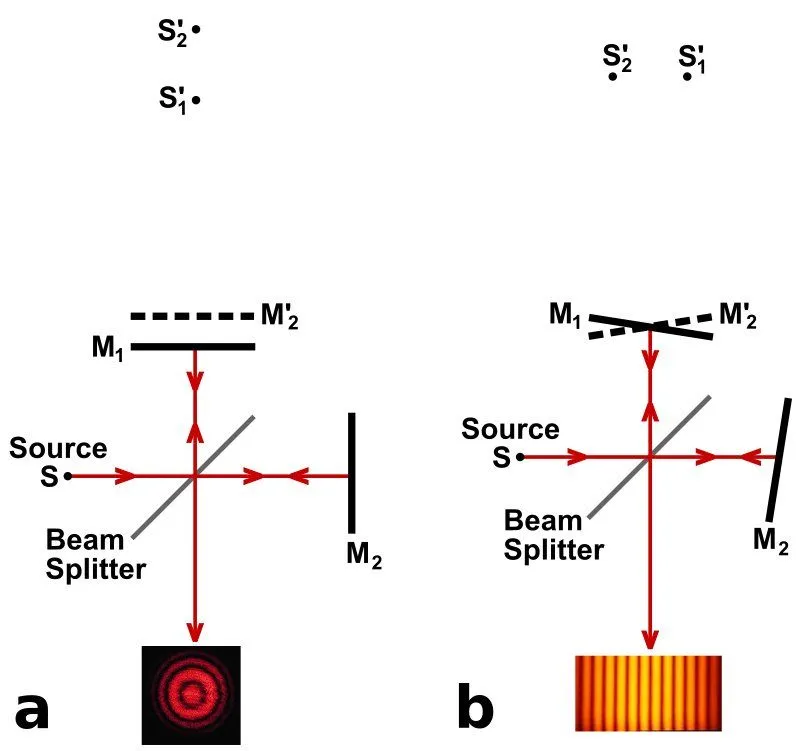
The formation of fringes in the Michelson experiment is shown in the above diagram. The observer has a direct view of the mirror M1 as seen through the beam splitter and a virtual image of M2 as M2’. The fringes that are formed in the first setup can be interpreted as the light coming from the virtual image S1‘ and S2’ of the original source S. The nature of the interference pattern created depends on the nature of the light source and the orientation of the mirrors. If the mirrors are slightly tilted with respect to one another, the interference pattern takes the shape of conic sections. If M1 and M2’ overlap, they will produce an interference pattern that consists of straight, parallel and equally spaced images. The change in the interference pattern of the interferometer can be used to study and measure various objects (or particles).
How Does An Interferometer Work?
So how does all of this actually let us measure something? The trick is that the two beams travel down their separate arms and back, and whether they line up (constructive interference, a bright fringe) or cancel out (destructive interference, a dark fringe) depends entirely on the difference in the distances they traveled. Move one of the mirrors by even a tiny amount, and you change that path difference, which makes the fringes march across the detector. Count the fringes that pass by, and you have measured the distance the mirror moved.
Here is the neat part: each time the path difference changes by one full wavelength of the light, exactly one fringe shifts. Because the light makes a round trip down the arm, moving a mirror by a distance d changes the path by 2d. So the relationship is simply 2d = mλ, where m is the number of fringes that pass and λ is the wavelength of the light.
Let’s work through an example. Say you use a red helium-neon laser, which has a wavelength of about 633 nanometers (633 × 10-9 m), and you watch 1,000 fringes go by as you slowly slide one mirror. Rearranging the formula, d = mλ / 2 = (1,000 × 633 × 10-9 m) / 2 = 3.165 × 10⁻⁴ m, or about 0.32 millimeters (0.012 inches). In other words, by counting light fringes you just measured a movement of roughly a third of a millimeter to within a fraction of a wavelength. Now you can see why interferometers are the gold standard for precision measurement: the ruler is the wavelength of light itself.
The Michelson-Morley Experiment
The most famous use of this instrument was the experiment that arguably broke 19th-century physics. In the summer of 1887, at what is now Case Western Reserve University in Cleveland, Albert Michelson and chemist Edward Morley set out to measure Earth’s motion through the luminiferous aether, the invisible medium that light was assumed to ripple through.
Their reasoning was straightforward. If the aether existed and Earth was plowing through it at roughly 30 km/s (19 mi/s) in its orbit around the Sun, then light beamed along the direction of that motion should travel at a slightly different speed than light beamed across it, just as a swimmer crossing a river makes different time than one swimming up and down the current. The two arms of their interferometer pointed in those two directions, so any speed difference should show up as a shift in the interference fringes. To catch it, they floated the whole apparatus on a pool of liquid mercury so they could rotate it smoothly and watch the fringes for the expected shift.
The result was nothing. No matter the time of day or the season, the fringes refused to budge, and the experiment placed the speed of any aether wind below about 1.5 km/s (0.93 mi/s). This celebrated null result is one of the most important "failed" experiments in history. There was no aether wind because there was no aether. The puzzle it created was only resolved in 1905, when Albert Einstein’s special theory of relativity took the constancy of the speed of light as a starting point rather than a paradox to be explained away.
References (click to expand)
- What is an Interferometer? | LIGO Lab.
- Michelson interferometer. Encyclopaedia Britannica.
- The Michelson Interferometer. OpenStax University Physics, LibreTexts.
- Michelson-Morley experiment. Encyclopaedia Britannica.
- Albert A. Michelson - Biographical. NobelPrize.org.
- Michelson interferometer. Wikipedia.