Thomas Young’s double-slit experiment fires light or matter through two narrow slits at a screen. Unobserved, the photons form an interference pattern and behave like waves; the moment a detector watches which slit each photon goes through, the pattern collapses and they behave like particles. That wave-particle duality is the heart of quantum mechanics.
Light has been one of the major areas of inquiry for physicists since we first began questioning the world around us. Understandably so, as it is the medium by which we see, measure and understand the world. It holds a powerful symbolism in our imaginations, is reflected in our religions and is famously quoted in our scriptures.
Rigorous science has enlightened our ignorance about Light. Until the 1800s, light was thought to be made up of particles, attested by Newtonian physics.
This came rather intuitively, as we see light traveling in a straight line, like bullets coming out of a gun.
However, nature is often weirder than our expectations and light’s weird behavior was first shown by Thomas Young in 1801, in his now heavily worked upon and immortalized double-slit experiment. This experiment provides some fascinating insights into the minute workings of nature and has challenged everything we know about light, matter, and reality itself. Let’s revisit the experiment that has baffled legendary scientists – including Einstein!
The Double-Slit Experiment
The experiment is pretty straightforward, with very few parts. There are three main components:
- A source of light or matter – photons, electrons, bullets

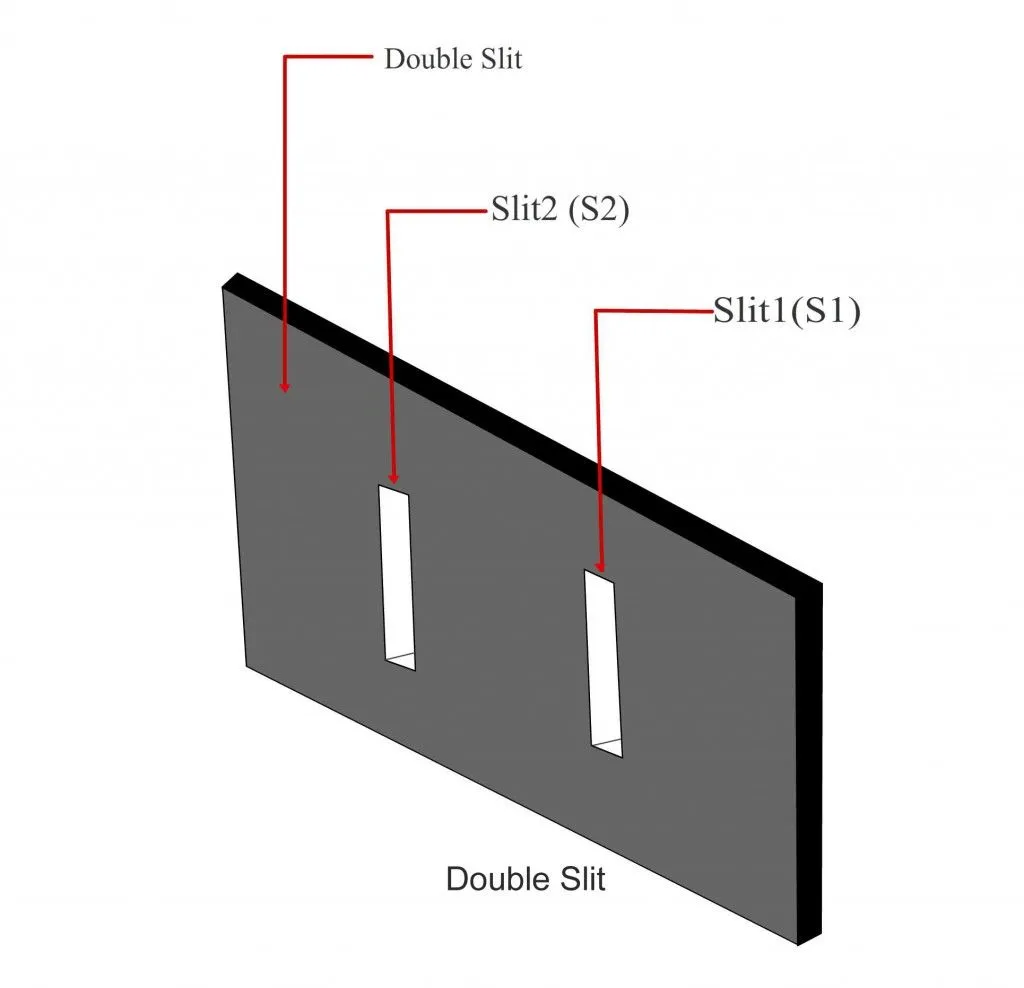
• Two narrow slits for the source to pass-through.
• A projection screen, where the source makes its impression. The pattern of the impression tells us if it is a wave or a particle.
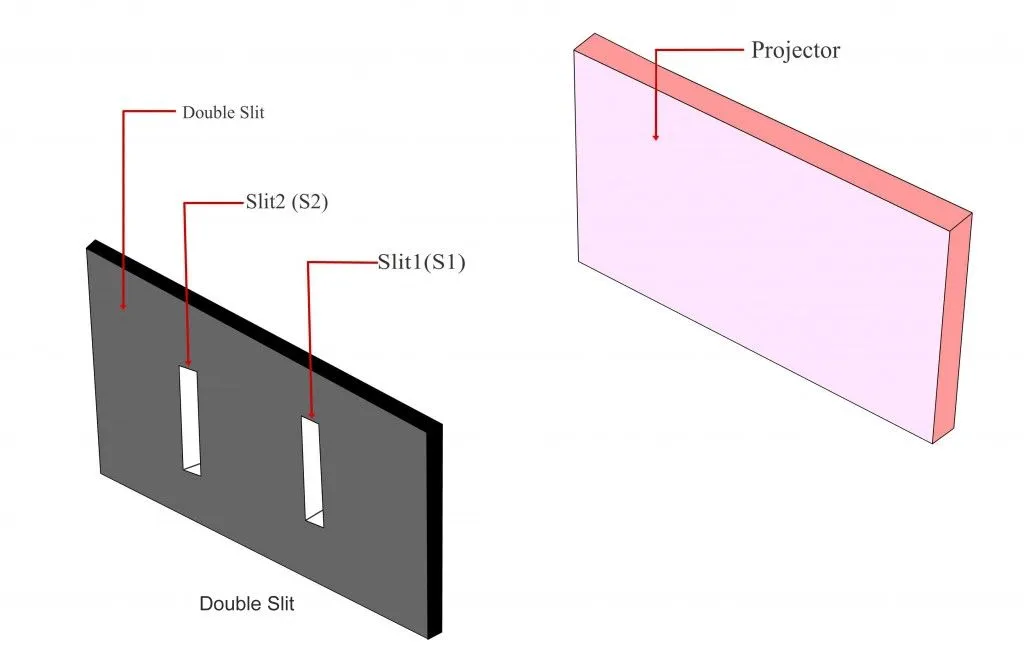
The objective of the experiment is to see the underlying make-up of light and matter.
Let’s start with something familiar, bullets from a machine gun. Our gun fires bullets at regular intervals towards the range of the two slits.
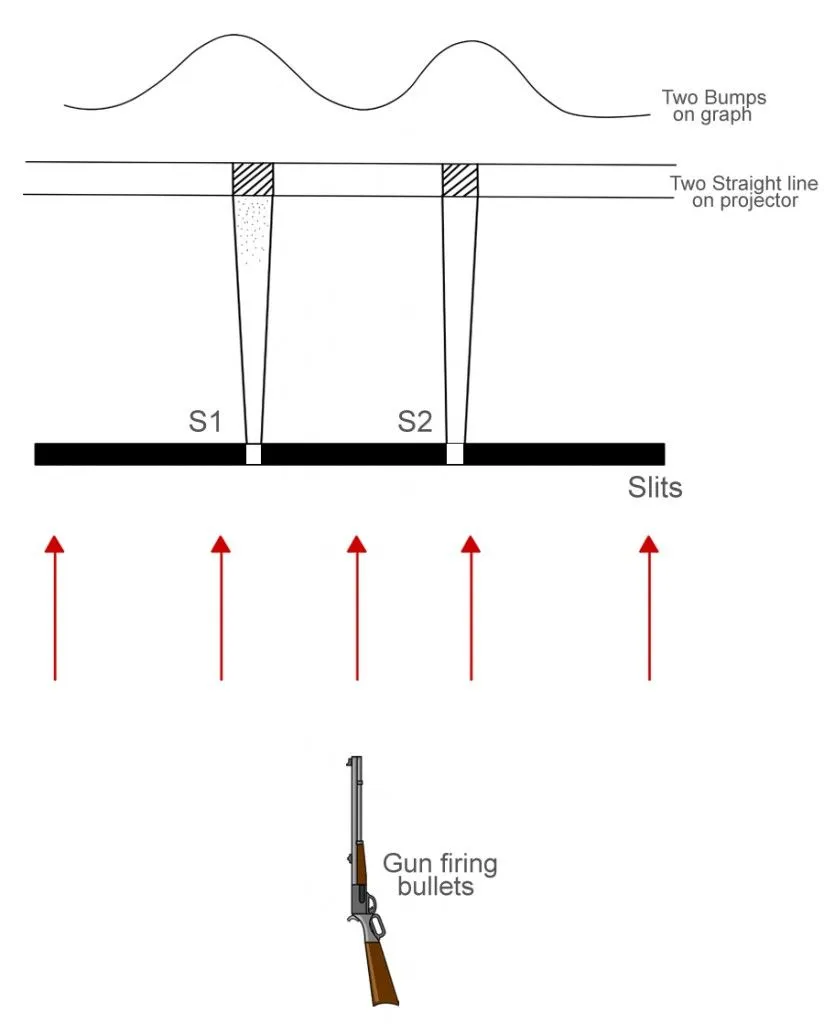
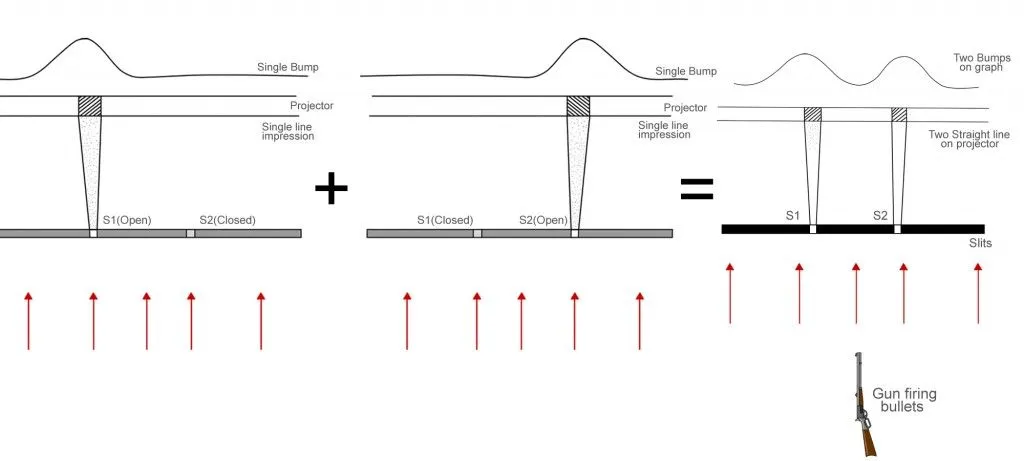
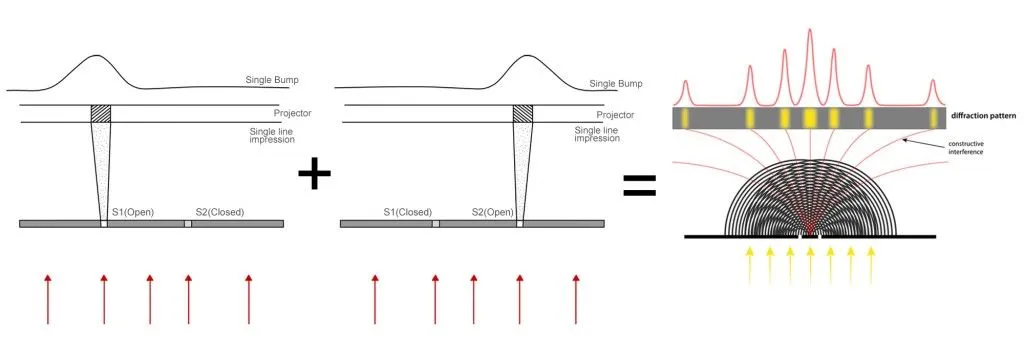
Two straight lines appear on the projector. The graph pattern is that of two mountains; where the crests imply the impression points, and the troughs imply empty places.
The thing to note here is, if we close S2 and fire the gun, only one line appears. Thus, we can safely say that S is equal to the sum of S1 and S2, i.e., S = S1 + S2.
Light is the next source for the experiment. The impression appears as bundles of photons fire through the two slits. What is the pattern you think will emerge? Is it similar to that of bullets? Well, light consists of bullet-like particles, so it isn’t farfetched to say the pattern will be the same.
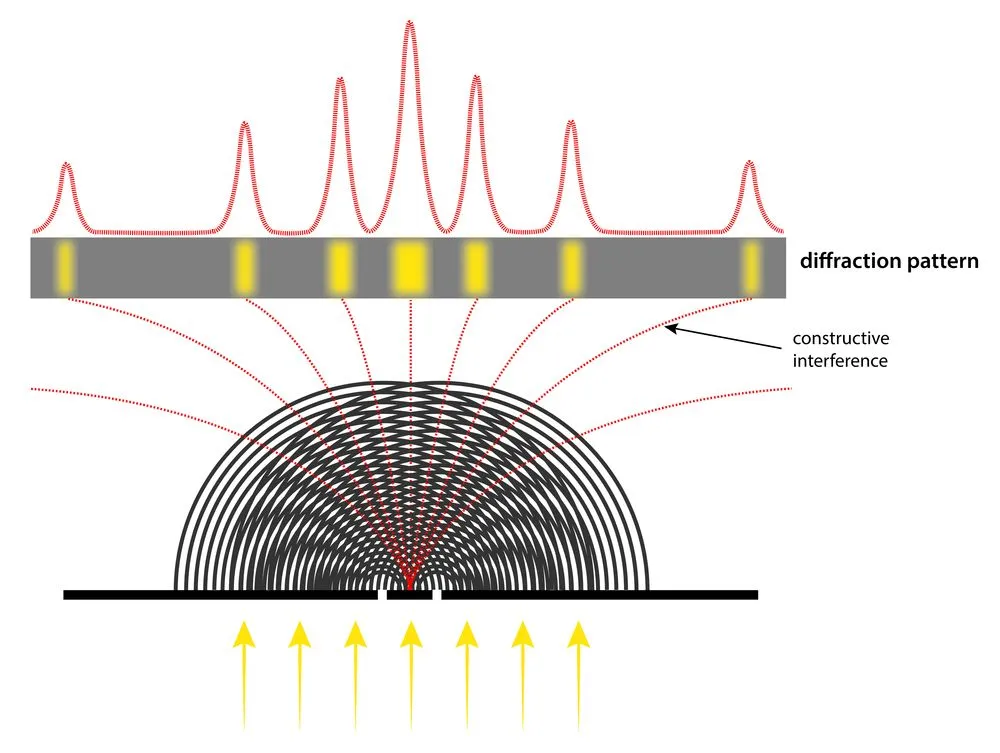
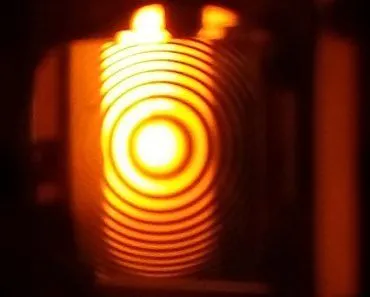
To everyone’s surprise, however, the impression isn’t of two straight lines. The graph pattern that emerges is an interference pattern; there is the brightest impression in the center, and recedes on both sides. An interference pattern is only made when two waves interfere with each other; there is no other possible explanation to it. The pattern shows that the light is moving in waves.
The waves from the two slits are colliding with each other. There is a peculiar formation that develops when two waves collide. A wave has a crest (the part above) and a trough (the part below).
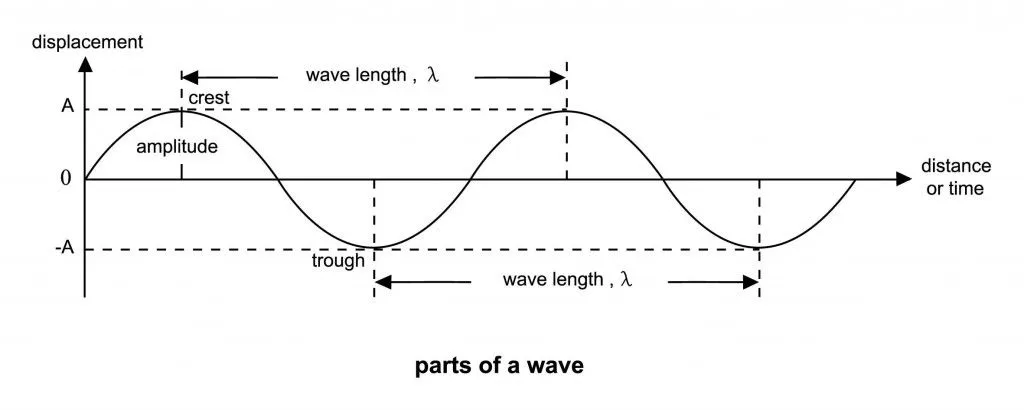
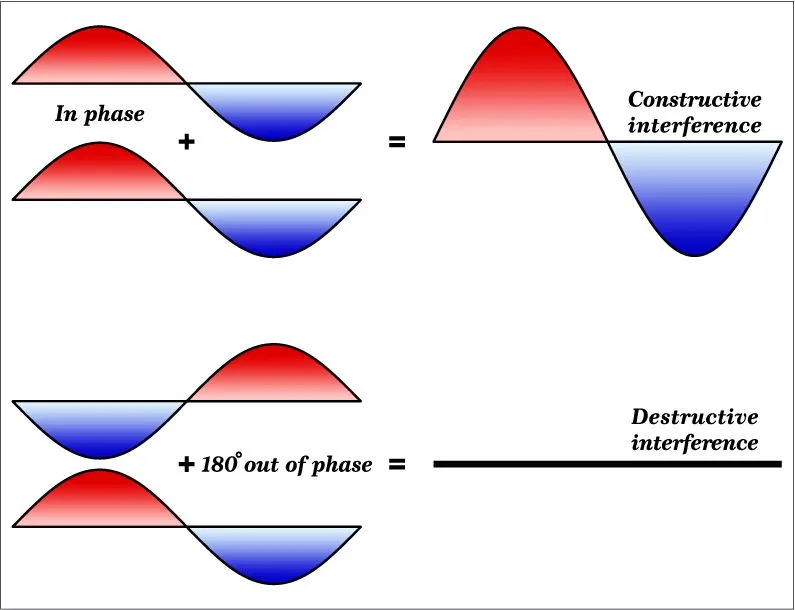
When the crest of one wave collides with the crest of another, it adds and forms constructive interference, seen as a bright spot on the projector. When the crest of one wave and trough of another collide, they cancel each other out and form a destructive pattern, which results in dark spots between the impressions on the projector.
The second slit is closed and the experiment is done again. Now with one slit to move through, the photons form a straight line. Note, here S is not equal to the sum of S1 and S2, and this is also where light’s wave-particle duality comes into focus.
This revelation changed our thinking about light, but the rabbit hole doesn’t end there; things just get weirder when we further iterate the experiment. Now, instead of flashing a bunch of photons together, only single photons are fired through the slits at regular intervals. Given that it is a single photon, and has no other wave to interact with, we can say that the photon will make a single line on the projector, yet the result is counter-intuitive; the formation on the projector is still an interference pattern!
How can this be? How can a single photon know about the photons coming after it and form a pattern resembling that of the group being shot together?
This is where quantum spookiness begins and things get pretty far out. It appears that a single photon is traveling through both the slits and colliding with itself to form the interference pattern. This has bothered physicists a lot, as it does not obey the laws that we see in our Newtonian scale. It turns out that a large assemblage appears to behave in a way that is different from the behavior of its minuscule components.
Now, let’s hit a home run and take this weirdness to another level. This last iteration of the experiment will make you appreciate nature’s absurdness and how totally wacky our world truly is.
Observation Affects Reality
At this point, we have established that a single photon travels from both the slit at the same time and collides with itself to form the interference pattern. As classical physics dictates, it is impossible for the same photon to move through the two slits at the same time. Perhaps it is splitting itself into two parts and interacting with itself. The only way to know is to watch. A detector is placed in one of the slits so when the photon passes through the slit, the detector identifies it.
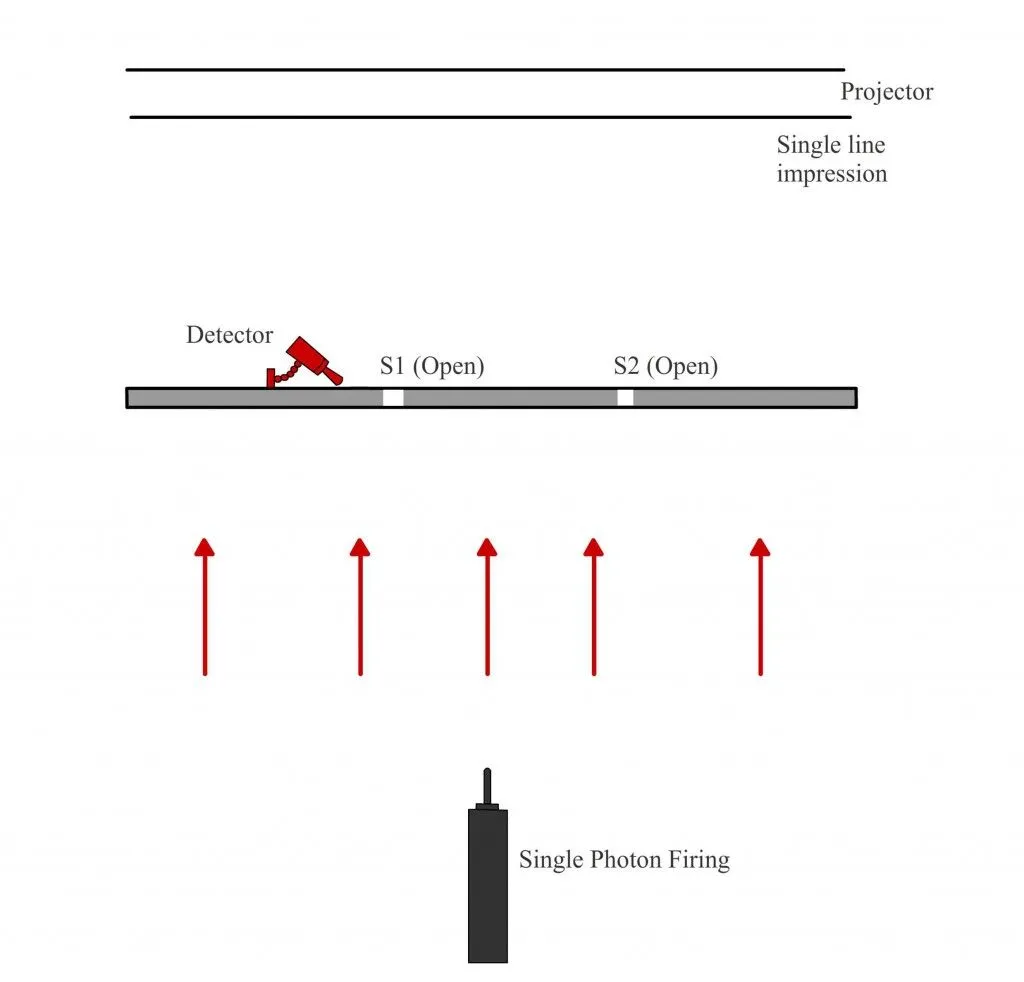
As the photon passes through the slit, the detector identifies it. The pattern that emerges on the projector is a single line.
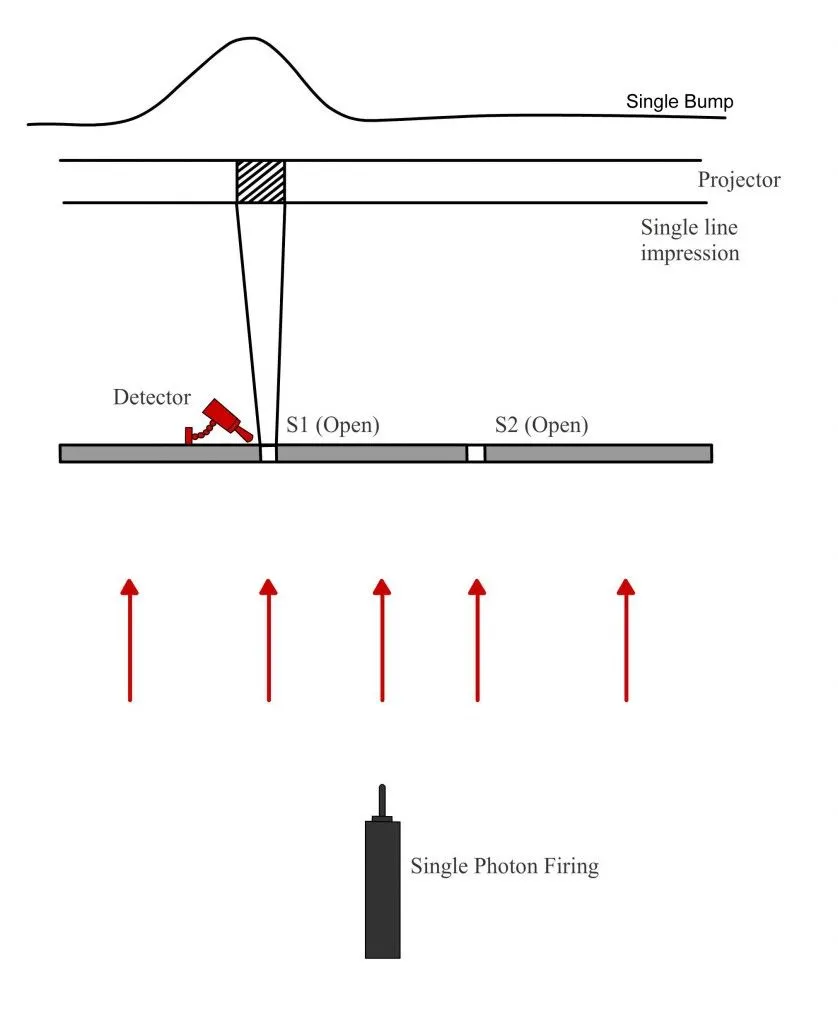
Just when you think you’re coming to terms with the quantum scale, things slip over your head. The act of measuring or observing the photon makes it go through only one path, making the impression on the projector of a particle. It doesn’t interact with itself anymore and no interference pattern emerges. When the experiment is carried out with varying degrees of detection, so that the detection is dimmer on every passing photon (say 7-10 photons are being detected and that number keeps decreasing), then the interference pattern starts to slowly emerge again. The photons act as a wave when not being observed and act as particles when they are being observed.

How Does A Photon Know It's Being Observed?
This is the question that turned the double-slit experiment into a meme, and it hides a big misunderstanding. The photon doesn't "know" anything, and no conscious mind is needed for the pattern to vanish. In quantum mechanics, "observing" or "measuring" something is not a person staring at it. It is a physical interaction.
Think about what it actually takes to catch which slit a photon goes through. You cannot spot a photon without doing something to it, because a photon can't be registered without being absorbed or scattered. To detect it you have to soak it up, bounce another particle off it, or otherwise couple it to a measuring device. That interaction disturbs the photon and ties its fate to the detector. Once that link exists, the two possible paths can no longer overlap cleanly, so the tidy interference fringes wash out and you are left with a particle-like clump.
The key point is that this happens with a fully automated detector and nobody in the room. What matters is whether the "which-path" information exists anywhere, not whether a human ever reads it. Even a stray air molecule or a photon bouncing off the particle can carry that information away and smear the pattern, a process physicists call decoherence, essentially unintentional observation by the environment. The popular line that "the universe behaves differently only when a conscious being looks" is a myth.
The clincher is the quantum eraser. If the which-path information is recorded and then erased again, the interference pattern returns. The photons were never deciding to perform for an audience. The pattern depends only on whether their two routes can still interfere, which depends on whether anything, anywhere, has tagged which way they went.
What Does The Interference Pattern Look Like, And What's The Math?
The signature of wave behavior is a row of evenly spaced bright and dark bands, called fringes. The brightest band sits dead center, and the brightness fades as you move out to either side. That central-bright, fading-outward shape is the giveaway that two waves are overlapping rather than particles piling up.

The geometry is tidy enough to put numbers on. A bright fringe appears wherever the path lengths from the two slits differ by a whole number of wavelengths, which gives the famous condition d sin θ = mλ. Here d is the gap between the slits, θ is the angle from the center, λ is the wavelength of the light, and m = 0, 1, 2, ... numbers the fringes (m = 0 is the central band). Dark fringes fall exactly halfway between, where d sin θ = (m + ½)λ.
On a screen a distance L away, the bright bands come out roughly equally spaced, separated by Δy = λL/d. Say you shine a red laser (λ = 633 nm) through slits 0.10 mm apart onto a wall 2.0 m (about 6.6 ft) back. The bands land about Δy = (633 × 10-9 m × 2.0 m) / (1.0 × 10⁻⁴ m) ≈ 0.013 m, or roughly 1.3 cm (0.5 in) apart. Notice that squeezing the slits closer together (smaller d) spreads the fringes wider, which is exactly why the slits have to be extremely fine to see the effect at all. The same math underlies ordinary diffraction of light.
Who Discovered The Double-Slit Experiment? Thomas Young's Original Test
For all its quantum strangeness today, the experiment began as a plain argument about ordinary light. In Newton's wake, the reigning view was the corpuscular theory, which treated light as a stream of tiny particles. The English polymath Thomas Young (1773-1829), a physician who also helped decipher Egyptian hieroglyphs, set out to challenge it.

Around 1801 to 1803, Young let a narrow beam of sunlight into a darkened room through a pinhole in a window shutter. He then held a thin slip of card, roughly one-thirtieth of an inch (about 0.85 mm) wide, edgewise in the beam so that it split the light into two parts. Where those parts overlapped on a far wall, they painted alternating bright and dark fringes. Block one side and the fringes vanished. Particles flying in straight lines could never do that; only overlapping waves could. Young named the effect interference and presented it in his Bakerian Lectures to the Royal Society.
Worth a small honesty note: Young's own demonstration split a single sunbeam with a card rather than using two clean slits, and the tidy two-slit picture we draw today is the idealized form of the same interference principle, later sharpened by physicists such as Augustin-Jean Fresnel. Young's result revived the wave theory of light first championed by Christiaan Huygens, and it reshaped how we understand the nature of light itself.
The Various Interpretations:
The double-slit experiment is one of the most iterated experiments in scientific history. Electrons, atoms, molecules, and even complex fullerenes like Buckyballs have been used as sources for the experiment. The same results are obtained using every source; the pattern is consistent in both light and matter. The current record-holder is a 2019 experiment at the University of Vienna, in which oligo-tetraphenylporphyrin molecules of more than 25,000 atomic mass units (around 2,000 atoms each) were sent through a multi-grating interferometer and still produced the telltale interference stripes of wave behavior.
Things on the quantum scale don’t follow the deterministic laws of the macro scale. There are many interpretations of this quantum phenomenon. The Copenhagen Interpretation states that the interference pattern is all the probable functions of the photon (a wave function) and the act of observing or measuring it makes the wave select one of the many alternatives (collapsing of the wave function).
Another interpretation is the many-worlds theory, which states that all the possible states of the photon’s wave function exist simultaneously and our detection is just this particular instance of the wave function.
The theories tend to run wild and it’s safe to say that the quantum realm is a little slippery to wrap your head around. However, there’s no need to feel bad, as you’re in good company. As Richard Feynman put it in The Feynman Lectures on Physics, the double-slit experiment is a phenomenon “which is impossible, absolutely impossible, to explain in any classical way, and which has in it the heart of quantum mechanics. In reality, it contains the only mystery.”
References (click to expand)
- Double-slit experiment. Wikipedia.
- Copenhagen Interpretation of Quantum Mechanics. Stanford Encyclopedia of Philosophy.
- Chapter 14: Interference and Diffraction. MIT 8.02 course notes.
- Young’s Double Slit Experiment. University of Central Florida Pressbooks.
- Lecture Notes, Quantum Physics III (8.06). MIT OpenCourseWare.
- Fein et al., Quantum superposition of molecules beyond 25 kDa. Nature Physics 15, 1242 (2019).
- Schlosshauer, M. Quantum Decoherence. Physics Reports 831 (2019).
- Double Slit Interference. HyperPhysics, Georgia State University.
- Thomas Young. Linda Hall Library, Scientist of the Day.
- Young's interference experiment. Wikipedia.