Table of Contents (click to expand)
- Rutherford Model As An Extension Of The Solar System
- Evolution Of The Structure Of An Atom
- Then What Stops The Electrons And Protons Of An Atom From Interacting?
- Odds Against Nuclear Collision
- Can Protons Move, Or Only Electrons?
- Why Don't The Protons In A Nucleus Just Fly Apart?
- What Happens When A Proton And Electron Actually Combine?
- Conclusion
Unlike charges are attracted to each other, but protons and electrons within the space of an atom do not interact with each other. Quantum physics attempts to explain the reason behind the absence of this forbidden interaction.
The foundation of the question ” Why do electrons not collide with protons?” comes from the Rutherford planetary model of an atom.
This is an overly simplified model of an atom as a central dense nucleus consisting of protons and neutrons, with electrons revolving around the nucleus, an idea structured on the solar system. Quantum physics attempts to explain this interaction less abstractly.
Rutherford Model As An Extension Of The Solar System
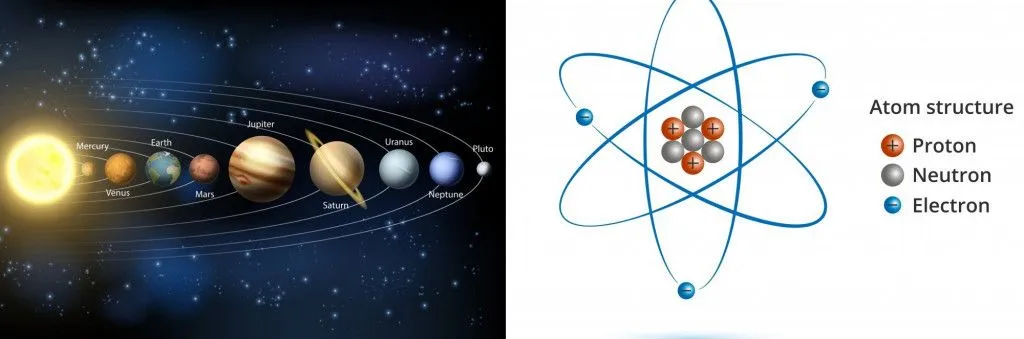
This model failed to explain the stability of a particle in a circular path, but it did leave an indelible question that has lingered for generations: Why don’t electrons end up pulling on their protons?
Rutherford hypothesized that the stability of an electron is a balance between the centrifugal force of the revolving electron and the attractive forces of the nucleus. It is a perfect picture hypothesis, but unsustainable!
Why Is Rutherford’s Planetary Model Invalid?
A charged particle revolving in an orbit must change direction, resulting in acceleration. A charged accelerating particle will lose energy in electromagnetic radiation, and eventually collapse into the nucleus.
However, this does not happen. An atom is extremely stable, so we need to move away from classical physics and spin towards quantum physics for an answer.
Evolution Of The Structure Of An Atom
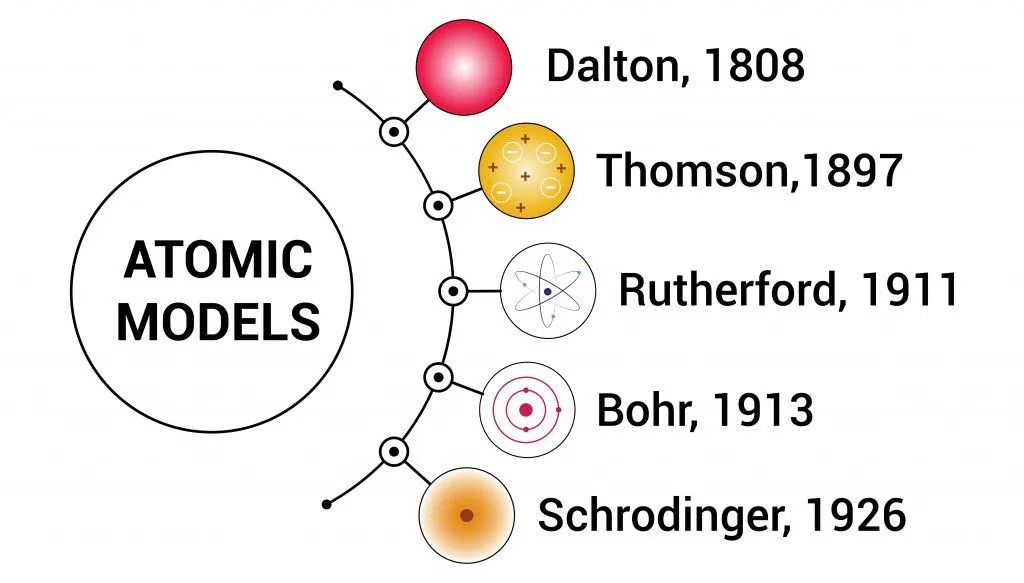
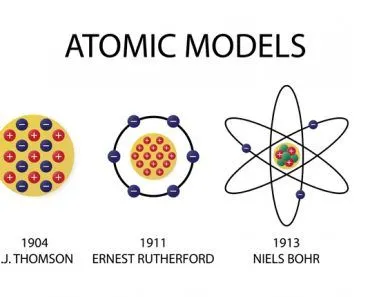
- (1803) Dalton’s billiard ball model of an atom as an indivisible entity. Today, we know that an atom is divisible into sub-atomic particles.
- (1904) Thomson’s plum pudding model embedded electrons in a sphere of positive charges. The theory failed upon the discovery of the nucleus by Rutherford and his team.
- (1911) Rutherford’s nuclear model proposed that the atom has a small, dense, central region, called the nucleus, consisting of positively charged particles. The negatively charged electrons revolved in orbits around the nucleus. This model, based on the planetary model, does not explain the stability of an atom.
- (1913) Niels Bohr’s quantum model was also based on a planetary model, but here, the electrons revolve in paths with fixed energy called orbits. The spaces between the orbits are forbidden for the electron. This model rules out the spiraling of electrons into protons because of the “forbidden paths” between different energy levels.
However, the model could not explain the line spectra of atoms with more than one electron.
- (1926) In Schrodinger’s quantum mechanical model, electrons do not move in circular orbits but exist in electronic clouds. An electron cloud is a region of space inside an atom, where there is a 90% probability of finding the electron; this space is called the orbital.
Schrodinger and Heisenberg put forward theories and mathematical equations for the stability of an atom, which led to the birth of quantum mechanics. According to this school of physics, the position and momentum of an electron cannot be determined simultaneously.
With the electron cloud model of an atom, there is no forbidden zone for electrons to cross.
Then What Stops The Electrons And Protons Of An Atom From Interacting?
A simple experiment can show that protons and electrons of different atoms interact, but protons and electrons of the same atom do not interact. Protons and electrons are of opposite charges, so traditionally, they would be attracted to each other.
This is very clear from a small balloon experiment. Static electricity is an electrical phenomenon in which charged particles can be transferred from one body to another.
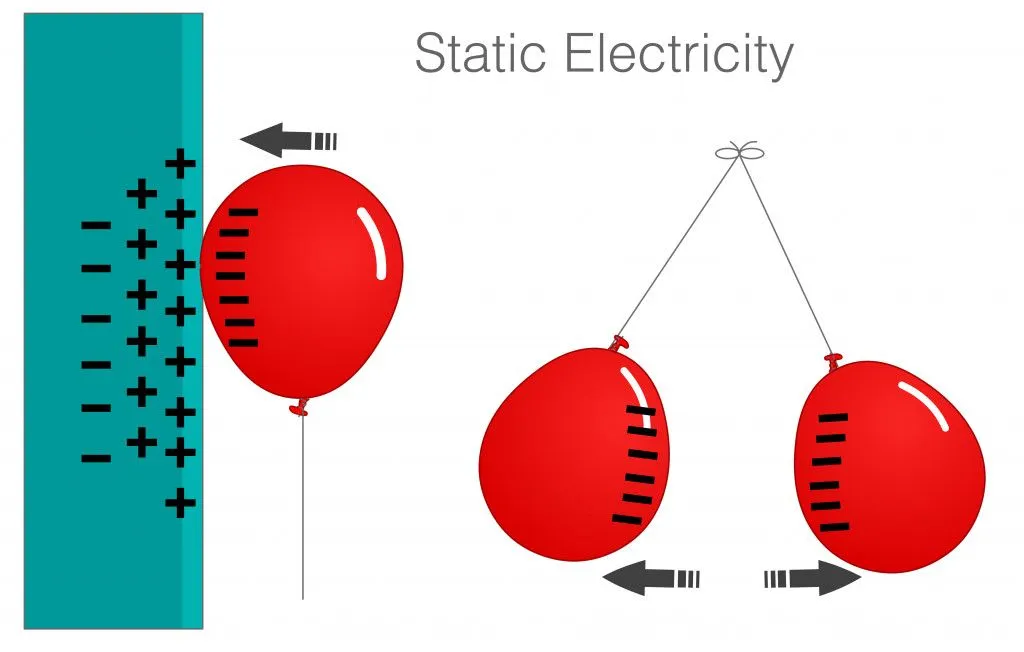
When a balloon is rubbed against a sweater or a person’s hair, the balloon gains negative charges. When the negatively charged balloon is brought close the wall, the electrons in the wall move, leaving the protons exposed, which interact with the negative charges on the balloon.
When the electrons from one type of matter are attracted to the protons of another, then why do electron and protons within the same atom not interact? In theory, electrons should zoom right into the nucleus!
Odds Against Nuclear Collision
Four concepts forbid interactions between protons and electrons of the same atom.
1. Kinetic And Potential Energy In Atomic Stability.
An electron in an atom always has both kinetic and potential energy. The farther it is from the nucleus, the higher its potential energy and the lower its kinetic energy. If the electron were to move closer to the nucleus, its potential energy would decrease, but its kinetic energy would increase sharply (as demanded by the Heisenberg uncertainty principle). This increase in kinetic energy prevents the electron from collapsing into the nucleus. There is an optimal distance where the total energy is minimized, keeping the atom stable.
2. The Final Deck In The Game: The Battle Of The Infinities
If the electron did enter the nucleus, it still wouldn’t combine with the proton. The potential energy of an electron becomes negative as it approaches the nucleus and is minus infinity inside the nucleus. In contrast, the kinetic energy of electrons keeps increasing and it is positive infinity inside the nucleus, which is called the confinement energy. A fall in potential energy is twice the kinetic energy. This will make the electron hop at a distance equal to Bohr’s radius, thus limiting its interaction with protons.
3. Dual Nature Of Electrons
As per the Heisenberg principle, the location and the momentum of an electron cannot be determined simultaneously. This is a fundamental property of microbodies, such as electrons. So, within the perimeter of an atom, an electron cannot be considered as a particle, but more as a wave. Thus, the electron can pass through the nucleus, but it cannot fall and remain in the nucleus.
4. Let’s Sum It Up
A proton–electron union must form a neutron. Both the charge and the mass have to match. Charge-wise, the positively charged proton will interact with the negatively charged electron to form a neutron, but the match of mass is improbable. The mass of a proton is 1.6726 x 10⁻²⁷ kg, and the mass of an electron is 0.00091 x 10⁻²⁷ kg, but the mass of a neutron is 1.6749 x 10⁻²⁷ kg. The sum of the mass of an electron and proton is not equal to the mass of a neutron.
Thus, for an electron and proton to combine together to form a neutron, energy, mass, or both must be added.
Can Protons Move, Or Only Electrons?
Here is a question that trips up almost everyone who first meets the balloon trick: when you rub a balloon on your hair, which charges are actually moving? It feels natural to assume the positive and negative charges shuffle around equally. They don't. In everyday charging, only the electrons move. The protons stay exactly where they are.

The reason is a matter of location and grip. An atom's outer electrons sit far from the nucleus and are held only loosely by the electromagnetic attraction, so a little friction is enough to peel them off and hand them to a neighboring material. Protons, on the other hand, are buried deep in the nucleus and clamped there by a far stronger force (more on that next). Changing the number of protons in a nucleus takes enormous amounts of energy, which is why ordinary rubbing, walking across a carpet, or touching a doorknob never adds or removes a single proton.
So when an object becomes positively charged, it has not gained protons; it has simply lost electrons, leaving its own protons unbalanced. The object that picked up those electrons turns negative. The total charge in the universe stays the same; the electrons just changed address. This is exactly the kind of transfer that produces static charge build-up.
Why Don't The Protons In A Nucleus Just Fly Apart?
If like charges repel, a nucleus should be impossible. Pack two, eight, or ninety-two positively charged protons into a space a few femtometers (10-15 m) across, and the electrostatic repulsion between them is ferocious. Yet nuclei sit there, perfectly stable, for billions of years. Something must be holding them together against that push.

That something is the strong nuclear force. At the most fundamental level it binds the quarks inside each proton and neutron together, and the leftover, or residual, part of it reaches just beyond each particle to glue neighboring protons and neutrons into a nucleus. Over distances smaller than about 10-15 m, the strong force is roughly 100 times stronger than the electrostatic repulsion between protons, so it wins easily. The catch is its incredibly short reach: step even a tiny distance further out and the strong force effectively vanishes, while the electric repulsion keeps acting at long range.
This is also where neutrons earn their keep. A neutron carries no charge, so it adds strong-force attraction without adding any repulsion. Neutrons act as spacers and extra glue, which is why heavier elements need proportionally more neutrons than protons to stay together. It is this same tug-of-war between the strong force and electric repulsion that ultimately decides which nuclei are stable and which are radioactive.
What Happens When A Proton And Electron Actually Combine?
We have argued that an electron from the same atom won't simply crash into a proton. But under the right conditions, a proton and an electron can merge, and the result is not a tiny explosion. They form a neutron, and a nearly massless particle called a neutrino shoots away. As the mass comparison above showed, a free proton and a free electron together are slightly lighter than a neutron, so this can never happen to two free particles on their own. The energy bill simply cannot be paid.
Inside certain unstable nuclei, however, the surrounding nuclear binding energy can cover that shortfall. The nucleus pulls in one of its own inner-shell electrons, a proton turns into a neutron, and a neutrino is emitted. Physicists call this electron capture. The atom's mass number stays the same, but its atomic number drops by one, so the element transforms into its neighbor on the periodic table. Silver-106, for instance, captures an electron and becomes palladium-106.
This is no laboratory curiosity. Electron capture is one of the recognized ways that radioactive isotopes decay, and on a cosmic scale it is crucial. When a massive star's core collapses, protons and electrons are crushed together on a staggering scale, leaving behind a city-sized ball of neutrons. That is the violent birth of a neutron star. So the "forbidden" union of a proton and an electron is forbidden only for lone particles in a stable atom; give nature enough energy, and it happens readily.
Conclusion
Electrons may occasionally enter the nucleus, but it is improbable for them to interact with protons to form a neutron. Several concepts explain the absence of this fatal attraction: the battle of infinities, the wave property of electron, and the gap in the mass of a neutron to the sum of the masses of a proton and electron. The forbidden interaction of protons and electrons is a fundamental property that keeps atoms and the Universe intact!
References (click to expand)
- Luck, W. A. P. (1985, October). Why doesn't the electron fall into the nucleus?. Journal of Chemical Education. American Chemical Society (ACS).
- Folger, T. (2018, June 19). Crossing the Quantum Divide. Scientific American. Springer Science and Business Media LLC.
- DOE Explains...the Strong Force. U.S. Department of Energy, Office of Science.
- Nuclear Structure and Stability. Chemistry LibreTexts (OpenStax).
- Electric Charge. Physics LibreTexts.
- Nuclear Decay (Electron Capture). Chemistry LibreTexts.