The twin paradox is a thought experiment demonstrating the concept of time dilation in special relativity. In this experiment, one twin embarks on a rocket ship and travels near the speed of light while the other twin stays on Earth. Due to time dilation, the twin on the rocket ages less than the twin on Earth.
Imagine having an identical twin (if you don’t have one already), meaning you are nearly the same age.
Now, what if I told you that one of you can stay young while the other ages much quicker?
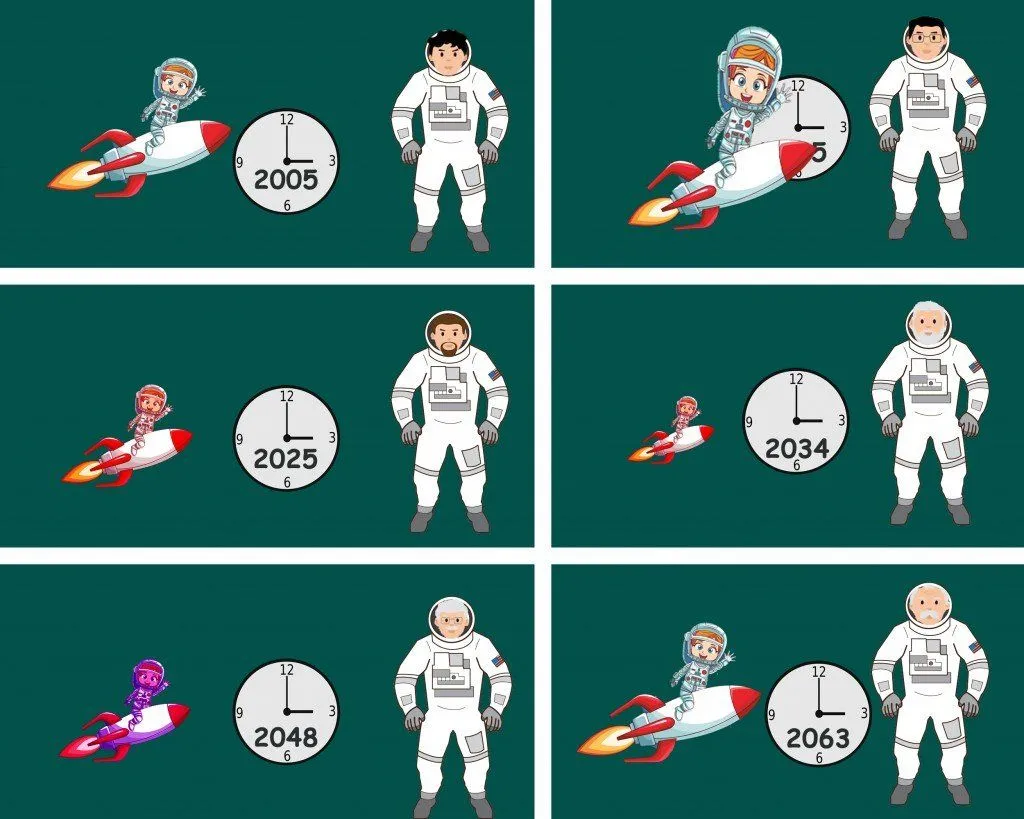
You would probably say that it’s highly improbable, wouldn’t you? Well, let me be the first to tell you that it is possible and has even been scientifically verified.
Let’s dive into how this “twin paradox” plays out.
The Problem
Let’s imagine two twins, Humpty and Dumpty, who have just turned 20. Humpty discovers a rocket that can travel near the speed of light, so he decides to embark on space exploration, knowing that he can travel vast distances across the Universe with such a fast rocket.
Humpty starts by traveling in a straight line at relativistic speed v to a distant location. He then slows down and turns back to return to his twin. Both Humpty and Dumpty have clocks with them.
Dumpty observes that on the outward and return leg of the journey, Humpty’s clock advances slower. Humpty sees Dumpty’s clock move slower on his outward and return voyage. Each twin concludes that the other will age less than they will.
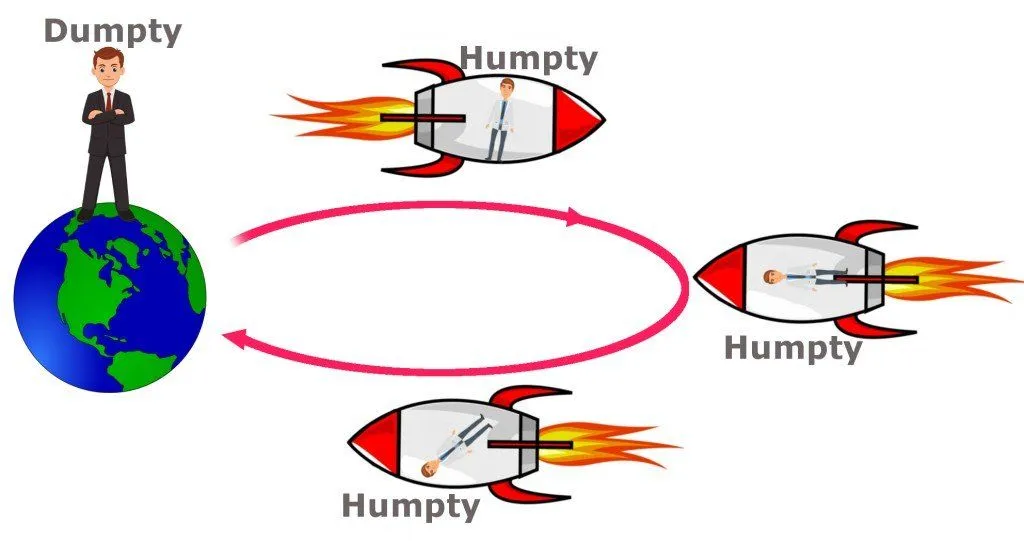
This is where the paradox arises, but we can scientifically prove that one twin will indeed age more significantly.
The twin paradox is a problem that involves relativistic time dilation, a concept from the special theory of relativity. Although the jargon may seem complex, the solution is quite intuitive and leads to a beautiful answer.
The Solution
To find the solution, we assume that both twins can keep track of each other’s clocks. The clock ticks only once per year, on the anniversary of the twins’ separation. They can also send an electromagnetic pulse to each other as an anniversary wish. The light from the telescope and the electromagnetic signal they send travel at the same speed.
Calculating from Dumpty’s frame of reference, assuming that the length of Humpty’s journey is 2.67 light-years for one leg of his journey, we can calculate the time of the journey to be 4 years (2.67 light-years/ 0.66c).
So, from Dumpty’s perspective, Humpty’s trip time would actually be 8 years.
Calculating from Humpty’s frame of reference, we multiply the distance of his trip by the inverse of the Lorentz factor, which is 0.75 (calculated by plugging his velocity of 0.66c into the Lorentz Transformation equation and taking the inverse of the value). According to Humpty, this 0.75 multiplied by the distance of 2.67 light years gives us approximately 2 light-years (to be more precise, it’s 2.0025 light years). Dividing this contracted distance of 2 light-years by the speed at which he is traveling (0.66c), we get 3 years on each leg of the journey.
Therefore, from the time Humpty leaves Earth and returns, Dumpty would have aged 8 years, whereas Humpty would have aged only 6 years. The asymmetry that resolves the paradox is that only Humpty undergoes acceleration when he turns around to come back. This breaks the apparent symmetry between the twins: Dumpty stays in a single inertial frame the whole time, while Humpty switches frames during the turnaround. So time dilation is real, but unevenly applied, and the twin who actually accelerates is the one who ends up younger.
Why Is It the Traveling Twin Who Ages Less?
Here is the part that trips most people up. If motion is relative, why can't Humpty insist that he stayed still while Dumpty and the whole Earth zoomed away and came back? If the situation were truly symmetric, each twin would have an equally good claim, and they couldn't both be younger when they reunite. Something has to break the tie.

The tie-breaker is the turnaround. Special relativity treats all inertial frames as equivalent, but only inertial frames, the ones moving in a straight line at constant speed with no acceleration. Dumpty stays in a single inertial frame the entire time. Humpty does not. To come home, Humpty has to decelerate, stop, and accelerate back toward Earth, switching from one inertial frame to another. As the University of Illinois Physics Van puts it, "Only one twin, the stay-at-home one, is stationary in a single frame of reference."
That difference is not just bookkeeping. It is something Humpty can physically feel. When he fires his thrusters to turn around, he is pinned into his seat and objects in the cabin lurch forward, exactly the way you feel pressed back when a car accelerates hard. Dumpty feels none of this. The acceleration is absolute, not relative, so the symmetry between the twins is genuinely broken. Whoever feels the turnaround is the one who took the shorter path through spacetime, and that twin returns younger.
What Is Time Dilation and the Lorentz Factor?
The engine behind the whole paradox is time dilation: a clock that moves relative to you ticks slower than your own. The amount of slowing is set by a single number called the Lorentz factor, written with the Greek letter gamma (γ):
γ = 1 / √(1 − v2/c2)
Here v is the moving clock's speed and c is the speed of light, about 300,000 km/s (186,000 mi/s). A moving clock's elapsed time gets stretched by this factor, so 1 second measured aboard the spaceship corresponds to γ seconds back on Earth.

At everyday speeds, gamma is almost exactly 1, which is why you never notice time dilation when you catch a flight. Plug in the speed of a passenger jet and gamma differs from 1 only by a few parts in 1013, far too little to notice. But as v climbs toward c, gamma shoots upward. At Humpty's cruising speed of 0.66c, gamma works out to about 1.33. So every year Humpty experiences aboard the rocket corresponds to about 1.33 years passing for Dumpty, which is exactly why a 6-year journey for Humpty plays out as roughly 8 years for Dumpty. Push the speed to 0.9c and gamma jumps to about 2.3; at 0.99c it is roughly 7. The closer you ride to light speed, the more dramatically the years fall away.
Is the Twin Paradox Real? The Experiments That Confirmed It
This may all sound like a chalkboard fantasy, but differential aging has been measured in the real world more than once. We don't have light-speed rockets yet, but we don't need them, because even tiny speeds produce tiny, detectable time differences.

The most direct test is the Hafele–Keating experiment of 1971. Physicist Joseph Hafele and astronomer Richard Keating flew four cesium atomic clocks around the world on commercial airliners, once eastward and once westward, then compared them with reference clocks at the U.S. Naval Observatory. The flying clocks really did disagree with the ground clocks by tens to hundreds of billionths of a second, in line with the combined predictions of special and general relativity. The traveling clocks were, in effect, the jet-setting twin.
Cosmic rays offer an even cleaner case. Muons are unstable particles created high in the atmosphere that normally decay in about 2.2 microseconds. Slamming downward at over 0.99c, they should almost all decay long before reaching the ground. Yet in the classic Frisch–Smith experiment, far more muons survived the trip from Mount Washington to sea level than Newtonian physics allows, because at those speeds their internal clocks ran several times slower, just as the Lorentz factor predicts.
You also rely on this effect every day. The atomic clocks aboard GPS satellites tick at a slightly different rate than clocks on the ground. Velocity-based time dilation makes them lose about 7 microseconds per day, while the weaker gravity at orbital altitude makes them gain about 45, for a net gain near 38 microseconds per day. According to Ohio State University's relativity primer, leaving that uncorrected would throw GPS positions off by roughly 10 km per day. Engineers build the relativistic correction straight into the satellites, which means the twin paradox is quietly working inside your phone's navigation.
Last Updated By: Ashish Tiwari
References (click to expand)
- Cacciatori, S., Gorini, V., & Kamenshchik, A. (2008, September 3). Special relativity in the 21st century*. Annalen der Physik. Wiley.
- We apologize for the inconvenience... - iopscience.iop.org
- Special Relativity and the Present.
- Haugan, M. P., & Will, C. M. (1987, May 1). Modern Tests of Special Relativity. Physics Today. AIP Publishing.
- The Twin Paradox: Introduction. Usenet Physics FAQ, University of California, Riverside.
- Twin Paradox. Physics Van, University of Illinois Urbana-Champaign.
- Real-World Relativity: The GPS Navigation System. R. W. Pogge, The Ohio State University.
- Experimental testing of time dilation (Hafele–Keating and Frisch–Smith experiments). Wikipedia.