Table of Contents (click to expand)
The Lorentz transformation is the set of equations that convert the space and time coordinates of an event from one inertial frame to another moving at a constant velocity v. Each coordinate is scaled by the Lorentz factor γ = 1/√(1 − v2/c2), which is why fast-moving clocks run slow (time dilation) and fast-moving objects shrink (length contraction). It underpins Einstein's 1905 special theory of relativity.
Every single person in the world should know the name Albert Einstein. And even if you’ve only dabbled in the achievements of Einstein, you likely know about relativity. There are two case constructs for relativity, one being the general theory of relativity and the other being the special theory of relativity. What if I told you that the math that acts as the foundation of the special theory of relativity can be easily understood – yes, even by you! To begin this journey of understanding, let’s first take a visual and geometric approach to how the Lorentz transformation came about.
Geometric Approach

Let’s consider a case where a man is standing stationary on the surface of the earth. Above him, his friend is traveling in a rocket. Let’s assume the speed at which his friend travels is v. Now, the hiccup we encounter when we consider relativity is that we must consider two frames of reference. For the man on Earth, his friend is traveling relative to him, whereas from the perspective of the floating friend, he is stationary while the man on Earth is moving away from him.
This poses a unique challenge, because in the Newtonian method, we only consider one frame of reference. Since both observers are right, from their given perspective, the only solution is to work around the problem in such a way that we merge them and include both frames of reference in our calculations. This can be done using a beautiful mathematical concept known as the Minkowski diagram or spacetime diagram.
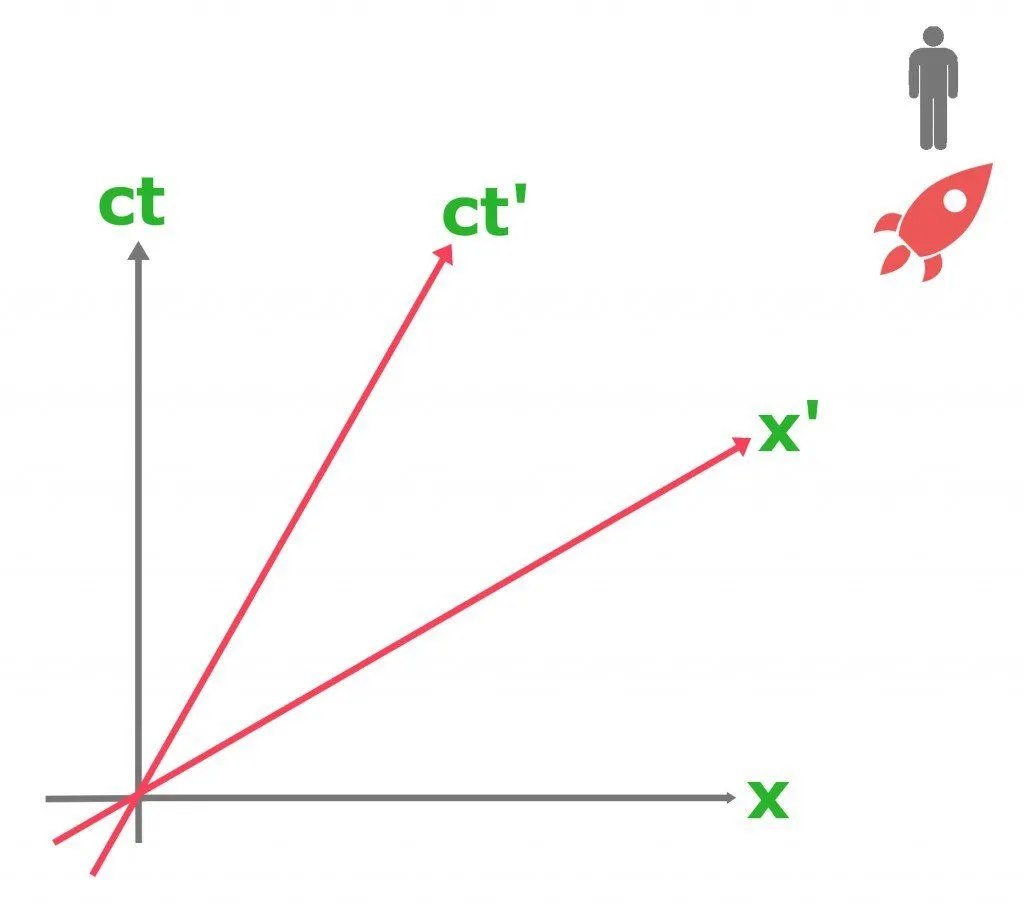
The Minkowski diagram, as seen above, takes both observers into consideration. The red axis acts as the frame of reference for the friend in the rocket, while the grey axis acts as the frame of reference for the man. This is different than the Newtonian description of motion, which only takes one frame of reference into consideration. The Minkowski diagram clearly shows that space and time have unique properties for different users, and the coordinates for a moving observer translate differently. Now, what do both axes denote? The x-axis represents distance in space, and the ct axis denotes the distance traveled by light in a unit of time. Together, this forms what is known as the space-time continuum.
In the graph above, you will notice that the man and his friend’s axes are skewed at an angle. Both of the friend’s axes (the x’ and ct’ axes) tilt inward toward the 45-degree path of a light ray by the same amount, and the consequence of that tilt is a phenomenon called the relativity of simultaneity: events that are simultaneous for the man are not simultaneous for his friend. Although the term may sound complex, the angle itself is quite simple to obtain. We divide the relative velocity of the friend by the speed of light and take the inverse tangent of the fraction. The equation is written as:
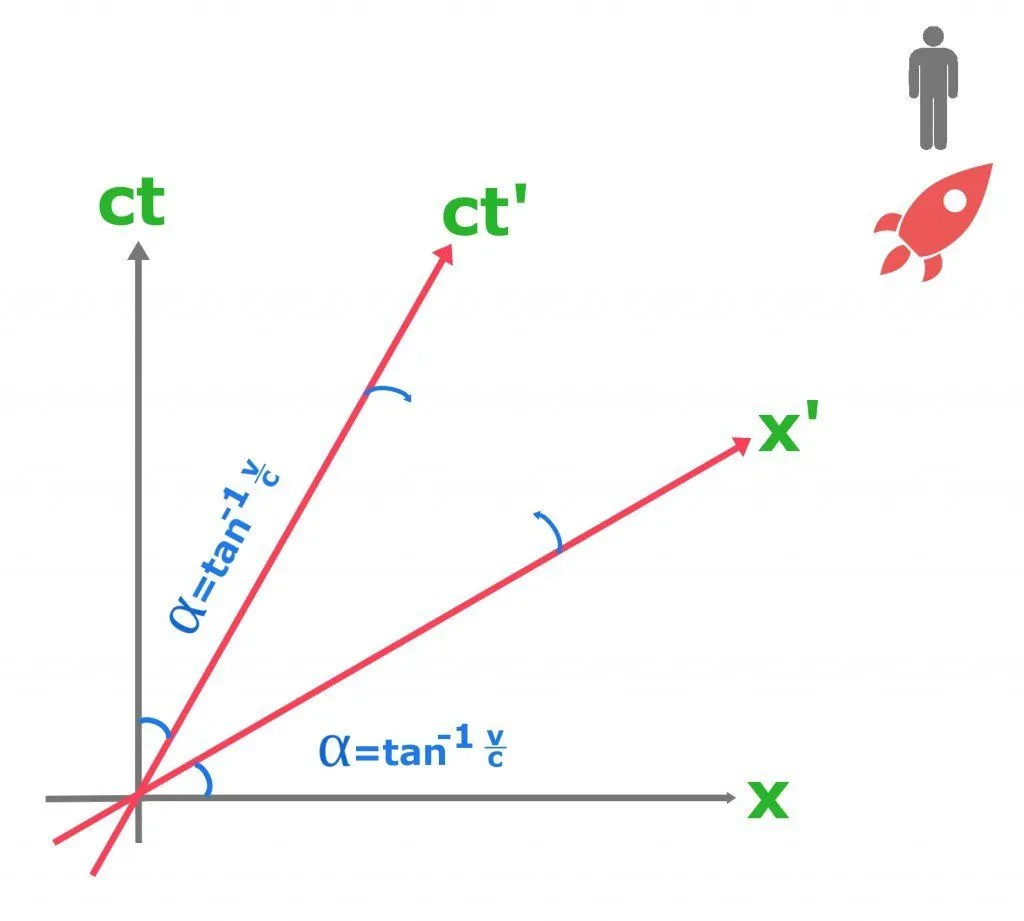
Tan-1(v/c)
When we look at the above equation, we notice that the more the speed of the friend increases, tending towards the speed of light, the closer his two axes squeeze together around the 45-degree light line. Now, to answer the million-dollar question… If we have the coordinates for both observers, how do we mark the coordinates for the same event for two different frames of reference in spacetime? This can be easily done by first drawing perpendicular lines from the event to the x-axis and ct-axis from the man’s frame of reference, giving the x and ct coordinates. After this is done for the friend, we draw lines parallel to his respective axes. Where these lines intersect will be x’ and ct’.
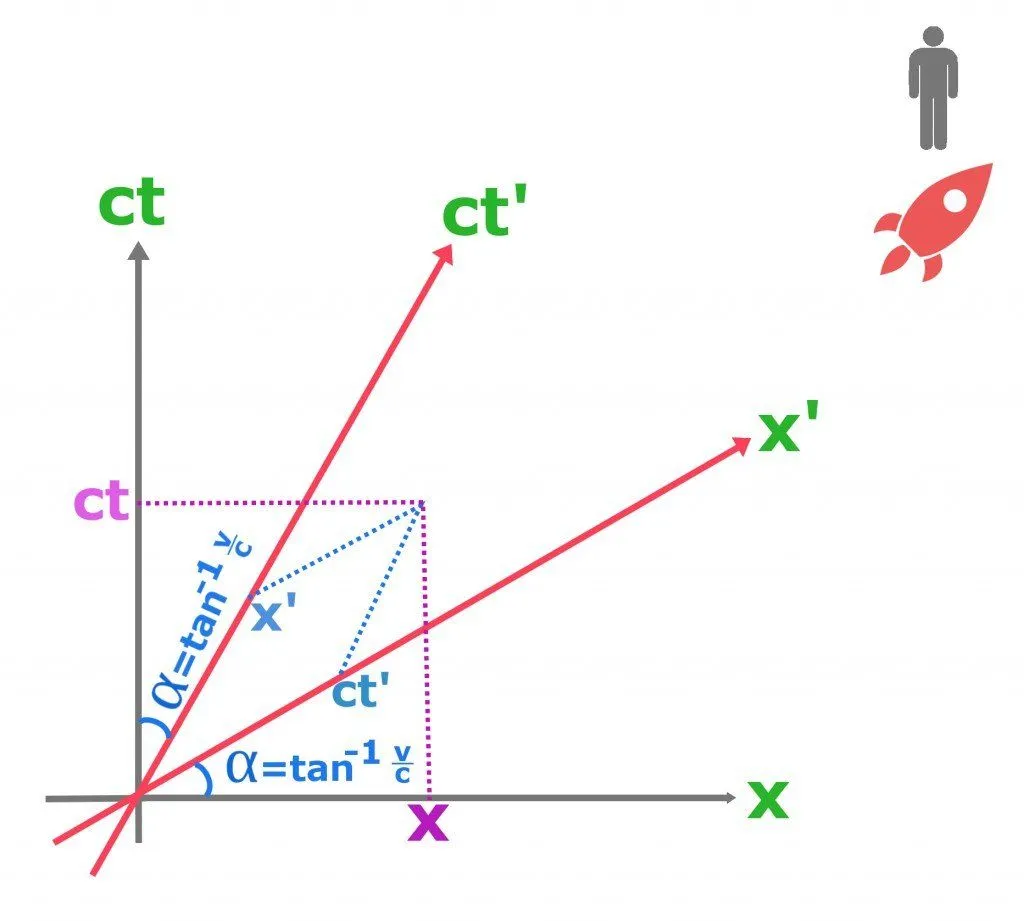
All that we did was take a geometric and visual approach, but the Lorentz transformation would help us find the friends’ coordinates much more easily using a few beautiful and intuitive algebraic expressions.
Algebraic Approach
The Lorentz transformation takes a very straightforward approach; it converts one set of coordinates from one reference frame to another. In this, let’s try converting (x, ct) to (x’, ct’). For conversion, we will need to know one crucial factor – the Lorentz Factor. The Lorentz factor is derived from the following formula:
The above equation can also be written as: 

Here, beta is the ratio between the relative velocity of the observer and the speed of light. The resulting equations are known as the Lorentz boost. Written out, they say x’ = γ(x − vt) for the space coordinate and t’ = γ(t − vx/c2) for the time coordinate, where γ is the Lorentz factor above. Notice that the time equation mixes in position: this is why time itself, and not just clocks, becomes relative.


The above equations not only serve as the mathematical framework for the working of the special theory of relativity, but it also played an integral part (no pun intended) in the ground-breaking solution to the twin paradox question!
How Is It Different From the Galilean Transformation?
Before Einstein, everyday physics used the Galilean transformation, which simply added velocities and assumed that time ticked the same for everyone: x’ = x − vt, and t’ = t. The Lorentz transformation looks almost identical, except for two crucial changes. First, the space equation is multiplied by the Lorentz factor γ. Second, time is no longer left untouched; it gets its own equation, t’ = γ(t − vx/c2).
The beautiful part is that the Lorentz transformation does not throw the old physics away. At the speeds we deal with in daily life, v is tiny compared to c, so v2/c2 is almost zero, γ is almost exactly 1, and the vx/c2 term vanishes. The equations quietly collapse back into the Galilean ones. That is why a thrown baseball or a passenger jet obeys Newton without any noticeable correction. It is only as you approach the speed of light that γ balloons and the relativistic effects take over.
Two of those effects fall straight out of the math. Because γ is always greater than 1 for a moving observer, a moving clock is measured to run slow (time dilation) and a moving object is measured to be shorter along its direction of travel (length contraction). The Lorentz transformation is simply the single rule that contains both.
Who Discovered the Lorentz Transformation?
The equations are named after the Dutch physicist Hendrik Antoon Lorentz, who introduced versions of them between roughly 1892 and 1904 as a mathematical fix while trying to explain why experiments could not detect Earth's motion through the supposed light-carrying aether. He even invented a quantity he called “local time” to make the equations work, without fully grasping that he had stumbled onto the real nature of time.
The French mathematician Henri Poincaré sharpened the equations into their modern form in 1905, showed that they form a mathematical group, and was the first to actually call them the “Lorentz transformation.” That same year, Albert Einstein derived the very same equations from scratch in his special theory of relativity, starting from just two postulates: that the laws of physics are identical in every inertial frame, and that the speed of light in a vacuum is constant for all observers. What had been a clever mathematical patch for Lorentz became, in Einstein's hands, a statement about the fabric of space and time itself.