Not every element has a stable isotope, but many do, and those stable forms never decay. An element with a short-lived isotope still exists because its stable isotopes persist and because decay constantly produces fresh atoms. Even elements with no stable isotopes, like technetium or uranium, survive because they decay slowly or are continually replenished.
Certain elements have extremely short half-lives, such that they decay at a very rapid pace. It’s natural to question why elements even exist when they have such short half-lives.
To understand the science behind this, it’s imperative to first comprehend certain basic concepts, such as isotopes, half-lives and radioactive decay. To begin with, when atoms of the same element have a different number of neutrons, they’re known as isotopes.
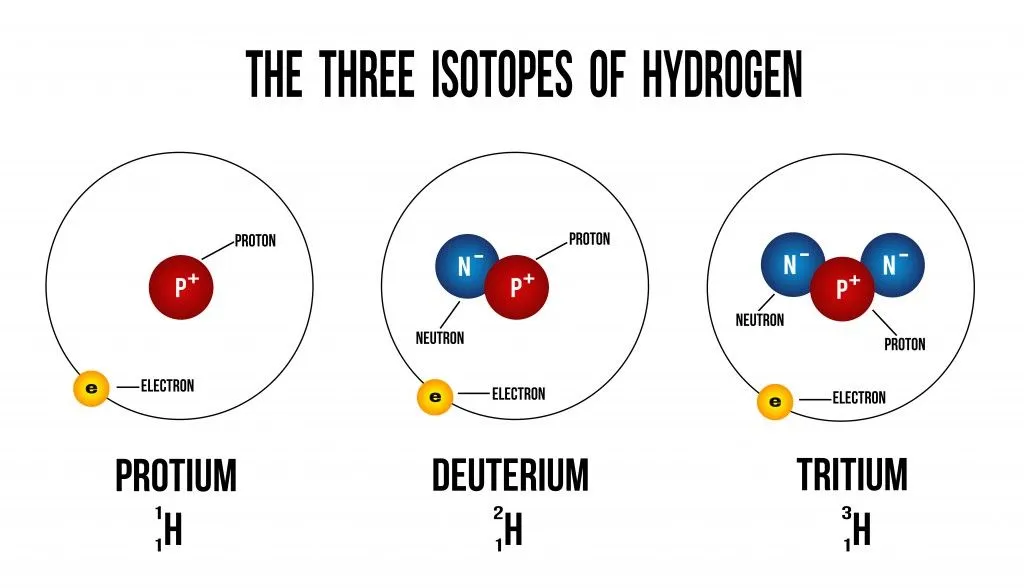
The image shown above depicts how additional neutrons create different isotopes of hydrogen. Isotopes have the same number of electrons, and therefore have the same chemical properties. There is, however, a difference in the element’s physical properties due to their difference in mass (number of neutrons).
What Is A Half-life?
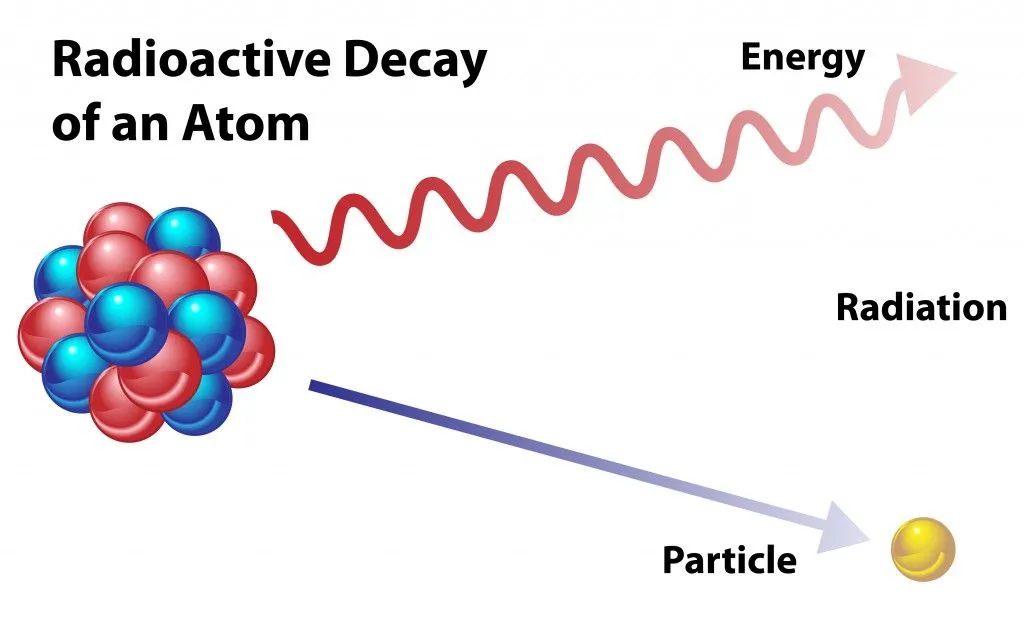
When an atom undergoes radioactive decay, it loses particles. The lost particle will change the original atom into a different isotope or element, as it reduces the amount of the original element.
“A half-life is the time it takes for the number of radioactive nuclei present in a sample at any given time to fall to half its value.” (Steve Owen, 2014)
In simpler terms, the amount of time required for an element to lose half its mass is the element’s half-life.
For example, an isotope of phosphorous (32P) has a half-life of fourteen days. If we had twenty grams of this isotope, after fourteen days, we would be left with only ten grams, as half of the original mass would have decayed away. After another fourteen days, we would be left with five grams. The following diagram showcases the effect of half-lives on this isotope of phosphorous.

Half-life Trajectory
All half-lives follow a similar trajectory in terms of their decay; as explained, after each half-life, the mass of the element halves. The resulting graph of this is a downward sloping line at a decreasing (absolute) slope. The following graph depicts the aforementioned trajectory.
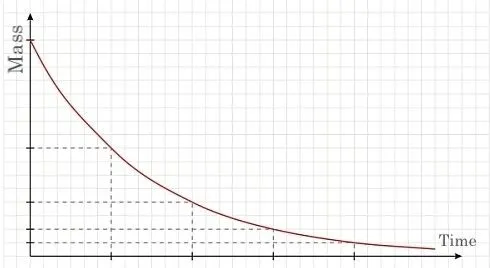
Each demarcated point on the horizontal axis represents the half-life (time), whereas the Y-axis represents the mass (grams) of the original sample of the element. Although the graph above depicts the graph of a half-life trajectory, different isotopes and elements have different half-life lengths. The stability of an atom influences the length of its half-life.
How Do Half-lives Differ?
The relationship between half-life lengths and atom stability can be illustrated using the game of Jenga.
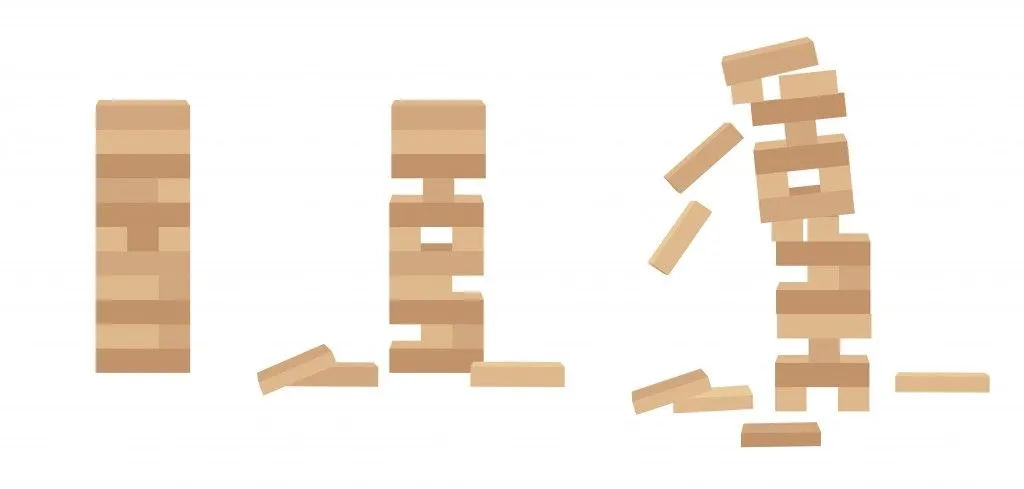
The more stable the tower, the higher the number of blocks are present in the tower. Similarly, the more stable an atom, the longer the half-life of the element.
The total number of Jenga pieces in a tower represent the length of a half-life. This analogy indicates that more instability is directly linked to having a shorter half-life (fewer blocks in the tower).
Different isotopes and elements have different half-life lengths based on their stability. The following graph illustrates the difference in decay speeds of 100 grams of Nitrogen 13, Carbon 11 and Fluorine 18, respectively.
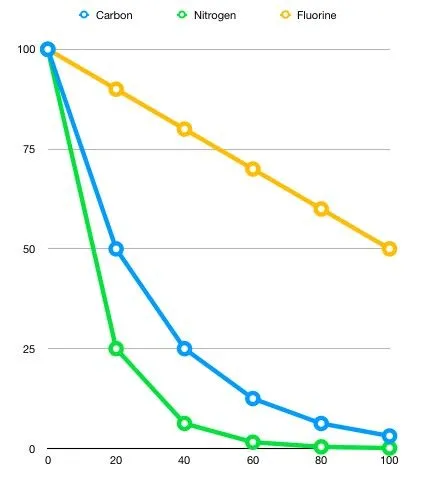
Can you figure out the half-life lengths from this graph ?
After twenty minutes, the mass of the nitrogen sample decreased from 100 grams to 25 grams. This would indicate that this sample experienced two half lives. The carbon 11 sample on the other hand halved in 20 minutes, indicating that 20 minutes is its approximate half-life length. The fluorine 18 sample halved over the course of 100 minutes, suggesting that its half-life length is therefore 100 minutes.
This example showcases different half-life lengths and their decaying process over time. Half-life lengths vary from years to split seconds. Scientists claim that any elemental sample is virtually ‘gone’ after experiencing ten half-lives.
Short Half-lives = Non-existent Elements?
With certain elements having very short half-lives, it’s fair to believe that certain elements’ atoms will experience radioactive decay at such a fast rate that they rapidly cease to exist. Although this may appear concerning, there are multiple reasons why elements will always exist, even when their half-lives are very short.
Most elements have multiple isotopes that vary in half-life length. For these elements, even if some isotopes have a very short half-life, a stable isotope is usually present that does not decay at all. The following table highlights the different half-lives of carbon isotopes:
| Isotope | Half life length |
| Carbon 10 | 19 seconds |
| Carbon 11 | 20 minutes |
| Carbon 12 | Stable |
| Carbon 13 | Stable |
| Carbon 14 | 5,730 years |
Many elements follow a similar trend to carbon: some isotopes have short half-lives, but at least one stable isotope is always present. For these elements, the stable isotope ensures the element is never wiped from existence. Not every element is so lucky, though. A handful (technetium and promethium) and every element heavier than lead (such as polonium, radon, radium, thorium and uranium) have no stable isotope at all, yet they still exist. The reason is explained next.
The other reason elements persist is that decay does not just destroy atoms, it also creates them. When a nucleus undergoes radioactive decay, the number of protons and neutrons inside it changes. A change in the proton number turns the atom into a different element. For example, when carbon-15 undergoes beta decay, it gains a proton and becomes nitrogen-15. That same logic works in reverse: an element with no stable isotope is constantly being replenished as heavier elements decay into it. Radium, for instance, is continually produced by the decay of uranium and thorium in rocks, which is why it still occurs in nature billions of years after Earth formed. So while individual atoms are decaying away, fresh ones are being created at the same time.
So which isotope has the shortest half-life of all? Among known nuclides, hydrogen-5 holds the record, decaying in roughly 86 yoctoseconds (about 8.6 x 10⁻²³ seconds) by ejecting two neutrons. Extreme instability is not limited to the heaviest elements either; it shows up right across the periodic table in nuclei that are badly out of balance. None of this threatens the elements themselves, because the fleeting isotopes are exotic, lab-made forms while the stable or naturally replenished isotopes carry on as before.
What Is The Half-life Of Hydrogen?
Hydrogen is a striking example of how the same element can be both perfectly stable and wildly unstable, depending on the isotope. Ordinary hydrogen (protium, 1H) and its heavier cousin deuterium (2H) are both completely stable, so they have no half-life at all. Between them, they account for essentially every hydrogen atom in your body, in water and in the oceans, and none of those atoms ever decay.
The isotope people usually mean when they ask about the "half-life of hydrogen" is tritium (3H), which carries one proton and two neutrons. Tritium is radioactive, with a half-life of about 12.32 years, decaying by beta-minus emission into helium-3. That steady, dependable output is exactly why tritium is sealed into some watch dials, gun sights and self-powered exit signs, where the emitted electrons make a phosphor coating glow for years without a battery.

Beyond tritium, physicists have created even heavier hydrogen isotopes in the lab, and they are astonishingly short-lived. Hydrogen-4, hydrogen-5, hydrogen-6 and hydrogen-7 are not really "atoms" so much as fleeting nuclear resonances that shed their extra neutrons almost immediately. Hydrogen-5 decays in roughly 86 yoctoseconds (86 x 10-24 seconds), the shortest half-life ever measured for any nuclide, while hydrogen-4 lasts around 139 yoctoseconds. So there is no single "half-life of hydrogen": the common forms live forever, tritium fades over a decade or so, and the exotic heavy isotopes vanish in well under a billionth of a trillionth of a second.
Does A Proton Have A Half-life?
A proton is not an element or an isotope, but it is one of the most searched "half-lives" of all, and the answer is genuinely strange: as far as anyone can tell, a free proton never decays. Every stable atom in the universe depends on this. If protons fell apart on any reasonable timescale, ordinary matter itself would slowly dissolve.
That said, several Grand Unified Theories, which attempt to merge the fundamental forces of nature, predict that a proton should eventually decay, for example into a positron (an antimatter electron) and a neutral pion. To test this, experiments such as Japan's Super-Kamiokande detector watch tens of thousands of tonnes of ultra-pure water for years, hoping to catch even a single proton breaking apart.

So far, not one proton decay has ever been seen. Those null results push the proton's half-life to more than about 1034 years for that particular decay channel. For perspective, the universe is only around 1.4 x 10¹⁰ years old, so a proton would outlast the current age of the cosmos by more than twenty orders of magnitude. For every practical purpose, then, the proton has no measurable half-life at all, which is precisely why the matter around us is so reassuringly permanent.
In conclusion, no matter how short an individual isotope’s half-life, an element survives for one of two reasons: it has a stable isotope that simply never decays, or, if it has no stable isotope, it is constantly being created as other elements decay. The speed of decay, regardless of how brief a half-life may be, never results in an element being wiped out of existence.
References (click to expand)
- Stable and Unstable Isotopes. Chemistry LibreTexts
- Carbon. Periodic Table of Elements. Los Alamos National Laboratory
- Owen S., Hoeben P.,& Headlee M. (2014). Chemistry for the IB Diploma Coursebook with Free Online Material. Cambridge University Press
- Isotope. Encyclopaedia Britannica
- Isotopes of hydrogen. Wikipedia
- Proton decay. Wikipedia