Table of Contents (click to expand)
Hydrogen and helium formed minutes after the Big Bang. Elements up to iron are forged by nuclear fusion in the cores of stars, which scatter them when they explode as supernovae. Heavier elements like gold and uranium are built by rapid neutron capture in supernovae and colliding neutron stars. The heaviest of all are made by us in particle accelerators.
One of the most beautiful things I’ve ever read in my life is that we are literally the remnants of stars. “The nitrogen in our DNA, the calcium in our teeth, the iron in our blood, the carbon in our apple pies were made in the interiors of collapsing stars”, wrote Carl Sagan, concluding, “We are made of star stuff.”
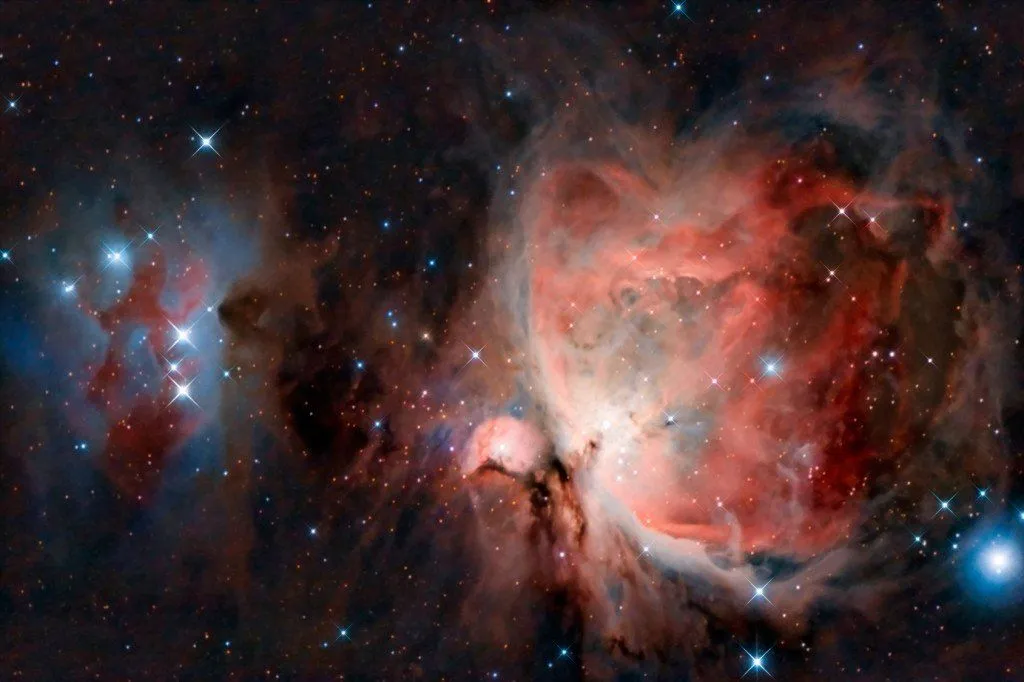
The elements that comprise life are the scattered ashes of stars after they suffer horrific, explosive deaths. So, in a way, they died so you could be born. However, not all elements in the periodic table were created in the core of a star. A few were created outside it, by nature, and the rest, by us. Let’s first understand how some were created inside a core, which requires us to examine the life of a star.
Natural Elements
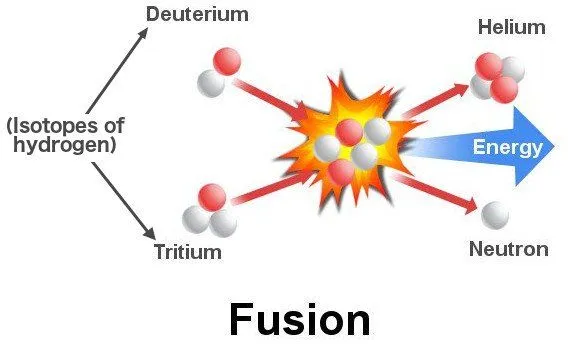
The lightest elements, hydrogen and helium, were created within the first few minutes after the Big Bang, when the infant universe was hot and dense enough to fuse protons and neutrons. This early burst of fusion also seeded a tiny amount of lithium, but it stopped there, as the universe cooled and thinned too quickly to build anything heavier. A nascent star comprises mostly this primordial hydrogen gas collapsing in on itself. This compression heats the gas and forces its atoms to collide violently with each other. The collisions further heat the gas and eventually the hydrogen atoms don’t collide and ricochet, but instead fuse to form helium atoms!
The mass of a helium atom is less than the combined mass of two hydrogen atoms. The remaining mass is released as energy whose magnitude is given by Einstein’s E = mc². While the magnitude might be small for a single fusion reaction, the cumulative total is tremendous. This process is called nuclear fusion. The same principle that makes stars shine is replicated inside devastating hydrogen bombs, albeit in a controlled manner.
Eventually, the star runs out of fuel. All the hydrogen in the core is exhausted. However, the compression and sweltering heat now force helium atoms to fuse. Two helium nuclei first merge into beryllium-8, which is so unstable that it almost instantly falls apart again. But if a third helium nucleus slams into it before it does, the trio fuses into carbon. This three-step shortcut, the triple-alpha process, is how stars climb past helium. From there, fusion forges oxygen, neon, and so on, building successively heavier elements until iron is synthesized in the core. Only the true heavyweights manage this full chain: a star must be born with at least eight times the mass of the Sun to fuse all the way up to iron. At that point, it can no longer counteract gravity’s compression, because iron refuses to undergo further fusion (fusing iron soaks up energy rather than releasing it). With no heat to hold itself up, the core gives way.
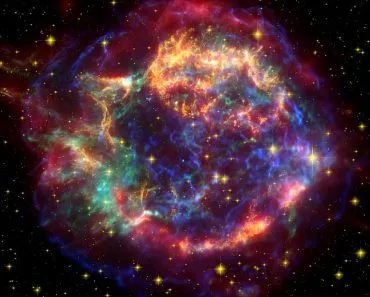
In the final stages of its life, the collapsing core becomes almost unimaginably dense, squeezing more than a sun’s worth of material into a ball only about 20 km (12 mi) across. The infalling outer layers rebound off this ultra-dense core and the star cataclysmically explodes, briefly outshining an entire galaxy. What it leaves behind, a city-sized neutron star or a black hole, depends on how heavy the original star was.
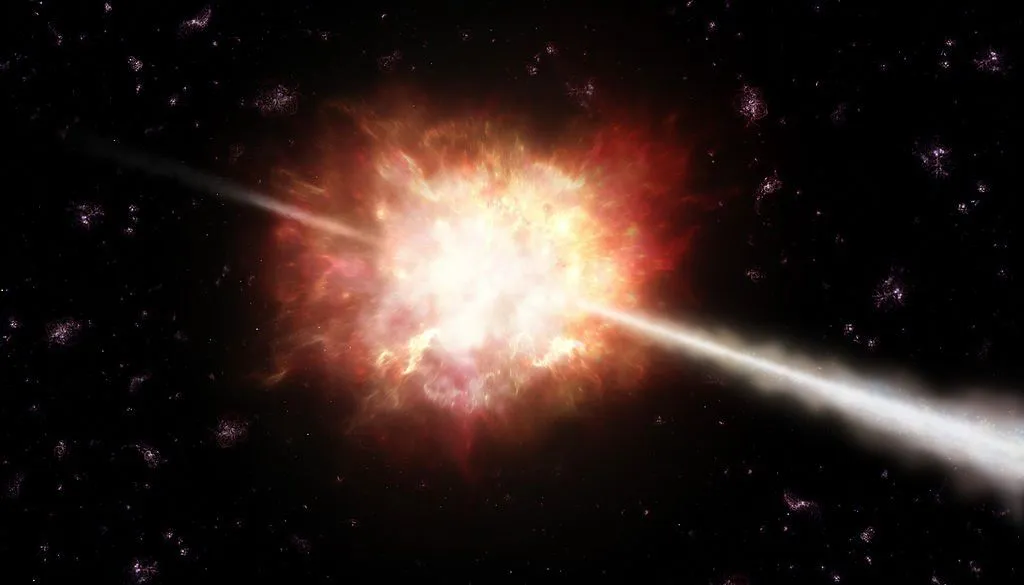
The explosive death of a star is called a supernova and it is the most colossal explosion one can witness in space. All the elements inside the core are violently dispersed into the surroundings. What’s more, the conditions are so extreme that the elements undergo reactions that weren’t previously possible inside the core. Existing iron nuclei are bombarded by a flood of free neutrons, capturing them so fast that the nuclei have no time to settle before grabbing the next one. This rapid neutron capture, called the r-process, is what builds elements heavier than iron, from silver and gold up through uranium, the heaviest element nature makes in any real quantity. Once the bombardment stops, these bloated, neutron-rich nuclei shed the excess and decay down into the stable heavy elements we know. Thus, destruction breeds creation.
For decades, supernovae were thought to be the main forge for these heavy elements. That picture changed in 2017. When the gravitational-wave detectors LIGO and Virgo recorded two neutron stars spiraling into each other (an event labeled GW170817), telescopes caught the glowing aftermath, a “kilonova,” and read its chemical fingerprints. The collision had manufactured a mountain of gold, platinum, and other heavy elements, several times the mass of the Earth in a single merger. Astronomers now think these neutron star collisions, rather than ordinary supernovae alone, are responsible for much of the gold in your jewelry and the uranium in the ground.
Man-Made Elements
The entire Solar System was created from a similar rubble dispersed by a supernova. Can you imagine the staggering amount of dust and debris that accrued to form not just the Sun, but eight planets and a dwarf that devotedly revolve around it?
However, like I said, not all elements are created in the core or outside it. Uranium is the 92nd element, so how did the other 26 spring into existence? A few of them barely brush the edge of nature. Trace amounts of neptunium and plutonium can form naturally where the conditions are right, and stars may briefly conjure even heavier nuclei, but those cannot survive more than a flicker. They immediately decay into lighter elements, leaving nothing behind to find. Everything past uranium that we can actually hold, study, and name had to be built by hand.
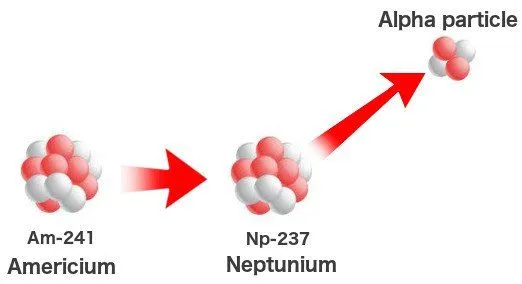
Man then took the laws of nature into his own hands when the technology sufficed. Elements heavier than uranium were created by simply bombarding uranium with high-speed neutrons in cyclotrons. A chain reaction ensues that might involve as many as 17 neutrons. This process, however, can also occur in ‘natural’ nuclear reactors or heavy deposits of uranium beneath the Earth. The meager quantity of plutonium and neptunium on Earth are found in uranium deposits where they formed a billion years ago when the uranium was pelted with free neutrons.
However, fermium (100) is the last element that can be forged by nuclear bombardment. The super-heavy elements could only be created after the development of particle accelerators more superiorly advanced than cyclotrons. The new elements weren’t created by just bombarding existent atoms with neutrons, but with entire atoms. Consider mendelevium (101), which was synthesized by firing helium nuclei (2) at einsteinium (99), or nobelium (102), made by bombarding curium (96) with carbon (6). Or the 118th element, oganesson, the heaviest yet confirmed, which was created by fusing californium (98) and calcium (20).
The question that is yet to be answered is whether there exists a limit to synthesizing heavier and heavier elements. People usually ask how protons can reside so close in a nucleus when the electromagnetic repulsive force should throw them apart. The force that binds them, however, is stronger than the repulsive force. In fact, it is the strongest of the four fundamental forces that govern the ways of the Universe. It is called, with the utmost lack of creativity, the strong force.
But even the strong force has its limits. There is certainly a configuration of protons in which the cumulative repulsive force between them becomes potent enough to overthrow the strong force binding them. Surely, the key to creating a new element is to avoid this configuration. This is our limit beyond which the laws of physics refuse to cooperate. However, it seems like we aren’t too far away. The periodic table seems to be nearly finished. We’re only a handful of revelations away from completing the puzzle.
References (click to expand)
- How to Make an Element | NOVA - PBS. The Public Broadcasting Service
- Nuclear Fusion - Hyperphysics. Georgia State University
- What Is a Supernova? - NASA Space Place. The National Aeronautics and Space Administration
- Nucleosynthesis - Encyclopaedia Britannica
- LIGO Detection of Colliding Neutron Stars Spawns Global Effort to Study the Rare Event - LIGO, Caltech
- Origin of the heavy elements in binary neutron-star mergers from a gravitational-wave event. Kasen et al., Nature (2017)
- What is radioactivity?| Explore | physics.org - www.physics.org