Table of Contents (click to expand)
The factorial of zero (0!) is equal to 1 because there is exactly one way to arrange zero objects: do nothing. The same value also follows from the empty product rule and from continuing the pattern n! = n × (n-1)!, where setting n = 1 forces 0! = 1.
The query is reminiscent of why a number raised to the power zero is equal to one, a query I resolved in an earlier article. Also, let me reassure what I have previously assured while explaining that obvious, shamelessly taken-for-granted, yet inexplicable fact: the relation is not arbitrary.
There are three ways to delineate why the factorial of zero is equal to one.
Complete The Pattern
The factorial of a number n is the product of all numbers starting from one until we reach n. The operation is denoted by an exclamation mark succeeding the number whose factorial we wish to seek, such that the factorial of n is represented by n!. Numerically, the trails of multiplication can be illustrated in this manner:
1! = 1*1 = 1
2! = 1*2 = 2
3! = 1*2*3 = 6
4! = 1*2*3*4 = 24
.
.
.
If, (n-1)! = 1*2*3*4…(n-3)*(n-2)*(n-1)
Then, logically, n! = 1*2*3*4…(n-3)*(n-2)*(n-1)*n
Or, n! = n × (n-1)! (equation i)
If you look at these trails carefully, a pattern will reveal itself. Let’s complete it until it manages to produce legitimate results:
4!/4 = 3!
3!/3 = 2!
2!/2 = 1!
1!/1 = 0!
Or, 0! = 1
One can arrive at this result by simply plugging in 1 for ‘n’ in equation (i) to get:
1! = 1*(1-1)!
1 = 1*0!
Or, 0! = 1
However, this explanation tells us nothing about why factorials of negative numbers cannot exist. Let’s turn towards our pattern again to find out why.
.
.
2!/2 = 1!
1!/1 = 0!
0!/0 = …uh-oh
I’d agree that these methods are a little fishy; they are seemingly sly, implicit ways to determine the factorial of zero. It is like arguing in favor of a straw-man. However, one can find an explanation in a field whose entire existence hinges on calculating factorials: combinatorics.
Arrangements
It was known as early as the 12th century that there are n! ways to arrange n number of different objects. This act of arranging objects is known as a permutation. Let me give you a simple example to explain why there are n! ways to arrange n objects.
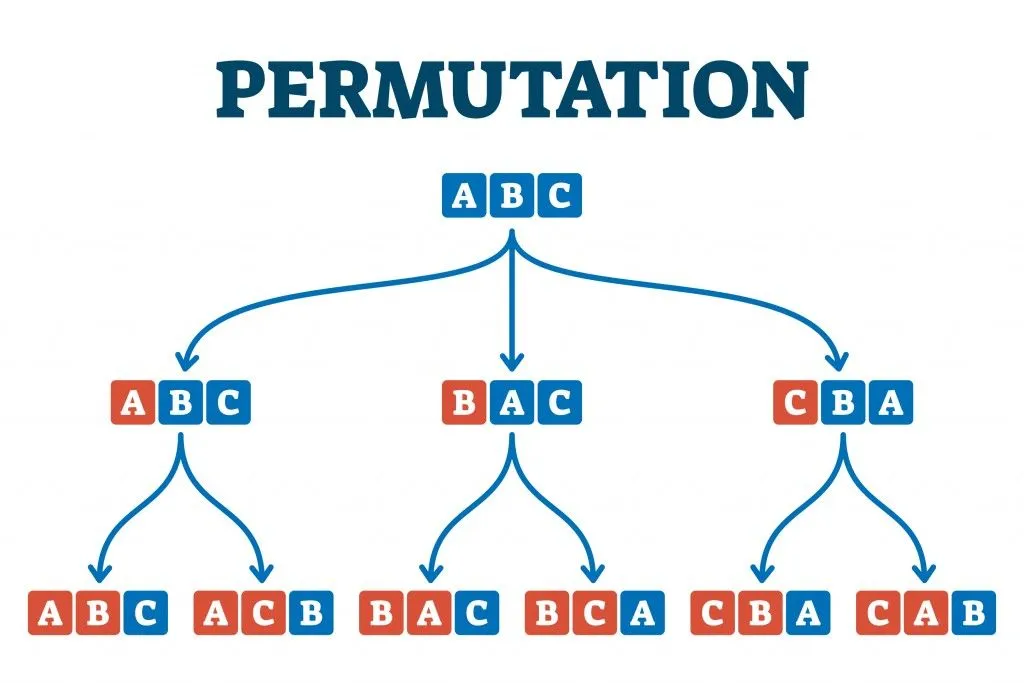
Consider 4 chairs that must be occupied by 4 people. The first chair can be occupied by any one of these four people, such that the resulting number of choices is 4. Now that one chair is occupied, we have 3 choices that are potential occupants for the next chair. Similarly, the next chair presents two choices, and the last chair presents a single choice; it is occupied by the last person standing. Therefore, the total number of choices we have is 4×3×2×1, or 4!. In other words, there are 4! ways to arrange 4 distinct people across the 4 chairs.
Thus, when the value of ‘n’ is equal to zero, the question translates to: how many different ways are there to arrange zero objects? One, of course! There is only one permutation, one way to arrange nothing, because there is nothing to arrange in the first place. WHAT? Honestly, this pertains to a branch of philosophy, albeit one of the obnoxious or phony notions that freshmen pontificate about after reading Nietzsche quotes on Pinterest.

Let’s consider an example that involves physical objects, as it might make for a better understanding. Factorials are also central to computing combinations, a process that also determines arrangements, except that unlike a permutation, the order of things is irrelevant. The difference between permutation and combination is the difference between a coded lock and a bowl bearing a mélange of diced fruits. Coded locks are often wrongly called “combination locks” when they should actually be called permutation locks, since 123 and 321 cannot both unlock it.
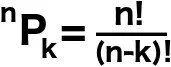
A general formula to determine the number of ways ‘k’ objects can be arranged amongst ‘n’ places is:
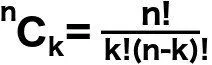
Whereas, to determine the numbers of ways to choose or combine ‘k’ objects from ‘n’ objects is:
This allows us to, say, determine the number of ways in which two balls can be selected from a bag that contains five balls of different colors. Because the order of the selected balls is not important, we refer to the second formula for computing the entailed combinations.
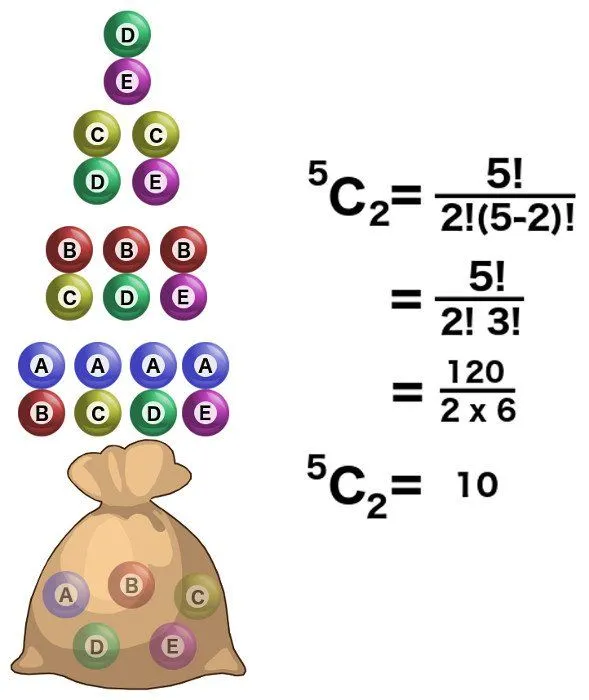
Now, what if the values of ‘n’ and ‘k’ are exactly same? Let’s substitute these values and find out. We observe that the factorial of zero is obtained in the denominator.
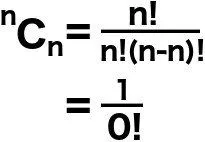
But how do we comprehend this mathematical calculation visually, in terms of our example? The calculation is essentially a solution to a question that asks: how many different ways are there to choose three balls from a bag that contains only three balls? Well, one of course! Picking them in any order would not make a difference! Equate the calculation with one and the factorial of zero turns out to be *drum roll*…… one!
The Empty Product Convention
There is an even tidier way to see why 0! must be 1, and it does not lean on any pattern that quietly skips over the awkward division by zero. The factorial of n is simply the product of all the whole numbers from 1 up to n. So what happens when n = 0? You are being asked to multiply together a list of numbers that has nothing in it at all. Mathematicians call this an empty product (or a nullary product), and by long-standing convention an empty product equals 1, the multiplicative identity.
Why 1 and not 0? Because 1 is the number that changes nothing when you multiply by it. Sticking a "× 1" in front of any calculation leaves it untouched, in exactly the way that adding 0 to a sum leaves it untouched. So the natural value for "the product of no numbers" is 1, just as the natural value for "the sum of no numbers" is 0. Defining 0! = 1 is not a fudge to keep the formulas working; it is the only choice consistent with how multiplication treats an empty list.
This convention pays for itself everywhere. It is what lets the binomial coefficient formula stay valid right up to its edges. For example, the number of ways to choose all n items from a set of n is written as n! / (n! × 0!), and that only equals the obvious answer of 1 if 0! is 1. Allowing a product with zero factors quietly removes a whole pile of special cases that would otherwise have to be handled by hand.
The Gamma Function: Factorials Beyond The Whole Numbers
I promised three ways to settle this, so here is the most powerful of them. Everything above treats the factorial as something that only makes sense for whole numbers. But what if we could draw a single smooth curve that passes through every factorial value, 1! = 1, 2! = 2, 3! = 6, and so on, and then simply read off where that curve crosses zero? That curve exists, and it is called the gamma function, written with the Greek capital letter Γ. It was first studied by the mathematician Daniel Bernoulli, and it is the standard way mathematicians extend the factorial to fractions, decimals, and even complex numbers.

The gamma function is defined by an integral known as Euler's integral of the second kind:
Γ(z) = ∫0∞ tz−1 e−t dt
The link to the factorial is delightfully simple: for any whole number n, the gamma function obeys n! = Γ(n + 1). To find 0!, then, we just need Γ(1). Plug z = 1 into Euler's integral and the messy-looking expression collapses, because t0 = 1 leaves only the exponential behind:
Γ(1) = ∫0∞ e−t dt = 1
Since n! = Γ(n + 1), setting n = 0 gives 0! = Γ(1) = 1. No pattern-chasing, no empty-set philosophy, just a direct calculation. The gamma function also satisfies the recurrence Γ(z + 1) = z × Γ(z), which is the continuous twin of the rule n! = n × (n−1)! we used right at the start. And it neatly explains the "uh-oh" from earlier too: the gamma function shoots off to infinity at zero and at every negative whole number, which is precisely why factorials of negative integers simply do not exist.
References (click to expand)
- Factorial. Encyclopaedia Britannica.
- Mahmood, M., & Mahmood, I. (2015, December 15). A simple demonstration of zero factorial equals one. International Journal of Mathematical Education in Science and Technology. Informa UK Limited.
- Factorial - Wikipedia. Wikipedia
- Combinatorics | World of Mathematics - Mathigon. mathigon.org
- §5.4 Special Values and Extrema (Γ(1) = 1, n! = Γ(n+1)). NIST Digital Library of Mathematical Functions.
- §5.2 Definitions (Euler's integral for the gamma function). NIST Digital Library of Mathematical Functions.
- Gamma Function. Wolfram MathWorld.