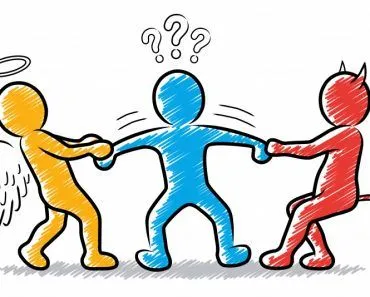
Conformity means changing your behavior or beliefs to match the unspoken rules of a group, usually so you feel accepted or because you assume the group knows better. In Solomon Asch’s classic line experiment, about 75% of people agreed with an obviously wrong majority at least once, even though they could plainly see the right answer.
Have you ever been on a metro when your phone went off? Did you whisper a quick explanation and then shut it off?
Have you ever been on a metro when someone else’s phone went off? Did they start talking loudly? Did you judge them or get annoyed by their seemingly oblivious actions?
Commuters on the metro are almost entirely silent in some countries, and most people tend to remain silent if they’re alone. They intentionally avoid phone calls, or whisper into their phones, when necessary, or keep the conversation really short. If you react in this way, then you conform to the unsaid, but heavily observed rule to keep to yourself. No one is forcing you to be quiet, but most people around you will tend to do the same, and it has largely become a standard rule for metro travel.
So, from the example above, it’s easy to guess that to conform is to give in to the unsaid rules of social situations in order to not stand out from the group.

Are Obedience And Conformity The Same?
We’ve all heard of obedience, but people often confuse this with the word conformity and use them interchangeably. However, the two are actually quite different. When a person is being obedient, he is listening to and following the orders given by someone else.
For example, in a prison, the warden commands the prisoners to walk in a line with their hands behind their backs, and they obey his commands. Normally, if the warden was not there, they would walk in groups, chattering on the way back to their cell, but since an order has been given, they will follow it, or else there would be consequences to face. This is not an unsaid rule and does not benefit them in any way, but since the command was given by an authoritative figure, they follow it.
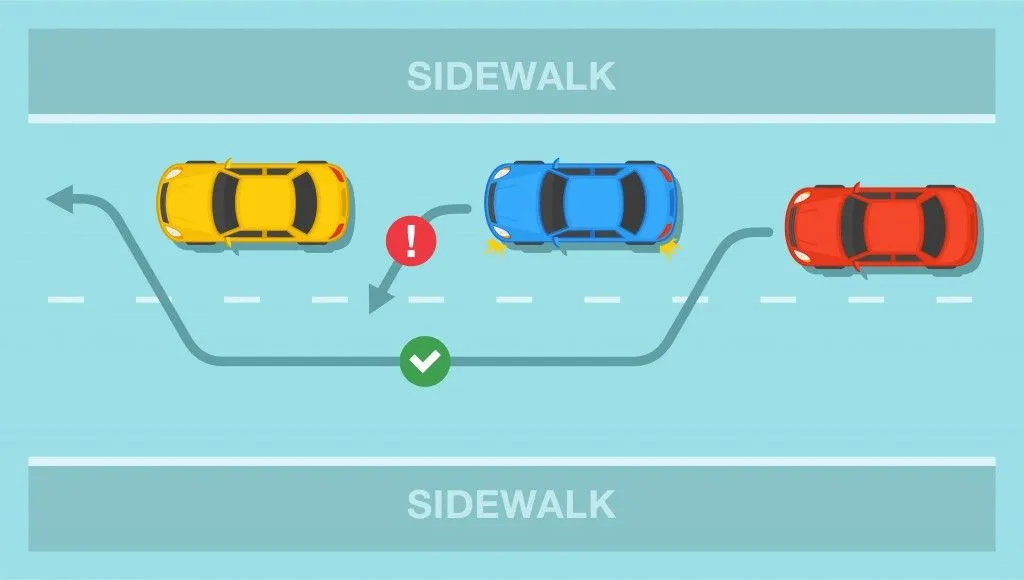
However, when one conforms to social norms, there is no external pressure to do so. People do it because they are intrinsically motivated to do so and behave in the same way as everyone else.
Asch Conformity Experiment
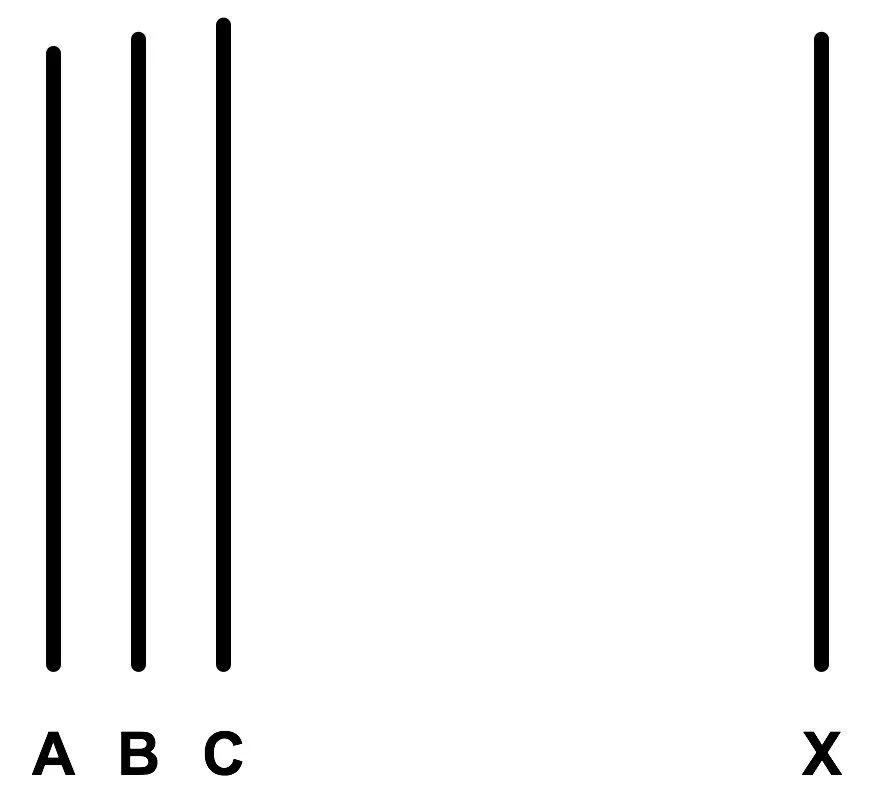
Solomon Asch was a famous researcher in the field of social psychology. In the early 1950s, he designed an experiment to see how conformity works. He placed a line, let’s call it the target line ‘X’, on one card, and on another card there were three options, three different lines of varying lengths; let’s call these A, B and C. The participants had to pick the line that was the same length as the target line.
When Asch questioned the students on what outcome they were expecting, most of them replied that the results were obvious and the participants would obviously be able to identify the lines of the same length.
Each group sat eight people around a table, but the catch here was that seven of them were confederates; only one was the actual participant! The confederates were told in advance what answer to pick, so the experiment tested whether the original clueless participant’s answer would change if the confederates’ answers were wrong. It’s also important to note that the original participant was never asked to report his answer first. He was always near the end of the order, so he heard the others speak before his turn came. So what do you think happened? Did our original participant stick to his guns and give the correct answer every time? Or did he change his answers as the group changed its overall decision?
Asch’s study reported that about 75% of the participants went along with the group’s wrong answers at least once. Across all the rigged trials, participants caved to the group roughly 37% of the time. When people did the same task alone, with no group to sway them, they got it wrong less than 1% of the time, so the errors clearly came from social pressure, not from any difficulty with the lines themselves.
That being said, 25% of the participants never went with what the group said, regardless of whether the group was right or wrong. At the other extreme, a small number of people (about 5%) caved on every single rigged trial. When asked about it afterward, many of these conformers admitted that they had actually seen the correct answer, but assumed that the group must know something they didn’t.
So no… conformity is not really an illusion. It is a very real concept that people regularly follow. Asch’s study was replicated multiple times in different countries, and each one had similar findings.
Why Do We Conform?
One of the main reasons we conform is because we don’t trust ourselves enough to believe that we are right. Like one of the participants reported, having everyone say one thing often makes us feel that we could be wrong. This only increases our self-doubt and adds to the pressure we feel to conform.

Sometimes, having these unsaid rules is quite beneficial. It gives us mental scripts for what to do in certain situations and know what not to say or do in others. It’s easy for the brain to act on something that has pre-made rules, rather than taking the time to make decisions.
For example, waiting in a queue while signing in at the office log book, no one explicitly tells us to do that, but most people form the rule innately and stand in the queue anyway. Therefore, conforming to this rule brings about harmony and avoids unnecessary quarrels.
Another reason why people conform is to simply look good in front of other people. All humans thrive off social connections, and we move towards a desire to be accepted by everyone around us. By conforming, we tend to feel more accepted by the group, thus increasing our chances of being part of the group, or giving others a favorable idea of us.

Being the generation that we are, we’re more likely to resist this, and stubbornly say that we won’t conform. Some brave ones stick to their determination, but most frequently, we have an innate tendency to move towards conformity. We wear clothes similar to others, we eat food that our culture appreciates, and we listen to music that is similar to our friends’ playlists.
So, while we don’t want to believe that we conform, we already do by “keeping up with the trends” to seem more modern and “with the times”. Those who fail to do this are given negative connotations like “hippie”, “ancient”, “boomer” and other derisive terms. Many people hate being labeled with something negative, so they tend to stick to the rules and follow the trends, whether or not it is beneficial or sincerely desired.
On a final note, we’re all aware of the impending environmental catastrophe facing our planet. We are also aware that simple changes can help to keep this at bay. Yet how many of us have felt weird asking a bartender to “hold the straw”? Have you felt awkward asking for your frappe in a steel mug? If this sounds like you, maybe it’s time to start shaking off those old rules of conformity and realize you can make whatever decisions you want, particularly if they’re for the greater good of your life and the health of the planet!
What Are The Main Types Of Conformity?
Psychologists usually sort conformity by how deep the change runs. Two researchers, Morton Deutsch and Harold Gerard, suggested in 1955 that we conform for two very different reasons. The first is normative social influence: we go along with the group because we want to be liked and accepted, and we are quietly afraid of being rejected or looking foolish. The second is informational social influence: we assume that other people know better than we do, especially when a situation is confusing or unfamiliar, so we copy them in the hope of getting it right.
You can see both at work in Asch’s line experiment. The people who could clearly see the correct answer but said the wrong one anyway, just to match the group, were responding to normative pressure. The ones who genuinely started to doubt their own eyes, assuming the majority must know something they didn’t, were swayed by informational influence.
A few years later, in 1958, psychologist Herbert Kelman described three levels of conformity that map neatly onto these reasons. Compliance is the shallowest: you agree out loud while privately disagreeing, and you drop the act the moment the group pressure is gone. Identification sits in the middle, where you adopt a group’s habits because you value being part of it, so the change lasts only as long as your membership does. Internalization is the deepest: you actually come to believe what the group believes, and that change sticks with you even after you leave, because it has become genuinely your own.
Everyday Examples Of Conformity
Once you start looking for it, conformity is everywhere, often in moments so ordinary that we never bother to label them. Standing in an orderly queue is a perfect example. No law says you must wait your turn, yet most of us join the back of the line without a second thought because everyone else is doing the same, and pushing ahead feels almost shameful.

Plenty of other small behaviors follow the same pattern. We laugh along when a group laughs at a joke we didn’t quite catch, we lower our voices in a library or a place of worship, and we start clapping when the people around us start clapping. These are mostly examples of normative influence, where we read the room and match it so we fit in.
Other examples lean on informational influence instead. If you walk into an unfamiliar restaurant and aren’t sure which counter to order from, you watch what other diners do and copy them. In an emergency, people often glance at the crowd before reacting, which is part of why a calm group can keep everyone calm while a panicked one can spread fear (a dynamic closely related to groupthink). In each of these cases, we treat other people’s behavior as a useful clue about what is correct.
References (click to expand)
- McLeod, S. Asch Conformity Line Experiment. Simply Psychology.
- The Asch Experiment: The Power of Peer Pressure. Social Sci LibreTexts.
- Conformity: Definition, Studies, Types, & Facts. Encyclopaedia Britannica.
- McLeod, S. What Is Conformity? Definition, Types, Psychology Research. Simply Psychology.
- Kelman, H. C. (1958). Compliance, Identification, and Internalization: Three Processes of Attitude Change. Journal of Conflict Resolution.