Table of Contents (click to expand)
The Dunning–Kruger effect is a metacognitive bias first described by social psychologists David Dunning and Justin Kruger in 1999. Low performers tend to overestimate their ability, often rating themselves above average, while top performers tend to underestimate how much better they are than the rest. Recent research suggests parts of the pattern are also driven by simple statistics, like regression to the mean.
The Dunning–Kruger effect is a cognitive bias in which people with limited skill in a domain tend to overestimate that skill, while genuinely skilled people tend to underestimate their relative standing.
You may have heard the popular adage, “The problem with the world is that the intelligent people are full of doubts, while the stupid ones are full of confidence.”
You’ve likely come across countless cases of people who think that they’re very smart or more intelligent than the average person, but actually aren’t that clever. Or perhaps you’ve encountered people who think they know a great deal about a subject or topic, but actually know almost nothing or very little?

There’s another angle to this… there are also those people who are really good at something, but insist that they are not really that skilled.
Why does this happen? In other words, what’s wrong with people’s perception of themselves!
As it turns out, this is a cognitive bias that many people have.
The Dunning-Kruger Effect
The Dunning–Kruger effect is a cognitive bias in which people incorrectly assess their cognitive abilities as greater than they actually are. The Dunning–Kruger effect suggests that “poor performers are not in a position to recognize the shortcomings in their performance.”
This phenomenon of illusory superiority was identified as a cognitive bias by a pair of social psychologists—David Dunning and Justin Kruger—in a study titled “Unskilled and Unaware of It: How Difficulties in Recognizing One’s Own Incompetence Lead to Inflated Self-Assessments”. This identification was derived from a popular criminal case of Mr. McArthur Wheeler.
The McArthur Wheeler Case
The McArthur Wheeler case is a rather unusual criminal case from January 6, 1995 that involved a 44-year-old man robbing two banks in the Pittsburgh area on the same day. The convict, Mr Wheeler, had read about some peculiar properties of lemon juice and misinterpreted them to a rather bizarre extent. He assumed that since lemon juice’s chemical properties are somewhat similar to invisible ink, his face would appear invisible or blurry to security cameras.
Equipped with confidence that no camera would be able to identify him (due to smearing his face with lemon juice), he boldly robbed two banks in Pittsburgh without using a disguise.
Security camera footage of him robbing the bank clearly showed his face (obviously) and he was arrested the very same day. He was quite shocked that the police found him so soon, given that he had applied lemon juice to his face.
David Dunning (then at Cornell University) and his graduate student Justin Kruger studied this interesting case in depth and published a study titled Unskilled and Unaware of It: How Difficulties in Recognizing One’s Own Incompetence Lead to Inflated Self-Assessments in the Journal of Personality and Social Psychology in December 1999.
Why The Incompetent Think They’re Amazing
Dunning and Kruger, in their paper, suggest that people suffering from such a cognitive bias overestimate their skills or talents. In other words, incompetent people have no idea how incompetent or unskilled they really are. People who perform poorly on a test, on average, realize that they performed poorly; it’s just that they don’t realize how much worse (than the average) they actually performed.
Dunning and Kruger suggested that this sort of overestimation is partly because unskilled people suffer a dual burden. Not only do these people reach incorrect conclusions and make unfortunate choices, but their incompetence or lack of skill robs them of the ability to even realize that they’re not skilled.
In other words, weaker performers don’t merely lack skill—they often lack the self-awareness to see how much they’re missing. In Dunning and Kruger’s data, bottom-quartile scorers typically placed themselves around the 60th percentile rather than at the very top, so the popular shorthand of “too dumb to know they’re dumb” is catchier than it is faithful to the paper.
Underestimation Of One’s Competence
There’s another interesting side to this bias—people who are more skilled than the average individual sometimes fail to realize how much better they are.
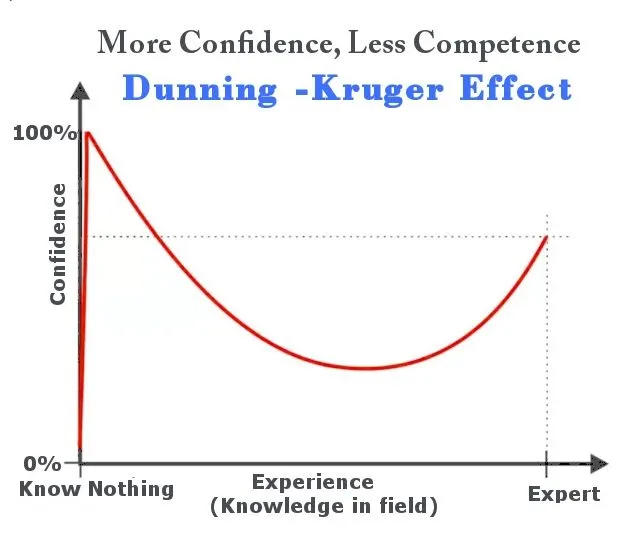
The more competent or experienced a person is in a given subject/field, the more they realize and appreciate the gaps or limitations in their knowledge. Therefore, they’re likely to be slightly less confident about their skills. A skilled computer programmer may feel something like, “Well, I know how to create this program, but I don’t know many other important things related to this program, which other people may understand, so I’m not really sure if I’m that good.”
The more a person learns about a topic or subject, the more they realize how large the gaps in their knowledge are, and how complicated the subject truly is. This realization leads to a decline in a person’s confidence in their own skills.
The incompetent, however, know so little about a subject that they think they’re amazing, when, in fact, they’re significantly less clever than the average person.
Is The Dunning-Kruger Effect Actually Real?
Here’s a twist worth knowing: even though the Dunning–Kruger effect has become a household name, the original 1999 result has been seriously challenged. Multiple peer-reviewed studies argue that the famous “scissors” chart—low performers wildly overestimating themselves while top performers slightly underestimate—is largely a statistical artifact, not a unique cognitive failing.
Two effects keep showing up in re-analyses. First, regression to the mean: anyone who scores at an extreme on a noisy test (very low or very high) will, on average, drift toward the middle on a second measurement, including a self-rating. Second, the better-than-average effect: most people, regardless of skill, rate themselves a bit above average. Plug random data into Dunning and Kruger’s plotting method, and a near-identical “scissors” chart appears even when no metacognitive deficit exists.
Recent papers making this case include Gignac and Zajenkowski (2020) in Intelligence and Magnus and Peresetsky (2022) in Frontiers in Psychology. The takeaway: there is still real evidence that people with weaker domain knowledge often have weaker self-assessment, but the pop-science version (“the dumber you are, the more confident you are”) overstates what the data actually shows.
References (click to expand)
- Kruger, J., & Dunning, D. (1999). Unskilled and Unaware of It: How Difficulties in Recognizing One’s Own Incompetence Lead to Inflated Self-Assessments. Journal of Personality and Social Psychology, 77(6), 1121–1134. — PubMed
- Dunning, D. (2011). The Dunning–Kruger Effect: On Being Ignorant of One’s Own Ignorance. Advances in Experimental Social Psychology, 44, 247–296. — ScienceDirect
- Motta, M., Callaghan, T., & Sylvester, S. (2018). Knowing less but presuming more: Dunning-Kruger effects and the endorsement of anti-vaccine policy attitudes. Social Science & Medicine. — Elsevier
- Gignac, G. E., & Zajenkowski, M. (2020). The Dunning-Kruger effect is (mostly) a statistical artefact: Valid approaches to testing the hypothesis with individual differences data. Intelligence. — Elsevier
- Magnus, J. R., & Peresetsky, A. A. (2022). A Statistical Explanation of the Dunning-Kruger Effect. Frontiers in Psychology. — Frontiers
- The 1995 Greater Pittsburgh Bank Robberies (the McArthur Wheeler case). — Wikipedia