Table of Contents (click to expand)
In real life, a laser beam is usually invisible from the side. You only see one when its light is scattered toward your eye by particles in the air (dust, smoke, mist or even air molecules). Brighter beams, shorter wavelengths (green and blue) and dustier or smokier air all make the beam easier to see; the movie-style glowing streak almost always relies on visible haze.
We’ve all seen enough sci-fi films over the years to see a few key similarities – massive futuristic ships, alien species and, of course, enough laser-beam shootouts to criss-cross the galaxy. Obviously, this incredible visual tool makes those interplanetary dogfights all the more thrilling, with their bursting flashes of green, blue and red.
However, these scenes do raise a very important question… is that really what a laser beam looks like? More importantly, can we see them in real life, just like we do in the movies?
Before we unpack that rather loaded question, we should explain what a laser beam actually is…
The Science Of A Laser Beam
At its most basic definition, a laser beam is a concentrated stream of electromagnetic radiation, but it can come in a variety of different forms. That electromagnetic radiation can be in the form of X-rays, visible light, ultraviolet or infrared light – basically the forms of radiation that are relatively safe to manipulate and be exposed to.
Now, to create a laser beam, you need to energize a group of atoms, which causes them to elevate into an excited state. At this point, the excited atoms will give off photons, and that “light” will move in a certain direction. This first photon will help to excite other particles, causing more of a release, and those photons will also move in the same direction, creating a cascade. Now, from a normal light source, these photons would quickly be scattered and diffused, like when you flip a light switch; the light spreads equally over the lit space.

When you are trying to create a laser beam, however, you can catch those photons between two mirrors, where the light will continue bouncing back and forth, exciting even more particles and releasing even more photons that have the same wavelength and phase. This manipulation of those energized atoms, concentrating them into a very narrow space and forcing the subsequent photons to move in a uniform direction, essentially creates a laser beam.
Depending on the strength and wavelength of this electromagnetic beam, lasers are used for hundreds of different modern applications. This form of concentrated light can be extremely powerful (industrial fiber lasers in the multi-kilowatt range routinely slice through solid steel). However, your everyday encounters with laser beams are probably much milder: the diodes in Blu-ray and DVD players, the red beams in supermarket barcode scanners, surgical equipment, and the fiber-optic links that carry your television and Internet traffic.
In many of those practical uses for lasers, they wouldn’t be exposed for the naked eye to see, but if they were, would we even be able to see them? After all, we can’t see X-rays, infrared or ultraviolet light without special equipment… why would laser beams composed of the same radiation be any different?
Laser Beams: To See Or Not To See?
As mentioned above, laser beams are concentrated forms of electromagnetic radiation that excites photons and generates an energetic stream. Laser beams are also very different from normal light, in that they are monochromatic (one wavelength of light will be generated), organized (meaning the photons move in a united front, with coordinated waves) and unidirectional (meaning it is focused and strong, rather than weak and diffuse).
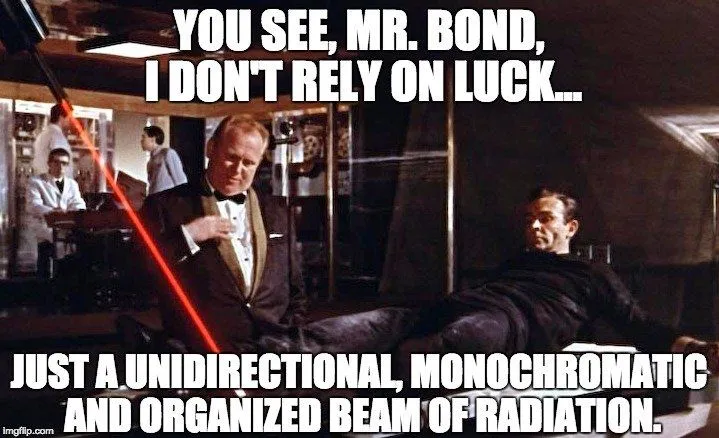
There are three other factors that affect whether or not a laser beam can be seen – the beam’s intensity, the beam’s wavelength and the amount of particulate matter in the air. To “see” a light, it needs to actually reach your eye, but due to the unidirectional and controlled nature of a laser beam, it should theoretically be invisible. The only way it can reach our eye is if that concentrated light is scattered somehow, and refracted to our eyes. A laser beam can be scattered by any particle in its path, including the particles already present in the air. Atoms and other molecules are present all around us in our atmosphere, but there are also larger particles, such as dust.
This is where these three factors come into play: the intensity and wavelength of the light, combined with particles in the air. Light scatters off air molecules according to Rayleigh scattering, whose strength rises sharply as wavelength drops (it is proportional to 1/λ4). That means shorter wavelengths like blue (around 450 nm) and green (around 532 nm) scatter several times more than red (around 650 nm), so green and blue laser beams are inherently easier to spot in mid-air than red ones. The greater the intensity of the beam, the more light there is to scatter through the molecules of the air, making it easier to see.
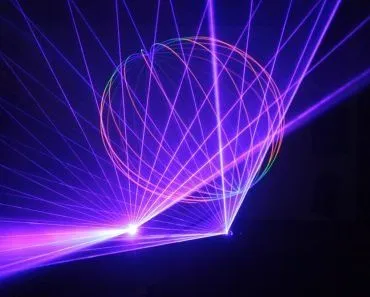
Imagine the last time you were in a crowded nightclub and the laser lights were going wild, cutting through the smoke and haze of the room like any respectable space battle. Those bigger smoke and dust particles scatter light by a different mechanism (Mie scattering), which is much stronger than Rayleigh scattering and far less picky about wavelength. That is why a fog machine can make any laser, even a weak red pointer, look like a solid bar of light. Interestingly enough, the human eye’s sensitivity peaks around 555 nm in the green, so even though green is a longer wavelength than blue, a green laser of the same power tends to look noticeably brighter to us than a blue or red one of equivalent output.
Now, to return to the most classic example: a huge Star Destroyer blowing holes in other spaceships in your favorite Star Wars film. In that scenario, laser beams would be completely invisible from the side, as the near-vacuum of space has almost no particles to scatter the light back to a camera. That being said, those battle scenes wouldn’t be nearly as exciting with a bunch of invisible lasers, so filmmakers have had to make a few alterations to reality to keep us coming back to the movies. (For the record, those bright bolts in Star Wars are not even lasers in-universe; they are described as plasma "blaster" rounds, which is a small comfort to the physics.)