Animals cannot reliably predict natural disasters. Dogs, elephants, and sharks are often reported acting strangely before an earthquake or storm, but the U.S. Geological Survey says no reproducible link has ever been proven. They more likely react seconds to minutes ahead by sensing physical cues, such as early seismic waves or falling pressure, with their sharper senses, not a true sixth sense.
There are numerous anecdotes about how dogs often start behaving abnormally right before an earthquake, how elephants seem to lose their mind before a landslide, or how sharks’ movement patterns change before a hurricane or a cyclone. All these incidents suggest an interesting fact; is it possible that animals can predict natural disasters, or at least some anomaly in the natural course of earthly events?
You might have noticed that your dog tends to always come back inside your house right before it starts raining. Also, just moments before an earthquake begins to shake the world, dogs are frequently seen to behave abnormally. One of the most famous accounts comes from the 2004 Indian Ocean tsunami: at Sri Lanka’s Yala National Park, elephants were reported trumpeting and fleeing to higher ground before the waves struck, and wildlife officials were later surprised to find very few large animal carcasses, hinting that many creatures had somehow gotten out of the way.
Although there is no concrete scientific proof to validate this hypothesis about animals’ power of detecting natural disasters before they actually occur, there is significant anecdotal evidence from which plausible explanations can be inferred.
Animals Sixth Sense
Scientists don’t appear to believe in the idea that animals possess a “sixth sense” that helps them sense disasters. Instead, they simply use their existing senses very efficiently, much more efficiently than humans, that is. The most critical sense to achieve this unique ability is hearing. Now, let’s see how.
Humans are able to hear sounds in the range of roughly 20 hertz to 20,000 hertz (20 kHz); any sound outside of this range is essentially undetectable to us. However, certain animals, like dogs, elephants, bats, and deer, transcend the boundaries of this range when it comes to hearing, which is why they appear to have this sixth sense.
Can Animals Predict Natural Disasters?
1. On Land
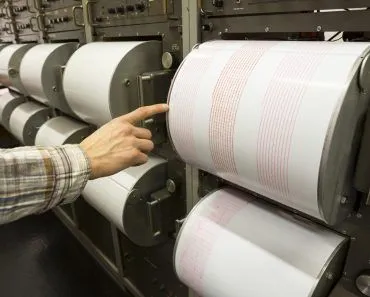
Let’s consider an earthquake; they start with the movement of tectonic plates far below the surface of the ground. There is a certain moment when this activity initially starts, and if you draw a straight line from this point to the ground, the endpoint of this line on the ground is called the epicenter. An earthquake sends out seismic waves, and they don’t all travel at the same speed. The fast-moving P wave (the primary wave) reaches the surface first, well ahead of the slower, far more destructive S wave that actually produces the shaking we feel. Most people never notice that gentle P wave, but an animal with keener senses can pick up that faint jolt, along with the low-frequency rumble it carries, seconds before the big shaking arrives, and voila! Dogs sense that something fishy is going on, so they start behaving… strangely. According to the U.S. Geological Survey, this head start is the best-supported explanation for animals reacting just before a quake, and there is still no proven evidence that they can forecast one minutes, hours, or days in advance.
 It’s not that dogs can rush up and say, ‘Golly! There’s an earthquake coming. Let’s evacuate the area!’ They simply sense something ‘unusual’ (the shockwaves) and due to having no concept of the source, they flee from the area until they can’t sense it anymore. Elephants, and certain other animals, also show similar behavior patterns in the wild.
2. In Water
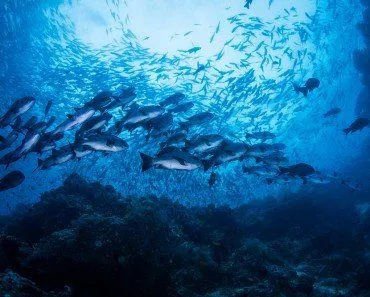
These disaster-sensing abilities are not limited to the ground; aquatic animals also show such behavior when a natural disaster is occurring. Aquatic animals are already highly attuned to conditions like hydrostatic pressure, so during a cyclone or a hurricane, when the air pressure and the hydrostatic pressure drop, underwater creatures start acting bizarre.
Aquatic animals, which are not used to this change, quickly sense that something is unusual and employ their defense mechanisms to avoid any danger that may come with those changes in underwater conditions. This is why sharks and some other fish are seen to go deeper underwater during a storm, as they may be able to avoid potential danger there and be safer.
As stated earlier, there is no concrete, reproducible evidence that animals can forecast disasters in advance. What the recurring reports more likely capture is animals reacting to early physical cues, such as a P wave or a dropping pressure, a fraction sooner than we do, rather than any true sixth sense for the future. Sorting genuine warning behavior from the countless other reasons animals act up remains a tough, unsolved scientific problem.
Which Animals Have Been Caught Reacting Before Earthquakes?
If you’ve read this far hoping for a smoking gun, here’s the honest answer: a handful of famous cases keep this question alive, but none of them prove genuine forecasting. They’re worth knowing, though, because they’re exactly the stories everyone repeats.

The most cited animal example is the common toad (Bufo bufo). Biologists Rachel Grant and Tim Halliday happened to be monitoring a toad breeding colony 74 km (about 46 mi) from L’Aquila, Italy, when a magnitude 6.3 earthquake struck in April 2009. Writing in the Journal of Zoology, they reported that 96% of the male toads abandoned the breeding site five days before the quake, and the number of mating pairs (like the two pictured above) dropped to zero three days before. The toads only trickled back after the last big aftershock. Grant and Halliday suspected the animals were reacting to pre-seismic changes in the air and water, perhaps shifts in the ionosphere or a spike in radon gas, rather than to anything mystical.
The other story you’ll hear is the 1975 Haicheng earthquake in China, where officials evacuated a city of roughly one million people before a magnitude 7.0 quake. Reports of restless cattle, snakes leaving their burrows in midwinter, and agitated chickens were folded into the warning, and the evacuation likely saved tens of thousands of lives. But when a U.S. scientific team later reviewed the call, they concluded it rested mainly on a clear sequence of foreshocks, not on the animals. The grim proof came a year later: the 1976 Tangshan earthquake gave almost no such warning and killed well over 240,000 people. One lucky save is not a method.
Can Science Turn Animal Behavior Into a Real Warning System?
So why not just wire up a barnyard and watch for nerves? Researchers have actually tried. The most rigorous attempt comes from a team led by Martin Wikelski of the Max Planck Institute of Animal Behavior, published in the journal Ethology in 2020.

The team fitted cows, sheep, and dogs on a farm near the epicenter of Italy’s magnitude 6.6 Norcia earthquake with motion-logging tags and tracked their movement around thousands of tremors. They reported bursts of unusually high activity 1 to 20 hours before quakes, with the lead time shrinking the closer the animals sat to the source. Curiously, the effect showed up only when the animals were penned together in the stable, not when they were spread across open pasture, hinting that the herd was sensing something collectively. Think of it as a more careful, sensor-driven cousin of how scientists study earthquakes with instruments.
Here’s the catch, and it’s why the headlines never quite arrive. Other scientists reanalyzed the data and argued the “anticipatory” spikes couldn’t be told apart from random fluctuations in animal activity. Geologist Wendy Bohon summed up the deeper problem memorably: “My cat could act crazy before an earthquake. But my cat also acts crazy if somebody uses the can opener.” To build a usable alarm, you’d have to show that animals get jittery only before quakes and almost never otherwise; fall short of that and you simply trade earthquakes for a flood of false alarms. As things stand, animals remain promising sensors of the present, not proven prophets of the future.
References (click to expand)
- Can animals predict earthquakes? U.S. Geological Survey
- Can Animals Predict Disaster? | Tall Tales or True? | Nature. The Public Broadcasting Service
- Can Animals Sense Earthquakes? National Geographic
- How Do We Hear? National Institute on Deafness and Other Communication Disorders (NIH)
- Tropical storms influence the movement behavior of a demersal oceanic fish species. Scientific Reports (Nature)
- Animal earthquake prediction. University of Washington
- Predicting the unpredictable; evidence of pre-seismic anticipatory behaviour in the common toad. Journal of Zoology (Zoological Society of London)
- Potential short-term earthquake forecasting by farm animal monitoring. Ethology
- Do Animals Really Anticipate Earthquakes? Sensors Hint They Do. Scientific American