Table of Contents (click to expand)
- What Is A Fingerprint?
- What Makes Fingerprints So Unique?
- How Do We End Up Leaving Fingerprints On Things We Touch?
- How Are Fingerprints Lifted From A Crime Scene?
- Can Fingerprints Be Lifted From A Gun After It Has Been Wiped Off?
- Does Water Wash Fingerprints Away?
- How Long Do Fingerprints Last On A Surface?
- Can You Permanently Remove Or Erase Your Fingerprints?
Every contact leaves a trace and everything we touch leaves a fingerprint. And despite what TV and movies often depict, a fingerprint can be detected even after it has been wiped off.
It’s common to see someone in a movie or TV show wipe their fingerprints from a surface or a weapon to avoid being caught by investigators. It’s so common a trope that one might think that cleaning your fingerprints is actually a foolproof way to avoid being caught.
But how true is that? In other words, can you really escape detection if you just clean your fingerprints from a surface after committing a crime?
Before we answer the question, let’s talk about fingerprints in general.
What Is A Fingerprint?
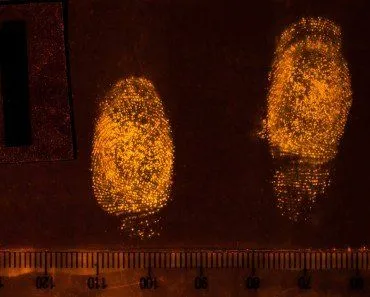
Our fingerprints have been with us since before we were born and will stay with us throughout our lifetime. Those grooves and ridges on our fingertips not only improve our touch perception and ability to grip things, but also provide us with a distinctive identification mark.
Every person on this planet has a unique set of fingerprints. Not even identical twins who have the same DNA code share the same fingerprints!
This peculiar property of friction ridge impression, aka fingerprints, has been a part of crime-solving for over 100 years, but its use as a personal identifier or even a legally binding signature has been around even longer.
What Makes Fingerprints So Unique?
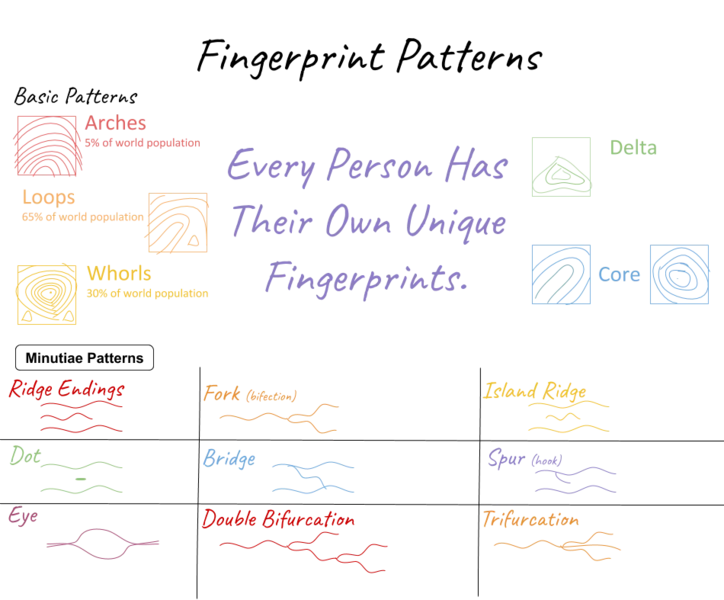
The folds on our skin give rise to ridges on our fingertips that create a unique arrangement of loops, whorls, and arches. These three shapes further give rise to an even more intricate and distinguishing pattern, known as the minutiae, which consist of lakes/enclosures, bifurcations, trifurcations, ridge endings, and many other defining ridge characteristics.
There are billions of people on this planet and everyone has their own tapestry of loops, whorls, ridges, and minutiae. The presence of a searchable and distinct sequence of shapes can act as anchor points for forensic experts and the fingerprint recognition software when cross-referencing found prints with biometric databases.
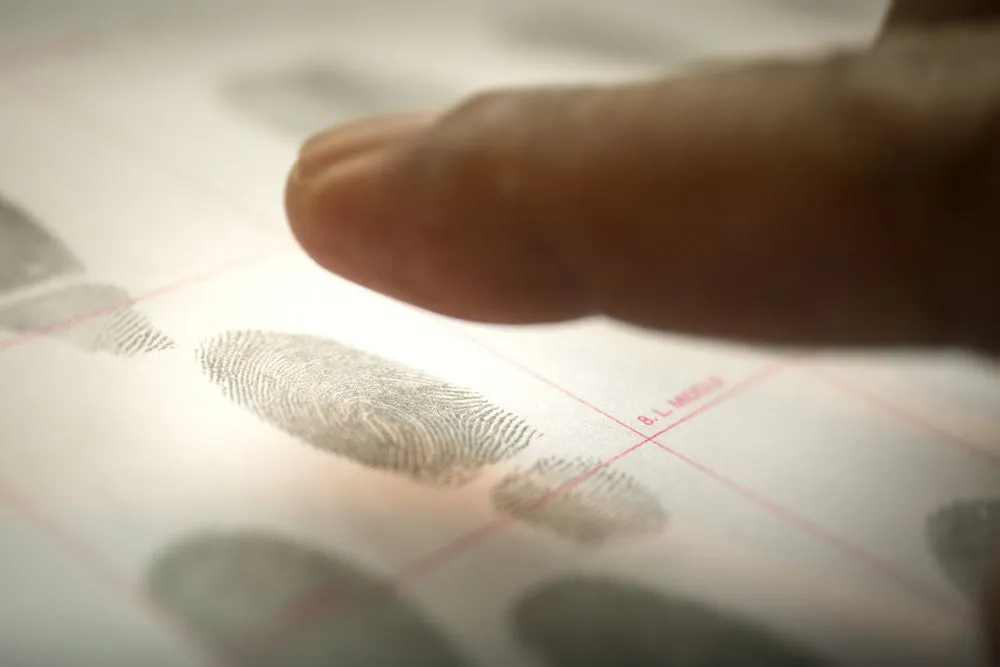
But how does one leave this unique print on objects if their hands aren’t soaked in ink?
How Do We End Up Leaving Fingerprints On Things We Touch?
The keyboard keys you just touched or the container you are drinking water from hold the invisible evidence of your presence; they now carry a trace of you because every contact leaves a trace.
This phrase is known as the “Exchange Principle” and forms one of the basic principles of forensic science. It was popularized by Edmund Locard, one of the pioneers in the field of forensics, who showed that every time two objects came in contact with each other, there was an exchange of material between them.

Even if your fingertips aren’t soiled by blood, dirt, or Cheeto dust, they still leave behind chemical imprints on the things you touch because the sebaceous glands under our skin secrete a cocktail of sweat, oils, and amino acids. These natural secretion traces help crime scene investigators (or CSIs) lift even the invisible fingerprints from a crime scene.
How Are Fingerprints Lifted From A Crime Scene?
CSIs look for three different types of fingerprints: Patent, Plastic and Latent.
Patent Fingerprints are visible to the naked eye, for instance, a finger soaked in blood.
Plastic Fingerprints are left on soft surfaces, like soft wax or wet paint.
Latent Fingerprints are the invisible impressions created by skin secretions on various surfaces.
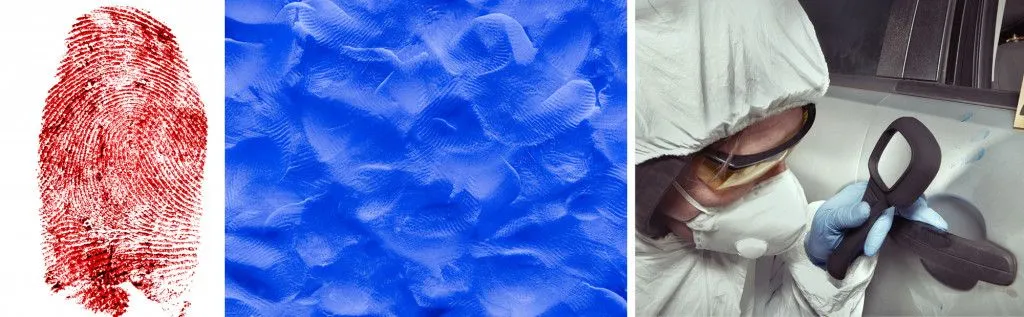
The CSIs usually begin by photographing the patent or visible fingerprints under normal light, if they’re clear enough, or they can use alternative light sources, such as UV black lights, to enhance the prints. Then they look for plastic fingerprints left on soft surfaces that can be lifted off by pouring a liquid, such as plaster, molten alloys or silicon rubber, which can later harden and create an impression of the print.
And now for the most challenging part, the hunt for lifting latent fingerprints. Since they are invisible or barely visible, CSIs use chemistry to enhance such prints, if any are present.
The most common technique and the one many of us might have already seen on TV shows is the use of fingerprinting powder. CSIs use their trusty brush and a palate of fingerprint powders to visualize prints from smooth and textured surfaces. The fingerprint-dusting powders stick to oils and moisture left by the ridges on our fingertips to create a visible print that is then lifted off using transparent tape.
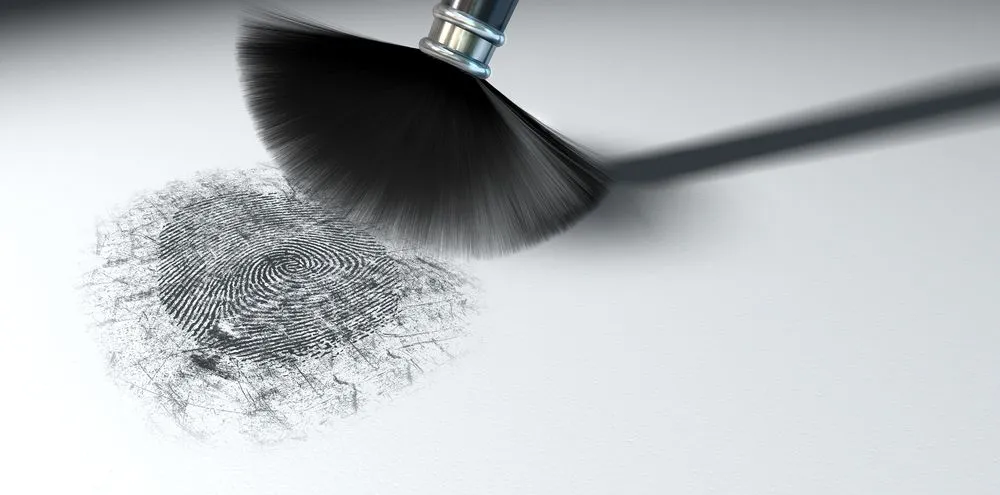
The powders used vary from surface to surface. For example, aluminum powders are preferred for glass surfaces, while brass or granulated jet black is used on silvery surfaces to create better contrast. Fluorescent powders are also used to enhance prints on multicolored surfaces.
For porous surfaces like paper or walls, fingerprints are detected by spraying a solution called ninhydrin on the surface where a print can be found. This ninhydrin solution reacts with the amino acids present in sweat and turns purple due to the formation of Ruhemman’s purple.
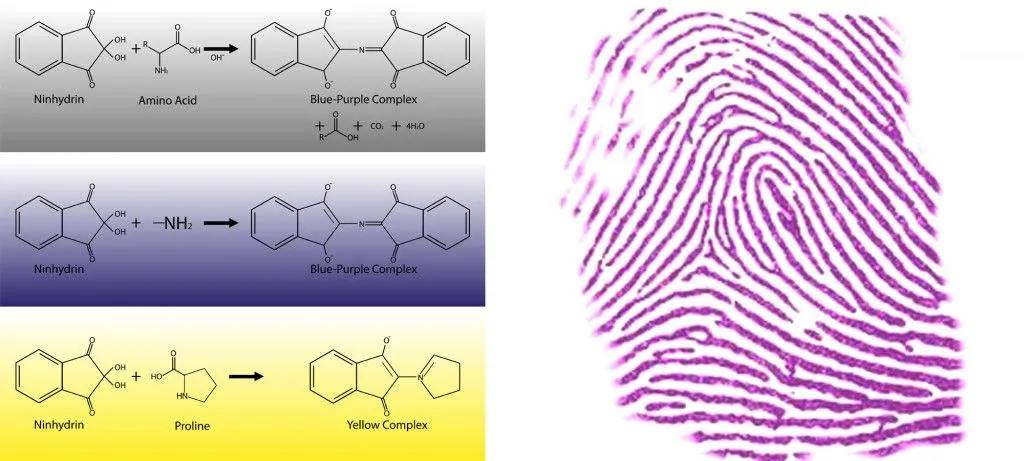
In some cases, CSIs will use cyanoacrylate or super glue fumes to enhance a latent fingerprint from a rough surface. The cyanoacrylate molecules react with skin residue and polymerize to create a 3D matrix of the fingerprint. If that doesn’t work, they might try the most recent and advanced method: vacuum metal deposition or VMD.
This method deposits a thin layer of gold and zinc. A part of the gold layer diffuses with the skin oils and the rest remains free. When the zinc is coated, it attaches itself to the undiffused free gold, creating a negative contrast of the fingerprint. Though quite expensive, this is the fastest method for developing a fingerprint on extremely tricky surfaces like wood or fabrics.
The investigators exposed the curtains near the entrance of the store to VMD in hopes that the burglar might have touched them while running out. Unfortunately, this led to a dead end because they found multiple fingerprints and there was no way of determining which were the burglar’s and which came from the employees or other customers.
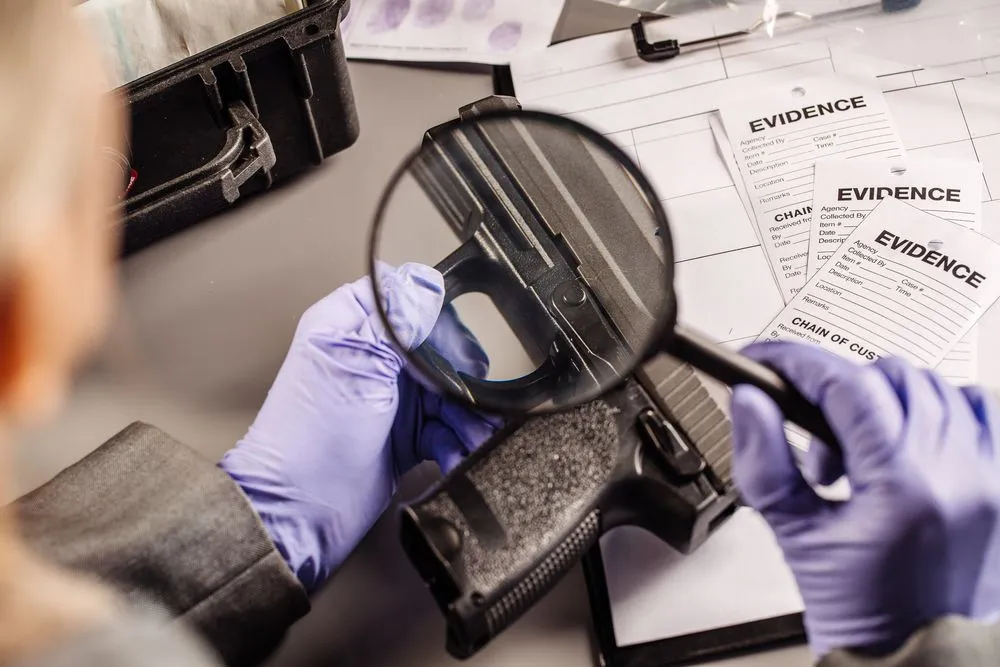
The only thing solely handled by the criminal was the gun. Even though a preliminary test didn’t reveal any fingerprints, the cops were still hoping they could recover prints from the gun once it was sent to a more advanced forensic lab.
Can Fingerprints Be Lifted From A Gun After It Has Been Wiped Off?
The answer is… yes!
Scientists have developed a method that can visualize prints from even the faintest fingerprint deposits left after the metal is wiped off. This technique uses a colored electro-active film that uses fingerprint residue as a stencil for blocking the electric current. Once a voltage is passed, the oily regions deflect the colored substances surrounding bare regions, which gives rise to a negative ridge pattern, similar to VMD.
Now, coming to our second piece of evidence, the bullet casing. Scientists can now identify who handled a bullet before it was fired by visualizing corrosion on the brass casing. The oil or sweat marks left by finger ridges can cause the brass casing to corrode, which is further accelerated by the heat produced while firing the bullet. Thus, scientists coat the casing with a conducting powder and pass an electric current.
The powder moves and sticks to the corroded spots, and voila! We have a fingerprint.
Many such phenomenal advances are happening in forensic technology, so the days of wiping down weapons to remove fingerprints will soon be from a bygone era. Say goodbye to the idea of wiping off fingerprints to protect your innocence!
Does Water Wash Fingerprints Away?
It is one of the most common assumptions you can make: splash an object with water, or toss it in a river, and the prints simply rinse off. The reality is far less reassuring for anyone hoping to hide. The amino acids, oils, and salts that make up a latent print are not very soluble, and the oily (sebaceous) component in particular clings to a surface rather than washing away. Investigators routinely pull usable prints off items that have been wet, or even fully submerged.

In a study published in the Egyptian Journal of Forensic Sciences, researchers deposited prints on non-porous items, sank them in fresh water and sea water, and then tried to develop them after 1, 2, and 10 days. Identifiable prints were still being recovered at the 10-day mark in both waters, although clarity dropped over time. Cyanoacrylate (super glue) fuming consistently outperformed black powder and small particle reagent, and fresh water preserved the ridges noticeably better than the salt and corrosive ions of sea water.
A more recent 2025 study in Scientific Reports pushed the timeline further: using a phloxine B small particle reagent, the team lifted identifiable prints from glass kept in tap water for up to 27 days, and from plastic for up to 29 days. So a quick rinse under the tap does almost nothing. Standing water buys a suspect days, not certainty, and a forensic lab can still find what is there. (For more on how labs piece a scene together, see our explainer on the real-life science of crime scene investigation.)
How Long Do Fingerprints Last On A Surface?
There is no single expiry date for a fingerprint, because how long it survives depends almost entirely on the surface and the surroundings. The biggest split is between porous materials like paper, cardboard, and untreated wood, and non-porous ones like glass, metal, and plastic.

On porous surfaces, the print is effectively a gift to investigators. The sweat and amino acids soak into the material and become trapped, rather than sitting on top where they can be smudged or wiped. That is why chemical developers such as ninhydrin, which reacts with amino acids to produce a purple stain, are the go-to method for paper. Because those residues are locked in place, prints on paper can survive for years, and questioned-document examiners have recovered them from materials that are decades old.
On non-porous surfaces, the residue sits on the outside, so it is more exposed but still surprisingly durable. Sheltered indoors and away from heat, humidity, and handling, a print on glass or metal can persist for months. Outdoors, the clock runs much faster: rain, wind-blown dust, and ultraviolet light all degrade the residue. The practical takeaway is that you can never assume a print has simply faded; on the right surface, it may still be sitting there long after you have forgotten you touched the object.
Can You Permanently Remove Or Erase Your Fingerprints?
If wiping and washing will not do it, what about getting rid of the fingerprints themselves? This is the plot of countless thrillers, and the short answer is that it almost never works. Your ridge pattern is not just printed on the surface of your skin. It is generated at the boundary between the outer epidermis and the deeper dermis, and that template is laid down before birth and persists, essentially unchanged, throughout your life.
Because the pattern is anchored in that deeper layer, superficial damage does nothing lasting. Minor cuts, abrasions, and even skin conditions like eczema disturb the ridges only temporarily; once the skin heals, the original pattern grows right back. To change a fingerprint permanently, you have to destroy the dermis itself, and the only thing deep enough to do that leaves an obvious, disfiguring scar.
History is full of failed attempts. The American gangster John Dillinger had a doctor burn his fingertips with acid in 1934, yet after he was killed, faint ridge markings were still clear enough to identify him. The lesson examiners drew is almost ironic: a deliberate scar does not erase your identity, it adds a new and unique feature to it. On top of that, the same friction-ridge skin covers your palms, and those prints are just as individual as the ones on your fingertips, much like how even identical twins can be told apart by traits they do not share. Short of catastrophic injury, your fingerprints are with you for good.
References (click to expand)
- Elkins, K. M. (2018). Introduction to Forensic Chemistry. CRC Press
- Crime Scene Chemistry – Fingerprint Detection. Compound Interest
- Mcdermid V. (2014). Forensics: The Anatomy of Crime. Profile Books
- White P. (2010). Crime Scene to Court: The Essentials of Forensic Science. Royal Society of Chemistry
- Sapstead (nee Brown), R. M., Ryder, K. S., Fullarton, C., Skoda, M., Dalgliesh, R. M., Watkins, E. B., … Hillman, A. R. (2013). Nanoscale control of interfacial processes for latent fingerprint enhancement. Faraday Discussions. Royal Society of Chemistry (RSC).
- Bond, J. W. (2008, July). Visualization of Latent Fingerprint Corrosion of Metallic Surfaces. Journal of Forensic Sciences. Wiley.
- Madkour, S., et al. (2017). Development of latent fingerprints on non-porous surfaces recovered from fresh and sea water. Egyptian Journal of Forensic Sciences.
- Latent fingerprint recovery on submerged non-porous surfaces using phloxine B-based small particle reagent. Scientific Reports (2025). PMC, NCBI.
- Fingerprint Analysis: How It’s Done. A Simplified Guide to Forensic Science.
- Fingerprint Analysis: Principles. A Simplified Guide to Forensic Science.