Understanding a language without being able to speak it well is so common that linguists have a name for it: receptive bilingualism. Comprehension and speech production are handled by different brain regions (Wernicke’s area for understanding, Broca’s area for producing speech), and in general, recognizing words is much easier than retrieving them on demand. Without actively practicing speaking, the speaking side stays underdeveloped even while listening gets better.
Back when I was starting to learn French, just like any other student of a foreign language, I resorted to translating words rather than understanding the language. Gradually, as I practiced more and more, I began to get a hang of its words and grammar, and could understand 20-25% of two people talking in French. I could also understand some moments in French movies and songs.

Yet, despite showing reasonable progress in understanding the language, my performance in spoken French was nothing short of abysmal. I could (partially) understand the language, but was truly bad at speaking French myself. Now, this was not just my struggle; I took sadistic pleasure in seeing that most of my classmates were as bad as me – if not worse.
Even so, this peculiarity is certainly something to ponder over, isn’t it? Linguists actually have a name for it: receptive bilingualism, where you can comfortably understand a language but cannot fluently speak (or write) it. As we learn, we tend to understand a language pretty well, but when it comes to reproducing through words (either spoken or written), we often struggle.
Why is that?
Understanding/Recognizing Vs Reproducing
It’s important to understand the difference between these two activities, which is where the answer to our question lies.
You see, recognizing/understanding something is generally much easier than reproducing it on one’s own. I’ll illustrate this with the help of an example: suppose you have all the words of a foreign language (say, Spanish) printed on a piece of paper, and imagine that they are all in alphabetic order. The first stack has all the words starting with ‘A’, the second stack has all words starting with ‘Be’ (Spanish ‘B’) and so on.
Now, when someone says the word ‘despacito’ in front of you, you instantly register that the word starts with a ‘De’ (Spanish ‘D’). Subsequently, you look for the word ‘despacito’ in the stack of words starting with ‘De’, locate it, and translate its meaning to English (‘despacito’ translates to ‘slowly’ in English).
This process seems a little cumbersome and long-winded, but the thing to note is that all of it happens inside your head. In reality, you don’t carry around a stack of Spanish letters, do you? You simply hear the word and you ‘run’ it inside your brain’s database, looking for matches. When the match is found, boom! You know what the word means.

Now, let’s consider another scenario. This time, you are shown a picture of a cat, and asked to say what’s it called in Spanish. You still have that all-words stack with you, but you realize that it’s not helpful in the least! You can surely translate a word that’s given to you, but you are at total loss if you are asked to “find” the right word (for a particular object) on your own. This is the basic reason why understanding and reproducing a language are two entirely different things, and why the former is usually considered easier.
The Trouble With ‘Understanding’ A Language
More often than not, it just so happens that while ‘understanding’ a conversation taking place in a foreign language, you basically understand the comprehensive meaning of what’s being said, but not the word-for-word meaning of every sentence. The context helps a lot too.
For instance, suppose a Frenchman approaches you and says “Excusez-moi, où sont les toilettes, s’il vous plaît?” Even if you know basic French, you’d get the idea (due to words like ‘toilettes’ and ‘ou’) that the gentleman wants to know how to reach the nearest toilet (lavatory).

However, if the same situation is reversed, i.e., you go to Paris and have to ask for directions to the nearest toilet, you will likely struggle to form entire sentences correctly and then speak them to a friendly French gentleman. (Pro tip: You should learn, for your own good, all the basic French sentences before taking a trip to Paris).
Now, let’s look at the biological aspect of this whole thing…
The Wernicke’s Area And Broca’s Area In The Brain
‘Language’, as a whole, is handled by a specialized region of the brain, but hearing/understanding and speaking are handled by separate regions of the brain.
Wernicke’s area in the temporal lobe deals with language understanding and comprehension, while Broca’s area in the frontal lobe handles speech language production.
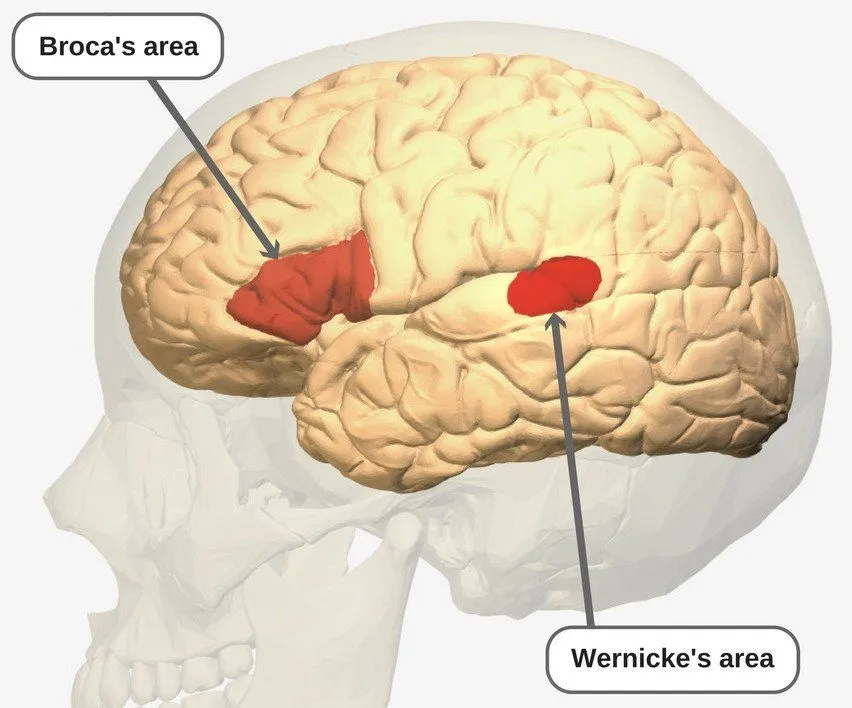
Thus, language comprehension and reproduction are NOT handled by the same part of the brain, which might further explain why understanding and reproducing a language may not necessarily go hand in hand.
Although they are in different regions of the brain, both of these areas are connected by a bundle of axons known as the arcuate fasciculus. It should be noted that these two regions may have different functions, but they are not the only two regions involved in the comprehension and production processes.
What Is It Called When You Understand A Language But Can’t Speak It?
Linguists have a tidy label for this exact mismatch: receptive bilingualism (you may also see it called passive bilingualism). A receptive bilingual is someone who can comfortably understand a language but produces little or no speech in it, and researchers treat these comprehenders as a distinct group from ordinary foreign-language learners.

The most familiar example is the heritage speaker: the child of immigrants who grows up hearing a home language, follows it perfectly when the grandparents talk, yet answers back in the majority language and feels tongue-tied trying to produce the heritage tongue. Self-reports from heritage speakers almost always show the same lopsided pattern, with listening and reading rated far higher than speaking and writing.
Why does this split the two skills apart? A study tracking Spanish-English bilingual children found that comprehension reliably outran production, and that the two depended on different things. Comprehension grew with sheer exposure to the language, while production needed exposure and active use. Roughly 40-60% of a child’s input in the heritage language was enough to reach monolingual-like understanding, but closer to 70% was needed to match it in speaking. Hear a language often enough and you will understand it; to speak it well, you also have to keep using it.
Can You Speak A Language But Not Understand It?
What about the reverse, speaking a language you don’t actually understand? In everyday learning this is the harder direction, because production normally trails comprehension. We can recognize far more words than we can summon on demand, and studies of second-language vocabulary find that comprehension of a word is typically acquired before the ability to use it. So genuine, flexible fluency without understanding is rare.

It does happen in a narrow way, though, whenever speech is purely memorized. A tourist who has drilled a few stock phrases, a singer belting out lyrics in a language they don’t speak, or a worshipper reciting prayers in Latin, Sanskrit, Hebrew, or Quranic Arabic can all deliver the sounds fluently while grasping little or none of the meaning. The words are reproduced as memorized strings of sound rather than assembled from understanding.
There is also a striking clinical version. Damage to Wernicke’s area, the comprehension hub mentioned above, can cause Wernicke’s (fluent) aphasia: the person speaks at a normal rate with natural rhythm and grammar, yet the output is peppered with wrong or invented words, and they struggle to understand others or even notice their own errors. It is, in effect, the mirror image of receptive bilingualism, with the speaking machinery running while comprehension falters, and a vivid reminder that the brain keeps these two jobs in separate places.
All in all, the key to properly speaking a language is practice. If you don’t actually practice speaking, you might get good at understanding a language, but you will never be able to perfect the ‘reproduction’ aspect of the language.
As a result, if you go on a trip someday to a foreign land, and you’re particularly unlucky and technologically-challenged, you will have to bear the discomfort of holding in your pee for a very long time, and simply hope that a compatriot comes to your rescue and guides you to your destination.
References (click to expand)
- HIGHER ORDER ASSOCIATION CORTEX: LANGUAGE RELATED AREAS. - www.indiana.edu:80
- Brain’s language center has multiple roles. MIT News.
- Wernicke area. Encyclopedia Britannica.
- Chapter 8: Higher Cortical Functions: Language. The Texas Medical Center
- Wernicke’s aphasia, Brain & Language. Tulane University.
- A classification of receptive bilinguals. Linguistic Approaches to Bilingualism.
- Bilingual Development in the Receptive and Expressive Domains: They Differ. International Journal of Bilingual Education and Bilingualism.
- The effect of productive vocabulary knowledge on second language comprehension. Frontiers in Psychology.
- Wernicke Aphasia. StatPearls. NCBI Bookshelf.