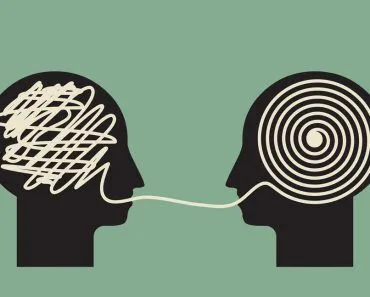
A language is harder to learn the greater its ‘linguistic distance’ from your native tongue, meaning how far apart the two sit on the family tree of languages. Difficulty is largely relative: a language that is tough for one speaker can be easy for another. For English speakers, the US Foreign Service Institute rates Mandarin, Cantonese, Japanese, Korean and Arabic the hardest.
There are more than 7,000 languages still spoken around the world today (Ethnologue counts roughly 7,150). Among these, a handful are spoken by far more people than the rest. This often makes it necessary to learn one of the most widely spoken languages in order to communicate globally. English and Mandarin Chinese are common examples of such languages.
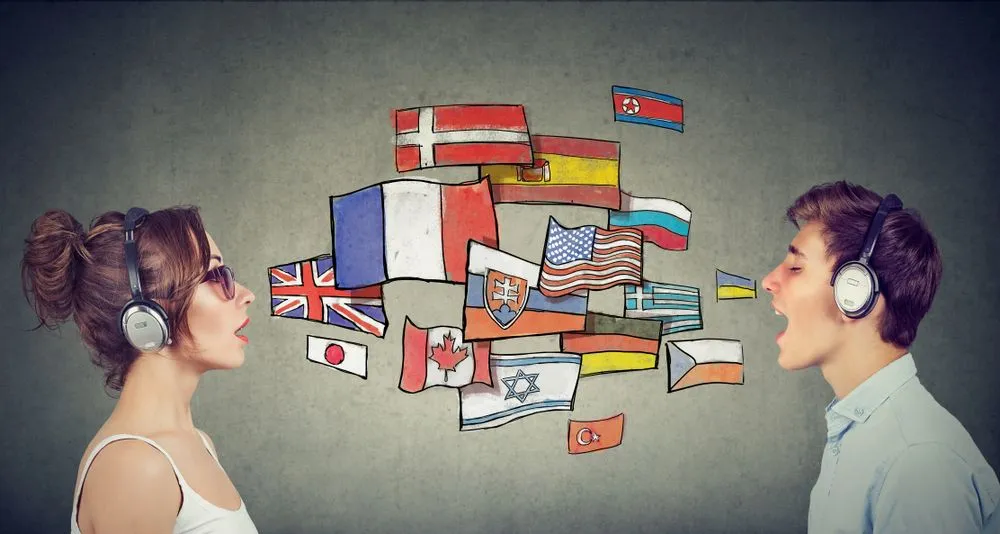
But often, there are hurdles to learning these languages. People from different countries report varied difficulty in learning them. For example, someone from Europe would find it easier to learn English, as compared to Chinese. Similarly, for someone from Japan, learning Chinese would be relatively easy, as compared to English. Why is this the case? What are the factors that affect the difficulty of learning a language?
How Many Languages Are There In The World?
We casually throw around the figure of "more than 7,000 languages," but pinning down an exact number is surprisingly tricky. The most widely cited catalogue, Ethnologue, lists somewhere between about 7,150 and 7,170 living languages depending on the edition, with its 2026 count sitting at roughly 7,170. The total keeps drifting because linguists do not always agree on where one language ends and a mere dialect begins, and because languages are steadily being lost as their last fluent speakers die.

These languages are spread very unevenly across the globe. Asia and Africa together are home to nearly two-thirds of them. A single country, Papua New Guinea, holds the record with around 840 living languages, more than any other nation on Earth, followed by Indonesia and Nigeria. Much of that diversity comes down to geography: Papua New Guinea's rugged, mountainous terrain kept neighboring communities isolated for thousands of years, letting their speech drift apart into hundreds of separate tongues.
Yet most of humanity crowds into a tiny sliver of this variety. Just a couple of dozen languages, led by English, Mandarin Chinese, Hindi and Spanish, are spoken by more than half of the world's population. At the other extreme, a large share of languages have only a few hundred or a few thousand speakers left, and more than 40% are now considered endangered. So while the planet is astonishingly multilingual on paper, day-to-day global communication leans on a very small club of dominant languages.
Why Are Some Languages Spoken So Widely?
If difficulty is relative and no language is inherently "better" than another, why do a handful of them blanket the globe while thousands stay confined to a single valley or island? The answer has very little to do with the languages themselves and almost everything to do with history, power and the movement of people.

The biggest driver has been empire. From the fifteenth century onward, European colonial powers carried Spanish, English, French and Portuguese across the Americas, Africa, Asia and the Pacific, installing them as the languages of government, education and religion. Long after the empires dissolved, many newly independent nations kept the colonial language as a neutral, unifying tongue for citizens who often grow up speaking several languages. That is why English is an official language in around 60 countries today, most of them former British territories.
Trade played its part too. When people with no common language meet to do business, they improvise a shared "lingua franca." The term itself comes from a simplified, Italian-based trade jargon spoken around the medieval Mediterranean. English later inherited that role on a planetary scale, boosted first by British industrial and naval power and then by the economic, scientific and cultural weight of the United States, until it became the default language of diplomacy, science, aviation and the internet.
Sheer numbers matter as well. Mandarin Chinese owes much of its reach to the enormous population of China, and Hindi to that of India. A widely spoken language, in short, is usually one that was carried far by conquerors, traders or a booming population, not one that happened to be easier to learn.
Language ‘Trees’
To understand why languages differ in difficulty, we first need to try to understand their similarities and differences. A German linguist, August Schleicher, was the first to do this in the 1850s by using tree-like diagrams that trace the origins of each language.
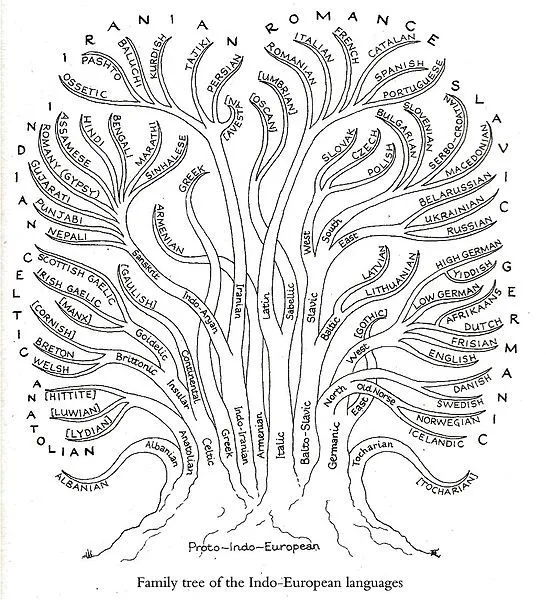
Linguists who succeeded him continued this work and studied the evolution of world languages and arranged them into ‘trees’ that map out their history and relationships. In this method, languages that are evolutionarily closer and have the same ancestor are grouped under one family.
For example, the Indo-European family includes most languages of Europe, along with languages of Iran and northern India. Within it, the Romance languages (French, Spanish, Italian, Portuguese) sit on one closely related branch. Because French and Spanish have so much in common, a native French speaker can pick up Spanish far more easily than an evolutionarily distant relative such as Hindi or Persian.
It’s interesting to note that this classification has little to do with geography. Hungarian, for instance, is surrounded by Indo-European neighbors yet belongs to the entirely separate Uralic family, sharing its deepest roots with Finnish and Estonian rather than with German or Romanian next door. That is why a German speaker, despite living right beside Hungary, finds Hungarian grammar so alien, while Dutch (a close Germanic cousin) comes much more naturally.
This explains why a person might have an easier time learning one language over another.
Linguistic Distance
The theory of ‘language trees’ is helpful to understand the relative difficulty of learning one language over another for the same individual. Now, let’s look at another interesting phenomenon where the converse happens – different individuals report different difficulties for learning the same language.
The varied difficulty of learning the same language received a spotlight due to non-English speakers immigrating into English-speaking nations. Linguists noted that immigrants with different native languages varied in their ability in learning English. They proposed that this might be because the native languages of these immigrants varied in similarity with respect to English, as per the ‘language tree’ hypothesis.
They devised a measure called ‘linguistic distance’ denoting the degree of similarity of one language with respect to another. They did this by studying the difficulty of learning different languages with respect to the English-speaking American population.
Interestingly, they noted that the proficiency of immigrants in English was correlated to the ‘linguistic distance’ of their native language from English. This meant that this measure was valid in a reciprocal fashion! Therefore, if a native Chinese speaker has difficulty learning English, a native English speaker faces the same level of difficulty in learning Chinese.

Linguistic distance has since been adapted to understand learning second languages other than English, such as to study the acquisition of European languages among people with varying native languages.
Other Factors Affecting Language Learning
In addition to linguistic distance, there are several other factors that decide the difficulty with which one learns a language. This includes, for example, the ability to pick up the sounds of the new language, or its ‘phonology’. This ability determines how ‘native-like’ someone sounds when speaking a language. This also seems to be significantly influenced by the learner’s age at the onset of learning.
We are generally better at acquiring ‘native-like’ accents when we learn them at a young age. This is because our perception of sounds of a language has a ‘critical period’ after which it becomes significantly less efficient.
This is why children are better at sounding ‘native-like’ than adults after spending the same amount of time in a new country after immigration and despite sharing the same native language. Due to this, it is easier for adults who are well past their critical period to pick up languages that don’t require learning new sounds.
Furthermore, languages also differ in their word order and grammatical rules such as the use of gender, etc. However, the most significant factor influencing second language learning seems to be linguistic distance.
You can see this play out in real numbers. The US Foreign Service Institute (FSI), which trains American diplomats, sorts languages into difficulty groups by how long English speakers take to reach professional working proficiency. Languages closest to English, such as French, Spanish, Italian and Dutch, need only about 600 to 750 class hours (24 to 30 weeks). Languages a little farther out, like German, take roughly 900 hours. The hardest group, what the FSI calls its “super-hard” languages, takes around 2,200 hours (88 weeks), nearly four times the effort of an easy language. That group is Mandarin Chinese, Cantonese, Japanese, Korean and Arabic, all of which combine an unfamiliar sound system, grammar or writing system with a large linguistic distance from English. So if you have ever wondered what the hardest language to learn is, the honest answer is that it depends on the language you already speak.
What Makes The Hardest Languages So Hard?
Earlier we saw that the US Foreign Service Institute places Mandarin Chinese, Cantonese, Japanese, Korean and Arabic in its toughest tier for English speakers. But what exactly makes these five so punishing? It is rarely one single thing; each stacks several unfamiliar systems on top of a large linguistic distance from English, testing the limits of how we learn a language.

Tones. In Mandarin, the single syllable "ma" can mean mother, hemp, horse or a scolding depending on which of its four tones you use, so pitch carries meaning much as vowels do in English. Cantonese piles on even more tonal contrasts. For a native English speaker, whose language uses pitch mainly for emotion and emphasis, retraining the ear to hear these differences is a genuine hurdle.
Writing systems. Chinese sets aside the alphabet entirely: a literate reader needs to recognize on the order of 3,000 characters, each learned more or less individually. Japanese is arguably tougher still, juggling three scripts at once, the two syllable-based kana (hiragana and katakana) plus thousands of imported Chinese characters known as kanji. Japan's official "everyday use" list alone runs to 2,136 kanji that a school-leaver is expected to know.
Grammar and register. Korean, by contrast, has a refreshingly logical alphabet called Hangul that can be learned in a matter of days; its difficulty lies instead in an elaborate system of honorifics and a word order that feels alien to English speakers. Arabic adds a right-to-left script and a feature called diglossia: the formal Modern Standard Arabic of news and books differs noticeably from the everyday dialects people actually speak, so learners effectively juggle two versions of the language at once.
None of this makes these languages the hardest in some universal sense. A Korean speaker finds Japanese grammar broadly familiar, and an Arabic speaker has a head start on the Persian script. The "super-hard" label is written entirely from the point of view of someone who already speaks English.
Conclusion
Languages of the world are diverse, but based on linguistic evolution, they can be classified into families organized in a language tree. A measure called ‘linguistic distance’ denotes how far language A is from language B based on their location in this ‘language tree’. This measure decides how close or similar one language is to another.
The closeness of a language to one’s native language determines the difficulty in learning it. This is because our brains define new experiences based on prior experiences. Thus, our native language shapes our foreign or second language learning.
In short, it would be a good idea to look up your native language on the ‘language tree’ before deciding which foreign language you want to learn. Next time you have a bad time recalling all the rules of grammar in French, just blame it on your mother tongue!
References (click to expand)
- Three early language trees in the history of linguistics. A .... ResearchGate
- (1995) Language-tree divergence times support the Anatolian theory .... mapageweb.umontreal.ca
- Chiswick, B. R., & Miller, P. W. (2005, January 15). Linguistic Distance: A Quantitative Measure of the Distance Between English and Other Languages. Journal of Multilingual and Multicultural Development. Informa UK Limited.
- Van der Slik, F. W. P. (2010, June 29). Acquisition Of Dutch As A Second Language. Studies in Second Language Acquisition. Cambridge University Press (CUP).
- (1979) SECOND LANGUAGE ACQUISITION - JSTOR. JSTOR
- Edwards J. G. H.,& Zampini M. L. (2008). Phonology and Second Language Acquisition. John Benjamins Publishing
- FLEGE, J. E. (1987, June 1). A Critical Period for Learning to Pronounce Foreign Languages?. Applied Linguistics. Oxford University Press (OUP).
- Foreign Language Training. Foreign Service Institute, U.S. Department of State.
- How many languages are there in the world?. Ethnologue.
- Papua New Guinea has more living languages than any other country. Our World in Data.
- What is a lingua franca? A brief history, from the Crusades to today. The Conversation.
- Jōyō kanji (Japan's official list of 2,136 everyday-use characters). Wikipedia.
- Modern Standard Arabic (diglossia in Arabic). Wikipedia.