Imaginary time is a mathematical reformulation of time used in quantum mechanics and cosmology, in which real time t is replaced by an imaginary quantity τ = it (where i = √−1). This trick, called Wick rotation, turns problematic singularities (like the Big Bang) into smooth, well-behaved geometry. Stephen Hawking and James Hartle famously used it in 1983 in their no-boundary proposal for the origin of the universe.
What happened at the beginning of the universe? Most people would simplify and say that there was a Big Bang and then everything spontaneously burst into existence. That statement certainly has an element of truth, to some extent.
However, what exactly happened at the beginning of time itself? And what happened before that? Questions like these have eluded the scientific community to this day.
When we start to look at things at the beginning of the universe, or even before the beginning, nothing is what it seems. The math gets fuzzy, the physics gets hazy, and conventionally accepted “truths” tend to fall apart.
How would one even begin to understand the universe at a time so close to the beginning (t=10-33 seconds)? That number has thirty-three zeroes after the decimal point! Trying to solve problems in physics at that stage of our universe’s lifecycle gets incredibly tedious. Actually, tedious might be an understatement… it gets downright impossible!
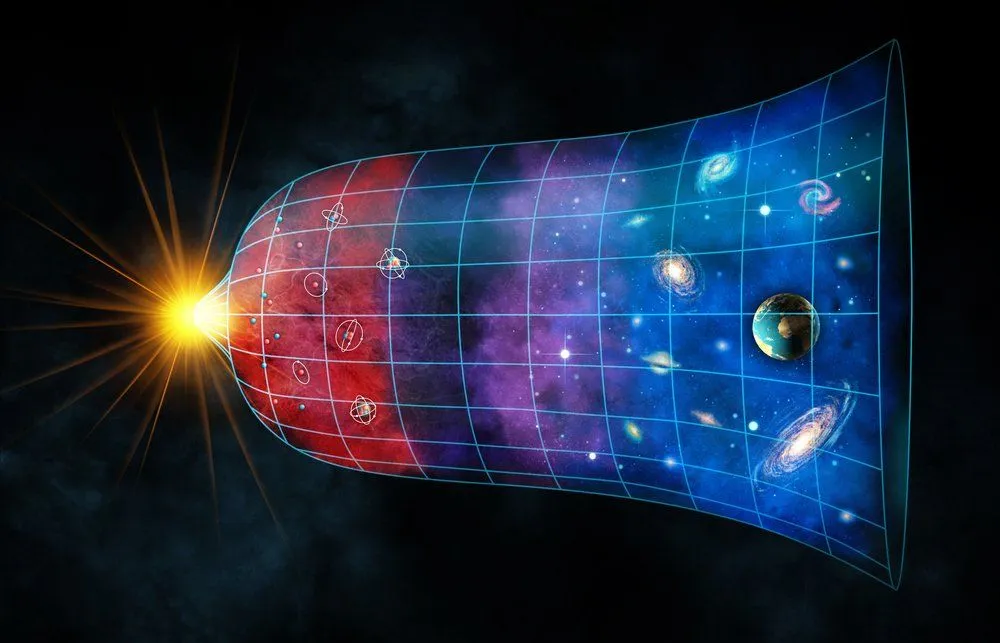
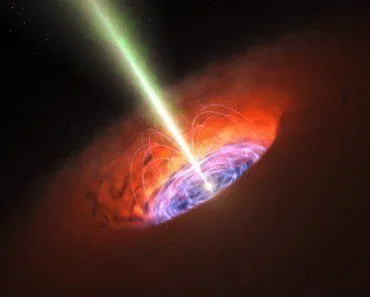
This impossible nature is primarily because, close to the very beginning of time, we approach what is called a singularity.
A singularity is the theorized state of the universe prior to the Big Bang. As we get closer to a singularity, the conventional laws of physics begin to break down. The scientific community needed a workaround for this. How would they analyze the state of the universe that close to the beginning without dealing with the pesky, physics-bending singularity?
Enter… imaginary time!
What Is Imaginary Time?
Simply put, imaginary time is a mathematical simplification of time used in several equations across quantum mechanics and general relativity.
Think of real-time as a horizontal line. A single point on that line is a moment in time. To the left of that point is the past and to the right is the future.
Now imagine a second line perpendicular to real-time. This essentially represents imaginary time. Being perpendicular to real-time, it allows for everything to occur all at once. Since humans can only perceive single moments in time, wrapping your head around ‘imaginary time’ may prove difficult.
However, by allowing for everything to happen simultaneously, we’re able to avoid the idea of a beginning. Without a starting point, imaginary time becomes something that has always been in existence. There is no boundary from where ‘imaginary time’ started. In imaginary time, there was no big bang and hence, close to the beginning of real-time, imaginary time still remains very much like any other point in time. There is no fuzzy physics or hazy mathematics. There is no occurrence of that pesky singularity.
The concept of imaginary time may not immediately seem useful or easier to visualize, but mathematically, it becomes a physicist’s best friend when he or she is tired of dealing with singularities in all their calculations.
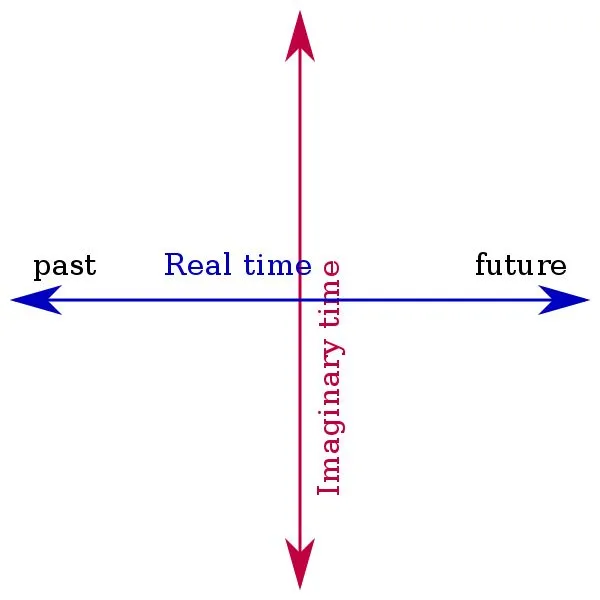
So how do we create this convenient perpendicular line of time? Do we arbitrarily sketch a line anywhere in space and call it ‘imaginary time’? I wish it were that simple, but when dealing with four-dimensional space-time, “simple” is seldom on the menu, so let’s begin.
How Do You Convert Real-time To Imaginary Time?
The three dimensions of space, along with the dimension of real-time, form what is known as Minkowski’s spacetime. By incorporating all four dimensions, Minkowski’s spacetime becomes an area where one can plot anything that occurs in the universe simply by specifying its time and spatial orientation.
Of course, visualizing four dimensions is no easy feat. Some of the numbers may make mathematical sense, but don’t physically translate well. Moreover, there is also a boundary, which can be a cause for alarm that we discussed earlier.
Minkowski’s spacetime must be altered to make it simpler. For this, we can translate the complexity of Minkowski’s spacetime into conventional geometrical space, which makes it easier to understand and solve for. This geometrical space is known as Euclidean space.
Wick Rotation
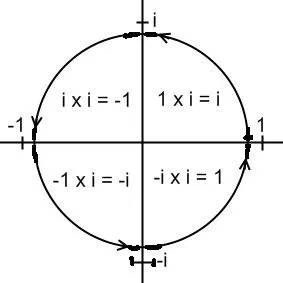
The translation is done using what’s known as Wick’s rotation. This involves substituting the component of time in Minkowski’s space with the value for ‘imaginary time’. This involves multiplying the value of real-time by √−1, which is an imaginary number denoted by ‘i’.
Remember the flat line of real-time we discussed earlier? By multiplying the value of real-time by ‘i’, we are essentially rotating that line and turning it into a perpendicular. Once we convert Minkowski’s space into Euclidean space by rotating the time axis, we are left with space that lacks a boundary, and thus lacks any scope to contain a pesky singularity. Once we solve whatever we need to solve at a time close to the Big Bang, we can then resubstitute the values, i.e., undo Wick’s Rotation and find the final result in real spacetime, i.e., Minkowski’s spacetime.
How Physicists Use Imaginary Time For Heat And Temperature
Smoothing away the Big Bang is the headline-grabbing use of imaginary time, but it is not the one that working physicists reach for most often. That title goes to something far more down-to-earth: describing hot stuff.
Here is the neat coincidence at the heart of it. In quantum mechanics, a system marches forward in real-time according to an operator that looks like e−iHt/ℏ, where H is the energy (the Hamiltonian) and t is time. In thermal physics, everything about a system sitting in equilibrium at temperature T is bundled into a single quantity called the partition function, Z = Tr(e−H/kBT), where kB is Boltzmann’s constant. Stare at those two expressions and you will notice they are almost the same thing. Swap real-time for imaginary time (t → −iτ) and the quantum evolution operator turns into the thermal Boltzmann factor.
The catch is that this imaginary time cannot run forever. To reproduce the thermodynamics of a system at temperature T, the imaginary-time direction has to close into a loop whose length is exactly ℏ/(kBT). In other words, a hot quantum system behaves like an ordinary one evolving around a circle of imaginary time, and temperature sets the size of that circle: the hotter it gets, the shorter the loop.
This is the imaginary-time (or Matsubara) formalism, and it is a standard tool in finite-temperature quantum field theory and in the computer simulations physicists use to predict how quantum materials behave when they are heated. Fields that repeat exactly around this imaginary-time loop describe force-carrying particles like photons, while those that flip sign each time around describe electrons and other matter particles. Far from being a cosmic curiosity, imaginary time is quietly doing the bookkeeping whenever someone calculates the physics of something warm.
What Is Complex Time, And How Is It Different?
Imaginary time and complex time are often mentioned in the same breath, but they are not quite the same idea. Imaginary time is the special case where the clock reading is purely imaginary, τ = it. Complex time is the more general version, in which time is allowed to carry both a real part and an imaginary part at once, placing it somewhere on a two-dimensional plane rather than on a single line.

Why would anyone want time to be a point on a plane? The clearest example is quantum tunneling, the strange effect that lets a particle slip through an energy barrier it does not classically have enough energy to cross. A ball rolled gently at a hill simply rolls back down; a quantum particle can, with some small probability, appear on the far side.
Physicists can make sense of this by letting the particle travel through complex time. In the standard semiclassical picture, the particle still follows a well-behaved classical path, but only if that path is allowed to detour through imaginary or complex values of time while it is inside the forbidden region (Aoyama and Harano, 1994). The stretch of the journey spent in pure imaginary time is closely related to a special solution called an instanton, which is essentially a classical trajectory that lives in imaginary time. So while imaginary time began as a trick for taming the Big Bang, the broader notion of complex time has become a workaday tool for calculating just how likely a quantum particle is to do the seemingly impossible.
Use Of Imaginary Numbers In Science
However, the use of “imaginary” time met with some resistance from the scientific community. In fact, an entire section of the community has long been at war with ‘imaginary’ numbers altogether. They basically believe that it is a ridiculous notion. How could any number representing a real quantity be imaginary?
If we said that, where would the imagination end? Why not just make everything imaginary? A whole world made of imagination. A sort of Wonderland, perhaps with a girl named Alice exploring it for an inexplicable reason. Do we even need a reason? That could be imaginary too! We could suggest that a little rabbit caught her attention, so she followed him down a rabbit hole.
Alice In Wonderland
One often-cited literary parallel here is Alice in Wonderland, published in 1865 by Lewis Carroll, the pen name of Oxford mathematician Charles Dodgson. Dodgson was a conservative mathematician who disliked some of the abstract directions that 19th-century mathematics was taking, including imaginary numbers and quaternions. A widely circulated reading by Melanie Bayley (New Scientist, 2009) suggests that several scenes in the book, especially the Mad Hatter's never-ending tea party where time has stopped, are satirizing those new mathematical ideas. The interpretation is debated, but it is at least a fun lens on how strange “imaginary” entities seemed even to mathematicians of the era.
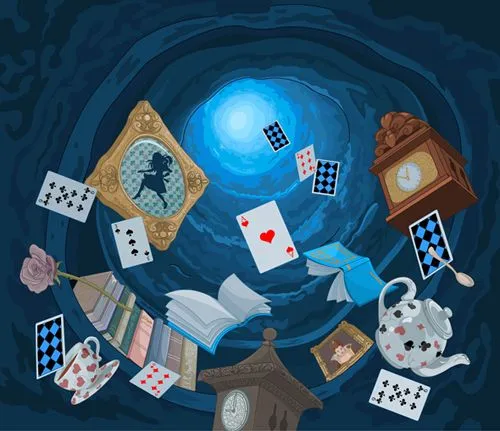
Think back to the Mad Hatter’s tea party. There have been several versions of this scene over the years, but every version stayed true to one attribute—the party was outrageous. It was a party where it was always tea-time, no matter the time, because time had left the room. According to Charles Dodgson, the whole world would eventually turn into a massive Mad Hatter’s tea party if imaginary numbers had their way.

On the other end of the spectrum sat one of the most brilliant minds in modern physics, Stephen Hawking. Both in A Brief History of Time (1988) and in The Universe in a Nutshell (2001), Hawking devoted serious space to imaginary time. In 1983, he and physicist James Hartle proposed the Hartle–Hawking no-boundary proposal, in which the universe has no initial singularity once you work in imaginary time. Instead, near the Big Bang, real time effectively rotates into a fourth spatial dimension, and the universe becomes a smooth, closed surface, with no “start” to point to.
Hawking pointed out that several mathematical models incorporating imaginary time correctly predict phenomena we can already observe in the universe. Of course, this begs the question: how imaginary is ‘imaginary time’? If it can make accurate real-world predictions, doesn’t it warrant the title ‘real’? Rather than being relegated to a mathematical simplification, Hawking argued that perhaps it’s time to reconsider our perspective of time itself. Imaginary time may be just as real as our narrow perception of linear time.
References (click to expand)
- StarTalk (2018). The Universe and Beyond, with Stephen Hawking. Youtube
- The Beginning of Time - Stephen Hawking. Hawking.org.uk
- Wick Rotation | Not Even Wrong - Columbia Math Department. Columbia University
- Wick rotation in nLab. The nLab
- Spacetime - University of Pittsburgh. The University of Pittsburgh
- Thermal quantum field theory. Wikipedia
- Aoyama, H. & Harano, T. (1994). Complex-time Approach for Semi-classical Quantum Tunneling. arXiv